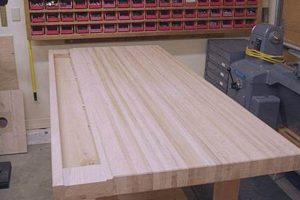
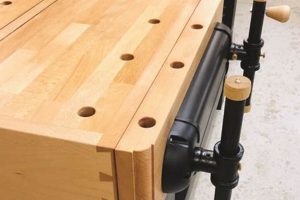
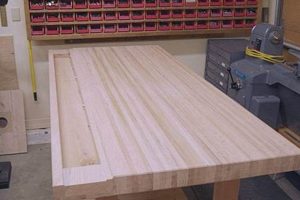
The specific workbench design, often associated with a particular historical communal sect, represents a functional and aesthetically restrained approach to furniture construction. These benches, traditionally built with durable materials like hardwoods, are characterized by their simplicity, practicality, and longevity. They are a cornerstone within the workshop, providing a stable and versatile surface for a range of woodworking tasks, from joinery and carving to assembly and finishing.
The significance of this bench design lies in its emphasis on utility and efficiency. Its robust construction allows it to withstand the rigors of daily use, while its straightforward design makes it relatively easy to build and maintain. Historically, the principles guiding its creation reflected a commitment to quality craftsmanship and enduring value, aligning with the broader values of the community from which it originated. These benches are valued for their contribution to a productive workspace and their embodiment of a timeless aesthetic.
Subsequent sections will delve into the key features of this workbench, exploring its construction techniques, common dimensions, and the ways in which it continues to inspire modern woodworking practices. The article will also address variations in design and adaptations for contemporary workshops, offering insights for both experienced woodworkers and those new to the craft.
Crafting Excellence
The following guidelines are crucial for constructing and utilizing a workbench designed with principles of functionality and durability. These recommendations, rooted in historical practices, will enhance the workbench’s utility and longevity.
Tip 1: Material Selection is Paramount: Hardwoods such as maple, beech, or oak are preferred for the frame and top due to their density and resistance to wear. Softwoods may be suitable for secondary components, but should not comprise the primary work surface.
Tip 2: Prioritize a Flat and Stable Work Surface: The workbench top must be meticulously flattened to ensure accurate and consistent results when performing joinery or other precision tasks. Periodic re-flattening may be necessary.
Tip 3: Incorporate a Robust Vise System: A well-mounted vise is essential for securely holding workpieces. Consider both face and tail vises for maximum versatility. Ensure the vise jaws are parallel and true.
Tip 4: Implement Effective Work Holding Solutions: Bench dogs, holdfasts, and other clamping devices are critical for securing material during planing, sawing, and carving operations. Position dog holes strategically for optimal utility.
Tip 5: Strive for Optimal Bench Height: The workbench height should be tailored to the individual user, typically aligning with the height of the wrist when the elbow is bent at a 90-degree angle. This minimizes strain and maximizes efficiency.
Tip 6: Employ Traditional Joinery Techniques: Mortise and tenon joints, dovetails, and other robust joinery methods should be used to ensure the bench’s structural integrity and longevity. Avoid relying solely on fasteners or adhesives.
Tip 7: Consider Integrated Storage Solutions: Drawers or shelves beneath the workbench top can provide convenient storage for tools and materials, minimizing clutter and maximizing workspace efficiency.
Adhering to these guidelines will result in a workbench that is not only functional and durable but also a testament to the enduring principles of quality craftsmanship. The investment in time and effort during construction will be repaid through years of reliable service.
The concluding section will offer insights into maintaining and preserving the traditional workbench, ensuring its continued performance and value for generations to come.
1. Simplicity

The principle of simplicity is foundational to understanding the essence of a woodworking bench designed with Shaker influences. It manifests not as a lack of features but as a deliberate distillation of form and function, prioritizing utility above superfluous ornamentation. This approach profoundly impacts every aspect of the bench’s design and construction.
- Unadorned Surfaces and Forms
Shaker-influenced benches eschew decorative carvings or elaborate moldings. The focus is on clean lines and smooth, unembellished surfaces. This aesthetic choice reduces visual clutter, allowing the user to concentrate on the task at hand. An example is the plain, flat workbench top without any applied decorative edging, which serves as an unobstructed surface for woodworking. The implication is a bench that facilitates focus and efficiency.
- Efficient Use of Materials
Simplicity extends to the economical use of resources. Designs emphasize structural integrity and functionality, minimizing waste. For instance, a bench leg may be constructed from a single piece of solid wood, shaped for strength without complex joinery or unnecessary ornamentation. This results in a durable and cost-effective piece, reflecting the Shaker value of resourcefulness.
- Straightforward Construction Techniques
The methods employed in building a Shaker-influenced bench are typically direct and uncomplicated. Joinery, such as mortise and tenon joints, is executed with precision but without unnecessary embellishments or complexity. For example, a through tenon might be used for its strength and ease of construction, rather than a more elaborate blind tenon that would require additional time and skill. The benefit is a bench that can be built and maintained by individuals with varying levels of experience.
- Prioritization of Function over Aesthetics
While Shaker designs possess an inherent beauty, it stems from their functionality rather than deliberate artistic expression. The placement of a vise, the height of the bench, or the inclusion of storage are all dictated by their contribution to the woodworking process. An example is a simple drawer positioned beneath the bench top, providing easily accessible storage for essential tools. The consequence is a bench that is inherently beautiful because it performs its intended function exceptionally well.
In summary, the emphasis on simplicity in the design and construction of a Shaker woodworking bench results in a tool that is both functional and aesthetically pleasing. By focusing on essential elements and eliminating unnecessary complexity, these benches provide a workspace that promotes efficiency, focus, and enduring value. The influence of this design philosophy continues to resonate in contemporary woodworking, inspiring craftspeople to create tools that are as practical as they are beautiful.
2. Functionality

Functionality, a cornerstone of the shaker woodworking bench design philosophy, dictates that every aspect of the bench must directly contribute to its utility in woodworking tasks. This principle transcends mere practicality, shaping the form, construction, and features of the bench to maximize its effectiveness in the workshop.
- Optimized Work Surface
The primary function of the bench is to provide a stable and versatile work surface. Shaker benches typically feature a thick, flat top made from durable hardwood. This surface is designed to withstand the rigors of daily use and provide a consistent platform for various woodworking operations. The absence of ornamentation or unnecessary features ensures that the entire surface is available for work, maximizing efficiency. For example, a large, uninterrupted surface allows for the assembly of sizable furniture components without obstruction.
- Integrated Vise Systems
A vise is an indispensable component of any woodworking bench, and Shaker designs prioritize its effective integration. Vises are securely mounted to the bench, providing a robust clamping mechanism for holding workpieces during sawing, planing, and joinery. Both face and tail vises may be incorporated to accommodate different workpiece shapes and sizes. The vise hardware is often simple and durable, reflecting the Shaker emphasis on practicality. As an illustration, a well-positioned face vise enables the secure clamping of boards for edge jointing.
- Strategic Work Holding Solutions
Beyond vises, Shaker benches often incorporate other work holding solutions, such as bench dogs and holdfasts. These devices allow the user to quickly and securely clamp workpieces to the bench top, freeing up both hands for working. Dog holes are strategically placed across the bench top to accommodate a variety of clamping configurations. A practical instance is the use of bench dogs and a planing stop to secure a board for flattening its surface.
- Ergonomic Considerations
Functionality extends beyond the immediate woodworking tasks to encompass the user’s comfort and efficiency. Shaker benches are often designed with ergonomic considerations in mind, such as a comfortable working height and strategically placed storage solutions. The bench height is typically tailored to the individual user, minimizing strain and fatigue during extended use. The location of tool storage, such as drawers or shelves beneath the bench top, is carefully considered to ensure easy access. For example, a bench built to the correct height reduces back strain during prolonged use of hand planes.
The unwavering focus on functionality distinguishes the shaker woodworking bench from more decorative or specialized designs. By prioritizing practical utility in every aspect of its construction, the shaker bench becomes an indispensable tool for woodworkers seeking efficiency, precision, and enduring value. This design continues to influence contemporary woodworking practices, underscoring the timeless appeal of functional design.
3. Durability

Durability stands as a central tenet in the conception and execution of woodworking benches designed with Shaker principles. The longevity and sustained performance of such a bench are not accidental; they are the direct result of deliberate choices in material selection, construction techniques, and design considerations.
- Hardwood Selection and its Impact
The choice of hardwoods, such as maple, oak, or beech, is fundamental to the workbench’s resistance to wear and tear. These species exhibit high density and inherent strength, capable of withstanding repeated impact, abrasion, and the stress of clamping forces. The selection of appropriate hardwoods contributes directly to the workbench’s ability to maintain its structural integrity over extended periods. For instance, a workbench top constructed from hard maple can endure decades of heavy use without significant deformation, preserving its flatness and stability.
- Joinery Techniques and Structural Integrity
Robust joinery is critical for ensuring the long-term stability and durability of the workbench. Traditional methods such as mortise and tenon joints, dovetails, and well-executed rabbets are employed to create strong and interlocking connections between the bench’s components. These joinery techniques distribute stress effectively, minimizing the risk of joint failure or loosening over time. As an example, a mortise and tenon joint connecting a leg to the workbench frame provides a rigid and durable connection that can withstand significant lateral forces.
- Finish Application and Environmental Resistance
The application of a suitable finish protects the wood from moisture, abrasion, and other environmental factors that can compromise its durability. A durable finish, such as oil-based varnish or a penetrating oil, creates a barrier against water damage, prevents the wood from drying out and cracking, and enhances its resistance to surface wear. This protective layer extends the workbench’s lifespan by minimizing the effects of exposure to humidity fluctuations and physical contact. Regular application of a protective finish maintains the workbench’s integrity and aesthetic appeal.
- Mass and Stability as Contributing Factors
The inherent mass and stable design of a Shaker-influenced workbench contribute significantly to its overall durability. A substantial workbench, typically weighing several hundred pounds, provides a stable platform for woodworking operations, minimizing movement and vibration. This stability reduces the stress on the bench’s joints and components, extending its lifespan. The weight of the bench, coupled with its solid construction, ensures that it can withstand the demands of rigorous use without compromising its structural integrity. The sheer mass of the workbench prevents it from shifting or rocking during forceful sawing or planing operations.
The convergence of these factors hardwood selection, robust joinery, protective finishing, and inherent stability underscores the emphasis on durability in Shaker woodworking bench design. The resulting workbench is not merely a tool; it is an investment in a durable and reliable asset that can serve a woodworker for generations, embodying the principles of lasting quality and enduring value.
4. Precision
Precision is not merely a desirable attribute, but a fundamental requirement intertwined with the philosophy and function of the shaker woodworking bench. The bench serves as the foundation for accurate woodworking, and its design directly facilitates precise execution. The flatness of the work surface, the accuracy of the vise mechanisms, and the stability of the overall structure all contribute to achieving exacting results in woodworking tasks. For instance, a precisely flattened bench top allows for consistent planing, ensuring uniform thickness and eliminating deviations that could compromise the integrity of a finished piece. The accuracy of joinery, such as dovetails or mortise and tenon joints, relies heavily on the bench’s capacity to provide a stable and reliable platform for cutting and fitting components. The direct consequence of a lack of precision in the bench itself is inaccuracy in the resulting woodwork, impacting the quality and functionality of the finished product.
The practical application of this principle is evident in the careful construction and maintenance of these benches. Woodworkers often invest considerable time in flattening the bench top, ensuring that it is perfectly level and free from irregularities. Vise mechanisms are adjusted and maintained to provide consistent clamping pressure and accurate alignment. The bench’s stability is enhanced through robust joinery and solid construction, minimizing movement and vibration during use. A real-world example is the meticulous setup required for cutting dovetails: a precisely aligned and stable bench is essential for achieving tight-fitting joints that are both aesthetically pleasing and structurally sound. Similarly, accurate marking and measuring rely on a stable and consistent reference surface, which the shaker workbench provides.
In conclusion, the connection between precision and the woodworking bench designed with Shaker principles is one of interdependence. The bench is not simply a work surface; it is an instrument of precision that enables woodworkers to achieve exacting results. Maintaining and valuing this attribute of precision within the woodworking environment promotes superior craftsmanship, yielding durable and aesthetically pleasing outcomes that reflect the values of quality and accuracy. The challenge lies in preserving this focus on precision in an age of automated manufacturing, where the emphasis on handcraftsmanship and individual skill can sometimes be overshadowed.
5. Stability
Stability constitutes a critical element in the design and function of a woodworking bench, particularly within the context of Shaker-influenced designs. A stable workbench provides a solid, immovable platform necessary for accurate and efficient woodworking. The absence of stability, characterized by wobbling, shaking, or shifting, directly undermines the precision and control required for tasks such as sawing, planing, and joinery. This lack of stability translates into compromised accuracy, increased risk of errors, and a diminished quality of the final product. The connection between stability and bench design extends beyond mere convenience; it is fundamental to the workbench’s core purpose.
The design of a stable Shaker woodworking bench often incorporates several key features. These include a substantial weight, typically achieved through the use of thick hardwood components; robust joinery techniques, such as mortise and tenon joints, which create strong and rigid connections; and a broad footprint, which lowers the center of gravity and increases resistance to tipping. The deliberate consideration of these factors ensures that the bench remains steadfast during demanding woodworking operations. For instance, during the planing of a long board, a stable bench resists the forces exerted by the woodworker, preventing the bench from moving and allowing for a consistent and accurate cut. Similarly, when chopping mortises, a stable bench absorbs the impact of the mallet, minimizing vibration and improving control over the chisel.
In summary, stability is not a mere add-on feature but an integral aspect of a Shaker woodworking bench. Its presence directly enables precise and efficient woodworking, while its absence compromises the bench’s functionality and diminishes the quality of the craft. Understanding the critical role of stability informs design choices and construction methods, resulting in a workbench that provides a reliable and unwavering foundation for woodworking endeavors. The practical significance of this understanding lies in the production of higher-quality woodworking, reduced errors, and a more enjoyable and productive woodworking experience.
6. Ergonomics

Ergonomics, the science of designing and arranging things people use so that the people and things interact most efficiently and safely, holds a significant connection to the design and utilization of a shaker woodworking bench. The physical demands inherent in woodworking, involving repetitive motions, forceful exertions, and sustained postures, necessitate careful consideration of ergonomic principles to mitigate the risk of musculoskeletal disorders and enhance overall productivity. The height of the bench, the placement of vises and tools, and the overall layout of the workspace directly impact the woodworker’s posture, reach, and movement patterns. An improperly designed bench can lead to discomfort, fatigue, and, over time, chronic injuries such as carpal tunnel syndrome, tendinitis, or back pain. Conversely, a bench designed with ergonomic principles in mind can promote a comfortable and efficient working posture, reducing strain and improving long-term physical well-being.
The application of ergonomic principles to a shaker woodworking bench manifests in several key features. Bench height is a primary consideration, typically customized to the individual user’s height to minimize bending or reaching. A bench that is too low forces the woodworker to stoop, placing excessive strain on the lower back, while a bench that is too high can lead to shoulder and neck pain. The placement of vises and frequently used tools is also crucial. Positioning these items within easy reach reduces the need for excessive stretching or twisting, minimizing the risk of strain injuries. Furthermore, the bench’s design may incorporate features such as rounded edges or padded surfaces to reduce pressure points and improve comfort during extended use. An example includes incorporating a footrest to alternate weight distribution, thereby reducing fatigue during prolonged standing tasks. The practical significance of these design elements lies in their cumulative effect: a well-designed bench promotes a comfortable and efficient workflow, enabling woodworkers to perform their tasks with greater ease and precision.
In summary, ergonomics is not merely an ancillary consideration in the design of a shaker woodworking bench, but an integral component that directly impacts the woodworker’s physical health, comfort, and productivity. The careful application of ergonomic principles, including customized bench height, strategic tool placement, and features designed to reduce strain, can significantly mitigate the risk of musculoskeletal disorders and enhance the overall woodworking experience. While traditional Shaker designs may not have explicitly articulated ergonomic principles, the emphasis on practicality and functionality often resulted in benches that were inherently more ergonomic than more ornate or decorative designs. The continued integration of modern ergonomic knowledge into the design and construction of woodworking benches remains essential for ensuring the well-being of woodworkers and promoting sustainable craftsmanship.
Frequently Asked Questions
This section addresses common inquiries and misconceptions regarding the nature, construction, and utilization of woodworking benches designed with Shaker influences.
Question 1: What distinguishes a woodworking bench inspired by Shaker design from other types of workbenches?
The defining characteristics include an emphasis on simplicity, functionality, and durability. Ornamentation is minimal, with a focus on clean lines and practical features. Hardwood construction and robust joinery techniques ensure longevity. The design prioritizes utility and efficiency.
Question 2: Are these benches suitable for all types of woodworking, or are they specialized for certain tasks?
While versatile, benches of this design excel in tasks requiring precision and stability, such as joinery, carving, and hand tool work. Their solid construction provides a stable platform for demanding operations. Adaptation for specific needs is possible through modifications or the addition of specialized accessories.
Question 3: What are the typical dimensions of a woodworking bench adhering to Shaker design principles?
Dimensions vary based on individual needs and workshop space. However, common dimensions include a length of 6 to 8 feet, a width of 24 to 36 inches, and a height of 30 to 36 inches. Customization is encouraged to optimize ergonomics and functionality for the user.
Question 4: What type of wood is most appropriate for constructing this type of workbench?
Hardwoods such as maple, oak, and beech are preferred for their density, strength, and resistance to wear. These materials provide a durable and stable work surface that can withstand heavy use. Softwoods may be used for secondary components, but are not recommended for the primary structure.
Question 5: How does the absence of ornamentation contribute to the bench’s functionality?
Minimizing ornamentation eliminates visual clutter and distractions, allowing the woodworker to focus on the task at hand. The clean lines and unadorned surfaces provide a clear and unobstructed work area, promoting efficiency and precision.
Question 6: How does the Shaker woodworking bench design address ergonomic considerations?
Ergonomic considerations are addressed through customizable bench height and strategically placed vises and tools. Optimizing the bench’s dimensions and layout minimizes strain and fatigue, promoting a comfortable and efficient working posture. These adjustments contribute to long-term physical well-being and productivity.
In summary, the woodworking bench design rooted in Shaker principles is characterized by its enduring functionality, robust construction, and unadorned aesthetic. Its adaptability and enduring appeal make it a valuable addition to any woodworking workshop.
The subsequent section will explore modifications and adaptations of this workbench for contemporary workshops.
Shaker Woodworking Bench
This exploration has detailed the defining characteristics of the shaker woodworking bench, underscoring its emphasis on simplicity, functionality, durability, precision, stability, and ergonomics. The bench’s design, rooted in principles of utility and efficiency, reflects a deliberate choice to prioritize performance over ornamentation. This has resulted in a workbench that serves as a foundational tool for woodworking, enabling accurate and reliable craftsmanship.
The enduring relevance of the shaker woodworking bench stems from its timeless design and its capacity to adapt to evolving woodworking practices. The principles embodied in its construction provide a valuable framework for contemporary woodworkers seeking to create workspaces that are both functional and aesthetically pleasing. Its continued use serves as a testament to the enduring value of thoughtful design and skilled craftsmanship. Further investigation into adapting this design for specialized needs will undoubtedly contribute to its continued legacy within the woodworking community.
![Build A Roman Woodworking Bench [DIY Guide] | Step-by-Step Guides, Tools & Inspiration to Build Beautiful Wooden Decor on a Budget](https://woodfromhome.com/wp-content/uploads/2026/05/th-207-300x200.jpg "Build A Roman Woodworking Bench [DIY Guide] Step-by-Step Guides, Tools & Inspiration to Build Beautiful Wooden Decor on a Budget")