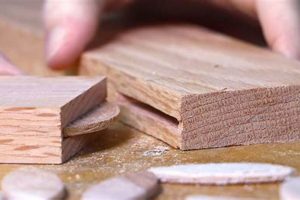
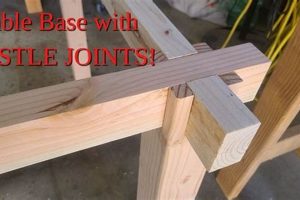
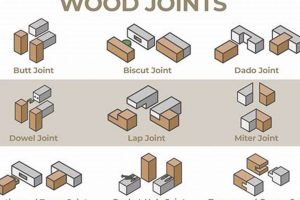
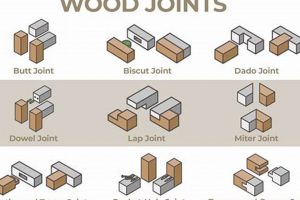
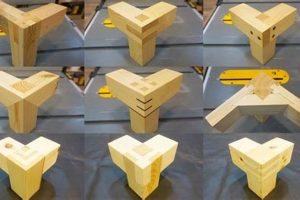
A method of joining two pieces of wood, this technique involves creating a projecting element on one piece that fits into a corresponding recess on the other. The projection, acting as a tenon, adds substantial surface area for adhesive and mechanical fastening, enhancing the overall strength of the connection. A common application is in frame construction, where this technique joins stiles and rails.
This approach offers significant advantages in terms of structural integrity and aesthetic appeal. The increased glue surface area provides a robust bond, crucial for load-bearing applications and resistance to stress. Historically, this method has been favored by cabinetmakers and furniture builders for its durability and clean, refined appearance, contributing to the longevity and value of crafted pieces. This joint also provides mechanical resistance against racking forces, further enhancing stability.
The following sections will delve into the specific tools and techniques employed in creating this type of woodworking joint, examining variations in its design, and discussing best practices for achieving optimal results in its execution.
Essential Considerations
Effective execution of this woodworking technique requires meticulous planning and precise craftsmanship. The following tips outline critical aspects to consider for optimal joint integrity and aesthetic outcome.
Tip 1: Material Selection: Choose wood species with compatible grain structures and moisture content to minimize stress and prevent joint failure due to expansion or contraction. Hardwoods such as oak or maple are generally preferred for their strength and stability.
Tip 2: Precision Measurement: Accurate measurement is paramount. Ensure that the dimensions of the projecting element and corresponding recess are precisely calculated and transferred to the workpiece to guarantee a snug and seamless fit. Utilize precision measuring tools for reliable results.
Tip 3: Sharp Tool Maintenance: Maintain sharp cutting edges on chisels, saws, and planes. Sharp tools produce clean, accurate cuts, minimizing tear-out and ensuring a precise joint. Dull tools can lead to splintering and inaccurate dimensions.
Tip 4: Gradual Material Removal: Remove material in small increments, especially when refining the fit. This approach allows for greater control and reduces the risk of overcutting, which can compromise the joint’s integrity. Test the fit frequently during the process.
Tip 5: Secure Clamping: Employ adequate clamping pressure during adhesive application and curing. Proper clamping ensures that the joint remains tight and aligned, promoting maximum bond strength. Use cauls to distribute pressure evenly and prevent marring the wood surface.
Tip 6: Adhesive Selection: Choose an appropriate adhesive based on the intended application and wood species. Consider factors such as open time, clamping time, and moisture resistance. Follow the manufacturer’s instructions for optimal bond strength.
Tip 7: Dry Fit Verification: Prior to adhesive application, conduct a dry fit to verify the joint’s accuracy and alignment. This step allows for any necessary adjustments before committing to the final assembly. A properly fitted dry joint should require minimal force to assemble.
Mastering these considerations will contribute to the creation of strong, aesthetically pleasing joinery. Careful attention to detail and adherence to sound woodworking practices are essential for achieving successful results.
The subsequent sections will explore specific joint variations and advanced techniques to further enhance the understanding and application of this valuable skill.
1. Joint Strength in Shoulder Joint Woodworking

Joint strength is a primary determinant of the overall quality and lifespan of any woodworking project employing shoulder joints. The integrity of the joint directly influences the structural stability and resistance to stress of the assembled piece. Proper execution and design considerations are essential to maximizing this characteristic.
- Surface Area of Adhesion
A significant contributor to joint strength is the surface area available for adhesive bonding. The shoulder joint, by design, provides a substantial glue surface compared to simpler joint types. This increased area allows for a stronger bond between the mating pieces, distributing stress more evenly. Examples include frame and panel construction, where the shoulder joints connecting the stiles and rails rely heavily on adhesive strength to resist racking and twisting forces.
- Mechanical Interlock
The mechanical interlock inherent in a shoulder joint also contributes significantly to its strength. The shoulder itself provides resistance to movement perpendicular to the joint face, preventing shear forces from directly stressing the adhesive bond. In applications such as table leg attachment, this mechanical resistance, combined with adhesive, provides a stable and durable connection capable of withstanding considerable weight and stress.
- Wood Grain Orientation
The orientation of wood grain in relation to the joint is a critical factor influencing its strength. Ideally, the grain direction should run parallel or at a shallow angle to the primary stress vectors acting on the joint. This minimizes the risk of splitting or cracking along the grain, which can weaken the entire assembly. Cabinetmakers often consider grain orientation when selecting lumber and designing shoulder joints for optimal strength and stability.
- Fit and Precision
The tightness and accuracy of the fit between the mating components directly impact the joint’s strength. A poorly fitted joint, characterized by gaps or excessive play, reduces the effective surface area for adhesion and compromises the mechanical interlock. Precise cutting and careful fitting are essential to achieving a tight, gap-free joint that maximizes both adhesive bond strength and mechanical resistance. Examples include carefully fitted tenons in mortise and tenon joints, a common application of shoulder joint principles.
In conclusion, the strength derived from shoulder joints stems from a combination of factors: maximized adhesive surface area, inherent mechanical interlocking, strategically oriented wood grain, and precise fitting. These elements must be carefully considered and executed to ensure the creation of robust and enduring woodworking constructions. Furthermore, understanding the interplay of these components enables woodworkers to tailor their designs and techniques to meet the specific strength requirements of each project.
2. Precision Cuts
The success of shoulder joint woodworking is inextricably linked to the accuracy of the cuts made. Deviations from precise dimensions and angles can compromise the structural integrity, aesthetic appeal, and overall functionality of the finished piece. Therefore, mastering precise cutting techniques is a cornerstone of this woodworking method.
- Dimensional Accuracy
Achieving dimensional accuracy is paramount. Each component of the joint, including the mortise, tenon, and shoulder, must adhere strictly to the planned dimensions. Inaccuracies, even fractions of a millimeter, can result in a loose, weak, or misaligned joint. For example, in cabinet door construction, precise tenon dimensions ensure a snug fit within the mortise, preventing racking and maintaining structural integrity.
- Angular Precision
Angular precision is equally critical, especially when dealing with angled shoulder joints. Accurate angles ensure that the joint components meet properly, distributing stress evenly and preventing unsightly gaps. A common example is in the construction of angled table legs, where precise angular cuts ensure that the legs splay correctly and provide stable support.
- Clean Edges and Surfaces
Clean, crisp edges and surfaces are essential for optimal adhesion and a professional finish. Ragged or splintered edges reduce the surface area available for glue, weakening the joint. Additionally, they detract from the aesthetic appeal of the finished piece. The use of sharp tools and appropriate cutting techniques, such as scoring before sawing, are crucial for achieving clean edges.
- Consistent Depth of Cut
Maintaining consistent depth of cut is particularly important when creating the shoulder itself. Variations in shoulder depth can lead to uneven surfaces and gaps in the joint, compromising its strength and appearance. Careful tool setup, consistent pressure, and accurate depth stops are necessary for achieving uniform shoulder depth.
The interconnectedness of these facets underscores the importance of precision cuts in achieving robust and aesthetically pleasing shoulder joints. By mastering these techniques, woodworkers can ensure the longevity, stability, and visual appeal of their projects. Furthermore, the principles of precision applied to this method extend to other woodworking techniques, reinforcing their fundamental importance in craftsmanship.
3. Adhesive selection

The choice of adhesive significantly influences the structural integrity and longevity of shoulder joint woodworking. Adhesive selection is not arbitrary; it requires considering the specific application, wood species, environmental conditions, and expected stress loads on the joint. A mismatch between adhesive properties and these factors can lead to premature joint failure.
- Wood Species Compatibility
Different wood species exhibit varying levels of porosity, density, and acidity, influencing adhesive bond strength. For instance, oily woods like teak or rosewood necessitate adhesives specifically formulated for oily surfaces, while hardwoods with tight grain structures may require adhesives with longer open times to ensure adequate penetration. Selecting an incompatible adhesive may result in a weak bond or complete adhesion failure.
- Joint Configuration and Fit
The configuration and tightness of the shoulder joint influence adhesive selection. Loose-fitting joints require gap-filling adhesives, such as epoxy or polyurethane, to compensate for imperfections and ensure adequate bond strength. Tighter-fitting joints may benefit from PVA (polyvinyl acetate) adhesives, known for their high initial tack and strength on close-fitting surfaces. Utilizing an adhesive with insufficient gap-filling properties in a loose joint can compromise the joint’s structural integrity.
- Environmental Considerations
Exposure to moisture, temperature fluctuations, and UV radiation necessitates adhesives with corresponding resistance properties. Exterior applications demand waterproof adhesives, such as marine-grade epoxy or polyurethane, to prevent joint degradation due to water ingress. Interior applications may utilize water-resistant PVA adhesives. Selecting an adhesive with inadequate environmental resistance can lead to bond failure, swelling, and eventual joint separation.
- Load-Bearing Requirements
The anticipated stress loads on the shoulder joint dictate the adhesive’s required strength and flexibility. High-stress applications, such as structural frame components, may benefit from epoxy adhesives, renowned for their exceptional strength and rigidity. Lower-stress applications may utilize PVA adhesives. Using an adhesive with insufficient strength for the intended load can result in joint failure under pressure.
The interplay between adhesive selection and shoulder joint woodworking is paramount. A comprehensive understanding of wood species characteristics, joint configuration, environmental factors, and stress load requirements is crucial for selecting the appropriate adhesive and ensuring a strong, durable, and long-lasting joint. Careful consideration of these factors will lead to superior craftsmanship and structural reliability, exemplified by its importance in the robust construction of furniture and architectural elements.
4. Wood Stability

Wood stability, characterized by a material’s resistance to dimensional changes due to variations in moisture content, profoundly influences the integrity of shoulder joint woodworking. The inherent hygroscopic nature of wood means it will absorb or release moisture until it reaches equilibrium with the surrounding environment. These moisture fluctuations cause expansion and contraction, potentially inducing stress within joints and compromising their structural soundness. Therefore, selecting stable wood species and controlling moisture content are critical steps in the creation of robust shoulder joints. For instance, using kiln-dried lumber with a moisture content appropriate for the intended environment significantly reduces the risk of joint failure caused by wood movement after assembly. This is particularly important in large-scale projects like timber framing, where dimensional stability is paramount for structural integrity.
Further complicating matters are differences in tangential and radial shrinkage. Wood shrinks more along the tangential plane (parallel to the growth rings) than along the radial plane (perpendicular to the growth rings). These differential shrinkage rates can induce stress within shoulder joints if not properly accounted for in the design and construction. A practical application involves orienting the grain in adjoining pieces to minimize the impact of differential movement. Employing quartersawn lumber, known for its stability and consistent grain orientation, is often preferred for critical components like tenons and shoulders, especially in high-value furniture making, where longevity is a key consideration.
In conclusion, wood stability is not merely a desirable characteristic but an essential prerequisite for successful shoulder joint woodworking. The dimensional changes caused by moisture fluctuations pose a significant threat to joint integrity. Diligent species selection, moisture content control, and awareness of grain orientation are crucial for mitigating these risks. Understanding and addressing these challenges are fundamental to creating durable and aesthetically pleasing woodworking projects that withstand the test of time. Neglecting these principles can result in compromised structural integrity, leading to joint failure and a reduced lifespan for the finished piece.
5. Design variations
The adaptability of shoulder joint woodworking manifests in a multitude of design variations, each tailored to specific structural requirements, aesthetic considerations, and material properties. These variations extend beyond basic geometric alterations, encompassing subtle refinements that significantly impact joint strength, stability, and visual appeal. An understanding of these variations is crucial for woodworkers seeking to optimize their projects for longevity and performance.
- Shoulder Width and Proportion
The width of the shoulder, relative to the tenon’s dimensions and the overall workpiece thickness, influences the joint’s resistance to racking and shear forces. Wider shoulders provide greater bearing surface, increasing stability but potentially impacting aesthetic balance. For example, in heavy timber construction, substantial shoulders are employed to distribute loads effectively, while in delicate casework, narrower shoulders are favored for a refined appearance. The selection depends on a trade-off between structural demands and visual harmony.
- Shoulder Angle and Profile
The angle and profile of the shoulder can range from a simple 90-degree intersection to complex curved or chamfered forms. Angled shoulders offer increased glue surface area and can enhance mechanical interlocking, while curved profiles add visual interest and soften the joint’s appearance. The choice depends on the desired aesthetic and the need for increased structural resistance. Consider a mitered shoulder on a picture frame, offering a seamless transition and a refined aesthetic compared to a standard square shoulder.
- Tenon Geometry and Taper
Variations in tenon geometry, such as tapered or haunched tenons, significantly impact joint strength and resistance to pull-out forces. Tapered tenons create a wedging action as they are driven into the mortise, increasing friction and preventing loosening over time. Haunched tenons, with a reduced width near the shoulder, provide additional support and prevent twisting. The choice between straight, tapered, or haunched tenons depends on the anticipated stress loads and the need for enhanced mechanical locking. A haunched tenon in a table leg provides added stability compared to a simple rectangular tenon.
- Decorative Shoulder Treatments
Beyond structural considerations, shoulder joints can incorporate decorative elements to enhance visual appeal. These treatments may include carving, molding, or the integration of contrasting wood species. Decorative shoulders add a layer of artistic expression to the joint, transforming it from a purely functional element into a design feature. Examples include hand-carved shoulders on antique furniture or the use of contrasting wood inlays to highlight the joint. The use of decorative treatments allows the joint to become an integral part of the design aesthetic.
These design variations illustrate the flexibility and adaptability of shoulder joint woodworking. Each variation offers unique structural and aesthetic properties, allowing woodworkers to tailor their joints to specific project requirements. Understanding the interplay between these factors is essential for creating robust, visually appealing, and long-lasting woodworking creations. The judicious selection of these variations empowers craftspeople to elevate their work beyond mere utility, transforming functional joints into integral components of artistic expression.
6. Tool proficiency

Proficiency in the use of woodworking tools is not merely an ancillary skill, but a fundamental prerequisite for the successful execution of shoulder joint woodworking. The precision inherent in this joint relies heavily on the accurate and controlled application of various hand and power tools. Mastery of these tools directly impacts the strength, aesthetic appeal, and overall longevity of the finished piece.
- Chisel Control
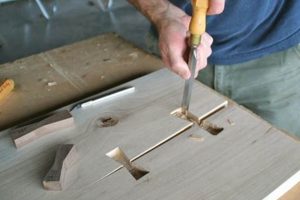
Precise chisel work is essential for defining sharp corners, removing waste material from mortises, and refining the fit of tenons and shoulders. Proper chisel technique involves understanding grain direction, employing appropriate striking force, and maintaining a keen cutting edge. An experienced woodworker, through adept chisel control, can achieve perfectly square shoulders and precisely dimensioned mortises, minimizing gaps and maximizing adhesive surface area. Inaccurate chisel work can lead to rounded corners, uneven shoulders, and a compromised joint.
- Sawing Accuracy
Accurate sawing is crucial for creating straight, square tenons and shoulders. Proficiency with hand saws, such as dovetail or tenon saws, allows for precise control over the cut, minimizing waste and ensuring a tight fit. Similarly, the skillful use of power saws, such as table saws or band saws, with appropriate jigs and setups, enables the efficient and accurate creation of multiple identical components. A lack of sawing accuracy results in skewed shoulders, ill-fitting tenons, and a weakened joint.
- Measuring and Marking Precision
Accurate measurement and marking are the foundation of any successful woodworking project, particularly in shoulder joint woodworking. The ability to precisely transfer dimensions from plans to the workpiece, using tools such as marking gauges, squares, and knives, is critical for ensuring that all components fit together correctly. Inaccurate measurements lead to cumulative errors, resulting in misaligned joints and a compromised final product. For instance, a slightly off-square marking of a mortise location can throw off the entire joint.
- Sharpening Skills
Consistently sharp tools are essential for clean, accurate cuts and efficient material removal. Proficiency in sharpening techniques, including honing and grinding, ensures that chisels, planes, and saw blades maintain their optimal cutting performance. Dull tools require excessive force, leading to inaccurate cuts, tear-out, and increased risk of injury. A woodworker skilled in sharpening can maintain the sharpness of their tools, ensuring consistent quality and efficiency throughout the project.
These facets of tool proficiency are inextricably linked to the successful creation of robust and aesthetically pleasing shoulder joints. Mastery of these skills allows woodworkers to execute complex joinery with precision and efficiency, resulting in durable and visually appealing finished products. The degree of tool proficiency directly impacts the quality and longevity of shoulder joint woodworking, highlighting its critical importance in the craft.
Frequently Asked Questions
This section addresses common inquiries regarding shoulder joint woodworking, providing concise and informative answers to enhance understanding and promote successful execution.
Question 1: What defines a “shoulder” in the context of shoulder joint woodworking?
In this context, the shoulder refers to the flat, projecting surface surrounding a tenon where it meets the mortised piece. This surface provides additional glue area and mechanical support to the joint.
Question 2: Why is wood selection crucial in shoulder joint applications?
Wood species impact the joint’s structural integrity. Denser hardwoods offer greater strength, while stability, specifically resistance to warping or movement with changes in humidity, is essential for joint longevity.
Question 3: What are the most common failures encountered in shoulder joint woodworking, and how are they prevented?
Common failures include adhesive bond failure, wood splitting, and joint racking. These are prevented through proper adhesive selection, accurate joinery, appropriate grain orientation, and secure clamping during assembly.
Question 4: What role does grain direction play in shoulder joint strength?
Grain direction significantly impacts the joint’s ability to withstand stress. Aligning grain direction to resist applied forces prevents wood splitting and maximizes joint stability.
Question 5: Is the shoulder joint suitable for outdoor applications?
Suitability depends on wood species, adhesive selection, and the presence of protective finishes. Weather-resistant woods, waterproof adhesives, and sealant applications are necessary for outdoor use.
Question 6: Can shoulder joints be used in conjunction with other joinery methods?
Yes, shoulder joints are often combined with other techniques, such as dowels or screws, for enhanced strength or to simplify construction. The hybrid approach optimizes structural integrity and aesthetic considerations.
Understanding these fundamental principles and addressing these common concerns will contribute to the successful application of shoulder joint woodworking in various projects.
The subsequent section will delve into advanced techniques and specialized applications of shoulder joint woodworking.
Conclusion
The preceding discourse has elucidated the multifaceted nature of shoulder joint woodworking, emphasizing its importance in achieving structural integrity and aesthetic refinement. Key aspects explored include joint strength, precision cuts, adhesive selection, wood stability, design variations, and tool proficiency. Each element contributes uniquely to the overall quality and longevity of woodworking projects incorporating this technique.
Mastery of shoulder joint woodworking represents a significant investment in craft and skill. Further exploration and diligent practice are essential to fully realize its potential, contributing to the creation of durable and visually compelling pieces for generations to come. Continued commitment to excellence in execution ensures the preservation and advancement of this time-honored craft.