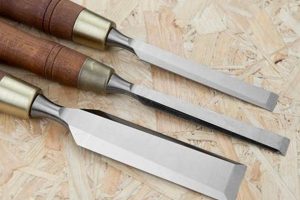
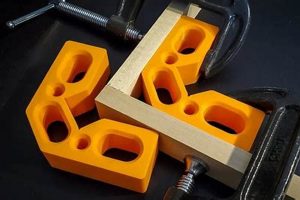
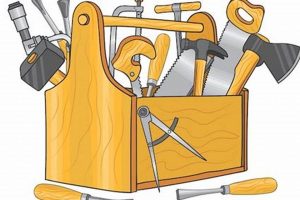
Essential implements facilitate the initial stages of creating objects from wood. These items range from simple hand-operated devices to more complex powered machinery, all purposed to shape, join, and finish wooden materials. A basic set might include a saw for cutting, a plane for smoothing, a chisel for shaping details, and measuring instruments for accuracy.
The acquisition and mastery of such fundamental instruments unlock the potential for crafting functional and aesthetic pieces. Historically, woodworking has been integral to construction, furniture making, and art. Proficiency allows individuals to engage in a tradition of craftsmanship while gaining practical skills and creative expression.
The subsequent sections will detail specific examples within the category, providing guidance on selecting appropriate equipment and best practices for safe and effective utilization. The discussion will cover both hand tools and power tools, offering a comprehensive overview for newcomers to the discipline.
Guidance on Essential Implements for Woodworking Initiation
The selection and proper use of implements are paramount for successful entry into woodworking. Prioritize safety and accuracy to ensure quality results and prevent injury.
Tip 1: Prioritize Hand Tools Initially. Starting with hand implements such as saws, chisels, and planes allows for a greater understanding of wood behavior and tool control before introducing the complexities of power tools.
Tip 2: Invest in Quality Measuring Instruments. Accurate measurements are crucial for joinery and project completion. A reliable measuring tape, combination square, and marking gauge are essential.
Tip 3: Sharpen Cutting Edges Consistently. A dull tool is more dangerous than a sharp one. Regular sharpening of chisels, planes, and saw blades is critical for efficient and controlled cutting.
Tip 4: Select Appropriate Wood for the Project. Different wood species have varying properties. Consider hardness, grain, and stability when choosing material for a particular application. Softwoods are generally easier to work with for beginners.
Tip 5: Learn Basic Joinery Techniques. Mastering fundamental joints, such as the mortise and tenon or dovetail, expands the range of projects that can be undertaken. Practice with scrap wood before committing to a final piece.
Tip 6: Wear Appropriate Safety Gear. Eye protection, hearing protection, and dust masks are mandatory when operating tools, regardless of experience level. Ensure a well-ventilated workspace to minimize dust exposure.
Tip 7: Start with Simple Projects. Building a box or a small shelf provides valuable experience and reinforces fundamental skills. Avoid overly ambitious projects in the initial stages.
Tip 8: Take a Class or Seek Mentorship. Learning from experienced woodworkers can significantly accelerate the learning process and provide valuable insights into techniques and best practices.
By adhering to these recommendations, beginners can establish a solid foundation in woodworking and enjoy the satisfaction of creating tangible objects. Safety, precision, and a commitment to continuous learning are key to success.
The subsequent sections will provide more in-depth guidance on specific implements and advanced techniques, building upon the principles outlined above.
1. Safety equipment imperative

The relationship between required safety gear and instruments utilized for working with wood is direct and fundamental. Exposure to hazards is inherent in manipulating tools designed to cut, shape, and join wooden materials. Eye protection, encompassing safety glasses or face shields, mitigates the risk of projectile debris generated during sawing, routing, or sanding. Hearing protection, such as earplugs or earmuffs, attenuates noise levels exceeding permissible exposure limits, preventing auditory damage from power tools. Respiratory protection, typically dust masks or respirators, filters airborne particulate matter produced during sanding or sawing operations, minimizing inhalation of potentially harmful wood dust.
The absence of requisite safety protocols directly correlates with an increased incidence of workplace injuries. For example, failure to wear eye protection while operating a lathe can result in corneal abrasions or more severe ocular trauma. Similarly, neglecting to use hearing protection when employing a router for extended periods may lead to noise-induced hearing loss. Insufficient respiratory protection while sanding hardwoods can exacerbate existing respiratory conditions or contribute to the development of occupational lung disease.
Therefore, the incorporation of safety provisions constitutes an inseparable component of woodworking practices. Adherence to these precautionary measures reduces the probability of injury, fostering a safer and more sustainable working environment. Integrating safety practices is not merely an accessory; it is intrinsic to competent and ethical woodworking.
2. Measuring instruments accuracy

Precision in woodworking is directly predicated on the accurate application of measuring instruments. The initial establishment of dimensions dictates the outcome of joinery, fitting, and overall project integrity. Deficiencies in accuracy at the outset propagate throughout the entirety of the woodworking process, culminating in substandard results.
- Dimensional Stability and Material Yield
Accurate measurements optimize material utilization. Precise layouts minimize waste by enabling efficient cutting and placement, maximizing the usable portion of lumber or sheet goods. Conversely, inaccurate measurements lead to excess material consumption and increased project costs. The ability to accurately measure dimensions prevents the need for corrective actions that consume additional resources and time.
- Joinery Integrity and Structural Soundness
Joinery, the process of connecting individual wood pieces, relies fundamentally on precise measurements. Accurately cut mortises, tenons, dovetails, and rabbets ensure tight-fitting, structurally sound connections. Inaccurate measurements in joinery compromise the integrity of the assembled piece, potentially leading to instability, weakness, or failure under stress. Precise measurement is critical to achieving optimal adhesion with glues and fasteners.
- Assembly Fit and Finish Quality
The final aesthetic and functional quality of a woodworking project depends on the precise execution of measured dimensions. Components that are accurately measured and cut align properly during assembly, resulting in seamless transitions and visually appealing surfaces. Inaccurate measurements lead to gaps, misalignments, and inconsistencies in the finished piece, detracting from its overall appearance and potentially affecting its functionality.
- Tool Calibration and Machine Setup
Accuracy in woodworking is not solely reliant on the measuring instruments themselves, but also on the calibration and setup of power tools. Accurate measurements are used to set fence positions on table saws, blade angles on miter saws, and cutting depths on routers. Without accurate measuring instruments to calibrate machinery, the inherent precision of the tools themselves becomes irrelevant. This interdependence highlights the critical role of reliable measurement in achieving accurate and consistent results.
These considerations underscore the fundamental importance of accurate measuring instruments in woodworking. From initial material selection to final assembly, precision is paramount. Investing in quality measuring implements and mastering their accurate application are essential steps toward achieving consistently high-quality woodworking results.
3. Sharpening maintains efficiency

The axiom “Sharpening maintains efficiency” directly impacts the performance and safety of implements intended for introductory woodworking tasks. A tool, regardless of its initial quality, loses effectiveness as its cutting edge dulls through use. This degradation affects the ease of cutting, the precision of the cut, and the overall control the user has over the instrument. A dull chisel, for instance, requires more force to pare wood, increasing the risk of slippage and potential injury. A dull saw necessitates greater effort to initiate and maintain a cut, resulting in uneven surfaces and increased fatigue. Thus, consistent sharpening is not merely an ancillary task; it is integral to the safe and productive utilization of implements.
Consider a beginner attempting to create a basic mortise and tenon joint. A sharp chisel allows for clean, controlled removal of material within the mortise, ensuring a tight-fitting tenon. A dull chisel, however, will crush and tear the wood fibers, resulting in a sloppy mortise and a weak joint. Similarly, a sharp plane effortlessly creates smooth, flat surfaces, ideal for preparing stock for joinery or finishing. A dull plane requires significantly more force and can lead to tear-out, necessitating additional sanding and potentially compromising the dimensions of the workpiece. Maintenance is imperative to the functionality and safe use of these devices.
In summary, the maintenance of sharp cutting edges directly affects the efficacy and safety during initial woodworking endeavors. Neglecting this fundamental aspect leads to increased physical exertion, reduced control, heightened risk of injury, and compromised project quality. Sharpening should be incorporated into any beginner’s regimen to experience woodworking effectively.
4. Wood selection crucial

The selection of appropriate wood species directly impacts the efficacy and longevity of instruments employed in introductory woodworking endeavors. The characteristics of the wood, such as hardness, grain direction, and stability, dictate the type of instrument required and the techniques employed. Inappropriate wood selection can lead to premature tool wear, substandard results, and potentially dangerous working conditions.
- Tool Suitability and Material Resistance
Wood hardness directly correlates with the force required to shape it. Softer wood species, such as pine or basswood, are more easily worked with hand tools like chisels and hand planes, making them ideal for beginners. Conversely, harder woods, such as oak or maple, require more robust power tools and specialized techniques to achieve the desired results. Attempting to shape hard wood with inadequate hand tools can damage the tools and increase the risk of injury.
- Grain Orientation and Cutting Techniques
The direction of the wood grain affects the ease and quality of cuts. Working with the grain, often referred to as “with the grain,” generally produces smoother, cleaner cuts. Working against the grain can cause tear-out, a condition where wood fibers lift and splinter, requiring additional sanding and potentially compromising the final appearance. Understanding grain direction informs tool selection and cutting techniques to minimize tear-out and optimize surface finish. For instance, a lower angle block plane is often preferred for working against the grain.
- Wood Stability and Dimensional Change
Wood is a hygroscopic material, meaning it absorbs and releases moisture from the environment. This moisture exchange causes wood to expand and contract, potentially affecting the dimensions and stability of finished projects. Wood species vary in their dimensional stability, with some being more prone to warping or cracking than others. Selecting dimensionally stable wood species minimizes the risk of project failure due to environmental factors and influences the choice of joinery techniques to accommodate potential wood movement.
- Finishing Characteristics and Tool Selection
Different species absorb finishes differently. Denser species may require more coats or specialized sanding techniques to achieve a uniform and aesthetically pleasing finish. Open-grained woods can create a different look when finished, so it is essential to experiment with sample pieces to determine the compatibility with the desired finish and to adapt the preparation process, which could affect your tool selection or usage.
The interplay between instrument selection and wood properties emphasizes the significance of thoughtful material choice for newcomers to woodworking. This choice not only impacts the efficiency of operations but also influences final results and the longevity of the piece.
5. Joinery techniques essential

Proficiency in joinery is fundamentally linked to the effective utilization of implements within the woodworking domain. The chosen method of joining wooden components dictates not only the structural integrity of the assembled piece but also the specific requirements for tools employed throughout the process. Mastery of joinery necessitates a corresponding understanding of the function and application of the tools used to execute those joints.
- Mortise and Tenon Joints: Chisels, Saws, and Measuring Instruments
The creation of mortise and tenon joints relies heavily on the precise use of chisels for shaping the mortise (the receiving hole) and saws for creating the tenon (the protruding element). Accurate measurement is critical to ensure a tight, secure fit. The size and type of chisel, as well as the saw’s kerf (width of cut), must be carefully selected to match the dimensions of the joint. The mortise and tenon exemplifies how joint design necessitates specific tool utilization.
- Dovetail Joints: Saws, Chisels, and Marking Gauges
Dovetail joints, known for their strength and aesthetic appeal, demand precision sawing and chiseling. A dovetail saw, characterized by its fine teeth and stiff blade, enables accurate cuts along the angled dovetail pins and tails. Chisels are employed to remove waste material between the tails and pins. Marking gauges ensure consistent layout and accurate transfer of dimensions. The complex geometry of the dovetail necessitates specialized tools and refined skills.
- Rabbet and Dado Joints: Saws, Routers, and Planes
Rabbet joints (edge recesses) and dado joints (grooves) are often used to join panels and boards. A rabbet plane or router can create precise rabbets. A saw, followed by a chisel or router, is used to form dados. The choice of tool depends on the size and precision required for the joint. Accurate setups and careful execution are essential for achieving strong, seamless connections.
- Butt Joints: Clamps, Fasteners, and Measuring Tools
While the simplest of joinery techniques, the butt joint still requires specific equipment for proper execution. Clamps are crucial for holding the boards in alignment while adhesive cures or fasteners are installed. Accurate measuring tools are necessary to ensure precise cuts and proper alignment before assembly. Even a seemingly simple joint demands precision in measurement and application of holding forces.
In summary, the selection and application of implements cannot be divorced from a thorough understanding of joinery. The choice of joint dictates the specific implements and techniques required to achieve a structurally sound and aesthetically pleasing result. Consequently, aspiring woodworkers must cultivate both a knowledge of joinery principles and the proficiency in using the instruments associated with their execution.
Frequently Asked Questions
The following questions address common concerns and misconceptions regarding the selection and utilization of implements suitable for initial woodworking endeavors. These answers aim to provide clarity and guidance for aspiring woodworkers.
Question 1: What constitutes the bare minimum selection of implements to commence woodworking projects?
A basic set should include a hand saw (crosscut and rip), a block plane, a set of chisels, a combination square, a measuring tape, a marking gauge, and sharpening equipment. Safety glasses and a dust mask are also essential.
Question 2: Is it advisable to invest in high-end implements from the outset, or are more affordable options sufficient for beginners?
While high-quality implements offer superior performance and longevity, more affordable options can be sufficient for beginners. It is more critical to focus on learning proper techniques and maintenance than on acquiring expensive implements. As skills develop, investment in higher-quality options may be warranted.
Question 3: What safety precautions are paramount when using woodworking implements?
Eye protection is non-negotiable. Hearing protection is recommended, especially when using power implements. Respiratory protection is necessary when generating dust. Secure workpieces to prevent movement. Maintain sharp cutting edges and proper body mechanics.
Question 4: What is the importance of sharpening implements, and how frequently should it be performed?
Sharp cutting edges are essential for efficient and safe operation. Dull implements require more force, increasing the risk of injury. Sharpening frequency depends on the type of wood being worked and the intensity of use. Regular honing can prolong the intervals between more extensive sharpening sessions.
Question 5: How does wood species affect implement selection and utilization?
Harder wood species require sharper implements and more robust power implements. Softwood species are more easily worked with hand implements. Grain direction influences cutting techniques to minimize tear-out. Understanding wood properties is critical for selecting appropriate implements and methods.
Question 6: Are power implements essential for beginners, or can projects be completed effectively with hand implements alone?
While power implements can increase efficiency and facilitate certain tasks, projects can be completed effectively with hand implements alone. Starting with hand implements allows for greater understanding of wood behavior and tool control, providing a solid foundation for future power implement utilization.
In conclusion, the selection, utilization, and maintenance of implements play a crucial role in successful woodworking outcomes. Prioritizing safety, accuracy, and a willingness to learn are fundamental to the development of woodworking skills.
The subsequent section will provide an overview of specific implements, categorized by function and application.
Tools to Begin Woodworking
This exposition has delineated the fundamental nature of implements required for initial woodworking projects, emphasizing their selection, appropriate application, and the essential consideration of safety. The significance of sharp cutting edges, accurate measurement, and informed wood selection has been underscored. Furthermore, the inseparable connection between these instruments and basic joinery techniques has been elucidated, providing a comprehensive overview for those entering the discipline.
Mastery of implements is not merely a technical skill, but a pathway to tangible creation and self-sufficiency. The diligent study and mindful practice within this domain offer the potential to realize functional objects and express artistic vision. It is now incumbent upon the individual to translate this knowledge into practice, laying the groundwork for continued growth within the craft.
![Buy Woodworking Tools Sales Online - [Your Brand] | Step-by-Step Guides, Tools & Inspiration to Build Beautiful Wooden Decor on a Budget](https://woodfromhome.com/wp-content/uploads/2026/05/th-213-300x200.jpg "Buy Woodworking Tools Sales Online - [Your Brand] Step-by-Step Guides, Tools & Inspiration to Build Beautiful Wooden Decor on a Budget")