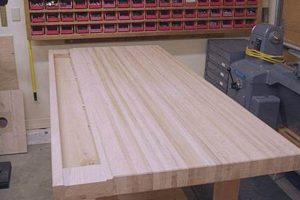
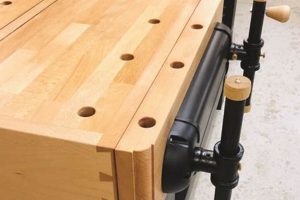
This essential piece of furniture serves as the central workstation for woodworking tasks. It provides a stable and robust surface designed to withstand the forces involved in sawing, planing, chiseling, and assembly. Constructed primarily from hardwood, its design often incorporates features such as vises, holdfasts, and storage options to enhance efficiency and precision. For instance, a cabinetmaker might use a well-equipped one to construct intricate joinery for a high-end furniture piece.
The presence of a dedicated area significantly increases productivity and accuracy in woodworking projects. It allows for the secure clamping and manipulation of materials, which is crucial for achieving clean cuts, precise fits, and strong bonds. Historically, these areas have been integral to the development of craftsmanship, providing a foundational platform for artisans to refine their skills and create lasting works. The right setup can also mitigate safety risks by providing stability and control during potentially hazardous operations.
Understanding the diverse types available, along with their specific features and optimal uses, is essential for any woodworker. Further exploration will delve into the various designs, construction techniques, and accessory options, empowering individuals to select the most suitable solution for their particular needs and workshop environment. This will include discussions on materials, dimensions, and customization possibilities.
Essential Guidance for Optimizing Your Workstation
The effectiveness of any woodworking endeavor is directly correlated to the quality and setup of the central work surface. The following recommendations offer insights into maximizing efficiency and precision when utilizing this vital tool.
Tip 1: Prioritize Stability. A solid foundation is paramount. Ensure the structure is level and does not rock or shift during use. Shimming the legs or securing it to the floor can eliminate unwanted movement.
Tip 2: Invest in Quality Vises. The vises are critical for holding workpieces securely. Opt for robust, well-machined vises that provide consistent clamping pressure without damaging the wood.
Tip 3: Incorporate Holdfasts. These provide a versatile and rapid method for securing stock to the surface. Practice using them effectively to enhance workflow efficiency.
Tip 4: Strategically Locate Dog Holes. Carefully plan the placement of dog holes to accommodate a wide range of projects and clamping configurations. Maintain consistent spacing for optimal usability.
Tip 5: Optimize Surface Maintenance. Regularly flatten the surface to ensure accuracy in joinery and prevent unevenness from affecting project outcomes. Waxing the surface also reduces friction.
Tip 6: Customize for Specific Tasks. Adapt the design to suit frequently undertaken projects. Add custom jigs, fences, or specialized clamping systems to enhance efficiency and precision for those operations.
Tip 7: Implement Effective Storage. Integrate storage solutions, such as drawers or shelves, to keep essential tools and supplies within easy reach. This reduces downtime and promotes a more organized workspace.
Adhering to these principles will result in a workstation that not only enhances the quality of woodworking projects but also contributes to a safer and more enjoyable working environment. The ability to securely hold, manipulate, and access materials is crucial for successful craftsmanship.
Further sections will explore advanced techniques and specialized equipment that build upon this foundational knowledge, enabling woodworkers to tackle increasingly complex and challenging projects.
1. Stability

The stability of a woodworker’s bench is a fundamental prerequisite for accurate and safe woodworking operations. Instability, even subtle movement, introduces inaccuracies that compound throughout the fabrication process. Each cut, joint, and assembly relies on a stable reference plane; deviations in this plane propagate errors, ultimately compromising the integrity of the finished piece. For instance, attempting to plane a board on an unsteady surface results in uneven removal of material, precluding a flat, true surface. The effect extends beyond hand tool operations; even power tools, such as routers or circular saws guided along the bench, are susceptible to generating flawed results if the underlying structure is not sufficiently rigid.
Achieving adequate stability involves several critical design and construction elements. A heavy, well-braced frame resists racking and deformation. Substantial leg dimensions, coupled with robust joinery, minimize flexing. The top itself must be sufficiently thick and dense to dampen vibrations and maintain a level surface. In practical terms, consider two benches: one built with thin, lightweight materials and the other with thick, seasoned hardwood. The former will vibrate excessively during sawing or hammering, rendering precise work difficult, while the latter absorbs these forces, providing a more controlled environment. The addition of a solid base or anchoring the bench to the floor further enhances stability, particularly in situations where significant force is applied.
In summary, stability is not merely a desirable feature but an essential characteristic of a functional and effective woodworker’s bench. It directly influences the precision, safety, and overall quality of woodworking endeavors. Overlooking this aspect can lead to frustration, wasted materials, and substandard results. Consequently, any investment in materials and construction techniques that enhance stability is a worthwhile pursuit. Prioritizing this foundational element ensures that the workstation functions as a reliable and unwavering platform for craftsmanship.
2. Workholding

Workholding is intrinsic to the function of a woodworker’s bench, representing the system by which material is securely positioned and stabilized during various operations. The bench itself serves as the foundation for these systems, providing a robust platform to resist the forces generated during sawing, planing, chiseling, and joinery. Without effective workholding capabilities, the precision and safety of these operations are severely compromised. The connection between the two is causal: the design and features of the bench directly dictate the types and effectiveness of workholding methods that can be employed. For example, a bench equipped with sturdy vises allows for the clamping of boards for edge jointing, while the presence of dog holes enables the use of bench dogs and holdfasts to secure larger panels for planing or routing.
The importance of workholding extends beyond mere convenience; it directly impacts the accuracy and repeatability of woodworking tasks. Consider the creation of mortise and tenon joints. Accurate mortises require the workpiece to be held firmly in place while chiseling, preventing movement that could lead to misaligned or oversized mortises. Similarly, creating precise tenons demands secure clamping to ensure consistent cuts with a saw or router. A poorly designed or inadequately implemented workholding system introduces the potential for errors at each stage of the process, accumulating to create significant deviations from the intended design. In essence, the reliability and predictability of woodworking outcomes are directly proportional to the quality and effectiveness of the workholding methods employed.
In conclusion, workholding is not merely an accessory to a woodworker’s bench; it is an integral and indispensable component that dictates the precision, safety, and overall quality of woodworking projects. The design of the bench must be considered in conjunction with the workholding needs of the woodworker, ensuring that the available systems are both versatile and robust enough to accommodate a wide range of tasks. Understanding this connection is paramount for any woodworker seeking to optimize their workflow and achieve consistent, high-quality results. Challenges in workholding often stem from inadequate bench design or a lack of suitable clamping solutions; addressing these issues is crucial for realizing the full potential of the woodworking process.
3. Material

The selection of material fundamentally dictates the performance and longevity of a woodworker’s bench. The connection between material properties and bench functionality is direct and consequential. Hardness, stability, and resistance to wear are primary considerations, as these factors determine the bench’s ability to withstand the rigors of daily use. Softwoods, while more economical, lack the density required to resist denting and deformation from tools and heavy workpieces. A softwood bench top, for example, would quickly exhibit wear, compromising its ability to provide a flat and true surface for accurate joinery. Conversely, hardwoods such as maple, beech, or oak offer superior durability, maintaining their shape and integrity over extended periods. This translates to greater precision in woodworking tasks and a longer lifespan for the bench itself.
The dimensional stability of the material is equally crucial. Wood is hygroscopic, meaning it absorbs and releases moisture from the surrounding environment. This process can cause expansion and contraction, potentially leading to warping, cracking, or joint failure. Properly seasoned and dried hardwoods minimize these effects, ensuring the bench remains flat and stable throughout the year. Furthermore, the choice of construction methods, such as mortise and tenon joinery, complements the material properties by distributing stress and accommodating wood movement. A well-constructed bench using stable hardwoods will resist the forces generated during clamping, sawing, and hammering, providing a reliable and consistent working surface. For example, a bench built from kiln-dried maple with interlocking joinery will exhibit far greater stability than one constructed from green lumber with simple butt joints.
Ultimately, the material selection is an investment in the quality and usability of the woodworker’s bench. While cost may be a factor, prioritizing durable, stable hardwoods is essential for creating a workstation that withstands the demands of serious woodworking. Overlooking this aspect can lead to premature failure, increased maintenance, and compromised accuracy. The practical significance lies in the ability to perform precise and efficient woodworking tasks without the frustration of a workbench that shifts, warps, or deteriorates. By understanding the connection between material properties and bench performance, woodworkers can make informed decisions that result in a durable and reliable centerpiece for their workshops.
4. Dimensions

Dimensional considerations are paramount in the design and construction of a woodworker’s bench, directly influencing its functionality, ergonomics, and suitability for specific woodworking tasks. Proper sizing ensures comfortable and efficient use, while inappropriate dimensions can lead to discomfort, reduced precision, and even injury.
- Height
The height of the bench dictates the user’s posture during work. A bench that is too low forces the user to stoop, leading to back pain and reduced visibility. Conversely, a bench that is too high causes shoulder strain and makes it difficult to apply downward force effectively. The ideal height is typically determined by the user’s stature, with a common recommendation being knuckle height when standing upright. Adjustability, either through adjustable legs or the addition of risers, enhances versatility and accommodates multiple users.
- Length
The length of the bench determines the maximum size of workpieces that can be accommodated comfortably. A longer bench provides ample space for supporting long boards during planing or sawing, reducing the risk of tipping or instability. Insufficient length necessitates awkward positioning and increases the potential for errors. The length should be proportional to the type of projects typically undertaken, with longer benches being advantageous for furniture making or large-scale construction.
- Width
The width of the bench influences the accessibility of tools and materials and the ability to perform tasks requiring a wide stance. A wider bench provides more surface area for organizing tools and accessories, reducing clutter and improving workflow. It also allows the user to position themselves closer to the workpiece, enhancing control and precision. However, excessive width can make it difficult to reach the far side of the bench, particularly for users with shorter arms. The ideal width balances accessibility with workspace maximization.
- Thickness (of Top)
The thickness of the bench top contributes significantly to its stability and resistance to vibration. A thicker top provides greater mass, damping vibrations generated during hammering or sawing and reducing the likelihood of the bench shifting during use. It also increases the bench’s ability to resist warping or sagging over time. Inadequate thickness can result in a less stable and less durable work surface. Hardwood tops, typically ranging from 2 to 4 inches in thickness, are generally preferred for their superior stability and longevity.
The interplay of these dimensional aspects directly impacts the usability and effectiveness of the woodworker’s bench. Careful consideration of these factors, tailored to the individual user’s needs and the types of projects undertaken, is crucial for creating a workstation that promotes efficiency, precision, and comfort. The dimensions are not arbitrary; they are functional parameters that determine the suitability of the bench for its intended purpose.
5. Accessories

Accessories are integral components that augment the functionality and versatility of a woodworker’s bench, transforming it from a mere surface into a comprehensive workstation. These adjuncts, ranging from simple hand tools to specialized hardware, directly influence the range of tasks that can be performed efficiently and accurately. The absence of appropriate accessories limits the bench’s capabilities, forcing the woodworker to improvise or rely on less precise methods. For instance, a bench lacking a vise restricts the ability to securely clamp workpieces for tasks such as sawing dovetails, while the absence of bench dogs and holdfasts complicates the process of planing large surfaces. The effective integration of accessories is, therefore, essential for maximizing the bench’s potential.
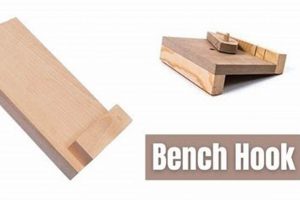
A practical example illustrating the significance of accessories is the use of a planing stop in conjunction with bench dogs. These accessories, when properly positioned, provide a secure and stable platform for planing boards, preventing them from sliding or shifting during the process. The planing stop, typically a metal or wooden projection that rises slightly above the bench surface, resists the forward motion of the board, while the bench dogs, inserted into pre-drilled holes, prevent lateral movement. This combination enables the woodworker to apply consistent and controlled pressure to the plane, resulting in a smooth and even surface. The availability of a variety of accessories, such as different types of vises, bench hooks, and measuring tools, further enhances the woodworker’s ability to tackle diverse projects with precision and efficiency.
In conclusion, accessories are not merely optional additions but essential elements that define the woodworker’s bench as a versatile and capable tool. The selection and integration of these components should be carefully considered, based on the types of woodworking tasks typically performed and the desired level of precision and efficiency. Challenges in maximizing the bench’s functionality often stem from a lack of awareness of available accessories or a failure to properly utilize them. Understanding the connection between accessories and bench performance is crucial for optimizing the woodworking process and achieving consistently high-quality results. The accessories selected should also be integrated to the maintenance plans for the bench.
6. Maintenance

Sustained functionality and accuracy of a woodworker’s bench hinge upon consistent and appropriate maintenance practices. The bench, subjected to repetitive impact, abrasion, and environmental fluctuations, requires proactive care to mitigate degradation and preserve its operational integrity.
- Surface Flattening
The bench top serves as a crucial reference plane for joinery and assembly. Over time, localized wear, accidental impacts, and seasonal wood movement can induce unevenness. Regular flattening, using hand planes or specialized surfacing tools, restores the trueness of the surface, ensuring accurate transfer of measurements and consistent clamping pressure. The frequency depends on usage intensity and environmental conditions.
- Vise Maintenance
Vises are critical for securing workpieces. Routine maintenance involves lubricating threaded components to ensure smooth operation and prevent corrosion. Jaws should be checked for alignment and repaired or replaced if damaged. Loose or worn vise hardware should be tightened or replaced to maintain clamping force and prevent slippage. Neglecting vise maintenance compromises workholding effectiveness and can lead to imprecise cuts or damaged materials.
- Hardware Inspection and Tightening
The structural integrity of the bench relies on sound joinery and secure hardware. Periodic inspection of all bolts, screws, and other fasteners is essential to identify and address loosening. Loose hardware reduces the bench’s rigidity, diminishing its ability to withstand forces generated during woodworking tasks. Tightening or replacing loose hardware prevents further degradation and maintains the bench’s stability.
- Wood Preservation
The wood itself is susceptible to environmental damage, including moisture absorption, fungal growth, and insect infestation. Applying protective finishes, such as oil or wax, shields the wood from moisture, reducing the risk of warping and cracking. Periodic inspection for signs of infestation or decay allows for early intervention, preventing extensive damage that could compromise the bench’s structural integrity. Addressing wood preservation prolongs the bench’s lifespan and maintains its aesthetic appeal.
These facets of maintenance, when consistently applied, safeguard the woodworker’s bench against premature deterioration and ensure its continued performance as a reliable and accurate workstation. Neglecting maintenance leads to a gradual decline in functionality, requiring more extensive and costly repairs in the long term. Investing in proactive care is, therefore, a prudent strategy for preserving this essential woodworking tool.
Frequently Asked Questions
The following addresses common inquiries regarding selection, use, and maintenance of a dedicated work surface for woodworking. These answers aim to provide clear and concise guidance for optimizing its utility.
Question 1: What constitutes an ideal height for a woodworker’s bench?
The optimal height is typically around knuckle height when standing. This allows for efficient transfer of force when using hand tools, minimizes back strain, and facilitates comfortable access to the workpiece. However, individual preferences and specific tasks may necessitate slight adjustments.
Question 2: What type of wood is most suitable for constructing the top?
Hardwoods such as maple, beech, or oak are generally preferred. These species exhibit superior resistance to wear and deformation, ensuring a stable and durable work surface. Softwoods are less desirable due to their susceptibility to denting and cracking.
Question 3: How often should the surface of a woodworking bench be flattened?
The frequency depends on usage and environmental conditions. In general, flattening should be performed whenever the surface exhibits noticeable unevenness. This is crucial for maintaining accuracy in joinery and assembly.
Question 4: What are the primary benefits of incorporating vises into the design?
Vises provide secure and reliable workholding, enabling precise manipulation of materials during sawing, planing, and other operations. They are essential for creating accurate joinery and preventing workpiece movement.
Question 5: Are dog holes a necessary feature?
While not strictly mandatory, dog holes significantly enhance the versatility of the bench. They accommodate bench dogs and holdfasts, providing a rapid and effective method for securing workpieces of various sizes and shapes.
Question 6: How does proper lighting contribute to the effective use of a woodworker’s bench?
Adequate lighting is crucial for visual clarity and precision. Task lighting, positioned to illuminate the workpiece without creating shadows, reduces eye strain and improves accuracy in fine detail work. Proper lighting is an important safety component.
These FAQs offer a foundation for understanding the key aspects of a functional and effective woodworking surface. Thoughtful consideration of these points will improve the woodworking experience.
The succeeding section explores methods for selecting and customizing your own solution to align with your woodworking style and needs.
Conclusion
The preceding discussion has elucidated the critical attributes and considerations surrounding the woodworker’s bench. From foundational stability and material selection to workholding mechanisms, dimensional parameters, accessories, and essential maintenance, each element contributes to the overall efficacy of this central workstation. Understanding these facets empowers informed decision-making, leading to the selection or construction of a workbench optimized for individual needs and woodworking practices.
The enduring value of a well-designed and maintained woodworker’s bench lies in its capacity to serve as a reliable platform for craftsmanship, fostering precision, safety, and efficiency. Continued attention to its design and care is not merely a matter of preserving equipment but of upholding the standards of the craft itself. The principles outlined herein serve as a foundation for continued exploration and refinement in the pursuit of woodworking excellence.
![Build A Roman Woodworking Bench [DIY Guide] | Step-by-Step Guides, Tools & Inspiration to Build Beautiful Wooden Decor on a Budget](https://woodfromhome.com/wp-content/uploads/2026/05/th-207-300x200.jpg "Build A Roman Woodworking Bench [DIY Guide] Step-by-Step Guides, Tools & Inspiration to Build Beautiful Wooden Decor on a Budget")