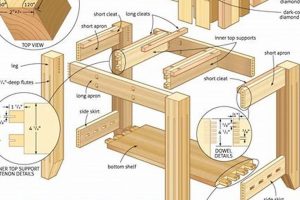
The creation of wooden items utilizing Computer Numerical Control (CNC) technology constitutes a significant sector within manufacturing and hobbyist endeavors. These undertakings encompass a broad spectrum, ranging from intricate decorative carvings to functional furniture components, all achieved through the precision and repeatability afforded by automated machinery. Examples include custom signage, complex joinery for cabinet making, and mass production of identical wooden parts.
Employing automated techniques for crafting wooden objects offers several advantages. It reduces material waste through optimized cutting paths, enhances production speed, and enables the creation of designs that would be difficult or impossible to achieve manually. Historically, this approach represents a shift from artisan-based production to a technology-driven model, increasing efficiency and design complexity.
Further discussion will address the selection of appropriate materials for automated wooden part production, the design software used to create toolpaths for CNC machines, and the considerations necessary for achieving successful and repeatable outcomes. Machine maintenance and safety protocols also warrant detailed examination.
Guidance for Computer-Controlled Wood Fabrication
Successful implementation of automated wood fabrication relies on careful planning and execution. The following guidelines aim to optimize design, material selection, and machine operation.
Tip 1: Prioritize Design Software Proficiency: Familiarity with CAD/CAM software is crucial. Invest time in learning the software’s capabilities and limitations. This enables the creation of optimized toolpaths that minimize material waste and machining time.
Tip 2: Material Selection Influences Outcome: Not all wood types are equally suitable. Hardwoods offer durability for structural components, while softwoods are easier to machine for decorative elements. Consider grain direction and density to avoid splintering or tear-out during the cutting process.
Tip 3: Toolpath Optimization is Essential: Efficient toolpaths reduce cycle time and improve surface finish. Experiment with different cutting strategies, such as climb vs. conventional milling, to determine the optimal approach for specific materials and geometries.
Tip 4: Accurate Fixturing is Critical: Securely holding the workpiece is paramount. Employ appropriate clamping methods to prevent movement during machining. Vacuum hold-down systems or custom jigs can enhance stability, particularly for complex shapes.
Tip 5: Regular Machine Maintenance Prolongs Life: Consistent maintenance ensures optimal machine performance. Regularly inspect and lubricate moving parts, clean the machine bed, and calibrate axes to maintain accuracy.
Tip 6: Incorporate a Test Cut: Always perform a test cut on a scrap piece of material to verify the toolpath and machine settings before committing to the final workpiece. This step minimizes potential errors and wasted material.
These guidelines emphasize the importance of meticulous preparation and execution in achieving precise and efficient automated wood fabrication. By adhering to these principles, users can maximize the potential of the technology and produce high-quality results.
The article will now move towards a concluding summary.
1. Design Complexity

Design complexity in automated wood fabrication presents both opportunities and challenges. The capacity to produce intricate patterns and geometries is a core advantage of CNC technology. However, escalating design complexity directly influences several critical factors: toolpath generation, machining time, material selection, and fixturing requirements. A complex design necessitates more sophisticated toolpaths, leading to longer processing durations and increased computational demands on the CAM software. The choice of wood species becomes more critical, as finer details may be prone to splintering in less dense materials. Furthermore, intricate shapes often require custom fixturing solutions to ensure secure workpiece retention during machining. An example is the creation of complex curved furniture components that demand elaborate toolpaths and precise machine movements to achieve the desired form without compromising structural integrity.
The connection between design intricacy and resource allocation is undeniable. Projects involving high degrees of detail necessitate a comprehensive understanding of both design software and CNC machine capabilities. Successful execution frequently involves iterative prototyping and refinement of toolpaths to optimize cutting parameters and minimize the risk of errors. Consider the creation of complex wooden gears or intricate decorative inlays. These projects exemplify the requirement for precise tool control and meticulous attention to detail to achieve the desired level of aesthetic quality and functional performance. The ability to manage and mitigate the complexities associated with intricate designs is a defining characteristic of proficient practitioners in this field.
In summary, design complexity significantly impacts the planning and execution of automated wood fabrication. While CNC technology enables the creation of elaborate forms, designers and machinists must carefully consider the implications for toolpath generation, material selection, fixturing, and overall project feasibility. A thorough understanding of these interdependencies is crucial for achieving successful and repeatable results. Overcoming these challenges unlocks the potential to produce innovative and high-value wooden products.
2. Material Properties

Material selection is a foundational element in automated wood fabrication. The physical characteristics of chosen wood species directly influence machining parameters, tool selection, and the final quality of the fabricated item. Understanding these properties is crucial for achieving predictable and repeatable results.
- Density and Hardness
Density and hardness affect cutting speed, feed rate, and tool wear. Hardwoods, such as maple or oak, require slower cutting speeds and more robust tooling than softwoods, like pine or cedar. Excessive feed rates when machining dense materials can lead to tool breakage or poor surface finish. Conversely, insufficient feed rates with softwoods can result in burning or splintering. Example: The high density of ebony necessitates specialized cutting techniques to prevent chipping and maintain precision when crafting small, intricate components.
- Grain Direction
Grain direction influences the strength and machinability of wood. Cutting with the grain typically produces a smoother surface finish than cutting against it. However, designs that require cross-grain cutting may be unavoidable. In such cases, strategies like climb milling or pre-scoring the material can minimize tear-out and improve edge quality. For example, constructing a mitered corner requires careful attention to grain orientation to ensure a seamless joint and prevent weakness along the glue line.
- Moisture Content
Moisture content significantly impacts dimensional stability and machinability. Wood expands and contracts with changes in humidity, potentially leading to warping or cracking after fabrication. Kiln-dried lumber with a consistent moisture content is preferred for automated woodworking to minimize these risks. Excessive moisture can also promote fungal growth and accelerate tool corrosion. For instance, a component fabricated from improperly dried lumber may exhibit significant dimensional changes after being installed in a different environment.
- Resin Content
The amount of resin present, especially in softwoods, influences tool life and the formation of deposits on cutting edges. High resin content can cause tools to gum up quickly, requiring frequent cleaning or the use of specialized coatings to prevent adhesion. Accumulated resin can also affect the precision of the cut and the surface finish. An example of this is working with pine, which has high resin content. Frequent cleaning may be needed to maintain optimal tool performance.
The preceding material properties exemplify the critical role of informed wood selection in automated fabrication. Consideration of density, grain direction, moisture content, and resin concentration are essential for optimizing machining processes, minimizing material waste, and ensuring the long-term stability and aesthetic appeal of finished components. Choosing appropriate materials enhances the potential for successful and efficient automated woodworking practices.
3. Toolpath Optimization
Toolpath optimization represents a critical stage in automated wood fabrication. It involves the strategic planning of the cutting tool’s movement across the workpiece to maximize efficiency, minimize material waste, and achieve the desired surface finish. Inadequate toolpath planning can result in prolonged machining times, excessive material removal, and a compromised final product, underlining the importance of this process in successful woodworking endeavors.
- Cutting Strategy Selection
The choice between conventional milling and climb milling significantly impacts surface finish and tool wear. Climb milling, where the cutter moves in the same direction as the feed, often yields a superior finish but may require more rigid machine setups. Conventional milling, with the cutter moving against the feed, can be more suitable for less rigid machines but may produce a less refined surface. For example, when creating detailed relief carvings, a combination of both strategies may be employed to optimize both material removal and surface quality.
- Depth of Cut and Stepover
Optimizing the depth of cut and stepover (the distance between successive cutting passes) balances machining time and surface finish. A deeper cut reduces the number of passes but increases the load on the tool. A smaller stepover improves surface finish but increases machining time. For instance, roughing operations may employ deeper cuts and larger stepovers to remove bulk material quickly, followed by finishing passes with shallower cuts and smaller stepovers for a refined surface.
- Tool Selection and Cutting Parameters
The selection of appropriate cutting tools and associated parameters (spindle speed and feed rate) directly affects machining efficiency and tool lifespan. Different tool geometries are suited for specific materials and cutting operations. Using an incorrect tool or inappropriate cutting parameters can lead to premature tool wear, poor surface finish, or even tool breakage. An example is selecting a spiral upcut bit for clearing deep pockets; this removes material quickly and efficiently, while a downcut bit is more suited for creating clean edges.
- Entry and Exit Strategies
How a tool enters and exits a cut influences the surface finish and the prevention of abrupt changes in load on the cutter. Ramping or helical entry strategies can reduce stress on the tool and prevent plunging directly into the material, which can cause chipping. Similarly, controlled exit strategies can minimize exit burrs. For example, using a tangential lead-in when profiling a curved edge can prevent a visible mark at the start of the cut.
Toolpath optimization is an essential skill for those involved in computer-controlled wood fabrication. By carefully considering cutting strategies, depth of cut, tool selection, and entry/exit techniques, it is possible to enhance machining efficiency, improve surface quality, and extend tool life. The successful integration of these optimization techniques is fundamental to achieving superior outcomes in automated woodworking. Moreover, effective toolpath management contributes to sustainable practices by minimizing material waste and energy consumption.
4. Machine Precision

Machine precision is a cornerstone of successful automated wood fabrication. It dictates the achievable tolerances, surface finish, and overall quality of the final product. Deviation from prescribed machine accuracy can compromise structural integrity, aesthetic appeal, and the functionality of crafted wooden components.
- Axis Accuracy and Repeatability
Axis accuracy refers to the ability of the CNC machine to position the cutting tool at the intended coordinates within the work envelope. Repeatability, on the other hand, describes the machine’s capacity to return to the same coordinates consistently over multiple iterations. High axis accuracy and repeatability are essential for producing parts that conform precisely to design specifications. An example includes the fabrication of intricate joinery, where even minor deviations in axis positioning can result in ill-fitting connections and weakened structures.
- Spindle Runout and Vibration
Spindle runout, the measure of radial deviation of the rotating spindle, and excessive vibration can negatively impact the quality of the cut. High runout leads to uneven material removal and can cause premature tool wear. Vibration can induce chatter marks on the surface of the workpiece and compromise dimensional accuracy. Consider a scenario where a machine with significant spindle runout is used to create a decorative engraving. The resulting lines may appear fuzzy or uneven, detracting from the aesthetic appeal of the final piece. Addressing these issues frequently involves spindle balancing or replacement.
- Backlash Compensation
Backlash is the clearance or play between mechanical components in the machine’s drive system. Backlash can introduce errors in axis positioning, particularly during direction reversals. Effective backlash compensation mechanisms, either through software or hardware adjustments, are necessary to mitigate these inaccuracies and ensure precise movement. An example illustrating the importance of this is the machining of precise circular pockets. Uncompensated backlash can lead to elliptical or distorted pocket shapes.
- Calibration and Maintenance
Regular calibration and preventative maintenance are essential for maintaining machine precision over time. Calibration procedures ensure that the machine’s axes are properly aligned and that its internal scales are accurate. Preventative maintenance, including lubrication, cleaning, and inspection of critical components, prevents wear and tear that can degrade machine performance. A CNC router used daily in a production environment requires frequent calibration to maintain alignment of the axes. Ignoring this aspect can cause misalignment and inaccuracy, affecting the dimensional accuracy of the products made.
The various facets of machine precision detailed above demonstrate its paramount importance in automated wood fabrication. Achieving high-quality results requires not only a capable machine but also a commitment to regular maintenance and meticulous calibration. The accuracy with which the CNC machine operates directly translates to the precision, aesthetic quality, and structural integrity of the final wooden product.
5. Fixturing Stability

Fixturing stability is paramount in automated wood fabrication. Its influence directly impacts the precision, safety, and efficiency of machining operations. Inadequate fixturing results in workpiece movement during cutting, leading to dimensional inaccuracies, surface finish defects, and potential tool breakage. Securely holding the material is, therefore, not merely a procedural step but a fundamental requirement for achieving predictable and high-quality results. An example of this is the machining of a large cabinet door. If the door is not rigidly held in place, vibrations during cutting can introduce chatter, resulting in an uneven surface finish. Similarly, creating mortise and tenon joints demands rigid fixturing; movement will alter the joint geometry, causing weak structural integrity. Effective fixturing counteracts the forces generated by the cutting tool, ensuring that the workpiece remains securely positioned throughout the machining process.
Practical implementation of robust fixturing involves selecting appropriate methods based on workpiece geometry, material properties, and machining parameters. Vacuum hold-down systems are effective for securing flat sheet materials, while clamps and jigs are more suitable for three-dimensional objects. Custom fixtures may be necessary for complex or irregularly shaped workpieces. The choice of fixturing method influences not only stability but also accessibility to the cutting tool. An example of this is the creation of custom furniture with complex curves; here, a custom-built jig designed to conform to the contours of the piece provides stable support. Proper fixture design considers the distribution of clamping forces to prevent distortion of the workpiece. Over-clamping can induce stress and deformation, while under-clamping fails to provide sufficient stability.
In summary, fixturing stability is an indispensable component of automated wood fabrication. Compromised stability leads to diminished precision and increased risk of errors. Employing appropriate fixturing methods, tailored to specific project requirements, is essential for maximizing machining efficiency, ensuring worker safety, and achieving the desired quality standards. Addressing potential challenges requires understanding mechanical principles and the forces during the cutting process, and applying this knowledge to proper fixture design and implementation. Consequently, meticulous attention to fixturing stability is not merely a detail, but a key determinant of success.
6. Software Proficiency

Effective operation and utilization of Computer Numerical Control (CNC) machinery within woodworking contexts hinges critically on the operator’s command of requisite software applications. This proficiency encompasses not only the fundamental manipulation of design elements but also the nuanced understanding of toolpath generation, simulation, and machine control interfaces. Lacking sufficient expertise in these software domains severely restricts the potential of automated woodworking endeavors.
- CAD Modeling Expertise
Computer-Aided Design (CAD) software skills are essential for creating accurate and machinable three-dimensional models. These models serve as the digital blueprint for the final product. Insufficient CAD proficiency limits design complexity and precision. An example includes the inability to accurately model intricate joinery, resulting in poor fit and structural weakness. Mastering CAD enables the creation of detailed designs that are both aesthetically pleasing and functionally sound.
- CAM Programming for Toolpath Generation
Computer-Aided Manufacturing (CAM) software translates CAD models into specific toolpaths that dictate the CNC machine’s movements. CAM proficiency includes selecting appropriate cutting tools, defining cutting parameters (feed rate, spindle speed, depth of cut), and optimizing toolpaths for efficiency and surface finish. Inadequate CAM programming results in inefficient machining processes, increased material waste, and compromised surface quality. For instance, improper toolpath generation for a complex carving can lead to excessive machining time, tool breakage, or a rough, uneven surface.
- G-code Comprehension and Editing
G-code is the programming language used to control CNC machines. While CAM software automates toolpath generation, a working understanding of G-code is crucial for troubleshooting, fine-tuning machine parameters, and customizing machining operations. An operator with limited G-code knowledge may struggle to diagnose and correct errors in the machining process, leading to delays and material waste. For example, manually editing G-code may be necessary to optimize cutting parameters for a specific wood species or to correct errors in toolpath generation.
- Simulation and Verification Capabilities
Software tools for simulating CNC machining operations allow users to visualize the cutting process and identify potential problems before running the program on the actual machine. Simulation helps prevent collisions, detect inefficient toolpaths, and optimize cutting parameters. A lack of simulation capabilities increases the risk of costly errors, tool breakage, and machine damage. Simulating the machining of a complex wooden component, for example, can reveal potential collisions between the cutting tool and the workpiece or fixturing, allowing the operator to make necessary adjustments before initiating the actual machining process.
Collectively, these facets of software proficiency highlight the intricate relationship between digital design, manufacturing processes, and the tangible output of woodworking automation. Investment in training and skill development related to these software domains is therefore essential for maximizing the benefits derived from Computer Numerical Control technology in woodworking applications. The skillful utilization of software enables the creation of intricate designs, efficient machining operations, and high-quality finished products, demonstrating the critical role of software competency in modern woodworking practices.
7. Project Planning

Effective project planning is foundational to successful automated wood fabrication. The intricate nature of these endeavors, involving design, material selection, toolpath generation, and machine operation, necessitates a structured approach. Inadequate planning results in inefficiencies, increased material waste, potential errors, and compromised project outcomes. The implementation of CNC technology does not negate the importance of traditional woodworking planning principles; instead, it amplifies the need for meticulous preparation and strategic execution. A real-world example is the creation of custom cabinetry. Without detailed planning, including accurate measurements, material calculations, and a defined production workflow, the project is highly likely to experience delays, cost overruns, and ultimately, a product that does not meet the intended specifications.
The planning phase should encompass a comprehensive assessment of project requirements, including the scope of work, design specifications, material considerations, and available resources. This includes a detailed workflow that outlines each stage of the fabrication process, from initial design to final assembly. Risk assessment forms a crucial element, identifying potential challenges, such as material availability, machine downtime, and design complexities. Mitigation strategies must be developed to address these risks proactively. Consider the fabrication of a complex wooden instrument. The planning phase would need to include contingencies for specialized tooling, precision alignment, and potential material imperfections. A thorough risk assessment allows for timely adjustments and minimizes the impact of unforeseen issues. Furthermore, resource allocation, including personnel, equipment, and time, should be carefully planned to optimize efficiency and maintain project momentum.
In conclusion, project planning is not merely a preliminary step but an integral component of automated wood fabrication. It provides a framework for managing complexity, mitigating risks, and optimizing resource utilization. By incorporating detailed planning practices, woodworking professionals and hobbyists can leverage the potential of CNC technology to achieve superior results, reduce waste, and enhance overall project efficiency. Neglecting the planning phase introduces significant vulnerabilities that can undermine even the most technically advanced woodworking operations, reinforcing the practical significance of this understanding.
Frequently Asked Questions
The following section addresses common inquiries regarding the utilization of Computer Numerical Control (CNC) technology in woodworking applications. The information provided aims to clarify misconceptions and provide objective insights into the practical aspects of automated wood fabrication.
Question 1: What level of woodworking experience is required to undertake automated woodworking endeavors?
While prior woodworking experience is beneficial, it is not strictly mandatory. A solid understanding of basic design principles, material properties, and machine operation is more crucial. Numerous training resources and tutorials are available to guide novice users in acquiring these skills.
Question 2: How cost-effective is automated wood fabrication compared to traditional methods?
The cost-effectiveness depends on various factors, including the complexity of the project, production volume, and labor costs. For repetitive tasks or intricate designs, automated methods often prove more efficient and economical. However, for one-off projects or simple designs, traditional methods may be more suitable.
Question 3: What software is essential for automated woodworking projects?
Computer-Aided Design (CAD) software for creating 3D models and Computer-Aided Manufacturing (CAM) software for generating toolpaths are indispensable. The specific software choices depend on the user’s skill level, project requirements, and budget constraints.
Question 4: What safety precautions are necessary when operating CNC woodworking machinery?
Adherence to safety protocols is paramount. This includes wearing appropriate personal protective equipment (PPE), such as eye protection and hearing protection, ensuring proper machine guarding, and following established operating procedures. Regular maintenance and inspection of machinery are also essential for preventing accidents.
Question 5: How does material selection impact the outcome of automated woodworking projects?
Material selection significantly influences machining parameters, surface finish, and structural integrity. Different wood species possess varying densities, grain patterns, and moisture content, all of which affect cutting performance. Choosing the appropriate material is critical for achieving desired results.
Question 6: What are the key factors to consider when selecting a CNC machine for woodworking?
Factors to consider include the machine’s work envelope, spindle power, axis speed, accuracy, and rigidity. The choice depends on the size and complexity of intended projects, the types of materials to be machined, and the available budget.
These frequently asked questions provide a starting point for understanding the intricacies of automated wood fabrication. A thorough understanding of these key concepts enables practitioners to approach woodworking endeavors with greater confidence and achieve more predictable outcomes.
The following section will synthesize the accumulated information into a concluding summary.
Conclusion
This exploration of automated wood fabrication has underscored the significance of several key elements in achieving successful outcomes. Design complexity, material properties, toolpath optimization, machine precision, fixturing stability, and software proficiency all exert a substantial influence on the quality and efficiency of woodworking cnc projects. Meticulous planning, rigorous execution, and a comprehensive understanding of these interconnected factors are essential for realizing the potential of automated woodworking processes.
The effective implementation of computer-controlled woodworking methods represents a strategic advantage for both professional woodworkers and hobbyists. Continued investment in education, software mastery, and equipment maintenance will ensure the sustained growth and advancement of this field. Further research and development into innovative tooling, material science, and machining techniques will undoubtedly yield future enhancements in the realm of woodworking cnc projects, fostering greater efficiency, precision, and creative potential.