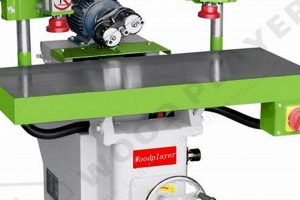
Equipment designed for creating precise holes in wood components is essential for various construction and fabrication processes. These tools utilize rotating bits to bore through material, enabling the creation of joints, pilot holes for fasteners, and decorative features. Examples include benchtop models for stationary work and portable options for on-site applications.
Accuracy and efficiency are paramount in woodworking, and dedicated drilling implements contribute significantly to achieving these goals. They offer improved control compared to manual methods, reducing the risk of errors and ensuring consistent results. Their evolution has facilitated complex designs and streamlined manufacturing workflows, leading to enhanced product quality and reduced production time. The tools are instrumental in crafting everything from furniture to architectural elements.
Subsequent sections will delve into the different types of these devices, exploring their specific functionalities, operational considerations, and maintenance requirements. Factors affecting their selection for particular tasks will also be addressed, alongside advancements in technology that continue to shape the field.
Operational Guidance
The following guidelines aim to optimize the utilization of devices that bore holes in wooden structures and components. Adherence to these practices will enhance precision, prolong equipment lifespan, and improve overall project outcomes.
Tip 1: Secure Workpiece Fixation: Prior to initiating drilling operations, ensure the wooden element is firmly secured. Clamps or vises should be employed to prevent movement during the drilling process, mitigating the risk of inaccuracies and potential material damage. For example, when drilling small pieces, use a drill press vise.
Tip 2: Select Appropriate Drill Bits: The type of bit significantly impacts the quality of the bore. Employ brad-point bits for clean, precise holes, spade bits for larger diameters, and Forstner bits for creating flat-bottomed holes. Incorrect bit selection can result in splintering or imprecise hole dimensions. Choosing a twist drill bit is effective on softwood, while an auger bit is suitable for boring deep, large holes.
Tip 3: Regulate Drilling Speed: Varying the speed is critical for different wood types and bit sizes. Hardwoods necessitate slower speeds to prevent burning or bit damage. Softer woods can accommodate higher speeds. A drill press with variable speed settings offers optimal control. Consult speed charts based on the materials.
Tip 4: Employ Pilot Holes: For screw applications, drilling pilot holes is highly recommended. This practice reduces the likelihood of wood splitting during screw insertion and ensures more secure fastening. Match the pilot hole size to the screw’s shank diameter.
Tip 5: Maintain Bit Sharpness: Dull drill bits require excessive force, leading to increased heat and potential damage to both the bit and the workpiece. Regularly inspect bits for sharpness and resharpen or replace them as needed. Sharpening drill bits not only ensure the wood can be bored easily but also enhances the quality of the output.
Tip 6: Implement Dust Extraction: Wood dust generated during drilling poses a respiratory hazard and can obscure the work area. Utilize a dust extraction system or wear a respirator to mitigate these risks. Clearing dust also allows for better visibility of the drilling point. Ensure the drilling environment is well-ventilated.
Tip 7: Periodic Machine Maintenance: Regular maintenance, including lubrication of moving parts and inspection of belts and pulleys, is essential for optimal performance and longevity. Neglecting maintenance can lead to premature equipment failure. Regularly check and tighten the components of the drilling equipment.
Adherence to these guidelines promotes safer, more efficient, and higher-quality woodworking outcomes. Implementing these practices enhances the operator’s skill and the equipment’s output, yielding superior results in every woodworking endeavor.
The subsequent section will provide an overview of safety protocols relevant to the use of these specialized woodworking instruments.
1. Precision

Accuracy in hole creation is fundamental to quality woodworking. The capabilities of these drilling implements directly correlate with the dimensional accuracy and structural integrity of finished products. Deficiencies in alignment, depth control, or hole diameter compromise the overall outcome.
- Collet and Spindle Accuracy
The accuracy of the collet and spindle assembly directly influences the concentricity of the rotating bit. Deviation from true center introduces inaccuracies in hole placement and diameter. High-quality machines employ precision-machined components to minimize runout, ensuring the bit rotates on its intended axis. If a woodworking project requires multiple bores on a piece, the collet of the spindle ensures that bores are created at a fixed distance from each other.
- Depth Stop Mechanisms
Repeatable depth control is crucial for creating consistent mortises, dados, and blind holes. Reliable depth stop mechanisms enable the user to accurately set the maximum drilling depth, preventing over-penetration and ensuring uniformity across multiple holes. Some machines offer digital depth readouts for increased accuracy and repeatability. These depth stops ensure that bores can be performed consistently to the depth required.
- Table and Fence Alignment
The perpendicularity of the table and fence relative to the drill bit is critical for accurate hole placement, particularly when drilling at angles or creating repeatable patterns. Adjustable fences and tables allow for fine-tuning alignment, ensuring the bit enters the workpiece at the desired location and angle. Using laser alignment guides helps increase the precision of bores, especially when using a drill press for complex woodworking pieces.
- Bit Selection and Sharpening
While the machine provides the framework for accuracy, the choice of drill bit and its sharpness profoundly affect the final result. Dull or improperly selected bits can wander, chip the wood, or create oversized holes. Selecting the correct bit type for the specific wood species and maintaining sharp cutting edges are essential for achieving precise and clean bores. Different drill bits cater to the size, depth, shape and quality of hole that is being bored.
These facets are interconnected and equally vital. Imprecise drilling can lead to weak joints, misaligned assemblies, and compromised aesthetic appeal in woodworking projects. A commitment to precision at each stage of the drilling processfrom machine calibration to bit maintenanceis necessary to achieve professional-level results. The quality of the equipment is only one aspect of achieving excellence, the skill and knowledge of the operator also plays a crucial role.
2. Power Source

The source of power fundamentally influences the performance, portability, and application of equipment used for creating holes in wood. The selection of a specific power source often dictates the operational context and limitations of such devices.
- Electric (Corded)
Corded electric implements provide a consistent and readily available power supply, suitable for stationary or workshop settings. Their primary advantage lies in their sustained power output, enabling prolonged operation without interruption. However, their mobility is restricted by the need for a continuous connection to an electrical outlet. Drill presses and larger boring machines often utilize corded electric power due to their high power demands and stationary nature. The constant power allows for consistent output across longer woodworking tasks.
- Electric (Cordless)
Cordless, battery-powered variants offer enhanced mobility and convenience, allowing operation in locations lacking immediate access to electrical outlets. Technological advancements in battery technology have significantly improved run time and power output, making them viable for a wider range of applications. However, their operational time is limited by battery capacity, requiring periodic recharging or battery swapping. Many portable drills and drivers are cordless, offering flexibility on construction sites or in areas where outlets are not easily accessible. The freedom of cordless technology is offset by the necessary downtime for battery replacements.
- Pneumatic (Air-Powered)
Pneumatic tools utilize compressed air as their power source, offering a high power-to-weight ratio and reduced risk of electrical hazards in damp environments. They require a compressed air supply, which may limit their portability. Air drills are commonly used in industrial settings for heavy-duty applications requiring high torque and sustained operation. Pneumatic drills are well-suited to wet conditions, where electric drills would not be practical.
- Manual (Hand-Powered)
Hand-powered boring tools, such as braces and augers, rely on human power for operation. While they offer complete portability and independence from external power sources, their use requires significant physical exertion and is generally limited to smaller-scale projects or situations where alternative power sources are unavailable. These tools offer an advantage in situations where noise or electricity are undesirable such as working outdoors during certain weather events.
The choice of power source involves a trade-off between power, portability, and convenience. Corded electric implements offer consistent power for stationary use, while cordless models provide enhanced mobility. Pneumatic tools deliver high power in specific environments, and manual options remain viable for specialized tasks. Careful consideration of the operational context and project requirements is essential for selecting the optimal instrument with the appropriate power capabilities.
3. Bit Compatibility
The relationship between drill bit compatibility and woodworking drilling machines is symbiotic; the utility of the machine is directly contingent upon its ability to accept and effectively utilize a range of drill bit types and sizes. This capability dictates the scope of tasks the machine can perform, influencing its versatility and overall value in a woodworking environment. If a machine cannot accept a standard range of bits, it limits the complexity and scale of woodworking tasks that can be done.
Drill bit compatibility impacts several critical woodworking operations. For example, the ability to use Forstner bits allows for the creation of clean, flat-bottomed holes essential for cabinet hardware installation. The acceptance of auger bits enables the drilling of deep, large-diameter holes required for timber framing. The inability to accommodate these diverse bit types would restrict the machine to basic drilling tasks, diminishing its practical application for many woodworking projects. An example of the consequence of poor bit compatibility is when a drill press designed for smaller bits is fitted with a large diameter bit, this may cause the machine to stall and can cause irreparable damage to the system.
Ensuring proper bit compatibility requires careful consideration of several factors, including the machine’s chuck size, spindle taper, and speed range. Chuck size determines the maximum shank diameter of the drill bit that can be securely held. Spindle taper dictates the types of adapters or arbors that can be used to mount larger bits. The machine’s speed range must be suitable for the specific drill bit type and the wood being drilled to prevent overheating, bit damage, or workpiece splintering. Understanding these factors is critical for optimizing the machine’s performance and maximizing its utility in a diverse range of woodworking applications. Bit compatibility is more than simply fitting a drill bit to a machine, but how well they function together to produce the desired result.
4. Speed Control
Speed control is a fundamental aspect of the operation of devices used for creating holes in wood. The ability to modulate the rotational speed of the cutting tool is essential for optimizing performance, ensuring safety, and achieving desired results across a diverse range of woodworking applications.
- Material Hardness Adaptation
Different wood species exhibit varying degrees of hardness, necessitating adjustments in drilling speed. Hardwoods, such as maple or oak, require slower speeds to prevent overheating and bit damage. Softwoods, like pine or cedar, can be drilled at higher speeds. Variable speed control allows the operator to match the drilling speed to the material properties, optimizing cutting efficiency and minimizing the risk of splintering or burning. If drilling too fast in a hardwood, the bit can quickly dull.
- Drill Bit Diameter Management
Larger-diameter drill bits require slower speeds to maintain optimal cutting performance and prevent excessive vibration. Conversely, smaller-diameter bits can be operated at higher speeds. Speed control facilitates the use of a wide range of bit sizes, expanding the versatility of the machine. The ideal speed reduces tear-out and improves the overall quality of the bored hole.
- Pilot Hole Precision
The creation of pilot holes for screws often requires precise speed control to prevent the drill bit from wandering or damaging the surrounding wood fibers. Slower speeds provide greater control during pilot hole drilling, ensuring accurate placement and minimizing the risk of splitting the wood. Precise drilling ensures the pilot hole is the correct size, which makes the screw easier to drive in.
- Specialized Bit Functionality
Certain specialized drill bits, such as Forstner bits or hole saws, have specific speed requirements to achieve optimal performance and prevent damage. Forstner bits typically require slow speeds to create clean, flat-bottomed holes, while hole saws may require variable speeds depending on the material thickness and desired hole diameter. Failure to adhere to recommended speeds can result in poor hole quality, bit damage, or even workpiece damage. Each bit type requires the appropriate speed for optimal material removal.
These factors collectively illustrate the importance of speed control in equipment used for boring holes in wood. The ability to precisely adjust drilling speed allows for adaptation to various wood types, bit sizes, and drilling techniques, ensuring optimal performance, safety, and quality in a wide range of woodworking applications. Skilled use of speed controls reduces the opportunity for error and waste of resources.
5. Material Capacity

The material capacity of woodworking drilling machines directly determines the size and type of wooden workpieces that can be processed. This capacity is a critical specification that influences the range of projects a machine can undertake. Insufficient material capacity restricts the ability to work with larger stock, limiting project scope. Conversely, a machine with excessive capacity for typical tasks may represent an inefficient use of resources and workspace. Therefore, appropriate selection necessitates aligning capacity with anticipated project requirements.
Practical implications of material capacity manifest in diverse woodworking scenarios. For instance, a drill press with limited throat depth restricts the drilling of holes near the center of wide boards, impacting applications like tabletop construction. Similarly, the maximum workpiece thickness a machine can accommodate dictates its suitability for projects involving thick lumber, such as creating structural components for furniture. Moreover, the table size and weight capacity influence the stability and precision when working with large or heavy wooden elements, affecting accuracy in tasks like mortise and tenon joinery. Real-world examples include a small benchtop drill press being unsuitable for drilling large cabinet doors due to insufficient throat depth, or an underpowered machine struggling to bore through thick hardwood timbers, leading to bit binding and potential motor strain.
Comprehending material capacity is crucial for optimizing workflow and minimizing operational constraints. Challenges arise when project demands exceed a machine’s specifications, resulting in either project limitations or the need for supplemental equipment. Careful evaluation of typical workpiece dimensions and project complexities enables informed decision-making during machine selection, ensuring compatibility between tool capabilities and woodworking aspirations. A nuanced understanding of material capacity, therefore, bridges the gap between equipment capabilities and practical woodworking execution.
Frequently Asked Questions
The following section addresses common inquiries concerning equipment used to bore holes in wood, providing succinct and technically accurate responses.
Question 1: What safety precautions are paramount when operating woodworking drilling machines?
Eye protection is mandatory to guard against flying debris. Workpieces must be securely clamped to prevent movement. Loose clothing should be avoided to minimize entanglement risk. Dust extraction systems should be employed to mitigate respiratory hazards. Regular inspection of power cords and machine components is essential for preventing electrical or mechanical failures.
Question 2: What distinguishes a drill press from a handheld drill?
A drill press offers greater precision and control due to its stationary nature and adjustable depth stop. A handheld drill provides increased portability and versatility for on-site or awkward drilling positions. A drill press is generally more suitable for repetitive, accurate drilling, while a handheld drill is preferred for general-purpose applications where mobility is prioritized.
Question 3: How does one determine the appropriate drilling speed for different wood species?
Hardwoods generally require slower drilling speeds to prevent burning and bit damage. Softwoods can be drilled at higher speeds. Consult speed charts provided by drill bit manufacturers as a guide. Experimentation on scrap wood is recommended to fine-tune the speed for optimal results.
Question 4: What types of drill bits are best suited for creating flat-bottomed holes?
Forstner bits are specifically designed for creating clean, flat-bottomed holes. They feature a circular cutting edge and a center brad point for accurate positioning. Spade bits can also be used, but they may produce a less refined result. A Forstner bit is especially useful for mortise creation.
Question 5: What maintenance practices are recommended for prolonging the lifespan of woodworking drilling machines?
Regular lubrication of moving parts is essential. Inspect belts and pulleys for wear and tear. Clean the machine after each use to remove dust and debris. Periodically check and tighten fasteners. Store the machine in a dry environment to prevent corrosion.
Question 6: How does one prevent tear-out when drilling through wood?
Use a sharp drill bit. Support the workpiece with a backer board. Drill slowly and apply consistent pressure. Consider scoring the wood fibers with a knife prior to drilling. Drilling from the face of the wood and exiting through the back can minimize tear-out.
These responses offer a foundational understanding of equipment used for boring holes in wood. Prioritizing safety, understanding equipment characteristics, and employing proper techniques are essential for achieving optimal outcomes.
The subsequent section will explore emerging trends and technological advancements in the field of woodworking drilling machines.
Conclusion
This article has provided a detailed exploration of equipment for creating precise holes in wood. Key aspects addressed include operational guidelines, power source considerations, bit compatibility, speed control necessities, and material capacity limitations. The intent was to offer a comprehensive understanding of the factors influencing the selection, operation, and maintenance of these devices.
Continued advancements in woodworking technology are anticipated, leading to increased precision, efficiency, and safety in drilling operations. The informed application of the principles discussed herein remains critical for maximizing the value and longevity of these tools in woodworking endeavors. Staying abreast of new developments is crucial for maintaining a competitive edge in woodworking and related industries.