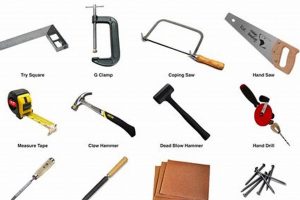
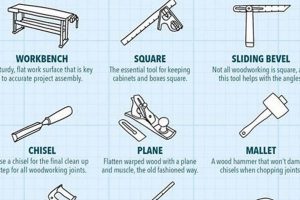
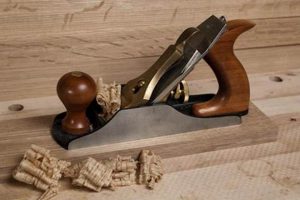
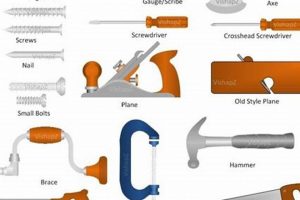
A specialized storage unit designed to organize and protect manual implements used in shaping wood. These structures often incorporate fitted compartments, drawers, and racks tailored to accommodate chisels, saws, planes, and other essential woodworking instruments. Functionality and accessibility are key features, allowing woodworkers to quickly locate and retrieve necessary tools.
The careful arrangement of implements within such a unit contributes to efficiency, prevents damage, and promotes a safer workshop environment. Historically, these storage solutions have evolved from simple chests to sophisticated pieces of furniture reflecting the craftsman’s dedication to their trade. Proper organization extends the lifespan of valuable tools and ensures they remain in optimal working condition.
Considerations in selecting or building a suitable storage solution encompass factors such as the size of the tool collection, available workshop space, and the preferred aesthetic. The subsequent sections will delve into specific design elements, material choices, and construction techniques for creating or acquiring an optimal storage solution for woodworking implements.
Optimizing Implemented Storage Solutions
The following recommendations aim to enhance the utility and longevity of storage systems designed for manual woodworking tools. Careful attention to these guidelines can significantly improve workshop efficiency and protect valuable implements.
Tip 1: Prioritize Tool Accessibility: Arrange tools based on frequency of use. Commonly used items should be placed in easily accessible locations, minimizing time spent searching during projects.
Tip 2: Implement a Shadow Board System: Consider creating shadow boards behind tools. This provides a visual indication of missing items, promoting accountability and preventing loss.
Tip 3: Incorporate Dust Protection: Enclose or partially enclose the storage unit to minimize dust accumulation on tools. Dust can accelerate corrosion and require more frequent cleaning.
Tip 4: Utilize Moisture Control Measures: Employ desiccants or ensure adequate ventilation within the unit to prevent rust formation. Humidity can severely damage metal components of tools.
Tip 5: Optimize Space Utilization: Employ vertical space effectively with tiered shelving or drawers. Maximize storage capacity without compromising accessibility.
Tip 6: Secure Tool Placement: Use custom-fitted inserts or secure clamping mechanisms to prevent tools from shifting during movement. This minimizes the risk of damage to both the tools and the storage unit.
Tip 7: Periodically Inspect and Maintain the Unit: Regularly examine hinges, drawer slides, and other moving parts. Lubricate as needed and address any damage promptly to ensure continued functionality.
Adhering to these suggestions will optimize the storage and preservation of woodworking implements, contributing to a more organized, efficient, and ultimately safer workshop environment.
The next section will discuss the selection of suitable materials for construction, followed by detailed building plans for custom solutions.
1. Organization

Effective organization within a woodworking hand tool cabinet is paramount for maximizing workflow efficiency and ensuring the longevity of valuable implements. A well-organized cabinet minimizes search time, reduces the risk of tool damage, and promotes a safer workshop environment. The following facets elaborate on the critical components of effective organization.
- Categorization by Tool Type and Function
Grouping tools by type (e.g., chisels, saws, planes) and function (e.g., cutting, shaping, measuring) streamlines the selection process. This system allows woodworkers to quickly locate the appropriate tool for a specific task without extensive searching. A logical arrangement based on application reduces frustration and enhances productivity.
- Dedicated Storage Solutions for Individual Tools
Providing individual slots, drawers, or hangers for each tool prevents them from colliding with each other, minimizing the risk of damage to delicate edges and surfaces. This also ensures tools are readily visible and accessible. For instance, custom-fitted chisel racks or saw till inserts prevent tools from rubbing against each other and maintain their sharpness.
- Systematic Labeling and Identification
Implementing a labeling system for drawers, shelves, or tool holders further enhances organization. Clear labeling ensures that tools are returned to their designated locations after use, maintaining order within the cabinet. This is particularly useful for cabinets containing a large number of similar-looking tools. An example includes labeling drawers by size or function, or using color-coded labels for different tool types.
- Strategic Placement Based on Frequency of Use
Arranging tools based on how frequently they are used optimizes workflow. Commonly used tools should be positioned in easily accessible locations, while less frequently used tools can be stored in less convenient areas. This approach minimizes the time spent retrieving essential implements, contributing to a more efficient woodworking process.
The systematic application of these organizational principles transforms a woodworking hand tool cabinet from a mere storage space into a highly functional and efficient workstation component. By minimizing wasted time and protecting valuable tools, a well-organized cabinet directly contributes to the overall quality and enjoyment of the woodworking process.
2. Accessibility

Accessibility is a core tenet in the design and utilization of a woodworking hand tool cabinet. Efficient workflow hinges on the swift and convenient retrieval of necessary implements. A poorly designed or organized cabinet that impedes access to tools negates its primary function and wastes valuable time. For instance, a cabinet with excessively deep drawers necessitates searching through multiple layers of tools to locate a specific item, hindering productivity.
The layout of the tool storage must consider the physical ergonomics of the user. Heavy or frequently used tools should be placed at waist level to minimize strain and fatigue. Lighter or less frequently used items can be stored higher or lower in the cabinet. Sliding trays, tilting shelves, or magnetic strips can further enhance accessibility by presenting tools in a clear and easily reachable manner. The goal is to minimize the number of steps required to obtain any given tool.
Ultimately, the accessibility of a woodworking hand tool cabinet directly impacts the efficiency and safety of woodworking operations. Prioritizing user-friendly design and logical organization ensures that tools are readily available when needed, fostering a more productive and enjoyable workshop experience. Overlooking this aspect can lead to frustration, wasted time, and potentially unsafe practices.
3. Protection

The woodworking hand tool cabinet serves as a crucial protective environment for valuable implements. Exposure to environmental factors, physical damage, and improper storage can significantly degrade tool performance and shorten lifespan. The cabinet’s protective function mitigates these risks through physical enclosure, organized arrangement, and, in some cases, climate control. For instance, a tightly sealed cabinet shields tools from dust and airborne particles, preventing premature corrosion and the dulling of cutting edges. Similarly, individual compartments or tool holders prevent tools from rubbing against each other, reducing the likelihood of nicks, scratches, and other forms of physical damage.
The choice of materials for the cabinet’s construction directly impacts its protective capabilities. A cabinet constructed from moisture-resistant wood or metal, and finished with a protective coating, provides enhanced protection against humidity and temperature fluctuations. The inclusion of features like felt-lined drawers or desiccant packs further optimizes the internal environment. A real-world scenario illustrating this importance involves high-carbon steel tools. Without proper protection from moisture, these tools are prone to rapid rusting, rendering them less effective or entirely unusable. A well-maintained cabinet mitigates this risk.
Therefore, the protective aspect of a woodworking hand tool cabinet extends beyond mere storage. It is an active defense against elements that threaten tool integrity, performance, and longevity. Understanding this protective function is essential for selecting or constructing a cabinet that effectively safeguards valuable woodworking implements, contributing to both workshop efficiency and the preservation of craftsmanship tools.
4. Durability

The longevity and reliability of a woodworking hand tool cabinet are inextricably linked to its inherent durability. The cabinet’s ability to withstand the rigors of workshop use, resist environmental degradation, and maintain its structural integrity over time directly impacts its value as a storage solution and its capacity to protect valuable woodworking implements. Considerations of durability must be central to both the design and material selection process.
- Material Selection and Structural Integrity
The choice of materials is paramount in determining a cabinet’s durability. Solid hardwoods, such as oak or maple, offer superior strength and resistance to warping compared to composite materials. The method of construction, including joinery techniques and fastener selection, further contributes to structural integrity. For example, dovetail joints provide exceptional strength and resistance to racking forces, ensuring the cabinet remains stable and square over years of use. Conversely, poorly executed joints or the use of inadequate fasteners can compromise the cabinet’s structural integrity, leading to premature failure.
- Resistance to Environmental Factors
Woodworking environments often present challenges in the form of humidity fluctuations, dust accumulation, and potential exposure to solvents or finishes. A durable cabinet must be constructed of materials and finishes that can withstand these conditions without degrading. The application of a durable finish, such as polyurethane or varnish, protects the wood from moisture absorption and chemical damage. Metal components should be corrosion-resistant or coated to prevent rust formation. Neglecting environmental resistance can lead to warping, cracking, and corrosion, ultimately shortening the cabinet’s lifespan.
- Load-Bearing Capacity and Weight Distribution
A durable cabinet must be capable of supporting the weight of the tools it is intended to store. The design should account for the distributed weight of the tools, ensuring that shelves, drawers, and supporting structures do not sag or collapse under load. Reinforcements, such as additional support braces or thicker shelf construction, may be necessary to increase load-bearing capacity. Failure to adequately address weight distribution can result in structural damage, compromising the cabinet’s functionality and potentially damaging the tools stored within.
- Resistance to Wear and Tear
The daily use of a woodworking hand tool cabinet inevitably subjects it to wear and tear. Durable cabinets are designed to withstand this repeated use without exhibiting significant degradation. Features such as reinforced drawer slides, durable hardware, and scratch-resistant surfaces contribute to wear resistance. For instance, heavy-duty drawer slides ensure smooth and reliable drawer operation even under heavy loads, while a durable finish protects the cabinet’s exterior from scratches and scuffs. Over time, resistance to wear and tear preserves the cabinet’s functionality and aesthetic appeal.
In summary, the durability of a woodworking hand tool cabinet is a multifaceted attribute stemming from careful material selection, robust construction techniques, and resistance to environmental factors and wear. Prioritizing durability ensures that the cabinet will provide reliable and long-lasting service, protecting valuable woodworking tools and contributing to an efficient and organized workshop environment.
5. Dimensions

Dimensional considerations are integral to the effective design and utilization of a woodworking hand tool cabinet. The physical size and internal configuration directly impact its storage capacity, accessibility, and overall integration within the workshop environment. Neglecting dimensional planning can result in a cabinet that is either inadequate for the tool collection or unwieldy within the available space.
- Overall Footprint and Workshop Space
The external dimensions of the cabinet must be carefully considered in relation to the available workshop area. A cabinet that is too large can obstruct workflow and create a cramped environment. Prior to construction or purchase, a thorough assessment of the workshop layout is essential to determine the maximum permissible footprint. This includes accounting for adequate clearance around the cabinet for tool retrieval and movement within the workspace. For example, a wall-mounted cabinet can conserve floor space in a small workshop, while a rolling cabinet offers greater mobility in a larger environment.
- Internal Compartment Sizes and Tool Inventory
The internal dimensions of drawers, shelves, and compartments must be tailored to accommodate the specific tools being stored. Measuring the length, width, and height of the largest tools is crucial for determining the minimum internal dimensions required. Providing adequate clearance around each tool prevents damage and facilitates easy retrieval. Designing modular compartments allows for flexible arrangement and future expansion of the tool collection. For example, a dedicated plane till requires specific dimensions to securely store various sizes of hand planes without them rubbing against each other.
- Drawer Depth and Reach Accessibility
The depth of drawers significantly impacts accessibility, particularly for tools stored towards the back. Excessively deep drawers can make it difficult to reach items, necessitating the removal of other tools to access the desired item. Optimizing drawer depth to match the length of commonly used tools minimizes the need to rummage and improves workflow. Implementing drawer dividers or tiered arrangements can further enhance accessibility in deeper drawers. Practical application suggests drawers exceeding 24 inches in depth may require specialized organization to maintain accessibility.
- Height and Ergonomic Considerations
The overall height of the cabinet should be ergonomically appropriate for the user. Positioning frequently used tools at waist height minimizes strain and fatigue during retrieval. Taller individuals may require a higher cabinet, while shorter individuals may benefit from a lower configuration. In instances where a tall cabinet is desired for maximum storage capacity, incorporating pull-down shelves or steps can improve accessibility to upper compartments. Ergonomic design principles promote both comfort and safety in the workshop environment.
In summary, dimensional planning is a critical aspect of woodworking hand tool cabinet design. By carefully considering the overall footprint, internal compartment sizes, drawer depth, and ergonomic factors, it becomes possible to create a storage solution that is both functional and integrates seamlessly into the workshop environment. Proper dimensional planning optimizes workflow efficiency, protects valuable tools, and enhances the overall woodworking experience.
6. Placement
The strategic placement of a woodworking hand tool cabinet within a workshop environment exerts a significant influence on workflow efficiency, safety, and overall usability. The chosen location dictates the accessibility of tools, the ease of movement within the workspace, and the potential for environmental factors to impact the implements stored within. Improper placement can negate the benefits of a well-designed cabinet, while optimal positioning maximizes its utility.
Consider, for example, a cabinet positioned directly in front of a primary workbench. This placement offers immediate access to tools during project execution, minimizing disruptions to workflow. Conversely, a cabinet located in a remote or obstructed area requires the woodworker to expend additional time and effort retrieving implements, hindering productivity. Furthermore, placing a cabinet near a source of moisture or direct sunlight can accelerate corrosion and damage to tools, underscoring the importance of environmental considerations in placement decisions. The weight of the cabinet, and the floor’s load-bearing capacity, also play a vital role in secure placement.
In conclusion, the optimal placement of a woodworking hand tool cabinet involves a careful assessment of spatial constraints, workflow patterns, and environmental factors. A strategic choice enhances accessibility, minimizes safety hazards, and protects the tools stored within, contributing to a more efficient and enjoyable woodworking experience. Neglecting the placement variable undermines the investment in a quality storage solution.
Frequently Asked Questions
The following addresses common inquiries and misconceptions regarding specialized storage units for manual woodworking implements. The information provided aims to clarify essential aspects of design, functionality, and maintenance.
Question 1: What is the primary purpose of a dedicated woodworking hand tool cabinet, as opposed to general storage?
A dedicated cabinet provides organized and secure storage tailored to the specific needs of woodworking tools. This includes custom compartments that protect delicate edges, prevent corrosion, and promote efficient workflow, whereas general storage lacks these specialized features.
Question 2: What materials are considered optimal for constructing a durable and long-lasting woodworking hand tool cabinet?
Solid hardwoods such as oak, maple, or cherry are generally preferred for their strength and stability. High-quality plywood with a hardwood veneer can also be a viable option, provided it is properly sealed and finished to resist moisture.
Question 3: How should the interior of a woodworking hand tool cabinet be organized to maximize efficiency?
Tools should be categorized by type and function, with dedicated compartments for each item. Commonly used tools should be placed in easily accessible locations. Shadow boards and labeling systems can further enhance organization and prevent tool loss.
Question 4: What measures can be taken to prevent rust and corrosion within a woodworking hand tool cabinet?
Maintaining a low-humidity environment is critical. This can be achieved through proper ventilation, the use of desiccants, and the application of rust-preventative coatings to metal tools. Enclosing the cabinet can also help to minimize dust accumulation, which can contribute to corrosion.
Question 5: Are there specific considerations for storing edged tools, such as chisels and planes, within a woodworking hand tool cabinet?
Edged tools require specialized storage to protect their cutting edges from damage. This includes dedicated racks, slots, or leather sheaths to prevent contact with other tools. Proper storage ensures tools remain sharp and ready for use.
Question 6: Is it advisable to build a woodworking hand tool cabinet, or is it more practical to purchase a pre-made unit?
The decision depends on individual skills, resources, and specific needs. Building a custom cabinet allows for tailored dimensions and organization, while purchasing a pre-made unit offers convenience and potentially lower upfront costs. Both options have their respective advantages and disadvantages.
Effective organization, appropriate materials, and climate control play pivotal roles in maximizing the utility and safeguarding of woodworking instruments within a dedicated cabinet.
The subsequent section will delve into specific case studies and examples of successful tool cabinet designs.
Conclusion
This discourse has underscored the critical role of the woodworking hand tool cabinet in the preservation, organization, and accessibility of manual woodworking implements. Examination of organizational strategies, material selections, protective measures, and dimensional considerations reveals the multifaceted nature of this essential workshop component. The implementation of sound design principles and consistent maintenance practices directly translates into enhanced workflow efficiency and prolonged tool lifespan.
The informed selection, construction, or adaptation of a woodworking hand tool cabinet represents a significant investment in the craft. Prioritizing durability, ergonomic design, and customized organization ensures that the cabinet serves not merely as a storage receptacle, but as an integral contributor to the quality and longevity of woodworking endeavors. Continued refinement of design and utilization will undoubtedly further optimize this indispensable element of the traditional workshop.