This stationary power tool is primarily used to flatten and straighten the edges and faces of boards. Its function is to create perfectly square edges, which are essential for constructing well-fitted joints in woodworking projects. A typical application involves preparing rough lumber for further processing by establishing a flat reference surface.
Accuracy in woodworking is significantly enhanced by the use of this equipment. It ensures that joinery is precise, resulting in strong and aesthetically pleasing finished products. Historically, the device evolved from hand planes, mechanizing the process of achieving flat, square surfaces, thereby increasing efficiency and reducing the physical demands of woodworking.
The following sections will delve into the specific components of the machine, explore the different types available, and discuss best practices for safe and effective operation. Understanding these aspects is crucial for anyone seeking to utilize this essential piece of woodworking machinery.
Tips for Optimal Use
The following guidance offers insights into maximizing the effectiveness and safety when operating this crucial woodworking equipment. Adherence to these principles will contribute to superior results and a safer working environment.
Tip 1: Material Inspection: Prior to commencing, examine the wood for any foreign objects such as nails or staples. The presence of such materials can cause significant damage to the cutterhead knives.
Tip 2: Grain Direction: Always feed the wood with the grain to prevent tear-out. Observing the grain pattern and feeding the wood accordingly results in a smoother, cleaner cut.
Tip 3: Proper Fence Adjustment: Ensure the fence is square to the infeed table. An improperly aligned fence will prevent the creation of a true 90-degree edge.
Tip 4: Consistent Feed Rate: Maintain a steady feed rate to avoid uneven cuts. A consistent speed yields a uniform surface and prevents the machine from bogging down.
Tip 5: Utilize Push Blocks: Employ push blocks and push pads to keep hands safely away from the cutterhead, particularly when working with smaller pieces. This minimizes the risk of injury.
Tip 6: Cutterhead Height: Adjust the cutterhead for a shallow depth of cut. Avoid excessive material removal in a single pass to prevent stress on the machine and enhance surface quality.
Tip 7: Regularly Sharpen Knives: Ensure the cutterhead knives are sharp and properly aligned. Dull knives produce rough cuts and place undue strain on the motor. Regular maintenance is paramount.
By implementing these techniques, users can expect to achieve improved accuracy, safer operation, and higher quality results. Careful attention to these details will extend the life of the equipment and enhance the overall woodworking experience.
The next segment of this article will address common troubleshooting scenarios and provide solutions to ensure continued efficiency.
1. Flat Reference Surface

The establishment of a flat reference surface is paramount in woodworking, and this machine is instrumental in achieving this essential prerequisite for precise joinery and accurate dimensioning of lumber.
- Foundation for Accurate Cuts
A flat reference surface provides a stable and consistent base for subsequent milling operations. Without it, any attempt to cut parallel or perpendicular surfaces will result in inaccuracies. For example, if a board’s face is not flat, planing its edge will yield an edge that is not square to the face, compromising the integrity of future joints.
- Enabling Consistent Thicknessing
When used in conjunction with a thickness planer, the creation of a flat reference surface on the face of a board allows for consistent thicknessing. The flat face is placed against the planer bed, ensuring that the opposite face is planed parallel to the reference face. This is crucial for projects requiring uniformly dimensioned components, such as cabinet doors or drawer fronts.
- Facilitating Precise Joinery
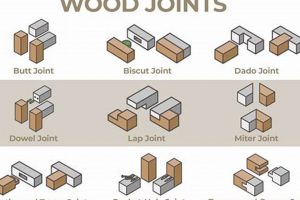
The flatness and straightness achieved by this machine are critical for creating tight-fitting joints. Whether constructing dovetail joints, mortise and tenon joints, or simple butt joints, accurate reference surfaces ensure that the components align properly, resulting in strong and aesthetically pleasing assemblies. An unflat surface leads to gaps and weak glue lines, compromising structural integrity.
- Minimizing Material Waste
By efficiently creating a flat reference surface, this equipment minimizes material waste. Warped or twisted lumber can be flattened and straightened, allowing for the use of boards that would otherwise be unusable. This is particularly important when working with expensive hardwoods, where maximizing yield is essential for cost-effectiveness.
In summary, the establishment of a flat reference surface by this particular machine is not merely a preliminary step, but a fundamental requirement for achieving accuracy, efficiency, and quality in woodworking projects. Its contribution extends beyond surface preparation, influencing the integrity and longevity of the finished product.
2. Edge Jointing Accuracy

The woodworking jointer’s primary function centers on achieving accurate edge jointing, establishing a precise 90-degree angle between the edge and face of a board. This precision is not merely an aesthetic consideration; it is a structural imperative. Inaccurate edge jointing results in compromised glue lines, leading to weakened joints that are susceptible to failure under stress. Consider a frame and panel door; if the stiles and rails are not accurately jointed, the door will not be square, the panel may not fit properly, and the overall assembly will be prone to racking.
The attainment of edge jointing accuracy is directly dependent on the jointer’s configuration and the operator’s technique. A fence that is not perfectly perpendicular to the cutterhead will introduce an error that is magnified across the length of the board. Furthermore, inconsistent feed rates or excessive material removal can induce warping or tear-out, negating the intended precision. For example, when creating a butcher block countertop, any deviation from a perfectly square edge across multiple boards accumulates, resulting in gaps and an uneven surface that detracts from both the appearance and functionality of the finished product.
In conclusion, edge jointing accuracy is inextricably linked to the capabilities and proper utilization of a woodworking jointer. Its impact extends beyond mere dimensional correctness; it is fundamental to the structural integrity, aesthetic quality, and overall longevity of woodworking projects. Understanding this relationship is crucial for woodworkers aiming to produce high-quality, durable pieces, as it dictates the precision and care required in selecting, maintaining, and operating the tool.
3. Cutterhead Knife Sharpness

The operational effectiveness of a woodworking jointer is fundamentally linked to the sharpness of its cutterhead knives. The primary function of this tool is to create flat, square surfaces on lumber, and the efficiency and quality of this process are directly contingent upon the condition of the cutting edges. Dull or damaged knives require increased force to remove material, leading to several detrimental effects. Increased pressure can cause the wood to flex, resulting in an uneven cut and negating the jointer’s purpose. For instance, attempting to flatten a long, thin board with dull knives can result in a warped or bowed surface, rather than a true, flat plane. Moreover, excessive force can strain the motor, reduce the lifespan of the machine, and increase the risk of kickback, a hazardous situation where the wood is forcefully ejected from the jointer.
Sharp knives, conversely, shear wood fibers cleanly, producing a smooth surface with minimal effort. This clean cut reduces the likelihood of tear-out, a common defect where wood fibers are pulled away from the surface, leaving a jagged or uneven finish. Tear-out is particularly problematic when working with figured wood or lumber with interlocked grain. Furthermore, sharp knives minimize the amount of sanding required to achieve a finished surface, saving time and preserving the material’s original dimensions. Consider the preparation of boards for fine furniture construction; achieving seamless joints and smooth surfaces requires precisely milled lumber, which is only attainable with sharp cutterhead knives. Regular maintenance and sharpening of the knives are, therefore, essential for optimal performance and safety.
In summary, the sharpness of the cutterhead knives is not merely a secondary consideration but a critical component of jointer operation. Dull knives compromise the accuracy, efficiency, and safety of the tool, while sharp knives enable precise, clean cuts that are fundamental to high-quality woodworking. Regular maintenance and replacement of the knives are necessary investments to ensure the woodworking jointer functions as intended, producing the flat, square surfaces that are essential for a multitude of woodworking applications.
4. Fence Squareness

Fence squareness on a woodworking jointer is a critical determinant of the machine’s accuracy and overall utility. It refers to the perpendicular relationship between the fence, which guides the workpiece, and the cutterhead, which performs the cutting action. Deviations from a true 90-degree angle introduce inaccuracies that propagate throughout the woodworking process.
- Impact on Edge Jointing Accuracy
A fence that is not square to the cutterhead will produce edges that are not perpendicular to the faces of the board. This introduces compounding errors in subsequent joinery. For example, if a frame is constructed with members that are not square, the resulting assembly will be skewed, making it difficult or impossible to achieve a flush, seamless fit. Such inaccuracies compromise the structural integrity and aesthetic quality of the finished piece.
- Influence on Board Stability
When jointing the edge of a board, the fence acts as a reference plane. If the fence is not square, the resulting edge will not be straight. This can lead to instability in larger assemblies. For instance, if multiple boards are edge-glued to create a wider panel, any deviation from squareness will result in a curved or warped surface. This curvature necessitates additional milling to correct, increasing material waste and labor.
- Effect on Mitered Cuts
The fence is often used in conjunction with a miter gauge or sliding table attachment to make accurate mitered cuts. If the fence is not square, the resulting miter angles will be incorrect. This is particularly problematic when creating closed shapes such as picture frames or boxes, where even slight inaccuracies can result in visible gaps at the corners.
- Operator Safety Considerations
A fence that is not properly aligned can create unpredictable cutting behavior. The workpiece may be more prone to kickback or binding, increasing the risk of injury to the operator. Maintaining fence squareness is therefore not only a matter of precision but also a fundamental safety practice.
In conclusion, fence squareness is a foundational element of woodworking jointer operation. Its influence extends beyond mere dimensional correctness, impacting structural integrity, aesthetic quality, and operator safety. Consistent verification and adjustment of the fence are essential to ensure the machine performs as intended and produces accurate, reliable results.
5. Infeed/Outfeed Table Alignment

Proper alignment of the infeed and outfeed tables on a woodworking jointer is paramount for achieving accurate and consistent results. These tables serve as the reference surfaces that guide the workpiece through the cutting process. Misalignment introduces errors that compromise the flatness and squareness of the jointed material.
- Coplanarity and Surface Flatness
The infeed and outfeed tables must be coplanar, meaning they exist on the same plane. If the outfeed table is higher or lower than the infeed table at the point where the knives cut, the workpiece will not be uniformly flattened. For example, if the outfeed table is too low, the jointer will remove more material from the trailing end of the board, resulting in a tapered cut. Conversely, a high outfeed table may prevent the knives from fully engaging with the wood, leaving an uneven surface.
- Parallelism and Edge Straightness
While the tables must be coplanar, they do not necessarily need to be parallel to the cutterhead. However, significant deviations from parallelism can induce unwanted curves or tapers along the edge of the board being jointed. Imagine attempting to straighten a warped board with severely misaligned tables; the resulting edge will likely mirror the original warp, rather than creating a true, straight reference.
- Impact on Joint Quality
Proper table alignment directly affects the quality of subsequent joinery. If the jointed edges are not flat and square due to misalignment, glue lines will be compromised, leading to weak or aesthetically unappealing joints. Consider the construction of a tabletop; misaligned tables on the jointer can result in gaps between the boards, requiring additional work to correct and potentially weakening the overall structure.
- Safety Considerations
Misaligned tables can increase the risk of kickback, a dangerous situation where the workpiece is forcefully ejected from the jointer. When the tables are not properly aligned, the workpiece may not be adequately supported, leading to uneven cutting forces and a greater chance of the wood being thrown back towards the operator. Regular inspection and adjustment of the tables are therefore essential for safe operation.
In conclusion, maintaining proper infeed and outfeed table alignment is not merely a technical detail but a fundamental requirement for achieving accurate, safe, and high-quality results with a woodworking jointer. Regular checks and adjustments are essential to ensure the machine performs optimally and produces the desired outcome in a variety of woodworking applications.
6. Consistent Feed Rate
A consistent feed rate is a crucial element in the effective operation of a woodworking jointer. It refers to the speed at which the workpiece is advanced across the cutterhead, impacting both the surface finish and the dimensional accuracy of the resulting cut. An erratic feed rate introduces variations in the amount of material removed, leading to uneven surfaces and potentially compromising the precision of the joint. For example, if a board is momentarily paused during the jointing process, the cutterhead will dwell on that area, creating a visible depression or gouge. Conversely, a feed rate that is too rapid may result in tear-out or an insufficient amount of material being removed, requiring multiple passes to achieve the desired flatness.
The relationship between a consistent feed rate and the cutterhead’s rotation is a significant factor. The cutterhead knives are designed to remove a specific amount of material per revolution. Maintaining a steady feed rate ensures that each knife engages with the wood at a uniform interval, resulting in a smooth, consistent cut. A lack of consistency forces the knives to either dig in too deeply or glide across the surface, producing an undesirable finish. Consider the process of jointing the edge of a long board; variations in feed rate along its length will manifest as a wavy or scalloped edge, hindering the creation of a tight, seamless glue joint.
In conclusion, a consistent feed rate is not merely a matter of technique but an essential requirement for maximizing the capabilities of a woodworking jointer. It directly influences the surface quality, dimensional accuracy, and overall efficiency of the jointing process. Adherence to a steady, controlled feed rate minimizes errors, reduces material waste, and ensures that the resulting workpiece meets the required specifications for subsequent operations. Mastery of this element is a cornerstone of skilled jointer operation.
Frequently Asked Questions
The following section addresses common inquiries regarding this essential woodworking machine, aiming to clarify its functions, limitations, and best practices for operation.
Question 1: What is the primary function of a woodworking jointer?
The primary function is to create flat, square edges and surfaces on lumber. It establishes a reference plane for subsequent woodworking operations.
Question 2: What distinguishes it from a thickness planer?
While both machines mill lumber, it creates a flat face or edge, and the thickness planer reduces stock to a consistent thickness parallel to an existing flat surface.
Question 3: What safety precautions are crucial when operating this machinery?
Essential safety measures include wearing eye and ear protection, using push blocks to keep hands away from the cutterhead, and ensuring the machine is properly guarded.
Question 4: How frequently should the knives be sharpened or replaced?
The frequency depends on usage and material type. Dull knives increase the risk of tear-out and place undue stress on the motor; therefore, regular inspection and maintenance are vital.
Question 5: What factors contribute to achieving optimal edge jointing accuracy?
Optimal accuracy relies on a square fence, coplanar infeed and outfeed tables, sharp knives, and a consistent feed rate.
Question 6: Can it be used to correct severely warped or twisted lumber?
While capable of flattening and straightening boards, attempting to correct severely warped lumber may require multiple passes or alternative methods to avoid excessive material removal and potential machine stress.
Understanding these aspects contributes to safer, more effective utilization of this machine.
The subsequent section will address common troubleshooting scenarios encountered during its operation.
In Summary
This discussion has explored the functionality, critical adjustments, and optimal usage techniques associated with the woodworking jointer. Essential elements such as cutterhead sharpness, fence squareness, infeed/outfeed table alignment, and consistent feed rate have been examined in detail to illustrate their impact on accuracy and safety.
Mastery of the woodworking jointer is a foundational skill for achieving precision in woodworking. Continued diligence in maintenance, adherence to safety protocols, and a commitment to refining operational techniques will yield consistent, high-quality results, ensuring its enduring value in any woodworking endeavor.