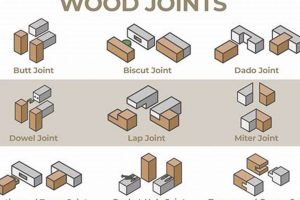
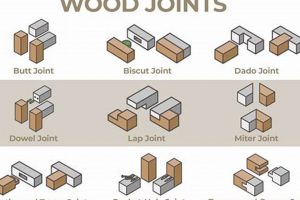
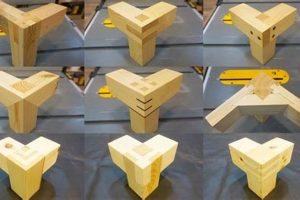
Connections between pieces of wood, critical for constructing stable and aesthetically pleasing objects, involve various techniques to interlock components. These connections can range from simple butt joints to intricate dovetails, each offering different levels of strength and visual appeal. For instance, a mortise and tenon creates a robust bond, while a miter joint provides a clean, angled corner.
The integrity of a woodworking project relies heavily on the chosen method of assembly. Strong connections ensure durability and longevity of the finished product. Historically, the mastery of these techniques was a hallmark of skilled artisans, allowing for the creation of enduring structures and intricate designs. These methods remain essential for furniture making, building construction, and countless other applications.
The following sections will delve into specific types, exploring their construction, advantages, and appropriate uses. Different approaches will be examined based on factors such as required strength, material properties, and desired aesthetic.
Essential Considerations for Robust Wood Assemblies
Optimal execution of wood connections requires careful planning and precise execution. The following guidelines will enhance the strength and longevity of woodworking projects.
Tip 1: Material Compatibility: Select appropriate adhesive based on wood species and environmental conditions. Some woods, such as oily tropical hardwoods, require specialized adhesives for proper bonding.
Tip 2: Joint Design Selection: Match the selection to the anticipated stress loads. Dovetail connections are suited for resisting tensile forces, while mortise and tenon arrangements excel under shear stress.
Tip 3: Precision Cutting: Accuracy is paramount. Ensure precise cuts using appropriate tools and techniques to achieve tight-fitting assemblies. Gaps compromise strength and aesthetic appeal.
Tip 4: Proper Clamping: Apply adequate and uniform clamping pressure during adhesive curing. This ensures intimate contact between surfaces for optimal bond formation. Distribute pressure evenly to prevent distortion.
Tip 5: Surface Preparation: Prepare surfaces by ensuring they are clean, dry, and free of debris or contaminants. Sanding or planing may be necessary to achieve a smooth, consistent bonding surface.
Tip 6: Grain Direction Awareness: Consider wood grain direction when designing and assembling. Aligning grain direction strategically can maximize strength and minimize the risk of splitting or warping.
Tip 7: Reinforcement Techniques: For high-stress applications, consider reinforcing connections with mechanical fasteners such as screws, dowels, or metal plates. Ensure fasteners are appropriately sized and positioned.
Adhering to these guidelines will significantly improve the structural integrity and aesthetic quality of woodworking projects, resulting in durable and visually appealing finished products.
The subsequent sections will explore advanced techniques and considerations for specialized applications.
1. Strength and Stability

The inherent structural integrity of a woodworking project is intrinsically linked to the selection and execution of its connections. These connections, when properly designed and implemented, dictate the ability of the assembled piece to withstand applied forces and maintain its intended form over time.
- Joint Geometry and Load Distribution
The geometric design of a given connection directly influences the distribution of stress within the assembly. For example, a mortise and tenon connection, with its interlocking components, distributes force across a larger surface area compared to a simple butt joint, reducing stress concentration and enhancing overall resilience. Conversely, poorly designed geometries can create stress risers, leading to premature failure.
- Material Properties and Grain Orientation
The mechanical properties of the wood species employed, as well as the orientation of the grain relative to the applied load, significantly impact connection strength. Stronger, denser wood species offer greater resistance to shear and tensile forces. Aligning the grain direction strategically within the joint can maximize its ability to withstand stress, while neglecting grain orientation can compromise structural integrity.
- Adhesive Selection and Bond Strength
The adhesive used to secure the connection plays a crucial role in transferring load between the wood members. The proper selection of adhesive, based on the wood species, environmental conditions, and anticipated stress levels, is paramount. A robust adhesive bond ensures that the connection acts as a unified structure, resisting separation and maintaining stability under load. Weak or inappropriate adhesives compromise the integrity of the connection and can lead to catastrophic failure.
- Fastener Integration and Mechanical Reinforcement
The incorporation of mechanical fasteners, such as screws or dowels, provides supplementary reinforcement to the connection. These fasteners offer additional resistance to separation and shear forces, enhancing the overall stability of the assembly. The type, size, and placement of fasteners must be carefully considered to optimize their contribution to connection strength without inducing stress concentrations or compromising the wood’s integrity.
The interplay of joint geometry, material properties, adhesive selection, and fastener integration determines the overall strength and stability of any woodworking construction. Diligent attention to these facets is indispensable for creating lasting and structurally sound objects.
2. Design Integration

Design integration, in the context of woodworking, signifies the seamless incorporation of structural elements into the aesthetic vision of a project. The chosen methods of assembly are not merely functional necessities but contribute directly to the visual character and overall design statement.
- Aesthetic Expression Through Joint Selection
The selection is not solely a structural decision; it is an aesthetic one. Exposed dovetails on a drawer front signal craftsmanship and tradition. Conversely, a miter, carefully executed, can render a corner virtually invisible, emphasizing clean lines and minimalism. The type employed becomes a design feature.
- Form and Function Alignment
Successful integration harmonizes structural requirements with aesthetic goals. A complex frame-and-panel construction can provide both robust support and visual interest. This balance requires understanding the capabilities of different approaches and their impact on the overall design language of the piece. An approach that prioritizes either form or function without consideration for the other will ultimately result in a compromised design.
- Material Properties and Visual Harmony
Material choice and orientation also play a vital role. The visible grain pattern can be strategically aligned to accentuate particular aspects of the form. Contrasting wood species can be combined using different assembly methods to create visual interest. Incongruent material pairings or poorly executed orientation, however, will detract from the aesthetic.
- Concealment Versus Revelation
A conscious decision must be made whether to highlight or conceal the means of assembly. Hidden fasteners and seamless connections can create a sense of refinement, while exposed methods showcase the construction process. The choice depends on the desired aesthetic and the overall design concept. Both approaches can be valid when executed with skill and intent.
The integration of structural elements into the overall design is crucial for creating woodworking projects that are both functional and visually compelling. The selection process must therefore consider the structural requirements of the piece alongside its intended aesthetic qualities. Skilled woodworkers understand how to exploit the unique characteristics of different approaches to achieve a harmonious balance between form and function, ultimately enhancing the design.
3. Construction Techniques

The selection and execution of appropriate assembly methods form the cornerstone of all woodworking endeavors. Proficiency in various construction techniques is essential to ensure structural integrity, aesthetic appeal, and long-term durability.
- Precision Cutting and Preparation
Accurate cutting and meticulous surface preparation are prerequisites for achieving tight-fitting and structurally sound connections. Consistent dimensions, square edges, and clean surfaces are critical for optimizing adhesive bonding and mechanical fastener performance. Deviation from these standards compromises connection strength and aesthetic quality.
- Adhesive Application and Clamping Procedures
The proper application of adhesive and the implementation of appropriate clamping procedures are crucial for achieving robust bonds. Adhesives must be applied evenly and in the correct quantity to ensure adequate surface coverage. Clamping pressure must be distributed uniformly to maintain intimate contact between mating surfaces during the curing process. Improper adhesive application or insufficient clamping pressure results in weak, unreliable connections.
- Fastener Selection and Installation
The selection and installation of mechanical fasteners, such as screws, dowels, or nails, require careful consideration of material properties, load requirements, and aesthetic objectives. Fasteners must be appropriately sized and spaced to provide adequate reinforcement without inducing stress concentrations or compromising the wood’s integrity. Improper fastener selection or installation can weaken the connection and reduce its overall lifespan.
- Jig and Fixture Utilization
The use of jigs and fixtures streamlines the construction process and enhances accuracy. Jigs provide repeatable guidance for cutting and shaping components, while fixtures facilitate precise alignment and clamping during assembly. Employing appropriate jigs and fixtures increases efficiency, reduces errors, and improves the overall quality of woodworking projects.
Mastery of these construction techniques is fundamental to achieving successful woodworking outcomes. Skilled artisans understand the interplay between cutting precision, adhesive bonding, fastener integration, and jig utilization, enabling them to create robust, aesthetically pleasing, and enduring wooden structures. The consistent application of these techniques ensures the longevity and structural integrity of the finished product.
4. Material Compatibility

The selection of materials in woodworking directly influences the viability and longevity of the connection method. Incompatible combinations introduce stresses that can compromise structural integrity. Differential expansion and contraction rates between dissimilar woods, or between wood and other materials like metal, will induce strain, eventually leading to failure. A rigid adhesive, appropriate for hardwood, may lack the flexibility needed for a softwood, resulting in brittle bonds. Conversely, an overly flexible adhesive might not provide sufficient shear strength for high-stress applications.
Understanding the properties of different wood species is essential. For example, when constructing a mortise and tenon, utilizing woods with similar hardness and grain structure minimizes the risk of differential movement. Combining a dense hardwood tenon with a softer surrounding mortise can lead to the mortise crushing under stress. Similarly, when employing metal fasteners, the selection of corrosion-resistant materials is critical, particularly in outdoor applications. The galvanic reaction between dissimilar metals in humid conditions can weaken both the fastener and the surrounding wood.
In summary, careful consideration of material properties is indispensable for effective assembly in woodworking. The interaction between different materials within a connection dictates its long-term stability and performance. A thorough understanding of these factors allows for the creation of robust and enduring wooden structures. Ignoring these principles inevitably leads to premature failure and a compromised final product.
5. Aesthetic Considerations
The visual appeal of woodworking is inextricably linked to the chosen methods of assembly. The execution of these techniques directly influences the perceived quality and artistic merit of the finished piece.
- Joint Visibility and Integration
The decision to conceal or reveal the connections dramatically impacts the aesthetic. Exposed dovetails, for example, become a deliberate design element, showcasing craftsmanship and tradition. Conversely, hidden miters create a seamless, contemporary look. The visibility, or lack thereof, becomes an intrinsic part of the design language.
- Line and Form Harmonization
The lines created by the interplay of different elements must harmonize with the overall form. An ungainly connection disrupts visual flow and detracts from the aesthetic. A skillfully executed connection, on the other hand, enhances the form by reinforcing visual unity and creating a sense of intentionality.
- Material and Texture Contrasts
Varying material types and textures can be strategically incorporated. The contrast between different woods, or between wood and metal, highlights individual elements and creates visual interest. However, poorly chosen contrasts can appear jarring and detract from the overall aesthetic coherence.
- Craftsmanship and Precision Detailing
The level of precision and care invested in the execution directly reflects the perceived quality. Sloppy connections undermine the aesthetic, regardless of the overall design concept. Meticulous attention to detail, on the other hand, elevates the piece, conveying a sense of value and refinement.
Therefore, a thoughtful approach to selecting and executing these connections is critical for achieving visually appealing woodworking. The structural requirements must be balanced with the aesthetic goals to create pieces that are not only functional but also possess enduring artistic merit.
6. Durability Enhancements

Extending the lifespan of woodworking projects necessitates proactive measures focused on augmenting the inherent resistance to environmental stressors and physical wear. The longevity of wooden structures is significantly influenced by the selection and implementation of specific strategies aimed at reinforcing the integrity of the assembly.
- Protective Coatings and Sealants
The application of surface treatments, such as varnishes, lacquers, and penetrating oils, forms a primary line of defense against moisture intrusion, ultraviolet radiation, and physical abrasion. These coatings create a barrier that mitigates water absorption, reduces the fading and degradation caused by sunlight, and minimizes surface scratches. Exterior applications demand specialized coatings formulated to withstand extreme weather conditions, while interior projects benefit from treatments that enhance the aesthetic appeal and resist household chemicals. The selection of an appropriate coating must consider the intended use and environmental exposure of the finished product.
- Wood Stabilization Techniques
Wood undergoes dimensional changes in response to fluctuations in humidity. These changes can induce stress within a structure, potentially compromising the integrity of its connections. Employing wood stabilization techniques, such as kiln drying to a low moisture content or using chemically modified wood, reduces the extent of these dimensional changes. Stabilized wood is less prone to warping, cracking, and joint failure, thereby extending the service life of the finished product. The effectiveness of stabilization depends on the severity of the environmental conditions and the specific properties of the wood species.
- Reinforcement with Mechanical Fasteners
In addition to adhesives, the strategic incorporation of mechanical fasteners provides supplementary reinforcement. Screws, bolts, and dowels augment the resistance to tensile and shear forces, preventing separation under stress. The selection of fastener material must consider corrosion resistance, particularly in outdoor applications or environments with high humidity. Proper fastener placement and spacing are essential to distribute stress evenly and avoid creating stress concentrations. Mechanical fasteners serve as a critical backup system, ensuring structural integrity even if the adhesive bond deteriorates over time.
- Species Selection for Environmental Resistance
Certain wood species possess inherent resistance to decay, insect infestation, and moisture damage. Selecting durable wood species appropriate for the intended application can significantly extend the lifespan of woodworking projects. For example, cedar and redwood are naturally resistant to rot and insect attack, making them ideal for outdoor construction. Utilizing inherently durable wood species reduces the need for extensive chemical treatments and minimizes the risk of premature failure due to biological degradation.
The strategic implementation of these enhancements serves to fortify the structural integrity of the connected wood elements, mitigating the adverse effects of environmental factors and physical wear. The resulting structures exhibit increased resilience, extended service life, and reduced maintenance requirements, thus maximizing the long-term value of woodworking projects.
7. Precision and Accuracy
The attainment of structural integrity and aesthetic refinement in woodworking is fundamentally contingent upon adherence to principles of precision and accuracy. In the realm of woodworking connections, deviations from precise measurements and accurate execution directly correlate with compromised structural performance and diminished visual appeal.
- Dimensional Control in Component Fabrication
The creation of woodworking connections necessitates strict dimensional control during the fabrication of individual components. Minute variations in size, angle, or shape of the pieces involved directly impact the fit and strength of the final assembly. For example, a mortise cut even slightly oversized will result in a loose tenon, diminishing the load-bearing capacity of the joint. Similarly, inaccuracies in miter angles will create unsightly gaps and weaken the overall structure. Consistent application of precise measurement techniques and rigorous quality control throughout the fabrication process is essential for achieving tight-fitting and structurally sound connections.
- Jig and Fixture Implementation for Repeatability
Jigs and fixtures play a crucial role in maintaining precision and accuracy in woodworking. These specialized tools provide repeatable guidance for cutting, shaping, and assembling components, ensuring consistent results across multiple iterations. For instance, a dovetail jig facilitates the creation of precisely angled pins and tails, leading to strong and visually appealing dovetail connections. The utilization of jigs and fixtures reduces the reliance on manual skill and minimizes the risk of human error, thereby enhancing the overall quality and efficiency of woodworking projects.
- Tolerance Management in Joint Design
The design of woodworking connections must account for manufacturing tolerances and potential variations in material dimensions. A well-designed connection incorporates sufficient clearance to accommodate minor inaccuracies without compromising structural integrity. For example, a slight gap in a mortise and tenon allows for adhesive penetration and prevents binding due to wood expansion. However, excessive clearance reduces the contact area between the mating surfaces and weakens the connection. Effective tolerance management requires a thorough understanding of material properties, manufacturing processes, and the anticipated environmental conditions.
- Quality Control and Verification Procedures
The implementation of rigorous quality control and verification procedures is essential for ensuring the accuracy and precision of woodworking. Regular inspection of components and assemblies allows for the early detection of errors and deviations from design specifications. Measurement tools, such as calipers, squares, and protractors, are used to verify dimensions and angles. The application of quality control protocols minimizes the risk of producing substandard connections and promotes consistent results across all stages of the woodworking process.
The interconnectedness of these facets underscores the critical role of precision and accuracy in realizing successful woodworking connections. Consistent adherence to these principles ensures the creation of robust, aesthetically pleasing, and enduring wooden structures. Neglecting these aspects inevitably leads to compromised structural integrity and diminished visual appeal, ultimately detracting from the value and longevity of the finished product.
Frequently Asked Questions
The following section addresses common inquiries regarding selection, implementation, and performance of various aspects, providing clarity on critical considerations.
Question 1: What factors determine the optimal choice for a specific woodworking project?
Selection depends on several variables, including the type of wood being used, the structural load the piece will bear, and the desired aesthetic. High-stress applications often benefit from the strength of mortise and tenon, while more decorative pieces may utilize the visual appeal of dovetails.
Question 2: How does wood species affect the integrity of woodworking connections?
Wood density, grain structure, and moisture content all influence performance. Softer woods may require larger surface areas for adhesive bonding, while hardwoods demand precise cuts to ensure tight fits. Differential expansion and contraction rates between species must also be considered to prevent stress-induced failures.
Question 3: What are the common causes of failure in woodworking joints?
Failure often arises from improper execution, inadequate adhesive application, or the use of inappropriate construction methods for the applied load. Other factors include environmental exposure, such as excessive moisture or temperature fluctuations, and the use of incompatible materials.
Question 4: What role does adhesive play in the strength and longevity of woodworking assemblies?
Adhesive selection is critical for structural integrity. The adhesive must be compatible with the wood species, capable of withstanding the anticipated stress levels, and resistant to environmental degradation. Proper application and clamping techniques are essential for achieving a robust and durable bond.
Question 5: How does one ensure precision when cutting components for woodworking assemblies?
Precision relies on accurate measurement, proper tool selection, and the use of jigs and fixtures to guide cuts. High-quality saw blades, sharp chisels, and well-maintained equipment are essential for achieving consistent results. Careful attention to detail and adherence to established techniques are paramount.
Question 6: What maintenance practices can extend the lifespan of woodworking projects?
Regular cleaning, the application of protective finishes, and prompt repair of any damage are essential for prolonging the lifespan of wooden objects. Controlling humidity levels and avoiding exposure to direct sunlight also contribute to long-term preservation. Periodic inspection of assemblies allows for early detection of potential problems.
In conclusion, a comprehensive understanding of the principles governing the selection, execution, and maintenance of woodworking assemblies is essential for creating lasting and structurally sound objects.
The following section will delve into advanced techniques and specialized applications.
Woodworking Joints
This exploration has elucidated the multifaceted nature of woodworking joints, underscoring their pivotal role in determining both the structural integrity and the aesthetic characteristics of wooden constructions. From the selection of appropriate methods based on load-bearing requirements and material properties, to the meticulous execution of cuts and the precise application of adhesives, each step contributes to the creation of durable and visually compelling objects. Key considerations include material compatibility, precision, design integration, and the implementation of appropriate reinforcement techniques.
The ongoing refinement of woodworking techniques, coupled with a deeper understanding of material science, promises to further elevate the craft, enabling the creation of ever more complex and enduring structures. Mastering the principles outlined herein empowers woodworkers to transform raw materials into functional art, ensuring that the legacy of fine woodworking endures for generations to come. Continued study and practical application remain essential for achieving excellence in this demanding and rewarding discipline.