



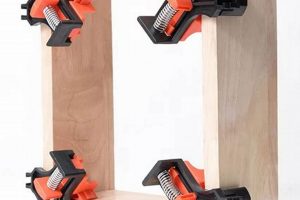
This tool is designed to hold workpieces at a precise right angle. It typically features jaws or clamping surfaces that align materials at 90 degrees, facilitating accurate and secure assembly during fabrication. For example, when constructing a box or frame, the device firmly secures the corners, ensuring squareness while fasteners are applied.
The utility of such a device stems from its ability to enhance accuracy, speed up the assembly process, and improve the overall quality of finished projects. It eliminates the need for constant manual adjustment and ensures consistent, repeatable results. Historically, woodworkers relied on various jigs and fixtures to achieve similar outcomes; however, modern designs provide enhanced precision and ease of use.
Subsequent sections will explore the different types available, their applications in various woodworking projects, and considerations for selecting the optimal tool for specific tasks. This will include discussions on materials, clamping force, and adjustability features.
Usage and Maintenance Tips
Effective utilization and proper maintenance of this tool are crucial for achieving optimal results and prolonging its lifespan. The following tips provide guidance for safe and accurate operation.
Tip 1: Verify Squareness Regularly: Prior to each use, confirm the device’s internal angle measures precisely 90 degrees. Use a reliable square or drafting tool for verification. Minor adjustments may be required to maintain accuracy.
Tip 2: Apply Consistent Clamping Pressure: Avoid over-tightening the clamp. Excessive force can damage the workpieces or distort the tool itself. Gradual pressure application ensures uniform contact and prevents material deformation.
Tip 3: Utilize Protective Pads: To prevent marring or indentation of softwoods, employ protective pads between the clamp jaws and the workpiece surface. Leather, cork, or purpose-made pads are suitable options.
Tip 4: Clean After Each Use: Remove sawdust, glue, or other debris from the tool’s surfaces after each project. A dry brush or cloth is typically sufficient. Solvent-based cleaners may be necessary for removing stubborn adhesive residue.
Tip 5: Lubricate Moving Parts: Periodically lubricate threaded components and pivot points with a light machine oil. This ensures smooth operation and prevents corrosion, extending the tool’s service life.
Tip 6: Store Properly: Store the tool in a clean, dry environment away from direct sunlight and extreme temperatures. Hanging the clamp or storing it in a dedicated storage case protects it from damage and ensures its availability when needed.
Tip 7: Inspect for Damage: Regularly inspect the clamp for signs of wear or damage, such as cracks, bent frames, or stripped threads. Replace or repair damaged components promptly to prevent accidents and maintain accuracy.
By adhering to these recommendations, users can ensure the accuracy, longevity, and safe operation of the device, ultimately contributing to higher quality woodworking projects.
The concluding section will summarize the key benefits and applications of this essential woodworking tool, reinforcing its value to both novice and experienced craftspeople.
1. Squareness

Squareness is a fundamental principle in woodworking, dictating that corners and angles must adhere to a precise 90-degree relationship. The reliable attainment of squareness is intrinsically linked to the correct application of a woodworking 90 degree clamp.
- Accuracy of Assembly
A primary function of the 90 degree clamp is to ensure workpieces are held at a precise right angle during assembly. This facilitates the creation of square corners in boxes, frames, and other structures. Deviation from squareness can result in structurally unsound joints and aesthetically displeasing results.
- Joint Integrity
The squareness of a joint directly affects its strength and stability. A joint assembled out of square may exhibit gaps, uneven stress distribution, and reduced surface area for adhesive bonding, ultimately compromising its load-bearing capacity. The clamp mitigates these issues by enforcing accurate alignment during the fastening process.
- Machine Setup and Calibration
Squareness considerations extend beyond assembly to machine setup. Ensuring that machine fences and tables are square relative to blades and cutters is crucial for accurate cuts. The 90 degree clamp can serve as a reference tool for verifying and adjusting the squareness of equipment, contributing to overall project accuracy.
- Measurement and Verification
Squareness must be verified throughout the woodworking process, from initial material preparation to final assembly. Reliable measurement tools, such as squares and combination squares, are used to assess the accuracy of cuts and joints. The 90 degree clamp, when properly aligned and calibrated, aids in this verification process by holding pieces in a known square configuration.
In summary, squareness is not merely a geometric ideal but a practical necessity in woodworking. The effective use of a 90 degree clamp, coupled with accurate measurement and machine setup, ensures that projects meet the required standards of precision and structural integrity.
2. Clamping Pressure
Clamping pressure, the force exerted by a device to hold workpieces together, is a critical factor in the effective utilization of a woodworking 90 degree clamp. The appropriate level of pressure ensures secure alignment without causing damage to the materials being joined. Precise control over this pressure is paramount for achieving high-quality, structurally sound woodworking assemblies.
- Ensuring Joint Integrity
Sufficient clamping pressure is necessary to maintain intimate contact between mating surfaces during adhesive curing or mechanical fastening. Inadequate pressure can result in gaps within the joint, leading to weakened bonds and potential structural failure. Conversely, excessive pressure can compress softwoods, distort thin materials, or damage delicate edges. The woodworking 90 degree clamp, when properly adjusted, provides the required force to achieve a robust and durable joint.
- Preventing Material Distortion
Different wood species exhibit varying degrees of compressibility and sensitivity to pressure. Applying excessive clamping force to softer woods, such as pine or basswood, can result in indentation or crushing of the fibers, compromising the aesthetic appeal and structural integrity of the finished piece. A well-designed woodworking 90 degree clamp allows for controlled application of pressure, accommodating the specific characteristics of the material being worked.
- Optimizing Adhesive Bonds
Many woodworking adhesives require a specific pressure range to achieve optimal bonding strength. Insufficient pressure may prevent the adhesive from properly wetting the surfaces, while excessive pressure can squeeze out too much glue, resulting in a glue-starved joint. The 90 degree clamp enables consistent pressure application across the joint, promoting uniform adhesive distribution and maximizing bond strength.
- Facilitating Mechanical Fastening
When using screws, nails, or other mechanical fasteners in conjunction with a woodworking 90 degree clamp, appropriate clamping pressure ensures proper alignment and prevents movement during the fastening process. This leads to stronger, more accurate joints and reduces the risk of fastener failure or material splitting.
Therefore, understanding and controlling clamping pressure is crucial when employing a woodworking 90 degree clamp. By carefully considering the material properties, adhesive requirements, and fastening methods, users can achieve optimal results and create high-quality, durable woodworking projects. Selection of a clamp with adjustable pressure settings and the use of protective pads further enhances the ability to achieve precise and controlled clamping force.
3. Material Compatibility
Material compatibility significantly influences the effectiveness and longevity of a woodworking 90 degree clamp. The interaction between the clamp’s components and the workpiece material dictates the potential for surface damage, deformation, and overall joint integrity. Clamps constructed from steel, for instance, can mar softer woods like pine or cedar if direct contact occurs. This incompatibility leads to aesthetic imperfections, requiring additional sanding or repair work. Conversely, using a clamp designed for delicate materials on hardwoods like oak or maple may result in insufficient clamping force, compromising the strength of the joint. The selection of a clamp that considers material hardness, surface finish, and potential for chemical reaction is, therefore, crucial for achieving optimal woodworking outcomes.
The application of protective pads or jaws made from non-marring materials such as plastic or rubber offers a practical solution to mitigate incompatibility issues. These interfaces distribute clamping pressure evenly, preventing localized stress concentration and minimizing the risk of indentation or scratching. Furthermore, understanding the adhesive properties of different wood species relative to the clamp’s material is vital. Certain adhesives may react negatively with clamp components, leading to corrosion or degradation, impacting the clamp’s functional lifespan. Selecting clamps with corrosion-resistant coatings or implementing a barrier between the adhesive and clamp surfaces addresses this concern. For example, applying wax paper or Teflon tape to the clamp’s contact points prevents direct adhesive contact, preserving the integrity of the clamp.
In conclusion, material compatibility is an essential consideration in the selection and application of a woodworking 90 degree clamp. Failure to account for material interactions can lead to aesthetic damage, structural weakness, and premature clamp failure. By employing appropriate protective measures and selecting clamps designed for specific material properties, woodworkers can ensure optimal joint quality, extend the lifespan of their tools, and enhance the overall efficiency and effectiveness of their woodworking projects. The challenges associated with material incompatibility underscore the importance of informed decision-making and proactive strategies for mitigating potential risks.
4. Adjustability

Adjustability in a woodworking 90 degree clamp directly influences its versatility and applicability across diverse projects. The capacity to modify the clamp’s settings, such as jaw opening and clamping pressure, allows it to accommodate workpieces of varying thicknesses and material densities. A clamp with limited adjustability restricts its use to specific material dimensions, rendering it unsuitable for a wider range of woodworking tasks. For example, a fixed-jaw clamp designed for 3/4-inch stock cannot effectively secure 1-inch or 1/2-inch materials. The consequence is either an insecure hold, leading to joint misalignment, or the outright inability to use the clamp for the intended purpose. The incorporation of adjustable features, therefore, expands the utility and return on investment of this woodworking tool.
The implementation of adjustable clamping pressure is particularly significant. Different wood species require varying degrees of force to achieve a secure bond without causing indentation or damage. Softwoods like pine necessitate lower pressure settings compared to hardwoods like oak. A clamp with a calibrated pressure adjustment mechanism allows the user to tailor the clamping force to the specific material properties, minimizing the risk of marring or crushing the wood fibers. Furthermore, adjustable jaws that can be positioned at different angles offer an advantage when working with non-uniform shapes or angled joints. This functionality ensures consistent pressure distribution across the joint surface, leading to stronger and more accurate assemblies. Cases involving complex joinery or curved components particularly benefit from the adaptability provided by such features.
In summary, adjustability is not merely a desirable attribute but an essential component of a versatile and effective woodworking 90 degree clamp. Its presence enables the tool to accommodate a wider range of materials, thicknesses, and joint configurations, enhancing its overall utility and contributing to higher-quality woodworking outcomes. The absence of adjustability, conversely, limits the clamp’s applications and increases the likelihood of material damage or joint failure. Understanding the importance of adjustability, therefore, empowers woodworkers to make informed decisions when selecting a clamp, ultimately improving the efficiency and quality of their projects.
5. Durability
The durability of a woodworking 90 degree clamp directly affects its lifespan, performance consistency, and overall value. Construction materials, manufacturing processes, and design considerations determine a clamp’s ability to withstand the repetitive stresses of woodworking applications. For instance, a clamp constructed from hardened steel and featuring robust welds will demonstrably outlast a clamp made from lower-grade materials with weaker joints. This difference translates to fewer replacements, reduced downtime, and more reliable performance over the long term. The initial investment in a durable clamp is often offset by its extended service life and reduced maintenance requirements.
A durable clamp maintains its clamping force and accuracy over extended periods of use. Fatigue, wear, and corrosion can degrade a clamp’s performance, leading to slippage, misalignment, or complete failure. Consider the scenario of constructing multiple identical frames where consistent squareness is essential. A clamp that loses its clamping pressure or develops play in its mechanism introduces variability, compromising the accuracy of subsequent frames. Conversely, a durable clamp provides consistent, reliable performance, ensuring uniform results and minimizing the need for adjustments or rework. Proper maintenance, such as regular cleaning and lubrication, contributes to extending the durability of the tool.
In summary, durability is a critical attribute of a woodworking 90 degree clamp, influencing its cost-effectiveness and the quality of finished projects. Selecting a clamp constructed from high-quality materials and designed for heavy-duty use ensures long-term reliability and consistent performance. Regular maintenance enhances durability, extending the clamp’s lifespan and maximizing its value. The importance of durability should be a primary consideration when selecting a woodworking 90 degree clamp for any application.
Frequently Asked Questions
This section addresses common inquiries regarding the selection, use, and maintenance of this tool, providing essential information for woodworkers seeking optimal performance and accuracy.
Question 1: What constitutes an acceptable level of squareness in a woodworking 90 degree clamp?
The acceptable tolerance depends on the project’s precision requirements. For general woodworking, a deviation of less than 1/32 of an inch over a 6-inch span is generally considered acceptable. High-precision applications may demand tighter tolerances, requiring careful calibration and verification.
Question 2: How does clamping pressure affect different wood species?
Softer woods, such as pine or basswood, are more susceptible to indentation and crushing under excessive pressure. Harder woods, like oak or maple, can withstand greater force without damage. Clamping pressure should be adjusted accordingly, utilizing protective pads when necessary to distribute the force evenly.
Question 3: What materials are best suited for the construction of a durable clamp?
Hardened steel and aluminum alloys are commonly used for clamp frames and jaws due to their strength and resistance to deformation. Threaded components are typically made from steel or brass to ensure smooth operation and prevent corrosion. Protective pads or jaw faces may be constructed from rubber, plastic, or cork to prevent marring of the workpiece.
Question 4: How frequently should a woodworking 90 degree clamp be inspected for damage?
A visual inspection should be conducted prior to each use, checking for cracks, bent frames, stripped threads, or other signs of wear. More thorough inspections, including verification of squareness and clamping pressure, should be performed regularly, particularly after heavy use or potential impact damage.
Question 5: What maintenance procedures are recommended to prolong the lifespan of a clamp?
Regular cleaning with a dry brush or cloth removes sawdust and debris. Lubricating threaded components and pivot points with light machine oil ensures smooth operation and prevents corrosion. Storing the clamp in a clean, dry environment protects it from damage and environmental factors.
Question 6: Can a woodworking 90 degree clamp be used on materials other than wood?
While primarily designed for woodworking applications, a 90 degree clamp can be used on other materials, such as metal or plastic, provided that appropriate precautions are taken to prevent damage. Protective pads should be used to avoid marring the material’s surface, and clamping pressure should be carefully controlled to prevent distortion or breakage.
In summary, a thorough understanding of these frequently asked questions regarding selection, use, and care ensures the woodworking 90 degree clamp is correctly applied, thereby enhancing its effectiveness and extending its usable life.
The succeeding segment will cover advanced techniques and creative uses for this crucial tool, enriching the woodworker’s skill set and broadening the scope of possible projects.
Conclusion
This exploration of the woodworking 90 degree clamp has underscored its critical role in achieving precise and structurally sound assemblies. The discussions of squareness, clamping pressure, material compatibility, adjustability, and durability highlight the multifaceted considerations involved in selecting and utilizing this essential tool. Understanding these factors allows for optimized performance and enhanced project outcomes.
The careful application of this knowledge will contribute to higher-quality woodworking, enabling the creation of projects that are both aesthetically pleasing and structurally robust. Continuous refinement of technique and adherence to best practices will further maximize the benefits derived from this invaluable device.
![Top-Rated: Best Quick Clamps for Woodworking Projects [2024] | Step-by-Step Guides, Tools & Inspiration to Build Beautiful Wooden Decor on a Budget](https://woodfromhome.com/wp-content/uploads/2026/04/th-264-300x200.jpg "Top-Rated: Best Quick Clamps for Woodworking Projects [2024] Step-by-Step Guides, Tools & Inspiration to Build Beautiful Wooden Decor on a Budget")