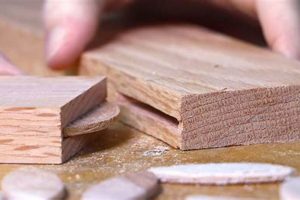
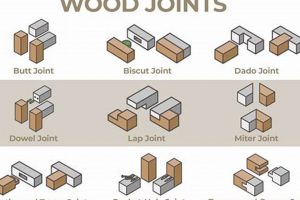
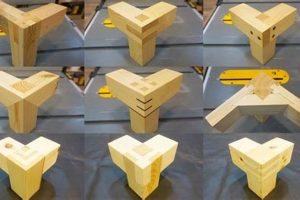
A method of joining two pieces of wood edge-to-edge, this technique utilizes a thin strip of material, often wood itself, inserted into mating grooves cut into both pieces. This strip, acting as a bridge, reinforces the connection, creating a robust and visually appealing seam. Examples can be found in table tops, cabinet sides, and box constructions where strength and alignment are paramount.
Its significance stems from the enhanced durability and stability it provides compared to simple butt joints. The increased surface area for adhesive application allows for a stronger bond, preventing warping or separation over time. Historically, this method has been favored by woodworkers seeking to create lasting pieces with superior structural integrity. Its benefits extend to accommodating wood movement, mitigating stress on the joint.
The following sections will delve into the specific tools required for creating this type of connection, detailing the process of cutting the necessary grooves, and providing guidance on selecting appropriate materials and adhesives for optimal results. Furthermore, variations and advanced applications of this technique will be explored, offering options for both beginner and experienced woodworkers.
Essential Techniques for Enhanced Woodworking Spline Joints
This section outlines crucial considerations for achieving strong, accurate, and aesthetically pleasing results in woodworking spline joint construction.
Tip 1: Grain Orientation Alignment: Ensure that the grain direction of the spline runs perpendicular to the grain of the joined pieces. This maximizes the splines reinforcing effect against potential wood movement and stress.
Tip 2: Precision Groove Cutting: Accurate and consistently sized grooves are essential. Utilize a router table with a fence or a dedicated slot cutter on a table saw to maintain uniform depth and width throughout the cut.
Tip 3: Spline Material Selection: Choose a wood species for the spline that is comparable in density and hardness to the joined pieces. This minimizes differential expansion and contraction, preventing stress fractures.
Tip 4: Proper Adhesive Application: Apply a consistent and adequate amount of wood glue to all surfaces of the spline and the grooves. Avoid excessive glue, which can weaken the joint by preventing proper wood-to-wood contact. A thin, even layer is optimal.
Tip 5: Clamping Pressure Regulation: Apply even and controlled clamping pressure during glue-up. Excessive pressure can squeeze out too much adhesive, while insufficient pressure may result in a weak bond. Aim for firm contact across the entire joint surface.
Tip 6: Adequate Curing Time: Allow sufficient time for the adhesive to fully cure before removing clamps and subjecting the joint to stress. Consult the adhesive manufacturer’s recommendations for specific curing times based on temperature and humidity conditions.
Tip 7: Careful Spline Fitting: The spline should fit snugly within the grooves, but not so tightly that it requires excessive force to insert. A tight fit ensures optimal glue contact and shear strength. Adjust the spline thickness as needed for a perfect fit.
Adhering to these techniques promotes robust and long-lasting connections, enhancing the structural integrity and aesthetic appeal of woodworking projects incorporating spline joints.
The subsequent sections will address specific applications of these techniques, further refining the understanding and mastery of woodworking spline joint construction.
1. Alignment precision

In the context of woodworking spline joints, alignment precision is paramount to achieving structural integrity and visual appeal. Deviations from accurate alignment can result in weakened joints, uneven surfaces, and compromised aesthetic quality. The spline, acting as a reinforcing element, relies on precise alignment of mating grooves in both workpieces to effectively distribute stress and prevent joint failure. Consider a tabletop construction: misalignment during spline insertion introduces undue stress along the joint line, predisposing the wood to warping or cracking over time. The structural inefficiency reduces the lifespan of the table.
The establishment of precise alignment necessitates careful measurement and cutting techniques. When utilizing a router table or a table saw, consistent fence positioning and blade height are crucial for creating accurately aligned grooves. Jigs and fixtures further enhance precision, particularly in repetitive applications. Correct alignment also facilitates seamless surface transitions, ensuring that the joined pieces lie flush. For example, when constructing cabinet doors or frames, precise alignment is crucial to provide a smooth, unblemished surface for painting or finishing. Any misalignment necessitates additional sanding or filling, increasing labor and potentially detracting from the final result.
Consequently, prioritizing alignment precision when executing woodworking spline joints is not merely an aesthetic consideration but a fundamental requirement for long-term durability and functionality. The investment in meticulous setup and accurate execution translates directly into a robust and visually appealing final product. Ignoring this aspect invariably leads to structural weaknesses and compromised aesthetic quality, underscoring the essential role of alignment precision in the successful application of this jointing technique.
2. Material compatibility

The selection of compatible materials constitutes a critical element in the successful execution of woodworking spline joints. The interaction between the joined wood pieces and the spline material directly influences the joint’s long-term structural integrity and resistance to environmental changes. Ignoring material compatibility can lead to premature joint failure, warping, or cracking.
- Differential Expansion and Contraction
Wood expands and contracts with changes in humidity. Utilizing dissimilar wood species with significantly different expansion coefficients can induce stress within the joint. For instance, a soft pine spline inserted into a hardwood joint (e.g., maple or oak) will expand and contract at a different rate, leading to potential glue-line failure or distortion of the surrounding wood. Matching wood species with similar expansion rates minimizes these risks.
- Wood Density and Hardness
The relative density and hardness of the wood components must be considered. A very hard spline inserted into softer woods can cause the surrounding wood to compress under stress, creating a loose joint over time. Conversely, a soft spline may lack sufficient strength to effectively reinforce the joint, particularly under heavy loads. A balanced approach, using a spline with comparable density and hardness, is generally optimal.
- Adhesive Compatibility
The chosen adhesive must be compatible with all materials used in the joint, including both the wood and the spline. Certain adhesives may not bond effectively with oily woods or may react adversely with specific wood preservatives. Always consult adhesive manufacturer guidelines to ensure suitable bonding characteristics and proper surface preparation techniques.
- Grain Orientation of Spline Material
While technically a component, the grain orientation of the spline plays a vital role in material compatibility. Aligning the spline grain perpendicular to the joint faces maximizes its strength and resistance to shearing forces. Conversely, running the spline grain parallel to the joint offers minimal reinforcement and can lead to joint failure under stress. Properly oriented grain enhances the structural effectiveness of the spline itself.
In summary, material compatibility within woodworking spline joints extends beyond simply selecting visually appealing wood. It encompasses a comprehensive understanding of wood properties, adhesive chemistry, and the potential for long-term interaction between dissimilar materials. Thoughtful selection and proper application are paramount for achieving durable and aesthetically pleasing woodworking outcomes.
3. Groove consistency

Within the context of woodworking spline joints, groove consistency refers to the uniformity of the dimensions, depth, and alignment of the grooves cut into mating wood pieces. This consistency is critical for the structural integrity, aesthetic appeal, and ease of assembly of the finished joint. Lack of groove consistency introduces potential for weak bonds, misaligned surfaces, and increased assembly difficulty, directly affecting the overall quality of the woodworking project.
- Dimensional Uniformity and Structural Strength
Variations in groove width or depth compromise the spline’s ability to evenly distribute stress across the joint. If one groove is wider than the other, the spline may fit loosely in that area, creating a point of weakness. Conversely, grooves that are too shallow limit the bonding surface area, reducing the overall strength of the joint. Consistent groove dimensions ensure a snug fit, maximizing adhesive contact and promoting a strong, durable connection. Example: Uneven tabletop boards joined with inconsistent grooves are prone to warping or separation under stress.
- Depth Control and Surface Alignment
Inconsistent groove depth leads to misaligned surfaces, where one workpiece sits higher or lower than the other. This misalignment not only detracts from the aesthetic quality of the finished piece but also creates challenges during finishing, requiring additional sanding or planing to achieve a smooth, even surface. Precise depth control, achieved through accurate router or table saw setup, guarantees flush surfaces and reduces the need for corrective measures. Example: Misaligned cabinet doors or drawer fronts resulting from uneven groove depths necessitate extensive rework to achieve a professional appearance.
- Alignment Accuracy and Ease of Assembly
Deviations in groove alignment hinder the smooth insertion of the spline, increasing assembly difficulty and potentially damaging the wood. Misaligned grooves force the spline to bend or twist, creating stress points within the joint and weakening the bond. Precise alignment, facilitated by jigs, fixtures, or careful marking and cutting techniques, allows for easy spline insertion and ensures that the joint components fit together seamlessly. Example: Attempting to assemble a picture frame with misaligned grooves can result in a frustrating and time-consuming process, often leading to a weakened joint.
- Consistency in Groove Finish Quality
Rough or uneven groove surfaces reduce the effective bonding area, as the adhesive struggles to make full contact. A smooth, consistent groove finish ensures optimal adhesion and a stronger bond. Techniques such as using sharp cutting tools, making multiple passes, or sanding the grooves can improve surface quality and enhance adhesive performance. Example: Glue starvation and failure in the grooves may occur if grooves are rough, or have burn marks on the wood.
Groove consistency is therefore an indispensable factor in the successful implementation of woodworking spline joints. Consistent dimensions, accurate alignment, proper depth, and smooth finishes are crucial for creating joints that are not only structurally sound but also visually appealing and easy to assemble. Mastering the techniques required to achieve groove consistency is essential for any woodworker seeking to produce high-quality, durable, and aesthetically pleasing pieces.
4. Adhesive selection

Adhesive selection constitutes a pivotal consideration in the execution of woodworking spline joints. The adhesive’s capacity to form a durable, resilient bond between the spline and the joined wood pieces directly influences the joint’s structural integrity and longevity. Inappropriate adhesive selection undermines the purpose of the spline, resulting in joint failure, warping, or aesthetic degradation.
- Wood Species Compatibility
Different wood species exhibit varying degrees of porosity, oil content, and acidity, influencing adhesive bonding characteristics. For example, resinous woods like pine require adhesives formulated to penetrate and bond effectively despite the presence of oils. Tropical hardwoods, such as teak, often necessitate surface preparation techniques, like solvent wiping, to enhance adhesive adhesion. Failure to account for wood species-specific properties results in weakened bonds and joint instability.
- Joint Stress and Load Requirements
The intended application of the spline joint dictates the necessary adhesive strength and flexibility. Joints subjected to high stress, such as those in furniture frames, demand high-strength adhesives like polyurethane or epoxy. Conversely, joints in non-structural components, such as drawer dividers, may suffice with less robust adhesives like PVA (polyvinyl acetate). Selecting an adhesive with insufficient strength jeopardizes the joint’s ability to withstand anticipated loads.
- Environmental Considerations
The environment in which the finished piece will reside influences adhesive selection. Outdoor applications require water-resistant or waterproof adhesives like resorcinol or marine-grade epoxy to prevent joint degradation from moisture exposure. Interior applications may utilize less water-resistant PVA adhesives, provided humidity levels remain stable. Neglecting environmental factors accelerates adhesive failure and compromises joint integrity.
- Open Time and Cure Time
Adhesive open time (the time available to assemble the joint after adhesive application) and cure time (the time required for the adhesive to reach full strength) affect the workflow and project timeline. Fast-setting adhesives like cyanoacrylate (CA glue) are advantageous for quick clamping and assembly, while slow-curing adhesives like epoxy offer extended working time and potentially higher bond strength. Selecting an adhesive with unsuitable open or cure times disrupts the assembly process and may compromise joint quality.
The interplay of these factors underscores the importance of informed adhesive selection in woodworking spline joints. A meticulous assessment of wood species, joint stress, environmental conditions, and desired working characteristics enables the selection of an adhesive optimized for long-term performance and joint stability. This diligence ensures that the spline effectively reinforces the joint, contributing to a durable and aesthetically pleasing finished product.
5. Clamping pressure

In woodworking spline joint construction, clamping pressure serves as a critical determinant of joint strength and overall structural integrity. The applied force directly influences the adhesive bond between the spline and the surrounding wood fibers. Insufficient pressure compromises the bond, resulting in a weak joint susceptible to failure. Excessive pressure, conversely, can starve the joint of adhesive, hindering proper adhesion. The ideal clamping pressure ensures consistent contact between all joint surfaces, promoting optimal adhesive distribution and a robust mechanical interlock.
The selection of appropriate clamping mechanisms and techniques is dictated by the size and geometry of the joint. For instance, band clamps are suitable for curved surfaces, providing even pressure distribution across complex shapes. Bar clamps offer targeted force application for straight edges, allowing for precise control over pressure intensity. Real-world examples illustrating the impact of clamping pressure include furniture frame assembly, where inadequate pressure leads to wobbly or unstable joints. Cabinet construction also exemplifies this point; panels joined with insufficient clamping force exhibit weak seams prone to separation over time. These practical applications underscore the direct correlation between clamping pressure and the functional lifespan of the woodworking project.
Achieving optimal clamping pressure necessitates careful consideration of adhesive type, wood species, and joint design. Proper technique involves evenly distributing pressure across the joint, avoiding over-tightening, and monitoring for adhesive squeeze-out as an indicator of adequate contact. Challenges in controlling clamping pressure often arise with complex joint geometries or large-scale assemblies. Overcoming these challenges requires specialized clamping equipment, custom-made jigs, or a staged clamping approach. Understanding the principles of clamping pressure, its effects on adhesive bonding, and the techniques for achieving optimal force application are fundamental to successful woodworking spline joint construction, ensuring durable and aesthetically pleasing results.
6. Spline fit
The precision of the spline fit within a woodworking spline joint directly determines the joint’s structural integrity and aesthetic quality. A properly fitted spline maximizes the surface area for adhesive bonding and ensures accurate alignment of the joined pieces. Deviations from an optimal fit compromise these benefits, leading to weakened joints and potential visual imperfections.
- Tolerance and Joint Strength
The tolerance, or allowable variation, between the spline’s dimensions and the groove’s dimensions significantly affects joint strength. A spline that is too tight requires excessive force to insert, potentially damaging the wood fibers and creating stress points within the joint. Conversely, a spline that is too loose reduces the surface area for adhesive bonding, resulting in a weaker connection. Achieving the appropriate tolerance is crucial for maximizing both the mechanical and adhesive strength of the joint. Real-world examples include loose-fitting splines in drawer boxes, which can lead to premature joint failure under repeated stress, or overly tight splines in tabletop construction, potentially causing warping or cracking.
- Alignment and Surface Flushness
The spline fit directly influences the alignment of the joined pieces. A well-fitted spline ensures that the pieces are flush and aligned, creating a smooth, seamless surface. A spline that is too thick or uneven can cause the pieces to be misaligned, resulting in visible gaps or an uneven surface. This misalignment not only detracts from the aesthetic appeal of the joint but also creates challenges during finishing, requiring additional sanding or filling to achieve a smooth surface. Consider a cabinet door frame with a poorly fitted spline; the resulting misalignment would be readily apparent and detract from the overall quality of the piece.
- Wood Movement Accommodation
Wood expands and contracts with changes in humidity. A properly fitted spline allows for some degree of wood movement without compromising the joint’s integrity. A spline that is excessively tight restricts wood movement, potentially leading to stress cracks or warping. Conversely, a spline that is too loose offers minimal resistance to wood movement, potentially allowing the joint to loosen over time. The ideal fit provides sufficient support to maintain alignment while allowing for natural wood movement. Examples include tabletops, where changes in humidity cause wood to expand and contract; a properly fitted spline prevents the tabletop from warping or cracking.
- Adhesive Distribution and Bond Quality
The fit of the spline dictates how evenly adhesive can be distributed across the mating surfaces. An overly tight fit can scrape away adhesive during insertion, leading to glue starvation in critical areas. A loose fit provides too much space, creating inconsistent glue lines. The appropriate fit allows for a thin, consistent film of adhesive to coat all mating surfaces, maximizing bond strength and resistance to stress. Imagine a spline fit too tightly where adhesive gets scraped off when assembled, leading to adhesive starvation which will eventually crack over time, versus a looser spline allowing too much movement.
In summary, the quality of the spline fit is an integral component of a successful woodworking spline joint. Achieving the optimal fit requires careful measurement, precise cutting techniques, and attention to detail. A well-fitted spline maximizes joint strength, ensures accurate alignment, accommodates wood movement, and promotes optimal adhesive bonding, contributing to a durable and aesthetically pleasing finished product. Ignoring the importance of spline fit invariably leads to compromised joint performance and reduced longevity.
7. Grain direction

Grain direction, pertaining to the alignment of wood fibers, exerts a significant influence on the strength, stability, and aesthetic properties of a woodworking spline joint. An understanding of grain direction and its interaction with the spline is crucial for producing durable and visually appealing joints.
- Spline Grain Orientation and Joint Strength
The optimal orientation of the spline’s grain is perpendicular to the grain of the joined pieces. This arrangement maximizes the spline’s resistance to shearing forces, effectively reinforcing the joint against racking or twisting. Conversely, orienting the spline’s grain parallel to the joint grain provides minimal reinforcement and can lead to joint failure under stress. For example, consider a frame where the spline grain runs vertically. The frame is significantly stronger against horizontal forces than one where the spline grain runs horizontally.
- Wood Movement and Cross-Grain Construction
Wood expands and contracts primarily across the grain. Introducing a spline with a grain direction that restricts this movement can create stress within the joint, potentially leading to cracks or warping. This is particularly relevant when joining boards with opposing grain directions. Careful consideration of wood movement is essential for ensuring the long-term stability of the joint. Solid wood table tops are a great example of the importance of grain direction when joining. Incorrect grain alignment will cause uneven expansion and contraction leading to cracks and warps.
- Aesthetic Considerations and Grain Matching
While structural integrity is paramount, grain direction also affects the aesthetic appearance of the joint. Matching the grain patterns of the spline to those of the joined pieces can create a visually seamless transition, enhancing the overall aesthetic appeal. Conversely, a mismatched grain direction can disrupt the visual flow and detract from the finished product. The key is thoughtful placement of the spline for the best look.
- Mitigating Weak Grain with Splines
Sometimes the orientation required leaves a section of end grain or short grain exposed at a weak point in the joint. The strategic use of a spline with appropriate grain orientation reinforces this weakness by providing long grain support where it is lacking. A good example of this would be a mitered corner on a picture frame. Splines are used to reinforce this corner as there is end grain that would otherwise be weak and prone to breakage.
In summary, grain direction represents a critical factor in woodworking spline joint construction. Proper alignment of the spline’s grain relative to the joined pieces maximizes joint strength, accommodates wood movement, and contributes to the overall aesthetic appeal. A thorough understanding of grain direction principles is essential for achieving durable and visually pleasing results in any woodworking project that incorporates spline joints.
Frequently Asked Questions
The following addresses common inquiries regarding the characteristics, applications, and best practices associated with this jointing technique.
Question 1: What advantages does the woodworking spline joint offer compared to a butt joint?
The spline joint significantly enhances strength and stability. By increasing the surface area for adhesive application and providing mechanical reinforcement, it mitigates the weakness inherent in butt joints.
Question 2: Is a specific wood species preferable for creating the spline?
The selected wood species should possess a density and hardness comparable to the materials being joined. This minimizes differential expansion and contraction, preventing undue stress on the joint.
Question 3: What is the recommended procedure for ensuring accurate groove alignment?
Accurate groove alignment necessitates the use of precision tools, such as a router table with a fence or a table saw equipped with a slot cutter. Consistent fence positioning and blade height are crucial.
Question 4: What type of adhesive is best suited for use in a woodworking spline joint?
The appropriate adhesive is determined by the wood species, joint stress, and environmental conditions. Polyurethane or epoxy adhesives are generally recommended for high-stress applications.
Question 5: How can excessive clamping pressure be avoided during glue-up?
Clamping pressure should be evenly distributed and carefully monitored. Excessive squeeze-out of adhesive indicates over-tightening, which can weaken the bond. Controlled clamping pressure is essential.
Question 6: What steps can be taken to ensure a proper spline fit within the grooves?
The spline should fit snugly within the grooves but not so tightly as to require excessive force for insertion. Fine-tuning the spline thickness allows for an optimal fit, maximizing adhesive contact.
Proper execution hinges on meticulous attention to material selection, tool precision, and assembly techniques. Adherence to established guidelines yields a robust and durable connection.
The subsequent section will explore advanced techniques and applications, providing deeper insights into the versatility of this jointing method.
Conclusion
This exploration has underscored the woodworking spline joint as a critical technique for achieving structural integrity and aesthetic refinement in woodworking. The discussions have centered on essential factors, including material compatibility, groove consistency, precise alignment, adhesive selection, controlled clamping pressure, and proper spline fit. Mastery of these elements enables the creation of durable and visually appealing connections, vital for lasting woodworking projects.
The informed application of these principles will elevate craftsmanship and enhance the longevity of woodworking endeavors. Continued refinement of technique and diligent adherence to best practices ensure that the woodworking spline joint remains a cornerstone of superior woodworking.