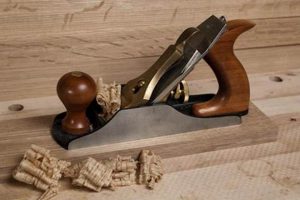
This tool represents a compact variation of a traditional instrument used to shape wood. It comprises a metallic body, typically iron or steel, that houses a blade, also known as the cutter. The size allows for enhanced maneuverability, particularly when working on smaller projects or intricate detailing. For instance, creating a chamfer on a delicate box or smoothing the edge of a narrow piece of trim are tasks well-suited to its capabilities.
The importance of this instrument lies in its ability to achieve a level of precision often unattainable with power tools. Its design enables the user to remove fine shavings of wood, resulting in a smooth, consistent surface. Historically, these instruments were essential for furniture making, cabinetry, and other woodworking endeavors. The control offered allows craftspeople to correct imperfections, refine joinery, and impart a specific aesthetic to their work. The tactile feedback provides a unique connection to the material being shaped.
The following sections will delve into the specific components of this implement, techniques for effective use, methods for maintaining optimal performance, and considerations for selecting the most appropriate model for a given task. Furthermore, potential applications within various woodworking projects will be explored, highlighting the versatility and enduring relevance of this essential tool.
Operational Considerations
The effective utilization of this instrument necessitates careful attention to several key factors, ensuring optimal performance and desired results.
Tip 1: Blade Sharpness: The sharpness of the blade is paramount. A dull blade will tear the wood fibers rather than cleanly slicing them, resulting in a rough surface. Regular honing and sharpening are crucial for maintaining optimal cutting action.
Tip 2: Blade Projection: Adjusting the blade’s projection, or the amount it extends beyond the sole, is critical. A slight projection is ideal for finishing passes, while a greater projection is suitable for removing more material quickly. Experimentation and careful observation are key to achieving the desired cut.
Tip 3: Sole Flatness: Ensure the sole, the flat bottom surface, is perfectly flat. An uneven sole will prevent consistent contact with the wood surface, leading to uneven planing. The sole can be flattened using lapping techniques on a flat surface with abrasive paper.
Tip 4: Grain Direction: Always plane with the grain of the wood. Planing against the grain will cause tear-out, resulting in a splintered and uneven surface. Identifying the grain direction and adjusting the planing direction accordingly is essential.
Tip 5: Consistent Pressure: Apply consistent and even pressure throughout the stroke. Varying pressure can lead to uneven cuts and an inconsistent surface. A balanced stance and deliberate movement are crucial for maintaining consistent pressure.
Tip 6: Lateral Adjustment: Pay attention to the lateral adjustment of the blade. The blade should be aligned perfectly parallel to the sole. If the blade is skewed, it will cut deeper on one side than the other, leading to an uneven surface.
Tip 7: Wood Stability: Ensure the wood being planed is properly dried and stable. Warped or twisted wood will be difficult to plane accurately. Acclimatizing the wood to the workshop environment before planing is recommended.
Mastering these considerations will significantly enhance the effectiveness of this tool, enabling the user to achieve smooth, precise, and aesthetically pleasing results.
The subsequent sections will explore the diverse applications of this instrument in various woodworking contexts, demonstrating its enduring value and versatility.
1. Compact Size

The characteristic of compact size directly influences the functionality and applicability of the metallic woodworking hand plane. This reduced scale, relative to larger planing tools, introduces specific advantages and dictates its suitability for particular woodworking tasks. The diminished footprint of the tool translates into enhanced maneuverability, particularly within confined spaces or when working on smaller, more intricate components. The inherent relationship between size and control is a primary consideration for woodworkers. The smaller dimensions allow for a more intimate connection between the tool and the material, enhancing tactile feedback and facilitating precise adjustments. Consider the creation of fine dovetail joints; the ability to accurately pare away minute amounts of material in tight corners is crucial, and a compact plane is uniquely suited to this task. Similarly, when shaping delicate moldings or refining curved surfaces, the manageable size contributes to greater control and accuracy.
The compact nature necessitates a trade-off in terms of material removal rate. While larger planes are designed for efficiently flattening broad surfaces, this instrument prioritizes precision over speed. The smaller blade and sole limit the amount of material that can be removed with each pass. However, this limitation becomes a strength when finesse and accuracy are paramount. The reduced scale also impacts the physical demands placed on the user. Operating a smaller plane generally requires less force, making it suitable for extended periods of use or for individuals with limited physical strength. Furthermore, storage and transportation become simplified due to the reduced dimensions, making it a practical choice for those with limited workspace or for individuals who frequently work on-site.
In summary, the compact size of this tool is not merely a superficial attribute but a defining characteristic that shapes its functionality and application. It fosters enhanced maneuverability, refined control, and reduced physical strain, while simultaneously necessitating a focus on precision over rapid material removal. Understanding this relationship is critical for woodworkers seeking to optimize their tool selection and achieve superior results in detailed and intricate projects. This feature underlines its importance in fine woodworking where control and finesse are required.
2. Metal Construction

The metal construction of this woodworking hand plane is fundamental to its function and durability. The choice of metal, typically iron or steel, provides the necessary rigidity and weight required for controlled material removal. A metal body resists warping and deformation under the stress of repeated use, maintaining the flatness of the sole, which is crucial for achieving a consistent cutting depth. The weight of the metal aids in transferring downward pressure, allowing the blade to engage with the wood fibers efficiently. For instance, when flattening a board, the consistent sole prevents the blade from digging in and ensures a smooth, level surface. Without the structural integrity of metal, the plane would be unable to perform its intended task effectively. The material’s density also dampens vibrations, leading to more comfortable and controlled operation.
The specific properties of the metal used directly influence the plane’s performance. High-quality steel, often heat-treated, is used for the blade to provide sharpness and edge retention. The body, often made of cast iron or ductile iron, is chosen for its dimensional stability and ability to absorb vibrations. The precision with which these metal components are manufactured is equally important. A perfectly flat sole, precisely aligned blade, and accurately machined adjustments are essential for optimal performance. Any deviation from these tolerances can compromise the plane’s ability to produce a smooth, consistent surface. The metal construction also allows for precise adjustment mechanisms, enabling the user to fine-tune the blade depth and lateral alignment. These adjustments are critical for adapting the plane to different wood types and planing tasks.
In summary, metal construction provides the necessary strength, stability, and precision for this hand plane to function effectively. The material properties, manufacturing tolerances, and adjustment mechanisms inherent in metal contribute to its ability to achieve smooth, controlled material removal. While other materials could theoretically be used, metal offers a combination of durability, precision, and adjustability that is difficult to replicate. The proper understanding of the connection between the metal construction and the plane’s overall performance allows woodworkers to choose the right tool and properly maintain it for optimal results, ensuring a longer lifespan and consistent quality in their woodworking projects.
3. Blade Sharpness

The effectiveness of the small metal-bodied woodworking hand plane is inextricably linked to the condition of its blade, specifically its sharpness. Blade sharpness dictates the instrument’s ability to sever wood fibers cleanly, producing a smooth, even surface. A dull blade, conversely, will tear or crush the wood, resulting in a rough, uneven finish, rendering the tool largely ineffective. The primary cause of inefficient planing is a dull or improperly sharpened blade. The sharpness of the blade acts as the critical factor in the tool’s performance. Consider, for example, attempting to create a smooth surface on a piece of hardwood. With a sharp blade, thin shavings can be consistently removed, yielding a polished result. However, with a dull blade, the plane will skip, chatter, and leave behind a jagged surface requiring extensive sanding or further planing with a properly sharpened tool. This demonstrates the direct cause-and-effect relationship between blade sharpness and the quality of the work produced.
Maintaining blade sharpness requires a systematic approach, including regular honing and occasional re-grinding. Honing, the process of refining the blade’s edge with progressively finer abrasive stones, should be performed frequently to remove any micro-nicks or burrs that develop during use. Re-grinding, which involves removing a larger amount of material to restore the blade’s original bevel angle, is necessary when the edge becomes severely damaged or when the honing process is no longer effective. The selection of appropriate sharpening tools, such as water stones, oil stones, or diamond stones, and the mastery of proper sharpening techniques are essential skills for any woodworker utilizing this tool. These techniques include maintaining the correct bevel angle, applying consistent pressure, and progressing through a sequence of increasingly finer grits to achieve a razor-sharp edge.
In conclusion, blade sharpness is not merely a desirable attribute, but a fundamental requirement for the successful operation of the small metal-bodied woodworking hand plane. Neglecting blade maintenance will inevitably lead to poor results and increased effort. Overcoming the challenge of maintaining a consistently sharp blade requires dedication to mastering proper sharpening techniques and investing in quality sharpening tools. This dedication is essential for realizing the full potential of this tool and achieving the desired level of precision and finish in woodworking projects. The importance of the sharp blade is central to proper tool functionality.
4. Sole Flatness

Sole flatness is a crucial attribute directly influencing the performance of a small metal-bodied woodworking hand plane. The sole, being the bottom surface of the plane that makes contact with the wood, must be meticulously flat to ensure consistent blade engagement and uniform material removal. Deviations from flatness, even minor ones, can lead to uneven planing, where the blade cuts deeper in some areas than others, resulting in a surface that is not smooth or level. This is because an uneven sole will cause the blade to follow the contours of the sole rather than cutting consistently across the entire surface. For example, if the sole is slightly convex, the blade will tend to cut more aggressively in the center, leaving the edges untouched. Conversely, a concave sole will cause the edges to cut deeper, leaving the center high. The effect is that the user will not achieve a smooth, flat surface on the wood being worked. The primary function is therefore compromised by lack of sole flatness.
The degree of flatness required depends on the intended use of the plane. For rough shaping, a slightly less-than-perfect sole might be acceptable. However, for fine finishing or creating precise joinery, the sole must be as close to perfectly flat as possible. To achieve and maintain sole flatness, manufacturers typically grind and lap the sole during the manufacturing process. Users can also improve sole flatness through lapping, a process that involves rubbing the sole against a flat surface covered with abrasive material. Regular maintenance, including cleaning and waxing the sole, can help prevent rust and corrosion, which can also affect flatness. The choice of plane also matters; higher-quality planes often have soles made of denser, more stable metals that are less prone to warping over time. Consider the process of preparing a surface for gluing. A slight imperfection in the plane’s sole could easily cause gaps in the glue line, undermining the strength and integrity of the joint. It is essential to consider that a well-maintained flat sole can yield excellent and efficient results, improving the joinery and overall piece.
In summary, sole flatness is not a mere cosmetic feature but a functional imperative for the effective operation of a small metal-bodied woodworking hand plane. Maintaining a flat sole is essential for achieving smooth, consistent material removal and producing high-quality finished surfaces. Overcoming challenges such as warping or manufacturing defects requires careful inspection, proper maintenance, and potentially, corrective lapping. The effort invested in ensuring sole flatness directly translates to improved planing performance and enhanced woodworking outcomes. The challenge for craftspeople lies in consistently maintaining the flatness of the tool over its lifespan, a task which calls for care, proper storage, and regular attention. Ultimately, the enduring utility of a well-maintained and flat-soled plane lies in its ability to reliably deliver precise and predictable results, allowing the craftsperson to realize their creative vision with accuracy and efficiency.
5. Adjustability

Adjustability constitutes a critical feature of the small metal-bodied woodworking hand plane, significantly impacting its versatility and precision in various woodworking applications. The ability to modify specific parameters of the plane allows the user to adapt it to different wood types, grain orientations, and desired surface finishes. The following points will explain the core elements of adjustability.
- Blade Depth Adjustment
Blade depth adjustment refers to the ability to precisely control how far the cutting edge of the blade protrudes beyond the sole of the plane. This adjustment dictates the thickness of the shaving removed with each pass. A smaller projection is ideal for achieving a fine, smooth finish, while a larger projection is suitable for rapidly removing material. Incorrect adjustment can lead to tear-out, uneven surfaces, or excessive resistance. For example, working with highly figured woods often requires extremely fine blade adjustments to prevent the grain from being lifted and torn.
- Lateral Blade Alignment
Lateral blade alignment ensures that the cutting edge of the blade is parallel to the sole of the plane. This adjustment prevents the blade from cutting deeper on one side than the other, which would result in an uneven or skewed surface. Precise lateral alignment is essential for creating flat surfaces and achieving accurate joinery. Misalignment can often be detected by observing that the shavings are thicker on one side. The adjustments allow for correction on the instrument to address these deviations.
- Mouth Opening Adjustment (where applicable)
Some advanced planes feature an adjustable mouth, which is the opening in the sole through which the blade protrudes. A smaller mouth opening reduces the likelihood of tear-out, especially when working with difficult grain. A larger mouth opening allows for the removal of thicker shavings. The mouth opening can be adjusted on some sophisticated models of the plane to accommodate wood types and operations. Adjusting the mouth opening provides additional control over the cutting action and can improve the quality of the finished surface.
- Chipbreaker Adjustment (where applicable)
The chipbreaker, or cap iron, is a component located just behind the blade that helps to curl and break the shaving. Adjusting the chipbreaker’s position relative to the cutting edge can significantly impact the planing action. When properly adjusted, the chipbreaker prevents tear-out and reduces chatter, resulting in a smoother surface. The placement of the component will ensure proper cutting and reduced resistance of cutting.
These facets of adjustability, collectively, enhance the versatility and precision of the small metal-bodied woodworking hand plane. By understanding and effectively utilizing these adjustments, the user can adapt the plane to a wide range of woodworking tasks and achieve superior results. The ability to fine-tune the plane’s performance empowers the woodworker to overcome challenges posed by different wood types and grain orientations, ultimately leading to more refined and aesthetically pleasing finished pieces.
6. Versatility

The small metal-bodied woodworking hand plane exhibits versatility stemming from its design and adaptability, enabling its use across a spectrum of woodworking tasks. This attribute enhances its value as a fundamental tool in a woodworker’s arsenal. The tool’s ability to perform diverse functions, from smoothing surfaces to shaping edges, establishes it as a multifaceted instrument. This contrasts with specialized power tools, which are often limited to specific operations. The cause of this versatility lies in the plane’s adjustable blade and manageable size, allowing for fine-tuning and control. For example, the creation of a chamfer along the edge of a board, smoothing the face of a small panel, or refining a curved surface can all be achieved with this instrument. This is particularly advantageous in situations where access is restricted or where precision is paramount.
This hand plane’s inherent versatility allows a woodworker to execute a complete project utilizing only a few tools, reducing the need for a vast collection of specialized equipment. For instance, in crafting a small wooden box, this plane can be employed for initial stock preparation, creating precise joinery, and finishing the exterior surfaces. Moreover, it is applicable in situations where power tools might be impractical or undesirable, such as in noise-sensitive environments or when working with delicate materials. The control afforded by manual operation allows for subtle adjustments and a tactile understanding of the wood, promoting a higher degree of craftsmanship. The versatility also extends to different types of wood, the instrument being adaptable through adjustments to blade projection and angle for hardwoods and softwoods alike.
In summary, the versatility of the small metal-bodied woodworking hand plane is a defining characteristic, contributing to its enduring relevance in both traditional and contemporary woodworking practices. Its adaptability to various tasks, wood types, and working conditions makes it an indispensable tool for achieving precision and control. While larger planes and power tools may offer greater speed in certain applications, the versatility of this tool makes it ideal for detailed work and where a quieter, more controlled approach is desired. The craftsperson finds that an appreciation for this tool is not for its speed, but instead its adaptability.
7. User Control
User control, in the context of a small metal-bodied woodworking hand plane, refers to the degree of influence a craftsperson exerts over the tool’s operation and resulting outcome. This influence manifests in several key areas, distinguishing the hand plane experience from that of power tools where much control is automated. The level of influence afforded to the user is what allows the tool to be versatile.
- Cutting Depth Precision
User control over cutting depth allows for the precise removal of material, ranging from coarse shaping to the finest finishing. The mechanism of blade projection adjustment enables the user to dial in the exact amount of wood to be removed with each pass. For instance, when fitting a delicate joint, a minute adjustment allows for removing only the necessary material, preventing over-cutting and ensuring a tight fit. Incorrect blade depth is something that is controlled by a person, which means they can correct the issue.
- Directional Control
The manual nature of the hand plane grants directional control that surpasses automated tools. The user directs the plane along the grain, accommodating variations and irregularities to prevent tear-out. When navigating around a knot or figured grain, the user can subtly adjust the angle and pressure to maintain a smooth cutting action. This is in contrast to automatic tool operation, where the user relinquishes directional and granular control.
- Tactile Feedback
Tactile feedback provides the user with a constant stream of information about the wood’s response to the cutting action. The resistance felt through the plane, the sound of the blade engaging with the wood, and the visual appearance of the shavings all contribute to an understanding of the process. This allows the user to make instantaneous adjustments to maintain optimal performance and avoid mistakes. The feedback is instant and informative for better tool operation.
- Surface Finish Customization
User control enables the creation of a variety of surface finishes, from smooth and polished to textured and rustic. By varying the blade angle, cutting depth, and planing technique, the user can achieve a specific aesthetic effect. For example, a skilled woodworker can create a subtle ripple effect on a surface or impart a unique sheen by altering the planing parameters. It is through tool user operation that they are able to control how a material surface is finished.
These facets of user control underscore the intrinsic value of the small metal-bodied woodworking hand plane as a tool that empowers the craftsperson to directly shape and refine wood with unparalleled precision and sensitivity. The reliance on manual skill and tactile feedback fosters a deep connection between the user and the material, resulting in craftsmanship that is both technically proficient and aesthetically refined. While automation has made some processes faster, the level of influence allowed by the hand tool has value to the operator.
Frequently Asked Questions About Small Metal Bodied Woodworking Hand Planes
This section addresses common inquiries regarding the selection, use, and maintenance of compact metal-bodied woodworking hand planes.
Question 1: What distinguishes a small metal bodied woodworking hand plane from larger models?
The primary distinction lies in size and weight. Smaller planes offer enhanced maneuverability for intricate work, while larger models are designed for efficiently flattening broad surfaces.
Question 2: What are the key indicators of a high-quality tool of this type?
Indicators include the quality of the metal used (typically hardened steel or ductile iron), the precision of machining (particularly the sole flatness and blade alignment), and the smoothness of adjustment mechanisms.
Question 3: How frequently should the blade be sharpened?
Sharpening frequency depends on the type of wood being planed and the intensity of use. As a general rule, the blade should be honed regularly (every few minutes of use) and re-ground when honing no longer restores a sharp edge.
Question 4: What is the recommended method for maintaining the sole of the plane?
Regular cleaning with a dry cloth is essential. Applying a thin coat of paste wax can help prevent rust and reduce friction. Lapping on a flat surface with abrasive paper may be necessary to restore flatness if the sole becomes uneven.
Question 5: Are these planes suitable for both hardwoods and softwoods?
Yes, with proper adjustments. Hardwoods require a sharper blade and a shallower cutting depth, while softwoods may tolerate a slightly more aggressive setup.
Question 6: What are some common mistakes to avoid when using this tool?
Common mistakes include planing against the grain, using a dull blade, applying uneven pressure, and neglecting to properly adjust the blade projection and lateral alignment.
In summary, the effective use of a small metal bodied woodworking hand plane requires attention to detail, a commitment to proper maintenance, and a willingness to develop the necessary skills through practice.
The following section will explore specific applications of this tool in various woodworking projects.
Conclusion
This exploration has elucidated the defining characteristics of a small metal bodied woodworking hand plane, emphasizing its compact size, durable metal construction, the critical importance of blade sharpness and sole flatness, and its inherent versatility stemming from user-controlled adjustments. The examination has underscored the instrument’s enduring value in achieving precision and control in a variety of woodworking applications. The analysis has detailed these factors and the cause and effect relationships that define its utility.
The foregoing should serve as a guide for practitioners seeking to optimize their tool selection and technique. Mastery of this instrument necessitates a commitment to both proper maintenance and a deep understanding of its capabilities. The enduring legacy of fine woodworking hinges on the skilled application of such tools, ensuring that craftsmanship remains a hallmark of quality and precision for generations to come. Continue to refine technique and appreciate this instrument in practical application.