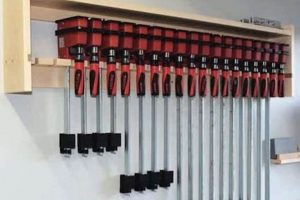
These workholding devices utilize a specialized track system to secure materials during fabrication. They often consist of a sliding clamp mechanism that fits within the track’s channel, allowing for adjustable positioning and firm pressure application. An example is a set of these clamps used to hold a wooden board securely against a fence while routing a decorative edge.
The implementation of such clamping solutions enhances precision and repeatability in woodworking projects. Their adaptability to various jigs and fixtures contributes to safer and more efficient workflows. Historically, these tracks and associated clamps represent an evolution from more cumbersome and less versatile clamping methods, offering a modular and customizable approach to workholding.
The subsequent sections will delve into the different types available, their applications in various woodworking tasks, considerations for selecting the optimal type for specific needs, and maintenance tips for prolonging their lifespan.
Optimizing Performance with Track-Based Clamping Systems
This section outlines crucial guidelines for effectively utilizing track-based clamping systems in woodworking, maximizing their benefits, and ensuring longevity.
Tip 1: Select Appropriate Clamping Pressure: Over-tightening can damage both the workpiece and the clamp itself. Apply only the necessary pressure to secure the material, preventing slippage without causing deformation. For instance, when working with softwoods, reduce clamping force to avoid leaving indentations.
Tip 2: Ensure Track Alignment: Proper alignment of the track system is paramount for accurate and consistent results. Regularly inspect tracks for straightness and parallelism, correcting any discrepancies before commencing work. Misalignment can lead to skewed cuts or inaccurate joinery.
Tip 3: Utilize Appropriate Hardware: Use fasteners compatible with both the track and the clamp. Employing incorrect hardware can compromise the system’s integrity and lead to clamp failure. Refer to the manufacturer’s specifications for recommended fastener types and sizes.
Tip 4: Employ Backing Blocks: When clamping thin or delicate workpieces, use backing blocks to distribute pressure evenly and prevent crushing. These blocks should be made from a material that will not mar the workpiece surface, such as soft wood or plastic.
Tip 5: Clean and Lubricate Regularly: Dust and debris accumulation can impede clamp movement and reduce clamping force. Regularly clean the tracks and clamp mechanisms, applying a light lubricant to ensure smooth operation. This practice will extend the lifespan of the system.
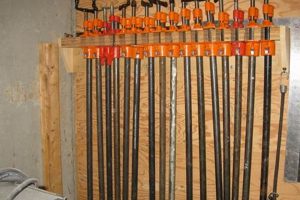
Tip 6: Store Properly: When not in use, store clamps in a dry environment, away from direct sunlight and extreme temperatures. Proper storage prevents corrosion and material degradation, maintaining the system’s performance over time.
Tip 7: Inspect for Wear and Tear: Regularly inspect the clamping components for signs of wear, such as stripped threads, cracks, or deformation. Replace any damaged parts immediately to prevent accidents and maintain optimal clamping force.
Adhering to these guidelines will maximize the efficiency, accuracy, and longevity of track-based clamping solutions. Consistent application of these principles translates to enhanced project quality and a safer working environment.
The subsequent conclusion will summarize the key aspects of these clamping systems and reiterate their significance in modern woodworking practices.
1. Secure Workpiece Holding

Secure workpiece holding forms the bedrock of precise and safe woodworking practices. The stability afforded by reliable clamping mechanisms directly impacts the accuracy of cuts, the integrity of joinery, and the overall safety of the operator. In the context of track-based clamping systems, this principle is paramount to unlocking their full potential.
- Consistent Pressure Distribution
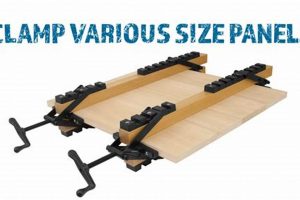
Track-based clamps excel at distributing clamping pressure evenly across the workpiece. This reduces the risk of localized indentations or crushing, particularly when working with softer wood species. For instance, when edge-gluing boards, even pressure is critical to achieving a seamless and robust joint.
- Adjustable Positioning for Optimal Support
The ability to precisely position clamps along the track allows for targeted support where it’s needed most. This is particularly advantageous when working with irregularly shaped or thin materials that are prone to flexing. Imagine routing a curved profile: strategic clamp placement prevents unwanted movement and ensures a clean, accurate cut.
- Reduced Vibration During Machining
Securely holding the workpiece minimizes vibration during machining operations such as routing or sanding. This results in smoother, cleaner surfaces and reduced tool chatter. Consider the difference in finish quality when sanding a securely clamped piece versus one that vibrates due to inadequate support.
- Enhanced Safety for the Operator
By eliminating the need to hold the workpiece manually, track-based clamping systems significantly enhance operator safety. This reduces the risk of accidents caused by slipping tools or sudden workpiece movement. For example, when using a router table, securely clamping the workpiece frees both hands to guide the material, improving control and minimizing the chance of injury.
These facets underscore the fundamental role of secure workpiece holding and highlight how track-based clamping systems provide a versatile and effective means of achieving it. The ability to maintain consistent pressure, adjust clamp positioning, reduce vibration, and enhance safety makes these systems an invaluable asset in any woodworking workshop. Proper implementation ultimately translates to improved accuracy, increased efficiency, and a safer working environment.
2. Adjustability and Positioning
The inherent design of track-based clamping systems directly enables precise adjustability and positioning capabilities. The t-track, acting as the foundation, permits clamps to be located and secured at any point along its length. This adaptability is not merely a convenience but a crucial factor in addressing the diverse requirements of woodworking projects. The cause is the track design and the effect is nearly limitless clamp placement. Without this feature, a woodworker’s ability to secure complex shapes or adapt to various project dimensions would be severely limited. A real-world example is the construction of a segmented bowl; the track allows clamps to be radially positioned, ensuring uniform pressure distribution across the entire assembly.
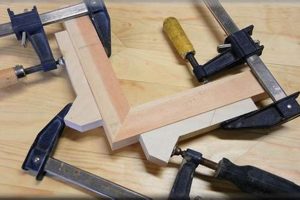
Furthermore, the adjustability extends beyond simple linear placement. Many clamps designed for use with these tracks incorporate mechanisms for fine-tuning pressure and orientation. This is essential for tasks such as veneer application, where consistent, even pressure is paramount to achieving a flawless bond. The practical significance of this adjustability lies in its ability to compensate for variations in material thickness, workpiece geometry, and even slight imperfections in the track system itself. This adaptability directly translates to reduced waste, improved accuracy, and increased efficiency in the woodworking process. For example, the ability to easily reposition a clamp is particularly crucial during the glue-up stage of a large table top, where achieving a perfectly flush surface requires constant monitoring and adjustment. Another example is to clamp 45 degree angle cutting.
In summary, the connection between adjustability and positioning and track-based clamping systems is fundamental to their utility. The track design enables infinite positioning possibilities, while the clamps themselves offer fine-tuning capabilities. While installation of the track can sometimes pose a challenge in older workshops, its overall benefits in terms of accuracy, efficiency, and adaptability render it an indispensable tool for modern woodworking. This understanding is therefore essential for maximizing the effectiveness of such clamping systems in various woodworking applications.
3. Versatile Jig Integration

The adaptability of these clamping systems extends significantly through their seamless integration with various jigs and fixtures. This integration expands the capabilities of both the clamping system and the jigs themselves, providing woodworkers with enhanced precision, repeatability, and efficiency across a broad spectrum of tasks. This is because the tracks readily accept a wide range of hardware and accessories, facilitating a modular and customizable approach to jig construction.
- Customized Workholding Solutions
Track-based systems facilitate the creation of custom workholding solutions tailored to specific project requirements. The ability to mount jigs directly onto the track allows for secure and repeatable positioning, eliminating the need for cumbersome and less precise clamping methods. For instance, a custom jig for cutting dovetails can be affixed to the track, ensuring consistent alignment and spacing for each joint.
- Enhanced Repeatability and Accuracy
Integrating these clamping devices with jigs improves the repeatability and accuracy of woodworking operations. Once a jig is properly aligned and secured to the track, it can be used to perform the same task multiple times with consistent results. This is particularly valuable for production runs or intricate projects that require precise tolerances. An example is a miter saw jig where the exact angle is required to repeated for many pieces of woods.
- Simplified Jig Construction
The standardized dimensions and ease of use of these tracks simplify jig construction. Woodworkers can quickly and easily build custom jigs using readily available materials and hardware, without the need for specialized tools or expertise. This democratization of jig building empowers woodworkers to create bespoke solutions that perfectly suit their needs. The availability of pre-made t-track components and joinery kits make the construction process even easier and more intuitive for all skill levels.
- Expanded Functionality of Existing Jigs
These tracks are not limited to new jig constructions but also to upgrading the function of existing jigs. This can be done by mounting the track onto an old jig to make it more versatile. For instance, adding a t-track to a crosscut sled improves the sled’s work holding capacity. This can be done by adding a fence to the crosscut sled with bolts. By adding t-tracks, the fence can be remove and be replaced, thus making the sled jig even more versatile.
In summary, the symbiotic relationship between jig integration and track-based clamping solutions offers woodworkers a powerful toolkit for achieving precision, repeatability, and efficiency. The ability to create custom workholding solutions, enhance the accuracy of existing jigs, and simplify the jig building process empowers woodworkers of all skill levels to elevate the quality and consistency of their work. Integrating these tools for woodworking will make the shop function like a well-oiled machine.
4. Consistent Clamping Pressure
Maintaining uniform pressure during woodworking operations is critical for achieving strong, durable, and aesthetically pleasing results. The ability to apply and sustain consistent force directly impacts the integrity of glue joints, the accuracy of cuts, and the overall stability of assembled components. Track-based clamping systems offer mechanisms designed to facilitate this consistency.
- Even Distribution Across the Workpiece
Track systems allow clamps to be positioned at intervals that distribute pressure evenly along the length of a joint or across a surface. This prevents localized stress points that can lead to weak bonds or material deformation. Consider edge-gluing multiple boards; evenly spaced clamps along a track ensure that each joint receives adequate and uniform compression.
- Controlled Force Application
Many track-compatible clamps incorporate mechanisms for controlling the amount of force applied. This allows the user to fine-tune the pressure according to the specific requirements of the material and the task at hand. For example, when clamping delicate veneers, a lower, more controlled pressure prevents crushing or indentations.
- Resistance to Pressure Creep
High-quality clamps designed for these tracks are engineered to resist pressure creep, the gradual reduction in clamping force over time. This is crucial for long clamping operations, such as when gluing up complex assemblies. The clamp’s design and materials minimize the loosening of the clamping force over time. In contrast, some lower-quality clamps may require periodic re-tightening to maintain adequate pressure.
- Adaptability to Varied Material Thicknesses
The adjustability of track-based clamping systems allows them to accommodate variations in material thickness while maintaining consistent pressure. The sliding mechanisms enable clamps to be quickly and easily repositioned to suit different workpiece dimensions, ensuring that the clamping force remains appropriate for the specific application. This is important for woodworking tasks where the different material requires different clamp forces.
The attributes of even distribution, controlled force, resistance to creep, and material adaptability collectively contribute to the capacity of track-based clamping systems to deliver consistent clamping pressure. These features are key elements in producing professional-quality woodworking results, minimizing the risk of joint failure, and ensuring the dimensional accuracy of finished pieces.
5. Enhanced Workflow Efficiency

Enhanced workflow efficiency in woodworking is intrinsically linked to the effective application of workholding solutions. Track-based clamping systems contribute significantly to this efficiency by streamlining operations and reducing setup times.
- Reduced Setup Time
The ease and speed with which clamps can be positioned and secured along a track significantly reduces setup time for various woodworking tasks. Unlike traditional clamping methods that may require multiple adjustments and shimming, track systems allow for rapid and precise clamp placement. For example, when assembling a cabinet frame, clamps can be quickly positioned and tightened along the track to secure the joints before fastening, minimizing the time spent on preparation.
- Simplified Clamping of Complex Shapes
Track-based systems simplify the clamping of complex or irregular shapes by providing adjustable support and pressure points. Traditional clamping methods often struggle to accommodate non-uniform geometries, requiring custom jigs or improvised solutions. With tracks, clamps can be strategically positioned to conform to the shape of the workpiece, ensuring even pressure distribution and secure holding. This is particularly advantageous when working with curved or contoured components.
- Streamlined Batch Production
Track-based systems facilitate streamlined batch production by enabling the rapid and repeatable clamping of multiple workpieces. Once a setup is established, clamps can be quickly positioned and tightened for each subsequent piece, minimizing the time required for each cycle. This is particularly beneficial for tasks such as edge-gluing boards or assembling identical components, where consistency and efficiency are paramount.
- Increased Operator Safety
By providing secure and reliable workholding, track-based clamping systems enhance operator safety, reducing the risk of accidents and injuries. When workpieces are securely clamped, operators can focus on the task at hand without worrying about the material shifting or slipping. This is particularly important when using power tools such as routers or saws, where precision and control are essential for preventing mishaps. A secure clamp reduces the need to hold the wood down, preventing accidental injuries.
The aspects of reduced setup time, simplified clamping, streamlined production, and increased safety collectively contribute to the enhanced workflow efficiency offered by track-based clamping systems. The adoption of these clamping solutions is therefore directly correlated with improved productivity, reduced labor costs, and a safer working environment in woodworking operations.
6. Improved Accuracy
Improved accuracy in woodworking is fundamentally linked to the stability and precision with which workpieces are held during fabrication. Track-based clamping systems directly address this requirement, contributing to enhanced dimensional control and reduced error in a wide range of operations.
- Precise Positioning and Alignment
Track systems allow for highly accurate positioning of clamps, ensuring that workpieces are securely aligned before and during cutting, joining, or shaping. This eliminates the potential for misalignment that can lead to dimensional inaccuracies. For example, when assembling a mitered frame, accurate clamp positioning along the track guarantees precise corner angles and a flush fit.
- Minimized Workpiece Movement
The secure grip provided by these clamps minimizes workpiece movement during machining operations, such as routing or sanding. This stability is crucial for maintaining tight tolerances and preventing defects. Consider routing a dado; a securely clamped workpiece ensures a consistent depth and width of the dado, free from wandering or chatter.
- Repeatable Setups
Track systems facilitate repeatable setups for batch production, ensuring that each workpiece is held in the same position and orientation. This consistency reduces the variability between parts and improves overall accuracy. For instance, when drilling multiple holes using a jig, a track-based clamping system allows for quick and accurate repositioning of the jig for each hole, ensuring consistent hole placement across all workpieces.
- Reduced Vibration
The rigid support provided by track-based clamps reduces vibration during machining operations, further enhancing accuracy. Vibration can cause tool chatter and dimensional inaccuracies, particularly when working with delicate materials. By minimizing vibration, these clamping systems contribute to smoother cuts, cleaner edges, and more precise finished dimensions. A practical instance is carving where vibration makes the wood pieces unstable and can cause inaccuracy.
The precision positioning, secure grip, repeatable setups, and vibration reduction collectively contribute to the enhanced accuracy afforded by track-based clamping systems. These attributes are pivotal for achieving professional-quality woodworking results, minimizing waste, and maximizing efficiency.
7. Material Compatibility
The selection of appropriate clamping solutions necessitates careful consideration of material compatibility. The interaction between the clamp’s components and the workpiece material directly impacts the effectiveness of the clamping action and the preservation of the material’s surface integrity. In woodworking, this is especially critical due to the varying hardness and sensitivity of different wood species.
- Clamp Pad Material and Wood Hardness
The material used for the clamp pads, which directly contact the workpiece, must be considered in relation to the hardness of the wood. Hardwoods can withstand higher clamping pressures without deformation, while softwoods are susceptible to indentation or crushing. Utilizing hard clamp pads on softwoods can result in undesirable markings. Therefore, softer materials like cork or felt are often preferred for use with more delicate woods to distribute pressure evenly and prevent damage. Furthermore, specialized pads exist for veneered or finished surfaces to avoid marring.
- Clamp Body Material and Chemical Reactivity
The primary material of the clamp body, typically metal or plastic, can present concerns related to chemical reactivity. Certain woods contain acids or extractives that may corrode or stain metal components over time, particularly in humid environments. Similarly, some adhesives used in woodworking may react with plastic clamp bodies, causing degradation or discoloration. Selecting clamps with corrosion-resistant coatings or inert plastic compositions mitigates these risks, ensuring longevity and preventing contamination of the workpiece.
- Thread Material and Clamping Force Durability
The thread material of the clamp screw is crucial for maintaining consistent clamping force over time. Steel threads are generally more durable and resistant to wear than plastic threads, particularly when subjected to high clamping pressures or frequent use. However, steel threads can be prone to corrosion, especially in humid environments. Therefore, stainless steel or coated steel threads are often preferred for their enhanced corrosion resistance, ensuring long-term reliability and preventing slippage during clamping.
- Finish Compatibility
The material compatibility extends beyond the raw wood to consider the applied finish. Some clamps may have rubber or plastic components that react adversely with certain finishes, causing discoloration or softening. Testing the clamp’s components on an inconspicuous area of the finished surface before full application is recommended. Using clamp pads made of inert materials or covering the clamp’s contact points with a protective barrier prevents undesirable interactions and preserves the integrity of the finish.
Consideration of these aspects of material compatibility enhances the utility and longevity of clamping systems while safeguarding the integrity of woodworking projects. Selecting appropriate materials and implementing preventative measures ensures that the clamping process contributes to, rather than detracts from, the quality of the finished piece. Ignoring the material of the clamp and how it interacts with different types of wood can lead to irreversible damages.
Frequently Asked Questions Regarding Track-Based Clamping Systems
This section addresses common inquiries and clarifies essential aspects concerning the selection, utilization, and maintenance of track-based clamping solutions in woodworking.
Question 1: What are the primary advantages of track-based clamping systems compared to traditional clamps?
Track-based systems offer enhanced versatility, precise adjustability, and consistent pressure distribution. They streamline setup times, simplify clamping of complex shapes, and facilitate repeatable setups, contributing to increased efficiency and accuracy.
Question 2: Are these systems suitable for all types of woodworking projects?
While versatile, the suitability depends on project size and complexity. Larger projects requiring extensive clamping surface benefit significantly, while smaller, simpler tasks may be adequately addressed with traditional clamps. Consider the scope and required precision of the project.
Question 3: What factors should be considered when selecting a track-based clamping system?
Critical factors include track length, clamp capacity, thread quality, clamp pad material, and compatibility with existing jigs. The intended applications and budget constraints should also influence the selection process.
Question 4: How is proper track alignment ensured for optimal clamping performance?
Accurate track alignment is essential for consistent results. Use precision measuring tools to verify track straightness and parallelism during installation. Address any discrepancies before commencing work to prevent skewed cuts or inaccurate joinery.
Question 5: What maintenance procedures are recommended for prolonging the lifespan of these clamping systems?
Regular cleaning, lubrication, and inspection are crucial. Remove dust and debris from tracks and clamp mechanisms. Apply light lubricant to moving parts. Inspect for wear, corrosion, and damaged components, replacing them as needed.
Question 6: Is specialized knowledge required to effectively utilize track-based clamping systems?
While familiarity with basic woodworking principles is beneficial, specialized knowledge is not mandatory. Manufacturers typically provide instructions and guidelines for proper usage. Practicing on scrap material is recommended to gain proficiency and avoid damaging workpieces.
Proper understanding and consistent application of these principles ensure optimal performance and longevity of track-based clamping systems in woodworking practices.
The following conclusion will summarize the key aspects of these clamping systems and reiterate their significance in modern woodworking practices.
Conclusion
The preceding exploration has detailed the multifaceted utility of track-based clamping solutions in woodworking. From enhancing accuracy and efficiency to facilitating complex jig integration, these systems represent a significant advancement over traditional clamping methods. Their capacity for precise adjustability, consistent pressure distribution, and streamlined workflows renders them indispensable in contemporary woodworking environments.
Consideration of the principles outlined herein will empower woodworkers to leverage the full potential of these devices, optimizing project outcomes and ensuring lasting value. Continued adherence to best practices and a commitment to informed decision-making will further solidify the role of track-based clamping systems as a cornerstone of quality craftsmanship.
![Top-Rated: Best Quick Clamps for Woodworking Projects [2024] | Step-by-Step Guides, Tools & Inspiration to Build Beautiful Wooden Decor on a Budget](https://woodfromhome.com/wp-content/uploads/2026/04/th-264-300x200.jpg "Top-Rated: Best Quick Clamps for Woodworking Projects [2024] Step-by-Step Guides, Tools & Inspiration to Build Beautiful Wooden Decor on a Budget")