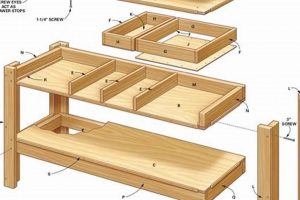
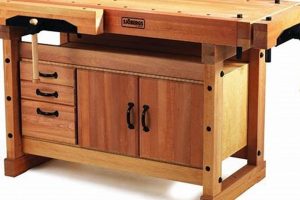
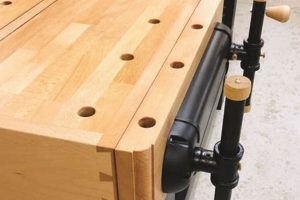
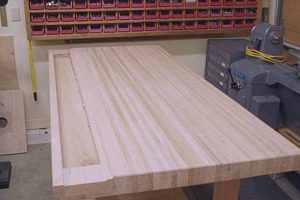
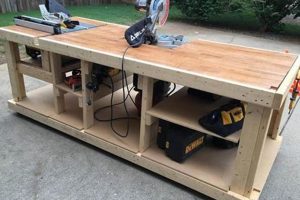
The acquisition of pre-owned workbench solutions designed for woodworking tasks presents a financially prudent approach for individuals establishing or expanding their workshops. These units, previously utilized in diverse settings, range from home hobbyist environments to professional carpentry shops, offering a spectrum of options regarding size, features, and overall condition.
The benefits of considering such a purchase extend beyond mere cost savings. A well-maintained, pre-owned work surface often boasts inherent stability and robustness derived from seasoned wood. Moreover, these benches frequently carry a history, representing craftsmanship and potential modifications tailored to specific woodworking needs. Historically, such work surfaces have been central to woodworking trades, evolving in design and functionality over centuries, with pre-owned options providing a tangible link to this heritage.
Subsequent discussions will address key considerations when evaluating available options, including assessing structural integrity, identifying desirable features, and navigating the secondary market to ensure a satisfactory procurement experience. This will involve analyzing various types of benches, inspecting for common issues, and understanding fair market valuation.
Essential Considerations for Procuring a Pre-Owned Woodworking Bench
Prior to finalizing the acquisition of a pre-owned woodworking bench, a systematic assessment of condition, features, and market value is paramount to ensure a worthwhile investment.
Tip 1: Inspect for Structural Integrity: Examine the bench’s frame and legs for signs of warping, cracking, or wood rot. A solid, level foundation is crucial for accurate and safe woodworking operations. Apply pressure to various points on the bench to assess stability.
Tip 2: Evaluate the Work Surface: Assess the flatness and condition of the benchtop. Minor imperfections can often be rectified, but significant damage, such as deep gouges or excessive wear, may compromise its utility. Note the presence of dog holes and their compatibility with intended projects.
Tip 3: Assess Vise Functionality: If equipped, the vise should operate smoothly and clamp workpieces securely. Inspect the jaws for wear and ensure the mechanism is free from binding or excessive play. Consider the type of vise (e.g., face vise, tail vise) and its suitability for anticipated tasks.
Tip 4: Consider Storage Options: Evaluate any built-in storage, such as drawers or shelves. Assess their condition and functionality. Adequate storage space contributes to a more organized and efficient workspace.
Tip 5: Research Market Value: Investigate comparable offerings on the secondary market to ascertain a fair price. Factors influencing value include the bench’s age, condition, brand, and features. Websites dedicated to woodworking forums and classifieds often provide useful price points.
Tip 6: Inquire About Previous Use: If possible, gather information regarding the bench’s prior use. This may provide insights into its history and potential limitations. Ask about any repairs or modifications that have been performed.
These considerations collectively enable a well-informed decision, maximizing the potential for acquiring a functional and valuable addition to the woodworking environment.
The subsequent section will address potential restoration techniques applicable to pre-owned woodworking benches, extending their lifespan and enhancing their performance.
1. Condition Assessment

The acquisition of a woodworking bench on the secondary market necessitates a rigorous condition assessment. The inherent variability in the state of pre-owned items directly influences their utility and lifespan. A thorough evaluation mitigates the risk of acquiring a bench unsuitable for its intended purpose or requiring extensive and potentially costly repairs. For instance, a bench with a significantly warped top will impede accurate joinery, while one with compromised structural integrity presents a safety hazard.
Condition assessment encompasses several key areas. Examination of the benchtop’s flatness is crucial; deviations from true flatness directly impact the ability to create accurate cuts and joints. The stability of the frame must also be evaluated, looking for signs of rot, insect damage, or previous repairs. Vise functionality demands careful scrutiny; a damaged or poorly maintained vise diminishes the bench’s clamping capabilities. Practical examples include checking for excessive play in the vise mechanism, examining the vise jaws for wear and tear, and assessing the overall smoothness of the vise’s operation.
In summation, a comprehensive condition assessment is paramount to the successful procurement of a pre-owned woodworking bench. Overlooking this step can lead to significant financial repercussions and hinder woodworking endeavors. The condition directly correlates with the value and usability, therefore meticulous examination is critical.
2. Vise Functionality

Vise functionality represents a critical component in the evaluation of a pre-owned woodworking bench. The vise, integral to securing workpieces during various woodworking operations, directly influences the bench’s usability and overall value proposition.
- Clamping Force and Stability
The vise must exert sufficient clamping force to hold workpieces securely, preventing movement during planing, sawing, and other operations. Insufficient clamping force renders the bench less effective for precision woodworking. Examples include planing a board edge where slippage due to inadequate clamping would compromise the straightness of the edge. In the context of a used woodworking bench, assessing the vise’s clamping capacity is essential to ensure it meets the user’s needs.
- Jaw Condition and Alignment
The condition of the vise jaws directly affects its ability to grip workpieces effectively. Worn, damaged, or misaligned jaws reduce clamping surface area and increase the risk of slippage. Inspecting the jaws for damage, such as cracks or excessive wear, is critical. Furthermore, ensuring that the jaws align properly prevents uneven pressure distribution and potential damage to the workpiece.
- Mechanism Smoothness and Play
The vise mechanism, including the screw and guide rods, should operate smoothly and without excessive play. Binding or sticking indicates potential damage or lack of maintenance, impacting ease of use and long-term reliability. Excessive play compromises clamping precision and can lead to inaccuracies in woodworking projects. Evaluating the smoothness of operation and the degree of play is vital when considering a pre-owned bench.
- Vise Type and Suitability
Various vise types exist, including face vises, tail vises, and leg vises, each suited for different applications. A face vise is typically used for general clamping, while a tail vise, in conjunction with bench dogs, is ideal for long workpieces. A leg vise offers high clamping force and minimal racking. Determining whether the existing vise type meets the intended woodworking needs is crucial when evaluating a used workbench. A mismatch can diminish the bench’s utility and necessitate costly modifications.
In conclusion, vise functionality significantly contributes to the overall value and usefulness of a pre-owned woodworking bench. Comprehensive assessment of clamping force, jaw condition, mechanism smoothness, and vise type suitability is essential to ensure a worthwhile purchase. Overlooking these aspects can result in a bench that inadequately supports precision woodworking tasks, thereby diminishing its value as a working platform.
3. Benchtop Flatness
Benchtop flatness is a paramount consideration when evaluating a pre-owned woodworking bench. The degree to which the benchtop deviates from a true plane directly impacts the accuracy and efficiency of woodworking operations performed upon it. Its relevance to the value and utility of a “used woodworking bench for sale” cannot be overstated.
- Accuracy in Joinery
A flat benchtop provides a stable and consistent reference surface for establishing accurate joinery. If the benchtop is not flat, attempting to create square and true joints becomes significantly more challenging, potentially leading to gaps, misalignments, and structural weaknesses in finished projects. For example, attempting to plane the edge of a board perfectly square on a warped benchtop will invariably result in an inaccurate edge. In the context of a pre-owned bench, substantial deviations from flatness may necessitate extensive resurfacing or render the bench unsuitable for precision work.
- Stability for Tool Setup
Woodworking tools, such as hand planes and marking gauges, rely on a flat surface for accurate setup and consistent performance. A non-flat benchtop can introduce errors in tool adjustments, leading to inconsistent cuts and inaccurate markings. For instance, attempting to set the blade depth of a hand plane on an uneven surface will result in variations in the thickness of shavings. When considering a “used woodworking bench for sale”, verifying the flatness ensures proper tool function and minimizes potential errors.
- Prevention of Workpiece Movement
A flat surface minimizes the risk of workpiece movement during woodworking operations. Uneven areas on the benchtop can create pressure points that cause the workpiece to rock or shift, compromising stability and potentially leading to inaccuracies or even safety hazards. Imagine attempting to chisel a mortise on a benchtop with a significant hollow; the workpiece is likely to shift under the impact of the chisel. Prioritizing flatness in a “used woodworking bench for sale” translates to enhanced control and safety during woodworking tasks.
- Impact on Clamping Efficiency
Effective clamping relies on even pressure distribution across the workpiece. A non-flat benchtop can result in uneven clamping pressure, increasing the risk of slippage or damage to the workpiece. For instance, attempting to glue up a panel on an uneven surface may result in gaps between the boards due to inadequate clamping force in certain areas. Thus, the flatness of a “used woodworking bench for sale” directly correlates with its ability to securely hold workpieces during glue-ups and other clamping-intensive procedures.
In conclusion, benchtop flatness is a crucial factor to consider when evaluating a “used woodworking bench for sale”. Its impact on accuracy, stability, tool setup, and clamping efficiency directly influences the bench’s overall value and suitability for precision woodworking. A thorough assessment of flatness is essential to ensure that the bench meets the user’s requirements and provides a reliable platform for woodworking endeavors.
4. Frame Stability

Frame stability is a fundamental attribute to consider when evaluating a pre-owned woodworking bench. It dictates the bench’s capacity to resist deformation under load, impacting precision and safety. A structurally sound frame ensures that the workbench serves as a reliable platform for a wide array of woodworking tasks.
- Resistance to Racking
Racking, or lateral movement in the frame, compromises the stability of the work surface and reduces accuracy. A stable frame resists this motion, maintaining a consistent plane for joinery and other precision tasks. For example, a bench with a frame prone to racking may exhibit noticeable movement when planing a wide board, affecting the flatness of the resulting surface. In the context of a used woodworking bench, evidence of previous repairs to address racking suggests potential structural weaknesses that warrant careful consideration.
- Load-Bearing Capacity
The frame must possess sufficient strength to support the weight of the benchtop, tools, and workpieces without sagging or flexing. Inadequate load-bearing capacity can lead to instability and potential failure under heavy loads. An example would be a bench collapsing under the weight of a large timber being worked on. When inspecting a used bench, look for signs of stress, such as cracks or excessive bending in the frame members, as these indicate potential limitations in its load-bearing capacity.
- Joint Integrity
The joints connecting the various frame members must be strong and rigid to maintain overall stability. Weak or poorly constructed joints can compromise the frame’s ability to resist racking and support heavy loads. For example, loose mortise-and-tenon joints or poorly executed dovetails can introduce instability into the frame. When assessing a used bench, meticulously examine the joints for any signs of looseness, separation, or previous repair, as these indicate potential weaknesses in the frame’s structure.
- Material Condition
The condition of the wood used in the frame significantly impacts its stability. Rot, insect damage, or excessive drying can weaken the frame members and compromise their ability to withstand stress. For example, wood rot can significantly reduce the strength of a leg, rendering the bench unstable. A used woodworking bench for sale should be carefully inspected for signs of material degradation, and if present, the extent and severity must be carefully evaluated.
These facets collectively highlight the importance of frame stability in the context of acquiring a used woodworking bench. A thorough evaluation of racking resistance, load-bearing capacity, joint integrity, and material condition enables an informed decision, ensuring the chosen bench provides a stable and reliable platform for woodworking endeavors. Failure to adequately assess frame stability can lead to compromised accuracy, reduced efficiency, and potential safety hazards.
5. Storage Capacity

The available storage integrated within a pre-owned woodworking bench represents a significant factor influencing its utility and overall value. Storage capacity dictates the extent to which tools, accessories, and materials can be readily accessed and organized directly at the workstation, affecting workflow efficiency. The presence or absence of drawers, shelves, or cabinets within a “used woodworking bench for sale” directly impacts its desirability, particularly for individuals with limited workshop space. The relationship between storage and functionality necessitates careful evaluation during the acquisition process. For instance, a bench lacking adequate storage may require the user to expend time and effort retrieving tools from distant locations, thereby diminishing productivity. Conversely, a bench with well-designed storage allows for immediate access to essential items, streamlining woodworking tasks. Therefore, storage is a key element.
The practical significance of storage capacity extends beyond mere convenience. A well-organized workbench contributes to a safer working environment by reducing clutter and minimizing the risk of tripping hazards or misplaced tools. Furthermore, integrated storage can help to protect delicate tools from damage by providing a secure and dedicated location. Consider the scenario of a woodworker frequently using a specific set of chisels; a bench with dedicated chisel storage compartments allows for immediate retrieval and protects the tools from accidental damage caused by being left exposed on the benchtop. The impact on workflow and on space is a large factor to consider. These benefits are practical examples of how storage solutions within a workbench directly benefit the user.
In conclusion, storage capacity is integral to the value and practicality of a pre-owned woodworking bench. An assessment of storage needs and a careful evaluation of the bench’s integrated storage solutions ensures a suitable acquisition that facilitates efficiency, safety, and organization within the woodworking environment. The absence of appropriate storage can undermine the potential benefits of the bench, necessitating the purchase of separate storage units and thereby increasing the overall cost. Therefore, careful consideration is prudent.
6. Price Evaluation

The price evaluation of a “used woodworking bench for sale” necessitates a comprehensive understanding of market dynamics, condition assessment, and feature analysis. The objective is to establish a fair market value that reflects the bench’s current state and potential utility. Overpayment represents a financial loss, while an unrealistically low price may indicate hidden defects or compromised structural integrity. The correlation between price and quality is fundamental in this context. For instance, a vintage workbench from a reputable manufacturer, meticulously maintained and equipped with high-quality vises, will command a significantly higher price than a generic, heavily used bench with minimal features. Therefore, price evaluation is a key step to consider.
Effective price evaluation incorporates several key factors. A thorough inspection of the bench’s condition, as previously discussed, is paramount. Structural soundness, benchtop flatness, vise functionality, and the presence of any damage directly impact the price. Comparison with similar benches currently available on the secondary market provides valuable insights into prevailing price ranges. Online marketplaces, woodworking forums, and auction sites offer a wealth of data points for comparative analysis. In addition, considering the original purchase price (if known) and any subsequent modifications or upgrades helps to establish a reasonable upper limit. For example, a bench originally purchased for \$1000 and upgraded with a premium vise costing \$300 might justify a higher asking price than a comparable bench without upgrades, assuming both are in similar condition. It is key to compare prices and upgrades when evaluating a product.
In summary, price evaluation is an essential component of the process of acquiring a “used woodworking bench for sale.” A systematic approach that considers condition, features, market comparisons, and historical context enables informed decision-making and minimizes the risk of overpayment or acquiring a substandard bench. Challenges may arise in accurately assessing the remaining lifespan or hidden structural weaknesses; however, a thorough inspection and diligent research can mitigate these risks. Ultimately, a well-executed price evaluation ensures a successful and cost-effective acquisition. Making this assessment ensures proper acquisition.
Frequently Asked Questions
The following addresses common inquiries regarding the acquisition of pre-owned woodworking benches, providing clarity on key considerations and potential challenges.
Question 1: What constitutes a fair price for a used woodworking bench?
A fair price hinges upon the bench’s condition, age, brand, features, and comparable market values. Researching similar offerings on online marketplaces and woodworking forums is advised. A meticulous inspection for structural defects is paramount to accurately determine its value.
Question 2: How can potential structural weaknesses in a used woodworking bench be identified?
Structural weaknesses can manifest as racking, loose joints, wood rot, or evidence of prior repairs. Careful examination of the frame, legs, and joints is necessary. Applying pressure to various points on the bench can reveal instability.
Question 3: What level of benchtop flatness is acceptable in a used woodworking bench?
The acceptable level of flatness depends on the intended use. For precision joinery, minimal deviation from a true plane is crucial. Minor imperfections can often be corrected, but significant warping or cupping may compromise its utility.
Question 4: How should the functionality of a vise on a used woodworking bench be assessed?
The vise should operate smoothly, clamp workpieces securely, and exhibit minimal play in the mechanism. Inspect the jaws for wear and ensure proper alignment. The vise type should also be suitable for the anticipated woodworking tasks.
Question 5: What are the potential benefits of purchasing a used woodworking bench over a new one?
The primary benefits include cost savings and the potential acquisition of a seasoned, well-built bench with inherent stability. Older benches often feature robust construction and may have acquired desirable modifications over time.
Question 6: What steps should be taken to restore a used woodworking bench to optimal condition?
Restoration may involve cleaning, repairing structural damage, flattening the benchtop, reconditioning the vise, and applying a protective finish. The extent of restoration depends on the bench’s condition and the desired level of refinement.
These answers provide a foundational understanding of key considerations when purchasing a pre-owned woodworking bench. Diligence and thoroughness are essential to ensure a satisfactory acquisition.
The subsequent section will offer guidance on selecting the appropriate woodworking bench based on specific needs and woodworking styles.
Conclusion
The preceding discourse has elucidated critical considerations for individuals seeking a used woodworking bench for sale. The structural integrity, benchtop flatness, vise functionality, storage capacity, and pricing must be thoroughly evaluated. This rigorous assessment ensures alignment with intended woodworking activities, mitigates financial risk, and promotes a safe and productive work environment.
The acquisition of a pre-owned woodworking bench represents a strategic investment requiring diligent research and careful evaluation. Prioritizing these crucial aspects enables a confident and informed decision, facilitating woodworking endeavors with a dependable and economically sound platform. Failure to perform a thorough assessment may result in purchasing a bench that is unsuitable, unsafe, or lacking in the necessary capabilities. With the correct approach, a used woodworking bench for sale can deliver exceptional value and performance for many years.