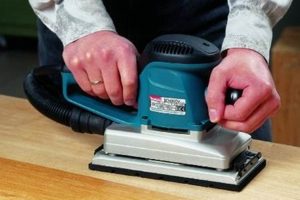
An electric handheld tool designed to smooth, shape, and dimension wood surfaces with precision and efficiency is the focus. This tool employs rotating blades powered by an electric motor to remove thin layers of wood, allowing for consistent and controlled material removal. It is frequently utilized in woodworking applications for tasks such as creating even surfaces, fitting doors, and achieving desired thicknesses.
The adoption of this particular tool offers significant advantages in woodworking projects. Its use provides increased speed and accuracy compared to manual planing methods. This allows for efficient completion of tasks and reduces the physical strain on the user. Historically, manual hand planes were the standard; however, the electric version provides a faster and often more consistent outcome, particularly beneficial for larger projects or repetitive tasks. The ability to adjust cutting depth further enhances versatility and precision.
The following sections will explore key factors to consider when selecting the optimal power tool for specific woodworking needs, examine performance characteristics that define effectiveness, and review available features that contribute to a high-quality user experience. Comparisons of several models available in the marketplace will also be presented, offering insights into their respective strengths and limitations.
Electric Hand Planer Optimization
The following tips aim to optimize the selection and usage of an electric handheld woodworking planer, emphasizing efficiency and precision.
Tip 1: Blade Sharpness Maintenance: Regular blade sharpening is crucial for optimal performance. Dull blades can cause tear-out and require excessive force, leading to inconsistent results and potential motor strain. Invest in a sharpening jig or professional sharpening services to maintain blade edges.
Tip 2: Depth Adjustment Considerations: Utilize shallow cutting depths for initial passes. Removing small amounts of material reduces the risk of gouging or uneven planing, particularly on figured or difficult-to-plane wood. Increase depth gradually as needed for efficient material removal.
Tip 3: Grain Direction Awareness: Always plane with the grain. Planing against the grain can cause tear-out and splintering, resulting in a rough and undesirable surface. Observe the wood’s grain pattern carefully before initiating each pass.
Tip 4: Consistent Feed Rate Control: Maintain a consistent feed rate during operation. Varying the speed at which the planer is moved across the workpiece can lead to uneven planing and inconsistent surface finishes. Practice smooth, controlled movements.
Tip 5: Dust Extraction System Integration: Connect the planer to a dust extraction system. This improves visibility, reduces airborne dust particles, and prevents the accumulation of wood shavings, ensuring a cleaner and safer work environment.
Tip 6: Soleplate Cleanliness: Ensure the soleplate is clean and free of debris before each use. Debris or accumulated resin can interfere with smooth gliding, causing uneven planing and potential surface marring.
Tip 7: Test Cuts and Calibration: Prior to working on the final workpiece, perform test cuts on scrap wood. This allows for fine-tuning depth settings and familiarizing with the planer’s performance characteristics.
By adhering to these practices, the lifespan and effectiveness of the electric hand woodworking planer are enhanced, resulting in superior woodworking outcomes.
The succeeding sections will delve into model-specific reviews and comparisons, providing further insights to inform informed purchasing decisions.
1. Power Output

Power output is a critical determinant of a woodworking planer’s overall performance and suitability for specific tasks. It directly impacts the tool’s capacity to efficiently remove material and maintain consistent cutting speeds, particularly when working with hardwoods or performing deeper cuts. Insufficient power can lead to stalling, uneven planing, and increased user fatigue.
- Motor Amperage and Wattage
The amperage or wattage rating of the motor provides a direct indication of its power output. Higher amperage/wattage ratings generally translate to increased torque and cutting power. For example, a planer with a 6-amp motor will typically perform better on hardwoods than a model with a 4-amp motor. This factor is crucial when the application involves planing dense or difficult-to-work woods.
- Cutting Depth and Width Capacity
A planer’s power output must be sufficient to support its maximum cutting depth and width. Attempting to remove excessive material in a single pass with an underpowered planer can overload the motor and compromise cut quality. Manufacturers typically specify the maximum cutting depth and width based on the tool’s power capacity; exceeding these limits can negatively impact performance and longevity.
- Blade Speed (RPM) and Material Removal Rate
Power output is directly related to the planer’s blade speed, measured in revolutions per minute (RPM). Higher RPMs generally result in a faster material removal rate and smoother surface finish. However, maintaining high RPMs under load requires sufficient motor power. A planer with a powerful motor can sustain high blade speeds even when encountering resistance from the workpiece, ensuring efficient and consistent material removal.
- Overload Protection Mechanisms
Effective power output is also linked to the presence of overload protection mechanisms. These mechanisms prevent motor damage by automatically shutting down the planer when it detects excessive load or overheating. This feature is particularly important in high-power planers, as it safeguards the motor from potential damage during demanding applications. The presence of overload protection contributes to the planer’s overall reliability and longevity.
In summary, power output is an indispensable attribute of a top-performing electric hand planer. Adequate power ensures efficient material removal, consistent cutting speeds, and the ability to handle a wide range of wood types and cutting depths. Selecting a planer with appropriate power characteristics for the intended applications is essential for achieving professional woodworking results and maximizing the tool’s lifespan.
2. Blade Precision
Blade precision is a non-negotiable element in defining a superior electric hand planer. It directly dictates the smoothness, accuracy, and overall quality of the resulting planed surface. Without precise blades, the tool’s effectiveness is severely compromised, regardless of other features.
- Material Composition and Hardness
The material from which the blades are manufactured significantly influences their cutting performance and longevity. High-speed steel (HSS) and tungsten carbide are common choices, with carbide offering superior hardness and wear resistance. For example, carbide blades maintain a sharper edge for longer periods, allowing for extended use before requiring resharpening. This is particularly beneficial when working with abrasive or dense hardwoods.
- Sharpening Angle and Edge Geometry
The precision of the sharpening angle and edge geometry are critical for optimal cutting performance. A consistent and precisely ground cutting edge ensures clean material removal and minimizes the risk of tear-out. Different angles are suitable for different wood types; a steeper angle might be appropriate for hardwoods, while a shallower angle is preferable for softwoods. Accurate sharpening jigs and techniques are essential for maintaining optimal blade geometry.
- Blade Alignment and Planarity
Precise blade alignment and planarity within the planer head are essential for achieving a uniform cutting depth and minimizing surface imperfections. Misaligned blades can result in uneven planing, ridges, and gouges. Manufacturers often incorporate mechanisms for fine-tuning blade alignment to ensure optimal planarity. Regular inspection and adjustment of blade alignment are necessary for maintaining consistent performance.
- Blade Securing Mechanism
The method by which the blades are secured within the planer head contributes significantly to blade precision. A robust and reliable blade securing mechanism prevents blade movement during operation, ensuring consistent cutting depth and minimizing vibration. Designs that allow for quick and easy blade changes without compromising blade alignment are particularly desirable. Secure blade mounting minimizes the risk of blade damage or ejection, enhancing user safety.
The interplay of these factors underscores the importance of blade precision in the overall performance of an electric hand planer. Selecting a model with high-quality blades, precise sharpening, accurate alignment, and a robust securing mechanism is crucial for achieving professional-grade results and maximizing the tool’s effectiveness in woodworking applications.
3. Ergonomic Design

Ergonomic design is an indispensable attribute of a high-performing electric hand planer. The direct correlation between a planer’s ergonomic features and the user’s ability to execute precise, controlled cuts is undeniable. Inadequate ergonomic considerations invariably lead to increased user fatigue, reduced control, and a heightened risk of errors, directly affecting the quality of the finished workpiece. For instance, a planer with a poorly positioned grip might necessitate awkward hand angles, leading to muscle strain and inconsistent planing depths.
Several elements constitute effective ergonomic design in electric hand planers. These include handle placement and contour, weight distribution, and vibration dampening. Ideally, the handle should be positioned to allow for a natural wrist alignment, minimizing strain during prolonged use. Weight distribution should be balanced to prevent excessive tilting or wobbling during operation, contributing to consistent planing depth. Vibration dampening mechanisms reduce the transmission of vibrations to the user’s hands, mitigating fatigue and enhancing control. Planers utilized for extended periods, such as those employed in furniture making or large-scale construction, demonstrate the value of these features most profoundly. A reduction in user strain subsequently translates to improved accuracy and efficiency.
In summation, ergonomic design is not merely an ancillary feature; it is an integral component of a woodworking planer’s performance capabilities. Planers that prioritize ergonomic considerations empower users to work more comfortably, maintain greater control, and achieve higher-quality results. The integration of thoughtfully designed handles, balanced weight distribution, and effective vibration dampening mechanisms serves to enhance the user’s experience and maximize the planer’s potential in a variety of woodworking applications. This attribute contributes directly to what defines a top-tier tool.
4. Dust Management

Effective dust management is intrinsically linked to the performance and utility of any woodworking planer, especially electric handheld models. The inherent nature of planing wood generates substantial amounts of airborne particulate matter. This byproduct, if uncontrolled, presents a range of challenges encompassing visibility impairment, respiratory health risks, and compromised tool efficiency. A superior electric hand planer mitigates these challenges through integrated dust collection systems, contributing significantly to a safer and more productive working environment. The absence of adequate dust control can lead to a rapid accumulation of shavings, obscuring the cutting path and necessitating frequent interruptions for cleanup. This results in decreased efficiency and potential inaccuracies in the planing process. Furthermore, prolonged exposure to wood dust, particularly from certain hardwoods, is recognized as a potential carcinogen and respiratory irritant. This makes the presence of a robust dust management system an essential component of a tool designed for professional or frequent use.
Practical implementations of dust management in planers include integrated dust ports designed to connect to vacuum systems, as well as self-contained dust collection bags. Models equipped with larger dust ports and efficient internal airflow mechanisms typically exhibit superior dust extraction capabilities. Some advanced systems also incorporate filters to capture finer dust particles, further enhancing air quality. The efficacy of these systems is often measured by the percentage of dust captured during operation. For instance, a planer with a highly efficient dust collection system may capture 90% or more of the generated dust, significantly reducing airborne particulate matter. In contrast, planers lacking effective dust management may leave a substantial amount of dust on the workpiece and in the surrounding environment. This emphasizes the critical role dust management plays in the overall user experience and safety.
In conclusion, dust management constitutes a critical factor in evaluating the quality and suitability of an electric hand planer for woodworking applications. By effectively controlling and removing wood dust, these systems enhance visibility, protect user health, improve tool efficiency, and contribute to a cleaner, safer workspace. The incorporation of robust dust management should be viewed as an essential feature, not merely an accessory, in the context of a high-performing electric hand planer, reflecting a comprehensive approach to tool design that prioritizes both performance and user well-being.
5. Durability

Durability represents a paramount consideration in the selection of an electric hand planer. A tool intended for woodworking applications must withstand the rigors of frequent use, potential exposure to abrasive materials, and the inevitable stresses associated with material removal. The inherent longevity of a hand planer directly impacts its long-term value proposition, reducing the need for premature replacement and minimizing operational downtime.
- Material Selection and Construction
The materials employed in the planer’s construction significantly influence its overall durability. High-quality metals, such as hardened steel or aircraft-grade aluminum, offer superior resistance to wear, impact, and corrosion. The robustness of the housing, base plate, and internal components directly correlates to the tool’s ability to withstand demanding workloads. Reinforced housings can mitigate the risk of cracking or deformation under stress, while precision-machined components ensure proper alignment and minimize friction, thereby extending the lifespan of moving parts. The use of premium materials is a key indicator of a planer’s intended longevity and ability to withstand harsh operating conditions.
- Motor Protection and Cooling
The motor is the driving force of any electric hand planer, and its durability is essential for the tool’s reliable performance. Effective motor protection mechanisms, such as overload protection and thermal cutoffs, safeguard the motor from damage caused by excessive loads or overheating. Adequate cooling systems, incorporating strategically placed vents and efficient fan designs, prevent the buildup of heat during prolonged use, minimizing the risk of premature motor failure. Motors designed with robust windings and high-quality bearings exhibit enhanced resistance to wear and tear, contributing to a longer operational lifespan. Investing in a planer with advanced motor protection and cooling features is a prudent measure to ensure its long-term functionality.
- Blade Material and Retention System
The durability of the planer’s blades, as well as the robustness of the blade retention system, directly influences the tool’s cutting performance and longevity. High-quality blade materials, such as tungsten carbide or high-speed steel, maintain a sharper cutting edge for extended periods, reducing the frequency of blade replacements. A secure and reliable blade retention system prevents blade slippage or ejection during operation, enhancing user safety and minimizing the risk of damage to the planer. Systems incorporating durable clamping mechanisms and precise blade alignment further contribute to the overall longevity and precision of the tool. Selecting a planer with premium blade materials and a robust retention system is crucial for sustained cutting performance and reduced maintenance costs.
- Overall Design and Component Integration
The overall design and integration of components play a critical role in determining the durability of an electric hand planer. A well-engineered design minimizes stress points, distributing forces evenly throughout the tool’s structure. Securely fastened components, using robust fasteners and interlocking mechanisms, prevent loosening or vibration during operation. A streamlined design reduces the risk of snagging or damage during handling and storage. Furthermore, features such as reinforced cord connections and durable switch mechanisms contribute to the planer’s overall resilience. A holistic approach to design and component integration is indicative of a manufacturer’s commitment to producing a durable and reliable tool.
In summary, durability is a multifaceted attribute that encompasses material selection, motor protection, blade quality, and overall design integrity. Selecting an electric hand planer that prioritizes durability is a crucial investment for woodworkers seeking a reliable, long-lasting tool capable of withstanding the demands of frequent use and delivering consistent performance over an extended period. These considerations directly contribute to the tool being categorized as among the “best electric hand planer for woodworking” applications.
Frequently Asked Questions
This section addresses common inquiries regarding electric hand planers, providing clarity on their optimal use, maintenance, and suitability for various woodworking applications.
Question 1: What factors determine the optimal electric hand planer for woodworking?
Key factors include motor power, blade quality and adjustability, ergonomic design, dust extraction capabilities, and overall tool durability. Motor power determines the planer’s capacity to handle different wood types and cutting depths. Blade quality impacts surface finish and longevity. Ergonomics influence user comfort and control. Effective dust extraction improves visibility and safety. Durability ensures long-term reliability.
Question 2: How does blade sharpness affect planer performance?
Blade sharpness directly affects the quality of the planed surface. Dull blades can cause tear-out, splintering, and require excessive force, leading to inconsistent results and potential motor strain. Regular blade sharpening or replacement is essential for optimal performance.
Question 3: What safety precautions should be observed when using an electric hand planer?
Safety precautions include wearing appropriate personal protective equipment (PPE), such as safety glasses and a dust mask. Ensure the workpiece is securely clamped. Always plane with the grain. Avoid excessive cutting depths. Disconnect the planer from the power source before making adjustments or changing blades.
Question 4: How does dust extraction contribute to a safer working environment?
Effective dust extraction reduces airborne particulate matter, improving visibility and minimizing the risk of respiratory irritation and long-term health problems associated with wood dust exposure. A cleaner work environment also reduces the risk of slips and falls.
Question 5: What are the common maintenance requirements for electric hand planers?
Common maintenance requirements include regular blade sharpening or replacement, cleaning the soleplate and dust extraction port, inspecting the power cord for damage, and lubricating moving parts as needed. Consult the manufacturer’s manual for specific maintenance recommendations.
Question 6: Can an electric hand planer be used on all types of wood?
While an electric hand planer can be used on various wood types, certain woods require more specialized techniques. Hardwoods may necessitate shallower cutting depths and sharper blades. Highly figured woods may be prone to tear-out, requiring careful attention to grain direction and feed rate. Test cuts on scrap wood are recommended before working on the final workpiece.
In summary, understanding these frequently asked questions regarding electric hand planers enhances the user’s capacity to operate the tool safely, efficiently, and effectively. Adhering to best practices ensures optimal results and extends the tool’s lifespan.
The subsequent section will provide a comparative analysis of specific electric hand planer models currently available in the marketplace, allowing readers to make informed purchasing decisions.
Conclusion
The preceding analysis has detailed the salient features that define a superior power tool for woodworking applications. Elements such as motor power, blade precision, ergonomic design, dust management capabilities, and overall durability have been examined to provide a comprehensive understanding of performance attributes. Consideration of these factors is critical for informed tool selection.
The determination of the optimal tool depends on individual needs and project requirements. Continued advancements in power tool technology promise further enhancements in efficiency and precision. Prioritizing research and aligning tool selection with specific application demands remains paramount to achieving professional-grade woodworking results.