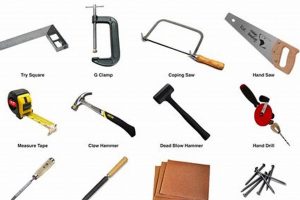
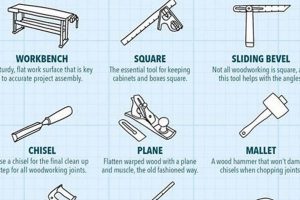
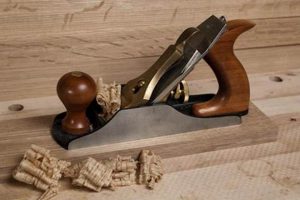
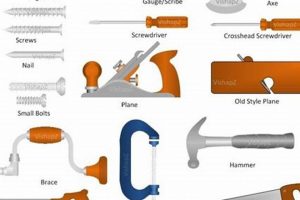
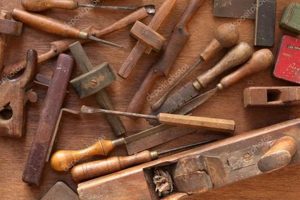
Implements powered by hand, designed for shaping and joining wood, constitute a foundational element within the craft. These instruments, including saws, chisels, planes, and measuring devices, facilitate controlled material removal and precise assembly. For example, a hand saw enables the accurate cutting of lumber to specific dimensions, while a chisel permits the refined shaping of joints for optimal structural integrity.
The employment of these instruments offers several advantages, notably increased control and precision compared to motorized alternatives. They promote a deeper connection with the material, fostering a heightened understanding of wood grain and its characteristics. Historically, these tools represent the primary means by which structures and objects were created, embodying a legacy of craftsmanship and resourcefulness. Their use encourages sustainability by reducing reliance on electricity and minimizing waste through careful material management.
Further discussion will delve into the specific types of these fundamental instruments, their proper usage, and essential maintenance procedures. Understanding the principles behind their operation is crucial for achieving quality results and ensuring longevity of both the tools and the crafted product. Subsequent sections will explore sharpening techniques, joint-making methods, and safety considerations necessary for effective and responsible work.
Essential Usage Guidelines
The proficient application of implements in woodworking necessitates adherence to specific principles. These guidelines facilitate precision, safety, and the attainment of optimal results.
Tip 1: Sharpness is Paramount. Maintaining a keen edge on all cutting tools is essential. A dull blade requires excessive force, increasing the risk of slippage and compromising the quality of the cut. Regularly hone and sharpen blades using appropriate stones and techniques.
Tip 2: Proper Grip and Stance. Adopt a stable stance and maintain a firm, controlled grip on the tool. Ensure hands are positioned safely away from the cutting path. Distribute body weight evenly for enhanced balance and control during operation.
Tip 3: Grain Direction Matters. Observe the grain of the wood and work with it, not against it. Cutting against the grain can lead to tear-out and splintering, resulting in an uneven surface and a compromised joint.
Tip 4: Use Guide Tools. Employ marking gauges, squares, and other guide tools to ensure accuracy in measurements and cuts. Precise layout reduces errors and minimizes material waste.
Tip 5: Practice Joint Preparation. Before committing to final assembly, practice dry-fitting joints. This allows for identification and correction of potential issues, ensuring a strong and aesthetically pleasing result.
Tip 6: Respect Material Limits. Wood possesses inherent properties, including hardness and flexibility. Recognize the limitations of the chosen material and adjust techniques accordingly. Avoid applying excessive force that could cause breakage or damage.
Tip 7: Employ Appropriate Lubrication. Applying wax or other appropriate lubricants to saw blades and plane soles reduces friction and facilitates smoother operation, particularly when working with hardwoods.
Adherence to these guidelines enhances both the quality of the woodworking project and the safety of the operator. A commitment to precision and careful technique yields demonstrably superior results.
The following sections will address specific tool maintenance procedures and advanced techniques for achieving complex woodworking outcomes.
1. Essential Cutting Edges

The functionality of implements for shaping wood directly correlates with the quality of the cutting edge. A keen edge allows for controlled material removal, enabling the creation of precise joinery and refined surfaces. Dull cutting edges, conversely, require increased force, leading to tear-out, splintering, and a higher risk of injury. A hand plane, for instance, with a razor-sharp blade will produce smooth shavings and a flawless surface, while the same plane with a dull blade will skip, chatter, and leave behind an uneven finish. A sharp chisel facilitates clean, accurate mortises and tenons, fundamental for strong and aesthetically pleasing joinery. Its sharpness determines precision and safety in operation.
The maintenance of cutting edges is, therefore, integral to proficiency. Regular honing and sharpening are not merely routine tasks but are critical factors influencing the outcome of any project. Specific techniques are employed to preserve or restore the integrity of these implements. Examples include using honing guides to maintain consistent bevel angles during sharpening and employing various grades of sharpening stones to achieve increasingly refined edges. Furthermore, the correct selection of cutting tools for specific tasks depends on an understanding of edge geometry and steel properties. A coping saw with fine teeth requires a delicate, sharp edge for intricate cuts, while a coarser tenon saw needs a more robust edge for efficient material removal.
In summary, the connection between cutting edges and woodworking implements is causal: sharpness directly determines the quality of work, influencing both accuracy and safety. Recognizing this connection is essential for achieving professional results, as well as maximizing implement lifespan and ensuring safe operation. Mastering sharpening skills is a foundational element of woodworking competence and reflects a commitment to quality craftsmanship.
2. Accurate Measuring Devices

Precision in woodworking hinges upon the employment of accurate measuring devices. These instruments establish dimensional control throughout the construction process, ensuring proper fit and function of components. Without accurate measurement, even the most skillful joinery becomes compromised.
- Rulers and Tape Measures: Establishing Overall Dimensions
Rulers and tape measures are used for establishing the overall dimensions of a workpiece. Their accurate calibration is essential for ensuring that individual components conform to the design specifications. An error in overall dimension can propagate throughout the project, leading to misaligned joints and structural instability.
- Squares: Ensuring Perpendicularity and Alignment
Squares, including try squares and combination squares, verify the perpendicularity of surfaces and ensure accurate alignment during assembly. A square that is out of true can result in skewed joinery and a visually unappealing final product. Miter squares are similarly employed for angled cuts, requiring precise calibration for accurate results.
- Marking Gauges: Consistent Material Removal
Marking gauges create consistent scribe lines for cutting and shaping operations. These instruments ensure that material is removed evenly, resulting in precise tenons, dados, and rabbets. An improperly adjusted marking gauge can lead to inconsistent material removal and poorly fitting joints.
- Levels and Plumbs: Assessing Horizontal/Vertical Alignment
Levels assess the horizontal alignment of surfaces, while plumbs determine vertical alignment. Although not directly related to cutting, levels and plumbs are essential when installing finished woodworking products (shelves, cabinets, etc). Errors in alignment can lead to instability or require shimming during installation.
The accuracy of measuring devices directly influences the quality and structural integrity of woodworking projects. Routine verification and maintenance of these instruments are essential for maintaining precision and minimizing errors. While advanced technologies like digital calipers offer increased accuracy, the principles of precise measurement remain fundamental to the craft.
3. Reliable Jointing Implements

The creation of robust and aesthetically pleasing woodworking projects necessitates the use of reliable jointing implements. Within the context of fundamental instruments, these tools assume a central role in uniting individual components into a cohesive whole. A lack of reliability in this category directly impacts the structural integrity and longevity of the finished product. For instance, a hand plane with a poorly secured blade, a quintessential jointing instrument, cannot produce consistent, flat surfaces necessary for tight-fitting joints, precluding the creation of durable furniture or architectural elements. Similarly, improperly maintained chisels, crucial for refining joint surfaces, will result in imprecise fits and weakened connections.
The practical significance of reliable jointing lies in their ability to create strong, visually seamless bonds between wood pieces. Mortise and tenon joints, dovetail joints, and rabbet joints, all require precise execution facilitated by well-maintained planes, chisels, and saws. Consider the construction of a cabinet; the cabinet’s structural integrity is directly linked to the quality of the joints holding its sides, top, and bottom together. If those joints are weak due to substandard tools or improper execution, the cabinet will be prone to racking, instability, and eventual failure. Reliable jointing enables the creation of heirloom-quality pieces capable of withstanding years of use.
In conclusion, the reliability of implements intended for creating joints is paramount within fundamental woodworking. Proper maintenance, careful selection of high-quality instruments, and a thorough understanding of joint-making techniques are all essential for achieving successful outcomes. Challenges such as tool wear, material inconsistencies, and operator error must be addressed proactively to ensure the durability and aesthetic appeal of woodworking projects. The connection between reliable jointing and project success underscores the importance of investing in and mastering these elements of the craft.
4. Secure Clamping Solutions

Secure clamping solutions are integral to the effective utilization of implements. They serve to immobilize workpieces during cutting, shaping, and assembly, directly influencing the precision and stability of woodworking operations. The application of appropriate clamping force prevents movement, minimizing the risk of errors and ensuring that joints are properly aligned and bonded. Without effective clamping, the potential for misalignment, slippage, and compromised structural integrity increases significantly. For example, when cutting dovetails by hand, vises securely hold the wood in place, enabling accurate and safe sawing and chiseling. Similarly, during glue-ups, clamps apply consistent pressure to ensure tight seams and strong adhesive bonds.
A range of clamping options exists, each designed for specific applications. Bench vises provide a stable platform for securing large workpieces, while hand-screw clamps offer versatility for clamping irregularly shaped objects. Pipe clamps, bar clamps, and spring clamps are used extensively in furniture making for applying even pressure across wider surfaces. Proper selection and application of these devices are crucial. Over-tightening can damage the wood, while insufficient pressure results in a weak joint. For instance, when gluing a miter joint, using corner clamps or band clamps ensures that the joint is held at the correct angle under uniform pressure while the adhesive cures. This exemplifies the direct correlation between secure clamping and joint quality.
In summary, the effectiveness of implements is inextricably linked to the availability and proper usage of secure clamping solutions. These devices provide the necessary stability for precise execution, ensuring that woodworking operations are conducted safely and with optimal results. The choice of the correct clamp for a given task, coupled with an understanding of appropriate clamping pressure, represents a core competency in woodworking. Neglecting this aspect can compromise the integrity and aesthetic quality of the finished product.
5. Effective Shaping Instruments
The ability to refine and contour wood forms represents a critical aspect of quality work. Effective shaping instruments, fundamental components, enable the creation of intricate details and the achievement of desired aesthetic profiles. These include rasps, files, spokeshaves, and drawknives. Their effectiveness lies in their capacity to remove small amounts of material precisely, allowing for controlled adjustments and the creation of complex curves and surfaces. Without these instruments, the ability to execute nuanced designs and achieve specific tactile qualities becomes significantly limited. A Windsor chair, for example, relies heavily on spokeshaves and drawknives to shape the spindles and create the curved seat. The final form and comfort of the chair are direct results of the skilled application of these shaping instruments.
Consider the use of rasps and files in creating a smoothly curved cabriole leg for a piece of furniture. These instruments allow for incremental material removal, enabling the woodworker to refine the leg’s shape until the desired profile is achieved. Similarly, spokeshaves are essential for shaping the curved rails of chairs and the rounded edges of tabletops. Drawknives are employed to remove larger amounts of material quickly, creating initial rough shapes that are then refined with other shaping devices. The selection and usage of the appropriate instrument depend upon the specific task, the type of wood, and the level of detail required. These tools are frequently employed in conjunction with layout lines and templates to ensure accuracy and consistency across multiple components.
In summation, effective shaping instruments form an indispensable part of the broader category. Their capacity to refine forms, create intricate details, and achieve desired tactile qualities directly influences the aesthetic appeal and functional performance of woodworking projects. The mastery of these shaping instruments requires practice, skill, and an understanding of wood characteristics. The success of a project requiring shaping is deeply connected to the proper choice and application of these essential tools.
Frequently Asked Questions Regarding Basic Woodworking Hand Tools
The following questions address common inquiries and misconceptions concerning fundamental implements employed in the craft of woodworking.
Question 1: What constitutes the essential set of hand tools for a beginning woodworker?
The essential set typically includes a crosscut saw, a rip saw, a smoothing plane, a block plane, a set of chisels, a marking gauge, a combination square, a measuring tape, and a sharpening stone. This selection allows for basic cutting, shaping, and jointing operations.
Question 2: Why are hand tools still relevant in an age of power tools?
These implements offer greater control and precision, particularly for intricate work. They also promote a deeper understanding of wood properties and require less reliance on electricity, fostering sustainability and quieter work environments.
Question 3: How often should implements require sharpening?
The frequency of sharpening depends on the type of wood being worked, the intensity of use, and the quality of the tool steel. Generally, planing tools and chisels benefit from honing before each use and sharpening after a few hours of use.
Question 4: What are the primary safety considerations when using implements?
Safety considerations include maintaining sharp edges, using proper grip techniques, securing workpieces adequately, wearing appropriate personal protective equipment (eye protection, gloves), and understanding wood grain direction.
Question 5: What is the difference between a smoothing plane and a block plane?
A smoothing plane is designed to produce a flawless surface on larger pieces of wood. A block plane, smaller and with a lower blade angle, is used for end-grain work and chamfering edges.
Question 6: How does the choice of wood affect the selection of implements?
Hardwoods, such as oak and maple, necessitate sharper, more robust implements compared to softwoods like pine. Certain wood species with interlocking grain may require specialized cutting techniques and tools.
Understanding these fundamental aspects of woodworking implements facilitates informed decision-making and promotes safe, effective practice.
The following section will transition to the maintenance and storage of tools, critical aspects of woodworking.
Conclusion
This exploration has underscored the enduring significance of implements within the domain of woodworking. These instruments, representing a legacy of craftsmanship and skill, facilitate controlled material removal, precise assembly, and refined shaping. Their continued relevance stems from their capacity to provide tactile feedback, promote sustainable practices, and foster a deeper understanding of wood’s intrinsic properties. Sharpness, accurate measurement, and secure clamping are fundamental principles that govern their effective utilization.
The ongoing mastery of implements represents a commitment to quality and precision. Individuals engaged in woodworking are encouraged to prioritize tool maintenance, understand wood characteristics, and adhere to safety protocols. Continued dedication to these practices ensures the preservation of traditional skills and the creation of enduring, aesthetically pleasing, and structurally sound woodworking projects. Their enduring legacy will continue to shape the craft for generations to come.