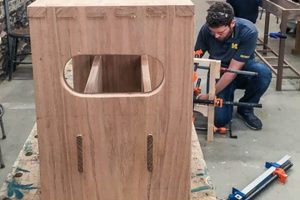
Introductory woodworking represents an individual’s initial forays into the craft of shaping wood. This stage typically involves projects of limited complexity, focusing on developing fundamental skills such as accurate measuring, safe sawing techniques, and proper joining methods. An example would be constructing a simple birdhouse or a small wooden box.
Engaging in this discipline offers numerous benefits, including the cultivation of problem-solving abilities, enhancement of hand-eye coordination, and the development of a tangible sense of accomplishment. Historically, these foundational skills were vital for creating essential household items and tools, demonstrating the enduring practicality of the craft.
The subsequent sections will delve into specific tools commonly used in this field, detail essential safety practices, and provide guidance on selecting appropriate wood types for starting projects. Furthermore, step-by-step instructions for basic projects will be offered to facilitate a practical understanding of the concepts discussed.
Guidance for Introductory Woodcraft
The following recommendations are designed to assist those commencing their journey in woodcraft, promoting safety, accuracy, and project success.
Tip 1: Prioritize Safety Equipment. Before initiating any project, ensure the availability and proper use of essential safety gear, including safety glasses, a dust mask, and hearing protection. These items minimize the risk of injury from flying debris, dust inhalation, and excessive noise.
Tip 2: Master Measurement Fundamentals. Accurate measurements are crucial for precise woodworking. Utilize a quality measuring tape and a combination square to ensure accurate markings before cutting or shaping wood. Consistency in measurement minimizes errors and material waste.
Tip 3: Sharp Tools Enhance Control. Dull tools require excessive force, increasing the potential for slippage and injury. Regularly sharpen chisels, planes, and saws to maintain optimal performance and control. Sharp tools result in cleaner cuts and improved efficiency.
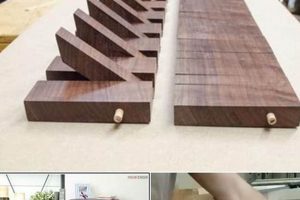
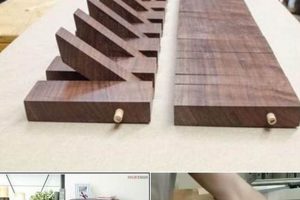
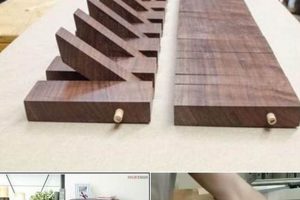
Tip 4: Practice Jointing Techniques. Learn and practice basic woodworking joints, such as butt joints, lap joints, and rabbet joints. Mastering these joints provides a solid foundation for constructing more complex projects. Secure and well-executed joints are essential for structural integrity.
Tip 5: Select Appropriate Wood Types. For early projects, consider using softwoods like pine or poplar, as they are easier to work with and less expensive than hardwoods. These woods are forgiving and allow for easier correction of mistakes while learning.
Tip 6: Apply Proper Finishing Techniques. A well-applied finish enhances the appearance and protects the wood. Start with sanding to a smooth surface, followed by the application of a stain or sealant, as desired. Follow manufacturer instructions for optimal results.
Tip 7: Seek Guidance and Resources. Consult experienced woodworkers, online resources, or instructional books to expand knowledge and refine techniques. Continuously learning and seeking feedback promotes skill development.
Adhering to these guidelines will contribute to a safer, more efficient, and ultimately more rewarding experience in the realm of introductory woodcraft.
The concluding section will provide resources and further learning paths to develop skills.
1. Safety First

The principle of “Safety First” is inextricably linked to success in introductory woodcraft. A failure to prioritize safety directly correlates with an increased risk of injury, project delays, and a diminished learning experience. For instance, the improper use of power tools without appropriate eye protection can result in severe eye damage, halting progress and potentially causing permanent harm. Similarly, neglecting to secure workpieces before cutting can lead to unstable material and an increased chance of the tool slipping, leading to cuts or abrasions.
Moreover, adherence to safety protocols fosters a culture of responsible craftsmanship. Correctly using a push stick when operating a table saw not only protects hands but also promotes precision in cutting. Wearing a dust mask prevents the inhalation of fine particles, minimizing the risk of respiratory problems that can develop over time. These practices create a positive environment where learning and skill development can flourish without fear of preventable incidents. A real-life instance is a beginner who, by consistently wearing ear protection when using loud power tools, avoids long-term hearing damage.
In conclusion, integrating “Safety First” into the initial stages of woodcraft is not merely a recommendation but a fundamental requirement. It provides a secure framework for skill acquisition, fosters a responsible approach to the craft, and ultimately contributes to a more enjoyable and sustainable woodworking practice. Prioritizing safety prevents injuries, reduces project disruptions, and enables continued learning and development, emphasizing the critical practical value of this integration within introductory woodcraft.
2. Accurate Measurement

In elementary woodcraft, accurate measurement serves as the foundational determinant of project success or failure. It dictates the precision with which wooden components fit together, directly influencing the structural integrity and aesthetic appeal of the final piece. Errors in measurement, even seemingly minor ones, can compound across multiple components, resulting in misaligned joints, unstable structures, and ultimately, unusable projects. The direct consequence of imprecise measuring is material wastage, increased labor time, and frustration for the individual initiating this craft.
The importance of accurate measurement manifests in numerous practical applications within woodcraft. Consider, for instance, the construction of a basic bookcase. If the shelves are not precisely cut to the specified width, they will either be too loose within the frame, compromising stability, or too tight, potentially splitting the side panels during assembly. Similarly, when creating a simple dovetailed box, even minute discrepancies in the layout of the dovetails can prevent the joints from fitting together correctly, leading to significant rework or complete abandonment of the project. Experienced woodworkers frequently emphasize the axiom: “Measure twice, cut once,” reflecting the cost-benefit analysis inherent in this essential skill.
In conclusion, accurate measurement is not merely a procedural step in introductory woodcraft, but rather an indispensable skill that underpins all subsequent operations. Its mastery requires patience, attention to detail, and the diligent application of appropriate measuring tools. While the initial learning curve may present challenges, the long-term benefits of precise measuring far outweigh the effort involved. The ability to accurately measure and transfer dimensions ensures project feasibility, reduces material waste, and fosters confidence in one’s woodworking abilities. It represents a critical building block for progressing to more complex projects and advanced techniques.
3. Sharp Tooling

Sharp tooling forms a critical, often underestimated, pillar of competent elementary woodcraft. The direct effect of utilizing properly sharpened tools is manifested in enhanced control, increased efficiency, and a significantly reduced risk of accidents. Dull tools necessitate increased force to achieve the desired cut or shaping, leading to slippage and a greater likelihood of injury. The importance of sharpness extends beyond mere ease of use; it directly impacts the quality of the finished product, leaving cleaner cuts and more precise joinery.
Consider the experience of a beginner attempting to create a mortise and tenon joint with a dull chisel. The required force can cause the chisel to veer off course, damaging the surrounding wood and resulting in a poorly fitted joint. In contrast, a sharp chisel allows for controlled, incremental removal of material, resulting in clean, square edges and a precisely fitted tenon. Similarly, a dull hand plane will tear the wood fibers, producing a rough, uneven surface that requires extensive sanding to correct. A sharp plane, on the other hand, effortlessly glides across the wood, leaving a smooth, burnished surface. The practical application of this understanding is evident in the reduced time and effort required to complete projects, as well as the superior quality of the final result.
In summary, the connection between sharp tooling and success in preliminary woodcraft is undeniable. While the initial investment in sharpening equipment and the time spent learning proper sharpening techniques may seem daunting, the long-term benefits far outweigh the perceived drawbacks. Sharp tools not only improve the quality of the work but also enhance safety and increase enjoyment of the craft. Overcoming the initial hurdle of mastering sharpening skills is an investment that pays dividends throughout a woodworker’s journey, enabling the creation of superior projects with greater ease and safety.
4. Basic Joinery
The link between basic joinery and introductory woodworking is causal and fundamental. Competency in joinery techniques dictates the structural integrity and aesthetic quality of completed projects. An understanding of these techniques provides the means to connect individual wooden components, transforming raw materials into functional or decorative items. Ineffective joinery results in unstable structures and projects prone to failure, while sound techniques yield durable and visually pleasing results. For instance, a novice woodworker attempting to construct a simple frame might utilize a butt joint secured only with fasteners. This approach, while seemingly straightforward, typically results in a weak connection susceptible to separation under stress. Conversely, learning to execute a mortise and tenon or dovetail joint, even in a simplified form, provides significantly greater strength and longevity.
The practical application of basic joinery extends beyond mere structural considerations. Well-executed joints often contribute to the visual appeal of a project, serving as decorative elements in their own right. Furthermore, mastering these techniques cultivates a deeper understanding of wood properties and the mechanics of assembly. A woodworker capable of accurately cutting and fitting joints gains a greater appreciation for the materials involved and develops a more refined sense of craftsmanship. The ability to create strong, visually appealing joints also allows for greater design flexibility, opening up possibilities for more complex and ambitious projects. For example, a craftsman attempting to construct a table might find a simple butt joint inadequate for supporting the weight and stresses placed upon it, leading them to apply half-lap joints to better distribute weight.
In conclusion, basic joinery is not merely a peripheral skill but a central competency within beginner woodwork. It bridges the gap between isolated components and functional wholes, providing the means to create durable and aesthetically pleasing objects. While mastering these techniques requires patience and practice, the benefits are substantial, fostering a deeper understanding of wood properties, enhancing design possibilities, and cultivating a stronger sense of craftsmanship. Addressing the challenge of learning joinery early in the woodworking journey is a worthwhile investment, setting the stage for future success and enabling the construction of more complex and rewarding projects.
5. Wood Selection

Wood selection is inextricably linked to success in introductory woodworking. The choice of wood directly influences the ease of working, the project’s structural integrity, and its final aesthetic appeal. Inappropriate selection can lead to difficulties in cutting, shaping, and joining, ultimately resulting in a compromised or failed project. For example, a beginner attempting to carve intricate details from a dense hardwood like oak will likely encounter considerable resistance and frustration, potentially damaging tools and hindering skill development. Conversely, choosing a softer wood like pine or basswood would allow for easier manipulation and a more satisfying learning experience.
The practical application of informed wood selection extends beyond workability. Different wood species exhibit varying levels of strength, stability, and resistance to decay. A project intended for outdoor use, such as a garden planter, requires a wood with inherent decay resistance, such as cedar or redwood. Utilizing a less durable wood like pine would necessitate extensive treatment with preservatives and even then, may result in premature failure. Furthermore, the aesthetic characteristics of different woods contribute significantly to the final appearance of a project. The warm tones and prominent grain pattern of cherry, for instance, lend themselves well to furniture making, while the lighter color and subtle grain of maple are often preferred for smaller, more delicate items. The selection of wood is a key design decision that impacts function and aesthetics. In contrast, plywood may offer an alternative for its dimensional stability.
In conclusion, the selection of an appropriate wood species is not a mere detail in beginner woodworking but a fundamental consideration that profoundly affects project outcomes. Knowledge of wood properties, including hardness, grain pattern, stability, and decay resistance, is essential for making informed decisions. By carefully considering these factors, beginners can choose materials that are both easy to work with and well-suited to the intended purpose of their projects, fostering confidence, encouraging skill development, and ensuring satisfying results. Addressing the challenges of initial wood selection by consulting experienced woodworkers or educational resources provides a solid foundation for a successful and rewarding woodworking journey. The wood selection significantly alters the skill demand.
Frequently Asked Questions
The following section addresses common inquiries and misconceptions surrounding the initial stages of woodcraft. Answers are provided to offer clarity and guidance for individuals embarking on their woodworking journey.
Question 1: What constitutes essential safety equipment for introductory woodcraft?
Appropriate safety gear includes, but is not limited to, safety glasses or a face shield to protect against flying debris, a dust mask or respirator to prevent inhalation of wood dust, and hearing protection to mitigate noise exposure from power tools. Additionally, wearing appropriate attire, such as close-toed shoes and avoiding loose clothing, is recommended.
Question 2: Is expensive equipment necessary to begin woodcraft?
No. A significant initial investment in high-end tools is not required. Basic hand tools, such as a hand saw, chisels, a measuring tape, a combination square, and a hand plane, can suffice for early projects. As skills develop, investment in power tools may be considered, but is not initially essential.
Question 3: What are appropriate wood species for beginner projects?
Softwoods, such as pine and poplar, are generally recommended for beginners due to their relative softness and ease of workability. These species are less expensive than hardwoods, making them more forgiving for mistakes during the learning process.
Question 4: How important is accurate measurement in woodcraft?
Accurate measurement is of paramount importance. Even slight errors can compound across multiple components, leading to misaligned joints, structural instability, and aesthetically displeasing results. Careful measurement practices, including double-checking dimensions, are crucial for project success.
Question 5: What are common mistakes made by beginner woodworkers?
Frequently observed errors include neglecting safety precautions, using dull tools, failing to properly secure workpieces, inaccurate measurement and cutting, and attempting projects beyond one’s skill level. Awareness of these potential pitfalls can aid in their avoidance.
Question 6: Are online resources sufficient for learning woodcraft, or is in-person instruction recommended?
While online resources offer valuable information and demonstrations, in-person instruction provides direct feedback and guidance from experienced woodworkers. A combination of both online learning and hands-on instruction is often the most effective approach.
In summary, prioritizing safety, utilizing appropriate tools and materials, practicing accurate measurement techniques, and acknowledging limitations are crucial elements for success in beginner woodcraft. Seeking guidance from experienced individuals and utilizing available resources can further enhance the learning process.
The subsequent section will delve into specific project ideas suitable for individuals with limited woodworking experience.
Conclusion
This exploration of beginner woodwork has emphasized the foundational skills, safety protocols, and material considerations essential for initial success. Mastering accurate measurement, maintaining sharp tools, understanding basic joinery, and selecting appropriate wood species are critical steps in developing competence. The consistent application of safety measures remains paramount throughout the learning process.
Proficiency in these fundamental areas establishes a solid basis for future woodworking endeavors. Continued practice, coupled with ongoing learning and refinement of techniques, will facilitate the construction of increasingly complex and rewarding projects. The diligent pursuit of knowledge and skill development is vital for sustained progress within this craft.