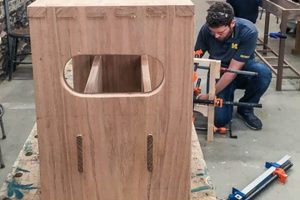
Introductory woodworking endeavors are characterized by their simplicity in design and execution, intended for individuals with minimal to no prior experience in woodworking. These projects typically involve basic cuts, joinery techniques, and readily available materials, emphasizing safety and skill development. A classic example would be constructing a birdhouse, requiring precise but straightforward cuts and assembly using nails or screws.
Engaging in elementary woodworking offers numerous advantages. It fosters the development of fine motor skills, spatial reasoning, and problem-solving capabilities. Furthermore, it provides an opportunity to create functional or decorative items, fostering a sense of accomplishment and creativity. Historically, woodworking served as a fundamental skill for crafting essential tools, furniture, and shelter, underscoring its enduring practical and artistic value.
The subsequent sections will delve into specific project ideas suitable for newcomers, discussing necessary tools, safety precautions, material selection, and step-by-step instructions to facilitate a successful and rewarding woodworking journey. Emphasis will be placed on projects that build a solid foundation of woodworking knowledge and technique.
Essential Guidance for Novice Woodcrafters
Embarking on the craft of woodworking necessitates a careful and considered approach, especially for individuals new to the discipline. The following tips are designed to provide foundational knowledge and best practices to ensure a safe, efficient, and rewarding introductory experience.
Tip 1: Prioritize Safety Protocols. Adherence to safety guidelines is paramount. Wear appropriate personal protective equipment, including safety glasses, hearing protection, and dust masks. Ensure the work area is well-ventilated and free of obstructions.
Tip 2: Master Fundamental Skills. Focus on developing proficiency in basic techniques such as measuring, marking, cutting, and sanding. Accurate execution of these skills forms the bedrock of all subsequent woodworking endeavors.
Tip 3: Select Appropriate Materials. Opt for readily available and inexpensive wood types such as pine or poplar for initial projects. These materials are forgiving and allow for error without significant financial consequence.
Tip 4: Invest in Quality Tools. While a comprehensive tool collection is not immediately necessary, prioritize acquiring high-quality essential tools, such as a hand saw, measuring tape, combination square, and sandpaper. These tools will provide better accuracy and longevity.
Tip 5: Start with Simple Designs. Choose project plans that feature straightforward construction techniques and minimal complexity. Avoid intricate joinery or advanced shaping methods until a solid foundation of skills is established.
Tip 6: Practice Patience and Precision. Woodworking requires a meticulous approach. Avoid rushing through steps and prioritize accuracy in all measurements and cuts. Small errors can compound into significant problems later in the project.
Tip 7: Learn from Mistakes. Errors are an inevitable part of the learning process. Analyze mistakes to identify areas for improvement and prevent their recurrence in future projects.
These fundamental guidelines provide a strong starting point for aspiring woodworkers. By emphasizing safety, skill development, and careful planning, individuals can cultivate a rewarding and enjoyable experience in the craft. The subsequent sections will explore specific projects designed to apply these principles and further enhance woodworking proficiency.
1. Safety First

Safety constitutes a foundational element within introductory woodworking projects. The inherent risks associated with woodworking tools and machinery necessitate a stringent adherence to safety protocols. For novices, the unfamiliarity with equipment and techniques amplifies the potential for accidents, making safety a non-negotiable aspect of project planning and execution. A lack of proper safety measures can result in injuries ranging from minor cuts and abrasions to more severe incidents involving power tools.
The integration of safety practices directly influences the success and overall experience of beginner woodworking. Proper eye protection, for example, prevents wood splinters and dust from causing eye injuries, thereby maintaining focus and efficiency. Similarly, the use of hearing protection mitigates the prolonged exposure to loud machinery noise, reducing the risk of auditory damage. Real-world scenarios illustrate the critical nature of these precautions; failure to use a push stick when operating a table saw can lead to severe hand injuries, while neglecting dust collection systems can result in respiratory problems over time.
In summary, prioritizing safety within entry-level woodworking serves as a protective measure against potential harm and fosters a sustainable, enjoyable engagement with the craft. By emphasizing safety education, implementing preventative measures, and cultivating a culture of responsible tool usage, beginners can mitigate risks, enhance their learning experience, and lay the groundwork for continued growth in woodworking. The understanding of this crucial link empowers novices to approach projects with confidence and a commitment to self-preservation.
2. Simple Designs

The adoption of elementary design principles is critical when initiating woodworking projects. Simplicity in design directly correlates with the accessibility and success rate for beginning woodworkers, influencing skill acquisition and overall project satisfaction.
- Reduced Complexity
Simple designs minimize the number of intricate cuts, complex joinery, and specialized tools required. A basic birdhouse, for example, typically involves straight cuts and simple assembly, contrasting sharply with the demands of a dovetail-jointed drawer. This reduction in complexity allows the beginner to focus on mastering fundamental skills such as measuring, cutting, and fastening.
- Lower Material Costs
Elementary designs often utilize less material and can be constructed from readily available, inexpensive lumber. A beginners cutting board, for instance, requires a single piece of wood, minimizing financial risk and allowing for experimentation. Conversely, elaborate furniture pieces necessitate significant investment in materials, which can be discouraging if errors occur.
- Increased Completion Rate
Projects with simple designs are more likely to be completed successfully by novice woodworkers. The reduced scope of these projects provides a tangible sense of accomplishment, fostering confidence and motivation to undertake more challenging endeavors. An unfinished, complex project, on the other hand, can lead to frustration and discouragement.
- Enhanced Skill Development
Simple designs provide an ideal platform for developing core woodworking skills. Practicing basic cuts and joinery on simpler projects allows the beginner to refine technique and build proficiency before tackling more demanding designs. A simple box, for example, provides valuable experience in accurate cutting, measuring, and fastening, skills that are transferable to a wide range of woodworking projects.
These facets underscore the importance of incorporating simple designs into introductory woodworking. By prioritizing projects with reduced complexity, lower material costs, increased completion rates, and enhanced skill development, novice woodworkers can cultivate a strong foundation in the craft. These early successes build confidence and encourage continued learning, fostering a lifelong passion for woodworking.
3. Basic Tools

The relationship between basic tools and introductory woodworking projects is fundamentally causal; the successful completion of such projects hinges upon possessing and properly utilizing a core set of implements. These tools are not merely accessories but rather essential components that facilitate the transformation of raw materials into finished products. The absence of even one critical tool, such as a reliable saw or measuring device, can significantly impede progress or compromise the integrity of the project.
The importance of basic tools extends beyond their functional utility. They serve as instruments for learning fundamental woodworking techniques. For instance, accurately marking dimensions with a combination square and a sharp pencil is a prerequisite for precise cuts, a skill that is essential for any woodworking endeavor. Similarly, mastering the use of a hand saw or a chisel develops dexterity and control, qualities that are invaluable for more complex projects. A real-world example would be constructing a simple wooden box. Success relies on the availability and correct application of a saw for cutting the pieces, a measuring tape for ensuring accurate dimensions, sandpaper for smoothing the surfaces, and a hammer or screwdriver for assembling the components. Without these tools, the project becomes impractical, if not impossible.
In summary, basic tools constitute an indispensable element of beginner woodworking projects. Their availability and proper usage directly influence project outcomes, skill development, and overall learning experience. While the allure of advanced machinery may be tempting, focusing on mastering basic tools provides a solid foundation for future woodworking endeavors. The challenge lies in selecting quality tools that offer both durability and precision, ensuring a rewarding and safe introduction to the craft.
4. Soft Wood

The utilization of softwood species directly impacts the success and learning curve associated with introductory woodworking projects. Softwoods, characterized by their relatively low density and ease of workability, offer distinct advantages for beginners. Their softer nature requires less force to cut, shape, and fasten, mitigating fatigue and reducing the risk of tool slippage. This ease of manipulation allows novices to focus on developing fundamental skills such as measuring, marking, and basic joinery techniques without the physical demands imposed by hardwoods. A practical example is evident in the construction of a simple birdhouse; using pine, a common softwood, allows for easy nail or screw insertion and cleaner cuts compared to a denser wood like oak, which may require pre-drilling and greater physical exertion.
Furthermore, softwoods typically exhibit a more consistent grain pattern and fewer knots than many hardwoods, simplifying the finishing process and reducing the likelihood of tear-out during planing or sanding. This characteristic is particularly beneficial for beginners who are still developing their skills in surface preparation and finishing techniques. A common application is in the creation of simple wooden boxes or shelves, where a smooth, even surface is desirable. Using a softwood like fir enables a more uniform stain or paint application, resulting in a more professional-looking final product. In contrast, the varied grain and density of some hardwoods can lead to uneven stain absorption and a less consistent finish, posing challenges for inexperienced woodworkers.
In conclusion, the strategic selection of softwood species plays a crucial role in facilitating a positive and productive learning experience for novice woodworkers. The ease of workability, consistent grain patterns, and forgiving nature of softwoods contribute to increased project success rates, enhanced skill development, and a reduction in potential frustration. While hardwoods offer aesthetic appeal and durability for advanced projects, softwoods remain the optimal choice for establishing a solid foundation in woodworking fundamentals. The careful matching of material properties to skill level is an essential element in the design and execution of successful introductory woodworking projects.
5. Accurate Measurement
Accurate measurement forms a cornerstone of success in all woodworking endeavors, but its significance is particularly pronounced for individuals undertaking introductory projects. Precise measurement is the causative factor in achieving properly fitting joints, level surfaces, and aesthetically pleasing proportions. Conversely, inaccuracies in measurement precipitate misaligned assemblies, structural weaknesses, and ultimately, project failure. The inherent simplicity of beginner projects amplifies the importance of accuracy; small errors, which might be masked in more complex designs, become glaringly obvious in simpler constructions.
As a component of introductory woodworking, accurate measurement serves as both a skill and a discipline. The act of meticulously measuring, marking, and verifying dimensions cultivates attention to detail and a systematic approach to problem-solving. Practical applications underscore this point. For example, constructing a basic picture frame necessitates precise measurements of the lumber pieces; even a slight discrepancy can result in a frame that is not square, rendering it unusable. Similarly, building a simple box requires accurate measurements to ensure the lid fits snugly and the sides align seamlessly. The ability to translate a design into tangible components through accurate measurement is a foundational skill that empowers beginners to progress to more challenging projects with confidence.
The practical significance of understanding the connection between accurate measurement and beginner woodworking lies in its ability to foster a positive and rewarding learning experience. When beginners experience early success due to accurate measurements, they are more likely to remain engaged and motivated to continue developing their woodworking skills. Conversely, repeated failures caused by inaccurate measurements can lead to frustration and discouragement. Therefore, instilling the importance of accurate measurement from the outset is crucial for cultivating a long-term passion for woodworking and ensuring a solid foundation for future success. Challenges often arise from improper tool usage or failure to double-check measurements, but these can be overcome through diligent practice and adherence to established best practices.
6. Patience Required

The successful completion of introductory woodworking hinges significantly on the attribute of patience. Beginner projects, while ostensibly simple, often present unforeseen challenges related to material behavior, tool operation, and joinery techniques. The iterative nature of woodworking involving precise measurements, careful cutting, and meticulous assembly necessitates a measured approach. Rushing through any of these stages increases the probability of errors, leading to rework, material waste, and ultimately, diminished project quality. The novice woodworker, lacking the ingrained efficiency of an experienced craftsman, will inherently require more time to execute each step effectively. For example, attempting to force a misaligned joint, rather than patiently diagnosing the issue and making necessary adjustments, may result in damaged components or structural weakness. A hurried approach to sanding can produce uneven surfaces, compromising the final finish. In essence, patience transforms from a virtue to a practical necessity for achieving satisfactory results in beginner woodworking.
The implications of impatience extend beyond the tangible outcome of a specific project. Developing patience during these initial woodworking experiences fosters a more resilient and adaptable mindset. Mistakes are inevitable in the learning process; however, a patient approach enables the beginner to view these errors not as setbacks, but as opportunities for learning and refinement. Consider the task of applying a finish; a rushed application may result in drips, runs, or an uneven sheen. A patient woodworker will take the time to properly prepare the surface, apply thin coats, and allow adequate drying time between applications, resulting in a superior finish. This process cultivates an understanding of material properties and the impact of various techniques. Furthermore, patience contributes to a safer working environment. Taking the time to properly set up tools, double-check measurements, and maintain a focused mindset reduces the risk of accidents. The cumulative effect of these benefits is a more confident and capable woodworker, better prepared to tackle increasingly complex projects.
In summary, patience is not merely a desirable trait but an essential ingredient for successful beginner woodworking. It mitigates errors, promotes skill development, and fosters a safer working environment. While the allure of quick results may be tempting, embracing a patient approach yields superior outcomes and cultivates a more profound appreciation for the craft. Challenges related to time constraints and the desire for immediate gratification can be addressed by setting realistic goals, breaking down projects into manageable steps, and focusing on the learning process rather than solely on the end product. This mindful approach transforms woodworking from a mere activity into a rewarding and enriching experience.
Frequently Asked Questions
This section addresses common inquiries and misconceptions encountered by individuals embarking on woodworking for the first time. The following questions aim to provide clear, concise, and practical guidance.
Question 1: What constitutes a suitable project for a woodworking projects beginner?
Appropriate projects for those new to woodworking are characterized by simple designs, minimal joinery, and readily available materials. Examples include cutting boards, small boxes, birdhouses, and simple shelves. The focus should be on mastering fundamental skills rather than tackling complex designs.
Question 2: What are the essential tools required for woodworking projects beginner?
The core tools for beginners include a measuring tape, combination square, hand saw or circular saw, sandpaper, a drill or screwdriver, and safety glasses. Additional tools may be added as skill and project complexity increase. Prioritizing quality over quantity is advisable when selecting initial tools.
Question 3: What type of wood is recommended for woodworking projects beginner?
Softwoods, such as pine or poplar, are generally recommended for beginners due to their workability and affordability. These species are easier to cut, shape, and fasten than hardwoods. As experience grows, experimentation with hardwoods may be considered.
Question 4: How crucial is safety in woodworking projects beginner?
Safety is of paramount importance. The use of safety glasses, hearing protection, and dust masks is essential. A thorough understanding of tool operation and adherence to safety guidelines are crucial to prevent injuries.
Question 5: What are common mistakes made by woodworking projects beginner?
Frequent errors include inaccurate measurements, improper tool usage, neglecting safety precautions, and rushing through the project. A methodical approach, careful planning, and attention to detail can mitigate these mistakes.
Question 6: How can woodworking projects beginner improve their skills and knowledge?
Skill enhancement is achieved through consistent practice, studying woodworking techniques, seeking guidance from experienced woodworkers, and analyzing mistakes. Online resources, books, and woodworking classes can provide valuable knowledge and instruction.
In summary, initiating woodworking requires a focus on simple projects, essential tools, appropriate materials, and unwavering attention to safety. Consistent practice and a willingness to learn from mistakes are vital for skill development and project success.
The subsequent section will delve into specific project ideas tailored for individuals starting their woodworking journey.
Conclusion
This exploration of beginner woodworking projects has underscored several fundamental principles: prioritizing safety, selecting simple designs, utilizing essential tools, choosing appropriate materials, emphasizing accurate measurement, and cultivating patience. These elements collectively form the bedrock upon which novice woodworkers can build a foundation of skills and experience. Success in initial woodworking endeavors depends not only on technical aptitude but also on a disciplined and thoughtful approach to the craft.
The path from novice to experienced woodworker is paved with consistent practice and a dedication to continuous learning. Individuals who embrace these principles and approach each project with diligence and attention to detail are best positioned to unlock the creative potential inherent in the craft. The future of woodworking rests on the shoulders of those willing to embark on this journey with a commitment to excellence and a respect for the traditions of the craft.