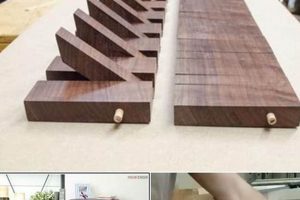
A compilation of essential implements serves as a foundational element for individuals initiating their journey into woodworking. This inventory typically encompasses items necessary for basic tasks such as measuring, cutting, shaping, and joining wood. A typical example might include a hand saw, a measuring tape, a combination square, chisels, and a hand plane.
The adoption of a well-considered set of these implements offers numerous advantages. It provides a structured approach to learning fundamental woodworking techniques, fosters safety through the use of appropriate equipment, and enables the completion of a wider range of projects. Historically, craftspeople would apprentice for extended periods to acquire and master these tools, highlighting their enduring significance in woodworking traditions.
The subsequent sections of this document will delve into specific categories of these implements, outlining their functions, selection criteria, and safe operating practices. Each section aims to equip aspiring woodworkers with the knowledge needed to make informed purchasing decisions and confidently embark on their woodworking endeavors.
Essential Guidance for Acquiring Woodworking Starter Implements
This section provides targeted guidance on the acquisition and utilization of essential woodworking starter implements. The focus remains on practical advice to ensure successful project completion and safe workshop practices.
Tip 1: Prioritize Measuring Instruments: Accurate measurements are fundamental to woodworking success. Invest in a quality measuring tape, combination square, and marking gauge to ensure precision in all project phases. For example, a precisely marked line using a marking gauge leads to cleaner, more accurate cuts.
Tip 2: Select a Versatile Hand Saw: A good hand saw is indispensable for making controlled cuts. A crosscut saw, suitable for cutting across the wood grain, or a rip saw, designed for cutting along the grain, represents a worthwhile initial investment. Practice proper sawing techniques to achieve straight and accurate results.
Tip 3: Acquire Sharp Chisels: Chisels are essential for refining joints and shaping wood. Begin with a set of three or four chisels of varying widths. Maintain their sharpness through regular honing and stropping. A dull chisel is more dangerous and less effective than a sharp one.
Tip 4: Invest in a Smoothing Plane: A hand plane, specifically a smoothing plane, allows for creating flat, even surfaces and refining edges. Learn to adjust the blade for optimal cutting depth and practice planing techniques on scrap wood before working on finished pieces.
Tip 5: Choose Appropriate Clamps: Clamps are crucial for holding workpieces together during glue-ups. Pipe clamps and bar clamps offer versatility for various project sizes. Ensure adequate clamping pressure to achieve strong and lasting bonds.
Tip 6: Consider a Block Plane for Small Tasks: A block plane is smaller and ideal for chamfering edges and refining end grain. Its compact size allows for greater control and maneuverability in detailed work.
Tip 7: Secure Necessary Safety Equipment: Safety is paramount. Prioritize safety glasses, a dust mask, and hearing protection. Establish a safe working environment and adhere to all safety precautions when operating any woodworking implements.
These guidelines emphasize the importance of selecting quality implements and mastering fundamental techniques. Investing time in learning proper usage and maintenance will contribute significantly to woodworking proficiency.
The concluding section will summarize key considerations and offer resources for continued learning and skill development in woodworking.
1. Essential hand tools

Essential hand tools constitute a core component of any beginner woodworking tools list. The selection and mastery of these implements directly influence the feasibility and quality of initial woodworking projects. Without access to tools such as saws, chisels, and measuring instruments, the ability to accurately dimension lumber or create basic joinery is severely limited. For example, attempting to construct a simple box joint without a precise saw and sharp chisels is likely to result in misaligned components and a structurally unsound final product. The inclusion of essential hand tools within a beginner’s list is, therefore, not merely a suggestion, but a practical necessity for learning fundamental woodworking skills.
The availability of these tools enables the execution of basic woodworking techniques and forms the foundation for more advanced skills. Understanding the function and proper usage of each tool is equally important as simply possessing them. For instance, a well-tuned hand plane allows for the creation of smooth, flat surfaces, a crucial step in many woodworking projects. Similarly, mastering the use of a marking gauge ensures consistent and accurate lines, essential for precise joinery. The correct application of these essential hand tools directly contributes to improved project outcomes and increased confidence in woodworking abilities.
In summary, essential hand tools represent an indispensable element of a beginner woodworking tools list. Their presence enables the learning and application of fundamental woodworking skills, directly impacting the success and quality of initial projects. Overlooking this connection can significantly hinder the learning process and result in frustration. A thoughtful and well-equipped hand tool collection serves as the foundation for continued growth and development in the craft of woodworking.
2. Safety prerequisites

Safety prerequisites represent a non-negotiable component within a comprehensive beginner woodworking tools list. The inherent risk associated with woodworking implements, such as sharp-edged cutting tools and high-speed power equipment, necessitates the inclusion of appropriate protective measures. Failure to address safety considerations introduces a tangible risk of injury, ranging from minor cuts and abrasions to more severe lacerations, eye damage, or even amputation. For example, neglecting to use safety glasses while operating a lathe can result in wood fragments or debris lodging in the eyes, causing potentially permanent vision impairment. Thus, safety gear constitutes a fundamental aspect of any inventory intended for novice woodworkers.
A well-defined list of safety prerequisites typically encompasses personal protective equipment (PPE), including safety glasses, hearing protection, and dust masks or respirators. It also extends to safe workshop practices, such as proper tool handling techniques, secure workpiece clamping, and awareness of potential hazards. For instance, instructing a beginner to always push a workpiece away from the blade of a table saw, rather than pulling it, significantly reduces the risk of kickback, a common and potentially dangerous occurrence. Moreover, ensuring adequate ventilation mitigates the health risks associated with inhaling sawdust or finishing fumes. The absence of such precautions undermines the learning process and exposes the individual to preventable harm.
In conclusion, the integration of safety prerequisites into a beginner woodworking tools list is paramount for mitigating potential risks and fostering a safe learning environment. The absence of these provisions compromises the individual’s well-being and potentially leads to severe injury. Prioritizing safety through the inclusion of appropriate equipment and the adherence to established practices is, therefore, not merely an option but a fundamental responsibility for both the instructor and the novice woodworker.
3. Measurement accuracy

Measurement accuracy is inextricably linked to the efficacy of any beginner woodworking tools list. Imprecise measurements inevitably lead to flawed projects, regardless of the quality of other implements. A discrepancy in dimensioning lumber, for example, can result in ill-fitting joinery, structural instability, and an overall reduction in the aesthetic appeal of the finished piece. The direct consequence of neglecting measurement accuracy is a diminished ability to execute woodworking techniques with proficiency, thereby hindering skill development and fostering frustration. The inclusion of reliable measuring tools is, therefore, not an ancillary consideration, but rather a critical component of a functional and effective list.
The practical significance of measurement accuracy extends beyond simply achieving correct dimensions. Accurate measurements are essential for creating repeatable cuts, a fundamental requirement for complex joinery and batch production. Furthermore, consistent measurements contribute to efficient material utilization, reducing waste and minimizing costs. In the construction of a cabinet, for instance, even minor variations in the dimensions of individual components can accumulate, leading to significant discrepancies in the overall size and shape of the final assembly. This underscores the importance of investing in high-quality measuring tools and developing meticulous measuring habits from the outset of a woodworking journey.
In summary, measurement accuracy is a cornerstone of successful woodworking, and its consideration is paramount when assembling a beginner woodworking tools list. Inadequate measuring implements or a lack of attention to detail in measurement processes directly impede project outcomes and hinder skill acquisition. Therefore, prioritizing accurate measuring tools and fostering meticulous measuring practices represents a fundamental investment in the aspiring woodworker’s capabilities and long-term success within the craft. The inclusion of these tools and skills directly correlates with the ability to produce high-quality, functional, and aesthetically pleasing woodworking projects.
4. Woodworking joinery

Woodworking joinery, the process of connecting two or more pieces of wood to create a functional or aesthetic whole, directly dictates the composition of a beginner woodworking tools list. The specific joinery techniques a beginner intends to learn necessitate the inclusion of corresponding tools. Mortise and tenon joints, for instance, require chisels for creating mortises and saws for shaping tenons, while simpler butt joints may only demand glue and clamps. Therefore, the planned application of joinery methods serves as a primary determinant in tool selection. The absence of appropriate tools for a chosen joint will invariably result in either a compromised joint or project abandonment.
The importance of woodworking joinery as a guiding principle in assembling a beginner’s inventory stems from its role in establishing structural integrity and defining the overall design of a woodworking project. A well-executed dovetail joint, for example, not only provides exceptional strength but also adds a visual element of craftsmanship. The beginner must, therefore, acquire the necessary saws, chisels, and marking tools to create this joint effectively. Conversely, if the initial focus is on basic box construction using screws, the tools required will shift towards drills, drivers, and countersinking bits. The selection process should reflect the desired level of skill development and project complexity.
In conclusion, woodworking joinery and a beginner woodworking tools list are inextricably linked. The desired joinery methods directly influence the tools required for project execution. Understanding this relationship enables a focused and efficient approach to tool acquisition, ensuring the beginner possesses the necessary implements to achieve their woodworking goals. Challenges arise when the planned joinery exceeds the capabilities of the selected tools, highlighting the need for careful consideration and progressive expansion of the tool inventory as skills advance.
5. Material preparation

Material preparation constitutes a crucial phase in woodworking that directly impacts the quality and precision of the final product. A well-considered beginner woodworking tools list must include implements essential for this preparatory stage, as the condition of the wood significantly influences the ease and accuracy of subsequent operations.
- Planing and Surfacing
Planing and surfacing establish a flat, even surface on lumber, eliminating warps, twists, and cupping. Tools such as hand planes or jointers are essential for achieving this. For instance, accurately flattening a face of a board using a hand plane is often the initial step in preparing stock for furniture construction. An inadequate surfacing process can lead to misalignment, difficulty in joinery, and structural weakness.
- Dimensioning and Squaring
Dimensioning involves cutting lumber to precise dimensions, while squaring ensures that edges and faces are perpendicular. Tools such as hand saws, measuring tapes, combination squares, and marking gauges are crucial for accurate dimensioning. Inaccurate dimensions can lead to ill-fitting joints, compromised structural integrity, and aesthetic imperfections. The ability to accurately dimension stock is paramount in cabinet making, frame construction, and nearly all woodworking applications.
- Smoothing and Sanding
Smoothing removes imperfections and prepares the wood surface for finishing. Scrapers, sandpaper, and sanding blocks facilitate this process. For example, smoothing a tabletop before applying a finish ensures a uniform and appealing appearance. Inadequate smoothing can result in uneven finish application, visible scratches, and a less professional outcome.
- Moisture Content Management
The moisture content of wood affects its stability and workability. A moisture meter can be a valuable addition to a beginner’s toolkit, enabling informed decisions about wood selection and acclimatization. Using wood with excessive moisture content can lead to warping, cracking, or joint failure. Conversely, excessively dry wood may become brittle and prone to splitting. Monitoring moisture content is essential for long-lasting and stable woodworking projects.
These facets of material preparation highlight the interconnectedness of tool selection, skill development, and project outcomes. A beginner woodworking tools list that addresses these preparatory needs equips the woodworker with the ability to transform raw lumber into precisely dimensioned and prepared stock, setting the stage for successful woodworking endeavors.
Frequently Asked Questions Regarding Beginner Woodworking Tools Lists
The following section addresses commonly encountered queries and misconceptions related to compiling a beginner woodworking tools list. These responses aim to provide clarity and direction for individuals initiating their journey into woodworking.
Question 1: What constitutes the absolute minimum set of implements required to commence woodworking?
A functional baseline should encompass a measuring tape, a combination square, a hand saw, a set of chisels (at least three sizes), and basic safety equipment. These allow for rudimentary dimensioning, cutting, and joinery.
Question 2: Is it advisable to purchase an all-inclusive ‘beginner’ tool kit, or acquire tools individually?
Acquiring tools individually often proves more beneficial. Pre-packaged kits frequently contain lower-quality implements and may include items that are not immediately necessary for basic tasks. Selective purchasing allows for investment in higher-quality tools that are specifically suited to the woodworker’s intended projects.
Question 3: What level of investment should be anticipated for establishing a basic woodworking toolkit?
A functional starting point necessitates a financial commitment ranging from $200 to $500, depending on the quality and brand of the chosen implements. Prioritize quality over quantity, focusing on acquiring essential tools that are durable and reliable.
Question 4: How crucial is the initial investment in premium-grade tools?
While top-tier professional tools are not mandatory for beginners, investing in mid-range implements from reputable manufacturers is highly recommended. These tools typically offer improved performance, longevity, and overall user experience, facilitating skill development and minimizing frustration.
Question 5: Where should new woodworkers focus their efforts for acquiring essential knowledge regarding tool operation and maintenance?
Educational resources encompass online tutorials, books, and local woodworking classes. Practicing proper techniques on scrap wood is crucial before undertaking projects using valuable materials. Regular maintenance, such as sharpening blades and cleaning tools, ensures optimal performance and extends the lifespan of the implements.
Question 6: What safety precautions should be considered paramount for beginner woodworkers?
Mandatory safety measures include wearing appropriate eye protection (safety glasses or a face shield), utilizing hearing protection (earplugs or earmuffs), and employing a dust mask or respirator to mitigate inhalation of wood dust. Additionally, familiarize oneself with safe tool operating procedures and maintain a clean and organized workspace.
These FAQs emphasize the importance of a thoughtful and informed approach to assembling a beginner woodworking tools list. By prioritizing quality, safety, and educational resources, novice woodworkers can establish a solid foundation for skill development and project success.
The subsequent section will offer guidance on expanding a basic toolkit as skills and project complexity increase.
The Indispensable Foundation
The preceding analysis has underscored the critical role of a strategically curated inventory for individuals embarking on woodworking. The selection process necessitates prioritizing essential hand tools, rigorous safety protocols, the attainment of measurement precision, an understanding of joinery techniques, and meticulous material preparation. A deficiency in any of these areas compromises the effectiveness of the inventory and hinders the acquisition of fundamental woodworking skills.
Therefore, the creation of a “beginner woodworking tools list” should not be approached as a mere compilation of implements, but as the establishment of a foundational platform for skill development and project success. The diligent selection, proper utilization, and conscientious maintenance of these implements represent a sustained investment in the craft. Future endeavors depend on the solid basis established at the outset, fostering a trajectory towards expertise and the realization of intricate woodworking aspirations.