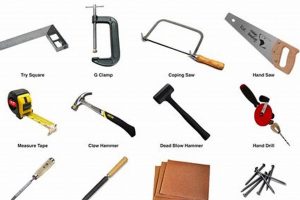
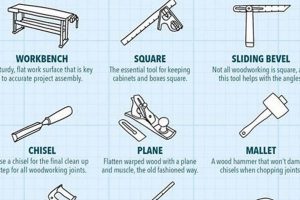
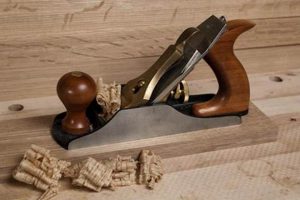
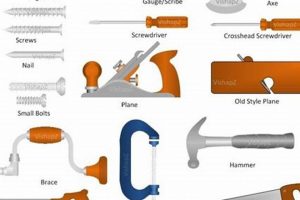
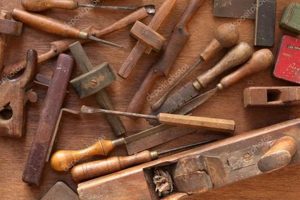
Implements manipulated directly by the user, without reliance on external power sources, designed specifically for shaping and constructing objects from timber. These instruments encompass a wide array, from saws and planes to chisels and measuring devices, each serving a distinct purpose in the creation of wooden articles. A block plane, for instance, is employed to smooth end grain, while a marking gauge establishes parallel lines on a workpiece.
The utilization of these implements promotes precision, control, and a deep understanding of the material. Historically, these were the primary means of fabrication, resulting in durable and aesthetically pleasing products. Their continued relevance stems from the enhanced level of tactile engagement they offer, allowing for minute adjustments and a connection to the craft absent in mechanized processes. They cultivate patience, develop fine motor skills, and often result in superior joinery and surface finishes.
Subsequent sections will delve into specific categories of these instruments, examining their functionalities, maintenance requirements, and optimal applications within a variety of project types. Further discussion will address the selection criteria based on project needs and budget considerations. Finally, methods for sharpening and preserving these valuable assets will be presented.
Essential Guidance
The following points provide crucial insights for maximizing the effectiveness and longevity of woodworking implements operated by hand.
Tip 1: Sharpening is Paramount: Maintaining a keen edge on blades is not merely desirable, but fundamentally necessary. Dull edges require excessive force, leading to inaccurate cuts and potential injury. Consistent honing and sharpening significantly improve both the quality of the work and the safety of the user.
Tip 2: Wood Grain Matters: Always assess the direction of the wood grain before initiating a cut. Working against the grain can result in tear-out and splintering, negatively impacting the final finish. Observational skill in grain orientation is critical for achieving clean and precise results.
Tip 3: Secure Workholding: Reliable clamping and workholding are essential for stability and safety. A properly secured workpiece minimizes movement during the cutting or shaping process, preventing errors and reducing the risk of accidents. Invest in quality vises, clamps, and bench dogs.
Tip 4: Gradual Material Removal: Instead of attempting to remove large amounts of material at once, opt for multiple shallow passes. This approach offers greater control, reduces strain on the implement, and produces a smoother, more consistent surface.
Tip 5: Regular Cleaning and Lubrication: Following each use, thoroughly clean each instrument to remove sawdust and debris. Apply a light coating of oil or wax to prevent rust and corrosion, preserving their performance and extending their lifespan.
Tip 6: Proper Storage: Store these specialized instruments in a dry, organized environment to prevent damage and maintain their optimal condition. Wall-mounted racks, drawers lined with protective material, and designated storage cases are recommended.
By adhering to these principles, practitioners can enhance their woodworking skills, improve the quality of their finished projects, and ensure the enduring functionality of their tools.
The subsequent section will examine techniques for troubleshooting common problems encountered during usage.
1. Precision

In woodworking, precision refers to the degree of accuracy and repeatability achieved in cutting, shaping, and joining timber. When utilizing instruments manipulated by hand, this characteristic becomes particularly critical, as the outcome is directly dependent on the skill and control of the individual. Variations in technique, sharpness of the cutting edge, and the stability of the workpiece all contribute to the final accuracy. For instance, constructing a dovetail joint with tight tolerances requires meticulous marking, precise sawing, and careful paring. The absence of this leads to gaps and structural weakness in the joint.
Attaining a high level of precision with manual implements demands understanding of the material properties, proper tool maintenance, and a refined technique. Consistent sharpening of blades is essential for clean, predictable cuts. Furthermore, secure workholding prevents movement and vibration, minimizing errors. The use of measuring devices, such as squares and marking gauges, ensures that lines and angles are accurately transferred to the workpiece. Example such as cabinetry and furniture making, where dimensional accuracy is paramount for proper fit and function.
While the pursuit of absolute accuracy is a continuous endeavor, understanding the factors that influence it allows for improved outcomes. Challenges include wood movement due to changes in humidity and inherent variations in the material itself. By mastering the fundamentals of tool usage, maintaining sharp cutting edges, and employing meticulous work habits, it is possible to achieve a level of precision that yields both functional and aesthetically pleasing wooden objects. The result is durable and aesthetically well designed pieces, like the type crafted by furniture artisans with hand tool woodworking tradition.
2. Sharpening

The maintenance of keen cutting edges on hand tools for woodworking constitutes a critical aspect of their effective utilization. Sharpness dictates the efficiency, precision, and safety of these instruments. Diminished edge quality results in increased force exertion, reduced accuracy, and elevated risk of injury.
- Cutting Efficiency
Sharp edges sever wood fibers cleanly, requiring less force and reducing fatigue. For example, a properly sharpened plane glides smoothly across the surface, producing even shavings, while a dull plane tears the wood, leaving a rough finish. This directly impacts the speed and quality of the woodworking process.
- Precision and Control
A sharp instrument allows for controlled cuts and refined details. Chisels with well-honed edges can create precise joinery, such as dovetails, while dull chisels tend to crush the wood fibers, hindering accurate shaping. This is essential for achieving tight-fitting and structurally sound joints.
- Safety Enhancement
Dull tools necessitate greater force, increasing the likelihood of slippage and accidental injury. A sharp saw requires less pressure, reducing the risk of losing control and cutting oneself. Maintaining sharp tools contributes to a safer working environment and minimizes the potential for accidents.
- Tool Longevity
Regular honing and sharpening, prevents excessive wear and tear on the blade. Over time, using only slightly dulled tools will ensure they are maintained in top condition.
Therefore, the application of appropriate sharpening techniques, coupled with the diligent maintenance of cutting edges, is fundamental to optimizing the performance of hand tools for woodworking. Prioritizing this aspect not only enhances the quality of the finished product but also safeguards the user and extends the lifespan of the instruments.
3. Material Knowledge

The effective application of implements powered by human strength when shaping timber necessitates comprehensive material knowledge. A craftsman’s understanding of wood species, grain orientation, and inherent characteristics directly influences tool selection, cutting techniques, and ultimately, the quality of the finished product. The hardness of oak, for instance, requires the use of robust, well-sharpened chisels and planes, while the softer nature of pine allows for finer tools and more delicate cuts. Ignoring these distinctions leads to inefficient work, tool damage, and unsatisfactory results. Material knowledge is therefore a critical prerequisite for successful hand tool woodworking.
Practical implications of this understanding are manifold. For example, attempting to force a plane against the grain of figured maple will inevitably result in tear-out, rendering the surface uneven and unsuitable for finishing. Conversely, employing a drawknife skillfully along the grain of green wood allows for efficient shaping and removal of material. The proper choice of saw blade tooth configurationrip-cut versus crosscutdepends entirely on the orientation of the grain relative to the intended cut. Likewise, when selecting fasteners, awareness of wood movement and moisture content is essential to prevent splitting or joint failure over time. Skilled use of hand tools can also mitigate certain defects; for example, small knots can be strategically incorporated into designs or carefully excised using saws and chisels to minimize visual impact.
In summary, proficiency in hand tools for woodworking is inextricably linked to a deep understanding of the materials being worked. Success relies on recognizing how the properties of wood influence tool performance and applying that knowledge to achieve optimal results. Challenges include the variability within a single board and the unpredictable behavior of wood over time. Ongoing learning and experience are essential for honing material knowledge and realizing the full potential of manual woodworking techniques.
4. Ergonomics

The application of ergonomic principles to manual woodworking instruments constitutes a critical factor in user comfort, efficiency, and long-term physical well-being. The design and utilization of these specialized tools should consider the natural movements and limitations of the human body to minimize strain and maximize control. Neglecting ergonomic factors can lead to musculoskeletal disorders and diminished performance.
- Handle Design and Grip
The shape, size, and material of tool handles directly affect grip strength, hand fatigue, and control. Handles should be designed to fit comfortably in the hand, allowing for a secure grip without excessive force. Materials like hardwood or textured composites provide a good balance of comfort and durability. For example, a carving knife with a contoured handle reduces strain during prolonged use, enabling more precise cuts.
- Tool Weight and Balance
The distribution of weight within a tool impacts stability and maneuverability. A well-balanced tool requires less effort to control, reducing fatigue and improving accuracy. Excessive weight can lead to muscle strain, while insufficient weight may compromise stability. A hand plane, for instance, should be balanced so that it glides smoothly across the wood without requiring undue pressure from the user.
- Posture and Work Surface Height
Maintaining proper posture during woodworking is crucial for preventing back pain and other musculoskeletal issues. Work surfaces should be adjusted to a height that allows the user to stand or sit comfortably without hunching or straining. The positioning of the workpiece should also be optimized to minimize reaching and twisting. Bending over can be avoided by adjustable work tables.
- Repetitive Motion and Vibration Dampening
Woodworking often involves repetitive motions, such as sawing, planing, and chiseling. Prolonged exposure to these motions can lead to repetitive strain injuries. Ergonomic tools should be designed to minimize vibration and reduce the force required for each motion. Using a saw with vibration-dampening handle can alleviate these issues.
Integrating these ergonomic considerations into the selection, use, and maintenance of instruments significantly enhances the woodworking experience. These ergonomic strategies are essential, allowing for improved comfort, reduced risk of injury, and increased long-term productivity.
5. Maintenance
The functionality and longevity of hand tools for woodworking are intrinsically linked to diligent maintenance practices. Neglect of these practices invariably leads to diminished performance, increased risk of tool failure, and compromised project quality. The correlation between maintenance and the operational lifespan of these instruments is direct: consistent care extends their utility; conversely, indifference accelerates their deterioration.
Preventative actions such as routine cleaning, lubrication, and sharpening represent fundamental aspects of this discipline. Sawdust, resin, and moisture accumulation contribute to corrosion and impede smooth operation. Periodic application of protective oils or waxes mitigates these effects. Similarly, the acuity of cutting edges is crucial for precise and efficient material removal. Dull blades necessitate increased force, augmenting the potential for accidents and producing substandard results. For instance, a neglected hand plane will produce a rough, uneven surface, necessitating additional sanding and reducing the overall efficiency of the task. A rusted saw will bind and buckle, making it difficult to produce a straight cut. The effectiveness of any woodworking project hinges upon the sustained condition of the involved instruments.
The practical significance of understanding this relationship lies in optimizing the return on investment in specialized woodworking implements. Regular maintenance, although requiring time and effort, far outweighs the cost of premature replacement or the consequences of using substandard instruments. Moreover, the skills acquired through maintaining implements directly enhance the craftsman’s understanding of tool mechanics and material properties, leading to improved woodworking outcomes. By prioritizing maintenance, woodworkers ensure their tools remain reliable assets, capable of producing high-quality work for extended periods.
6. Technique

Technique, in the context of hand tools for woodworking, represents the specific methods and skills employed to manipulate instruments for shaping and joining timber. A direct correlation exists between the refinement of technique and the quality of the finished product. The selection of appropriate instruments, combined with proper application, determines efficiency and precision. Inefficient technique leads to wasted material, flawed joinery, and user fatigue. Conversely, mastery of technique enables intricate detailing, seamless connections, and aesthetically pleasing results. The use of a spokeshave to create a smooth, flowing curve on a chair leg exemplifies the importance of practiced technique. A novice user may struggle to achieve a consistent curve, whereas an experienced craftsman can effortlessly shape the wood with precision and control.
Practical applications of refined technique extend beyond aesthetic considerations. For example, accurately sawing a tenon cheek requires a controlled grip, proper stance, and consistent saw stroke. Inadequate technique can result in an angled or uneven cut, compromising the structural integrity of the joint. Similarly, achieving a flat and smooth surface with a hand plane demands precise blade adjustment, consistent pressure, and a synchronized body movement. An understanding of grain direction and its impact on planing is also integral to preventing tear-out. Professional cabinetmakers rely on their refined techniques to fabricate robust and visually appealing furniture that endures for generations.
In summary, technique is a critical component of successful hand tool woodworking. Its mastery requires dedicated practice, focused observation, and a willingness to learn from mistakes. The challenges inherent in hand tool work are mitigated by the acquisition of appropriate techniques, which enable woodworkers to create durable, aesthetically pleasing, and functional objects. Understanding these techniques unlocks the full potential of these implements and elevates the craft to an art form.
7. Selection

The appropriate selection of hand tools for woodworking is a pivotal determinant of project success, craftsman satisfaction, and efficient resource allocation. The market offers a vast array of instruments, each designed for specific tasks and varying in quality, materials, and price. Informed decision-making during the selection process minimizes errors, optimizes workflow, and ensures long-term value.
- Tool Quality and Material Composition
The quality of materials used in manufacturing impacts durability, precision, and overall performance. Instruments crafted from high-carbon steel, for instance, retain their edge longer and withstand more rigorous use compared to those made from inferior alloys. Furthermore, the fit and finish of individual components contribute to ergonomic comfort and operational smoothness. The selection of a well-forged chisel over a stamped, mass-produced alternative exemplifies this principle; the former offers superior edge retention and control, resulting in cleaner cuts and prolonged usability.
- Task-Specific Suitability
Different woodworking projects demand different tools. A delicate inlay requires fine, precise chisels, while rough shaping of large stock necessitates robust saws and planes. Selecting the right tool for the job enhances efficiency and reduces the risk of damaging the workpiece or the instrument itself. Employing a block plane to smooth end grain, rather than a larger jointer plane, demonstrates task-specific tool appropriateness; the block plane’s smaller size and adjustable mouth allow for controlled cuts on delicate surfaces.
- Ergonomic Design and User Comfort
Prolonged use of poorly designed tools can lead to fatigue and musculoskeletal strain. Ergonomic considerations, such as handle shape, weight distribution, and overall balance, are crucial for comfortable and efficient operation. Selecting a saw with a well-shaped handle that fits comfortably in the hand, for instance, minimizes hand fatigue and improves control during extended cutting sessions.
- Budgetary Constraints and Value Assessment
While high-quality tools represent a long-term investment, budgetary limitations often influence selection. However, prioritizing value over the lowest price is essential. A slightly more expensive tool that offers superior performance and durability will often prove more cost-effective in the long run. The choice between purchasing a set of inexpensive chisels versus investing in a single, high-quality instrument illustrates this point; while the initial outlay may be higher for the latter, its superior performance and longevity provide greater overall value.
These four facets provide the base in which one should follow when making decision of what “hand tools for woodworking” is needed. The long-term implications of selection decisions ripple through every aspect of the woodworking process, influencing everything from the ease of project execution to the ultimate quality and longevity of the finished piece.
Frequently Asked Questions
The following addresses common inquiries concerning implements used in woodworking that are powered by human strength, providing concise and factual answers.
Question 1: What is the essential distinction between Western and Japanese woodworking tools?
Western tools typically cut on the push stroke, while Japanese tools generally cut on the pull stroke. Japanese saws often have thinner blades and produce finer cuts.
Question 2: How frequently should a woodworker sharpen specialized implements?
Sharpening frequency depends on usage and material. Regular honing after each use is recommended, with more intensive sharpening required when the tool’s performance diminishes.
Question 3: What are the primary safety precautions when utilizing manual woodworking implements?
Secure workholding, sharp tools, proper protective gear (eye protection, gloves), and a well-lit workspace are essential for preventing injuries.
Question 4: How does wood grain influence the use of specialized woodworking implements?
Wood grain dictates the direction of cut. Cutting against the grain can result in tear-out. Understanding grain orientation is critical for achieving smooth surfaces and strong joints.
Question 5: What are the recommended storage methods for these instruments?
Instruments should be stored in a dry environment, away from moisture. Protective cases, tool rolls, or wall-mounted racks are advisable to prevent damage and maintain edge sharpness.
Question 6: Is it necessary to acquire a complete set of implements before commencing a woodworking project?
No. Focus on acquiring essential instruments for the specific tasks involved in the project. Additional tools can be added as needed, based on expanding skill sets and project requirements.
This compilation offers guidance for optimizing the performance, safety, and longevity of woodworking implements operated manually.
Subsequent discussion will address advanced techniques in hand tool woodworking.
Conclusion
This exploration has illuminated fundamental aspects surrounding hand tools for woodworking, emphasizing their importance in precision, technique, material knowledge, ergonomics, maintenance, and selection. These implements, while predating mechanized alternatives, remain indispensable for achieving unparalleled control and craftsmanship in shaping timber. Diligent application of the principles outlined herein contributes directly to enhanced project quality and user safety. Sharpening is Paramount, Wood Grain Matters, Secure Workholding and Proper Storage are key notes for woodworkers to take to practice.
The enduring relevance of hand tools for woodworking lies not solely in their historical significance, but in the tangible connection they foster between the craftsman and the material. Continued dedication to mastering these instruments ensures the preservation of a time-honored tradition and the ongoing production of exceptionally crafted wooden objects. Further research and practice are encouraged to fully unlock the potential inherent in these essential implements.