![Build a Pro Hardwood Woodworking Bench [DIY Guide]](data:image/svg+xml;base64,PHN2ZyB4bWxucz0iaHR0cDovL3d3dy53My5vcmcvMjAwMC9zdmciIHdpZHRoPSI0NzQiIGhlaWdodD0iODMiIHZpZXdCb3g9IjAgMCA0NzQgODMiPjxyZWN0IHdpZHRoPSIxMDAlIiBoZWlnaHQ9IjEwMCUiIHN0eWxlPSJmaWxsOiNjZmQ0ZGI7ZmlsbC1vcGFjaXR5OiAwLjE7Ii8+PC9zdmc+ "Build a Pro Hardwood Woodworking Bench [DIY Guide] Step-by-Step Guides, Tools & Inspiration to Build Beautiful Wooden Decor on a Budget")
A robust and stable platform crafted from dense, close-grained lumber, specifically designed to aid in the execution of woodworking tasks. This substantial piece of furniture provides a secure surface for activities such as sawing, planing, chiseling, and assembling wooden components. For example, a craftsman might use this durable structure to precisely cut dovetail joints for a drawer, utilizing its vise to securely hold the wood in place.
The inherent stability and resistance to wear offered by the selected material provide significant advantages. These advantages include reduced vibration during demanding operations, increased accuracy in joinery, and prolonged lifespan compared to benches constructed from softer woods. Historically, these benches have been essential tools in workshops, supporting the creation of everything from intricate furniture to structural elements of buildings. Their enduring presence reflects their crucial role in woodworking traditions.
The following sections will delve into the specific attributes that contribute to the selection of suitable lumber, the various design considerations influencing its construction, and the essential accessories that enhance its functionality within a woodworking environment. The goal is to provide a thorough understanding of the factors that determine its effectiveness as a central piece of equipment for both amateur and professional woodworkers.
Essential Considerations for Selection and Maintenance
Optimizing the utility of a woodworking workspace necessitates careful attention to the characteristics of its central fixture. The following guidelines outline crucial aspects to consider when selecting and maintaining this essential piece of equipment.
Tip 1: Lumber Selection. Prioritize dense, stable species like maple, beech, or birch. These materials resist warping and provide a rigid platform necessary for precise work. For instance, a maple top minimizes deflection during planing operations.
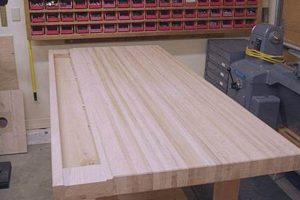
Tip 2: Benchtop Thickness. Ensure adequate thickness, typically exceeding 3 inches, to minimize vibration and provide sufficient mass for stability. A thicker surface allows for more secure clamping and reduces the likelihood of movement during demanding tasks.
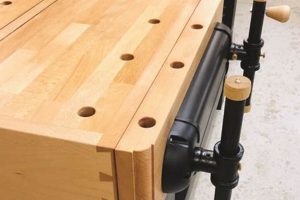
Tip 3: Vise Selection. Choose vises appropriate for intended applications. Consider both face and tail vises for versatile clamping options. A robust face vise, for example, can securely hold large workpieces for edge jointing.
Tip 4: Leg Construction. Employ mortise-and-tenon joinery for leg attachment to ensure structural integrity. This traditional method provides a strong and durable connection capable of withstanding significant stress.
Tip 5: Surface Treatment. Apply a durable finish, such as oil or varnish, to protect against moisture and wear. This prevents wood movement and maintains a smooth, consistent working surface. Regular waxing is recommended.
Tip 6: Regular Maintenance. Periodically flatten the surface to maintain a perfectly level working area. This can be achieved using hand planes or specialized flattening tools, ensuring accuracy in all subsequent operations.
Tip 7: Strategic Accessory Placement. Consider the strategic placement of accessories such as holdfasts and bench dogs. These tools provide versatile clamping options and enhance the overall usability of the fixture.
Adherence to these considerations ensures the selection and preservation of a durable and functional woodworking aid, facilitating precision and efficiency in all woodworking endeavors.
The subsequent section will address specific design modifications and customization options tailored to individual woodworking styles and project requirements, further optimizing its utility.
1. Species Density and the Hardwood Woodworking Bench

Species density is a primary determinant of a woodworking bench’s performance and longevity. The choice of wood profoundly affects its ability to withstand the rigors of daily use, resist movement due to environmental changes, and provide a stable surface for precise craftsmanship.
- Resistance to Deformation
Denser hardwood species exhibit superior resistance to deformation under load. A bench constructed from a high-density wood like maple is less likely to sag or flex when subjected to the force of hand planing or heavy clamping, maintaining a consistently flat and true working surface. This is critical for achieving accurate joinery.
- Vibration Dampening
Denser woods possess enhanced vibration-dampening characteristics. This reduces the transmission of vibrations generated by striking tools like chisels, resulting in improved control and reduced fatigue for the woodworker. A stable, vibration-free surface contributes directly to the precision of cuts and joinery.
- Resistance to Wear and Tear
Species with higher densities are more resistant to surface wear from abrasion and impact. A hardwood bench will withstand the constant friction of workpieces being moved across its surface and resist denting from accidental tool drops, preserving the integrity of the working surface over an extended period.
- Screw and Fastener Holding Power
The density of the wood directly correlates with its ability to securely hold screws and fasteners. This is essential for the attachment of vises, dog holes, and other bench accessories. A denser wood provides a more robust anchor point, preventing loosening and ensuring the stability of these critical components.
The careful consideration of species density is therefore paramount in the selection of lumber for a woodworking bench. Choosing a high-density hardwood ensures a stable, durable, and reliable platform for a lifetime of woodworking tasks. Alternative materials lack this essential characteristic and compromise overall functionality.
2. Benchtop Thickness

Benchtop thickness represents a critical structural parameter in the design and functionality of a hardwood woodworking bench. It dictates the bench’s overall stability, resistance to deformation, and capacity to effectively support a wide range of woodworking operations.
- Vibration Dampening and Stability
A thicker benchtop inherently possesses greater mass, contributing significantly to vibration dampening during tasks such as planing or chiseling. This stability minimizes unwanted movement of the workpiece, allowing for increased precision and control. Insufficient thickness can lead to excessive vibration, compromising accuracy and potentially causing errors in the final product. For instance, a benchtop less than 3 inches thick might exhibit noticeable vibration during vigorous hand planing, particularly when working with dense hardwoods.
- Resistance to Warping and Deflection
Increased benchtop thickness provides greater resistance to warping and deflection under load. Hardwood, while generally stable, can still be susceptible to movement due to changes in humidity or sustained pressure. A thicker top mitigates these effects, ensuring a consistently flat and true working surface. Deflection can lead to inaccuracies when using the bench as a reference surface for measuring or assembling components. A thick, rigid benchtop minimizes this risk.
- Clamping Surface Area and Security
A substantial benchtop thickness provides ample material for secure clamping. The greater the thickness, the more effectively vises, holdfasts, and other clamping devices can grip the surface, preventing workpiece slippage. This is particularly crucial when working with larger or irregularly shaped pieces. A thin benchtop may not provide sufficient purchase for clamping devices, leading to instability and potential damage to the workpiece or the bench itself. Using planing stops can prevent some movement too.
- Long-Term Durability and Longevity
A thicker benchtop contributes to the overall durability and lifespan of the hardwood woodworking bench. It provides a greater reserve of material to withstand wear and tear, accidental impacts, and the effects of repeated use. A robust benchtop will maintain its structural integrity over many years of service, representing a significant investment for the serious woodworker.
In summation, benchtop thickness is inextricably linked to the performance characteristics of a hardwood woodworking bench. Prioritizing sufficient thickness ensures stability, accuracy, and longevity, making it a fundamental consideration in bench design and construction. The long term use is dependent on this characteristic.
3. Vise Mechanisms

Vise mechanisms constitute an integral component of any functional hardwood woodworking bench, providing the necessary clamping force to secure workpieces during various operations. The effectiveness of these mechanisms directly influences the precision and efficiency achievable on the bench. A well-designed vise, firmly integrated into a stable hardwood structure, allows for controlled and accurate material removal, shaping, and assembly. Conversely, inadequate or poorly installed vise mechanisms can compromise stability, leading to imprecise work and potential damage to both the workpiece and the bench itself.
Different vise types cater to specific woodworking tasks. Face vises, mounted on the front of the bench, are commonly used for general-purpose clamping and edge jointing. Tail vises, integrated into the end of the bench, facilitate long clamping actions and are often paired with bench dogs to secure boards along their length. Leg vises, attached to the bench leg, provide exceptional clamping force for operations like chopping mortises. The selection of appropriate vise mechanisms, coupled with the inherent strength and stability of the hardwood bench, significantly enhances the versatility and capability of the woodworking station. A properly installed tail vise, for instance, allows a woodworker to easily secure a long board for edge jointing by using a series of bench dogs, while a robust face vise allows for securing large workpieces when dovetailing drawer sides.
The connection between vise mechanisms and a hardwood woodworking bench is thus symbiotic. The hardwood bench provides the stable platform and structural support necessary for the vise to function effectively, while the vise mechanisms provide the clamping force essential for performing a wide range of woodworking operations. A comprehensive understanding of this relationship enables woodworkers to select and implement the most suitable vise mechanisms for their specific needs, ultimately maximizing the potential of the bench as a cornerstone of their craft. Without an adequate vise mechanism, the bench’s utility is severely limited. The integration between the vise and the bench ensures that forces are distributed evenly, preventing racking or deformation of the bench structure itself.
4. Leg Stability

Leg stability is a fundamental attribute of a functional woodworking bench, directly influencing its overall performance and utility. The connection between leg stability and the broader concept of a woodworking bench is one of direct dependence. Without a stable foundation provided by the legs, the bench’s primary purposeto provide a solid and unwavering work surfaceis severely compromised. Any movement or vibration in the legs translates directly to the benchtop, affecting the precision of operations such as planing, sawing, and joinery. A common example is a bench with inadequately braced legs, which tends to rock or shift during aggressive hand planing, resulting in uneven surfaces and inaccurate cuts. Therefore, leg stability is not merely a desirable feature but a critical requirement for effective woodworking.
Achieving adequate leg stability involves several key design and construction considerations. The most common and reliable method involves the use of robust joinery techniques, such as mortise-and-tenon joints, to connect the legs to the benchtop and any lower stretchers or aprons. These joints provide exceptional strength and resistance to racking forces, preventing the legs from twisting or flexing under load. Furthermore, the dimensions and material of the legs themselves play a crucial role. Thicker legs constructed from dense hardwoods offer greater resistance to bending and deflection. A practical application of this understanding involves carefully selecting the lumber for the legs based on its strength and stiffness properties, ensuring that it can withstand the stresses imposed during demanding woodworking tasks. The addition of a lower shelf or cabinet between the legs also adds significant rigidity to the overall structure.
In conclusion, leg stability is an indispensable characteristic of a high-quality woodworking bench, directly impacting the accuracy and efficiency of woodworking operations. Compromises in leg stability translate into a compromised workbench. The selection of appropriate joinery methods, leg dimensions, and material properties are essential for creating a solid and unwavering foundation. This emphasis on stability ultimately enhances the woodworker’s ability to execute precise and controlled movements, resulting in higher quality craftsmanship and a more enjoyable woodworking experience. The inherent challenge lies in balancing the need for robust stability with considerations of cost and ease of construction. However, prioritizing stability ensures a long-lasting and reliable tool that will serve as the cornerstone of any woodworking shop.
5. Surface Flatness

Surface flatness is a critical attribute of any effective hardwood woodworking bench. The relationship is causal: a non-flat surface directly impedes the accuracy and precision of woodworking operations. The bench serves as a primary reference plane for measuring, marking, assembling, and shaping wood. Deviations from flatness introduce errors in these processes, potentially leading to misaligned joints, uneven surfaces, and compromised structural integrity in finished projects. For instance, if a benchtop is not perfectly flat, accurately planing a board to a consistent thickness becomes significantly more challenging, as the plane will follow the contours of the uneven surface rather than producing a true, flat face. This necessitates constant adjustments and increases the likelihood of errors.
The achievement and maintenance of surface flatness on a hardwood woodworking bench requires careful initial construction and ongoing maintenance. Typically, the process involves selecting stable, well-seasoned hardwood lumber and employing precise joinery techniques to minimize warping or twisting over time. Even with these precautions, hardwood can still be susceptible to movement due to changes in humidity. Therefore, periodic flattening, using hand planes or specialized surfacing tools, becomes necessary to restore and maintain a true, flat surface. Consider a scenario where a woodworker is building a cabinet. If the benchtop is not flat, assembling the cabinet’s frame will likely result in a structure that is out of square, requiring corrective measures and potentially weakening the joints. Regular surface flattening prevents such problems, ensuring the bench remains a reliable reference surface.
In summary, surface flatness is an indispensable element of a functional hardwood woodworking bench. Its absence compromises accuracy and precision in woodworking. While inherent challenges exist in maintaining this flatness due to wood’s natural properties, regular maintenance efforts ensure the bench remains a reliable and essential tool. The understanding of this relationship is crucial for any woodworker seeking to produce high-quality results. The pursuit of flatness is a continuous process, but the benefits in terms of accuracy and efficiency make it a worthwhile endeavor.
6. Accessory compatibility

Accessory compatibility represents a critical determinant of a hardwood woodworking bench’s overall utility and adaptability. A bench’s capacity to effectively integrate with a variety of auxiliary tools and devices significantly expands its functional range and enhances the woodworker’s ability to perform diverse tasks with precision and efficiency.
- Bench Dog Integration
Bench dogs, typically made of metal or wood, insert into precisely drilled holes in the benchtop and serve as adjustable stops against which workpieces can be secured. Compatibility with various sizes and styles of bench dogs is essential for accommodating different project requirements. A bench designed to accept both round and square dogs offers increased versatility in clamping strategies, allowing the woodworker to secure materials for planing, sawing, or carving with greater stability. Without appropriate dog holes, the ability to easily secure workpieces is severely limited.
- Vise Mounting Options
The ability to mount different types of visessecurely is a key aspect of accessory compatibility. A bench should be designed with sufficient material and structural support to accommodate face vises, tail vises, and leg vises. Furthermore, the bench should allow for flexible vise placement to optimize workflow and accommodate various workpiece sizes. A bench that can only accommodate a single type of vise in a fixed position restricts the woodworker’s ability to perform certain operations and limits overall adaptability. The ability to swap vise sizes in needed is helpful.
- Holdfast Accommodation
Holdfasts are traditional clamping devices that utilize friction to quickly secure workpieces to the benchtop. Compatibility with holdfasts requires appropriately sized and positioned holes in the benchtop. A well-designed bench will offer a variety of holdfast hole locations to accommodate different clamping angles and workpiece geometries. Holdfasts are often preferred for their speed and ease of use, making them a valuable addition to any woodworking bench. The location of the holdfast holes are important too.
- Power Tool Integration
While primarily designed for hand tool operations, a hardwood woodworking bench can also be adapted to accommodate power tools. This may involve incorporating features such as integrated power outlets, mounting points for jigs and fixtures, or a designated area for storing power tools. The ability to seamlessly integrate power tools into the bench’s workflow enhances efficiency and expands the range of projects that can be undertaken.
Accessory compatibility is therefore not merely a convenience but a fundamental aspect of a well-designed hardwood woodworking bench. The ability to effectively integrate with a variety of auxiliary tools and devices unlocks a greater range of functionality, enhancing the woodworker’s ability to perform diverse tasks with precision and efficiency. The initial cost of a bench with well-considered accessory compatibility is offset by the increased productivity and versatility it provides over its lifespan.
7. Joinery Durability
The longevity and structural integrity of a hardwood woodworking bench are intrinsically linked to the durability of its joinery. The bench, subjected to considerable stress during various woodworking operations, relies on robust joints to maintain its form and functionality. Failure of these joints compromises the entire structure, rendering the bench unstable and unsuitable for precise work. Consider, for example, a bench leg attached with poorly executed dovetail joints; under the stress of planing a large workpiece, these joints may weaken or fail, leading to instability and rendering the bench unusable. Therefore, joinery durability is not merely a desirable characteristic but a fundamental requirement for a functional and long-lasting woodworking bench. The selection of appropriate joinery techniques and their careful execution are essential for ensuring the bench’s ability to withstand the rigors of daily use.
Specific joinery techniques offer varying degrees of durability and suitability for different parts of the bench. Mortise-and-tenon joints, particularly those with wedged or pinned tenons, are frequently employed for connecting legs to the benchtop and for constructing sturdy frames. These joints offer exceptional strength and resistance to racking forces. Dovetail joints, while visually appealing, are often used in drawer construction or for attaching aprons to the benchtop, providing resistance to pulling forces. Screw joinery, while simpler to execute, typically requires reinforcement with glue and may not offer the same long-term durability as traditional joinery methods. The choice of joinery should be informed by the specific stresses that the joint will be subjected to and the overall design of the bench. Proper glue selection is also critical. It must be one that dries hard and is specifically designed to withstand the pressures placed on that joint.
In conclusion, joinery durability constitutes a cornerstone of a well-constructed hardwood woodworking bench. Its presence guarantees long-term stability and functionality, while its absence leads to premature failure and compromised performance. While the construction of durable joints demands skill and attention to detail, the resulting benefits in terms of longevity and reliability make it a worthwhile investment. Addressing the challenge of ensuring joinery durability requires a thorough understanding of woodworking principles, careful material selection, and meticulous execution. A bench built with durable joinery provides a reliable and enduring platform for woodworking endeavors, serving as a testament to the importance of craftsmanship and attention to detail.
Frequently Asked Questions About Hardwood Woodworking Benches
The following section addresses common inquiries regarding hardwood woodworking benches, offering concise and informative answers to assist in informed decision-making.
Question 1: What specific hardwood species are most suitable for constructing a woodworking bench?
Dense, stable hardwoods such as maple, beech, and birch are generally preferred. These species exhibit excellent resistance to warping and provide a rigid, durable work surface. Other options include cherry and oak, although these may be more prone to movement with humidity changes.
Question 2: What is the recommended minimum thickness for a hardwood woodworking benchtop?
A benchtop thickness of at least three inches is generally recommended. This provides sufficient mass for stability and reduces vibration during demanding operations. Thicker benchtops also offer greater resistance to deflection under load and provide more secure clamping options.
Question 3: How should a new hardwood woodworking bench be treated to prevent warping and cracking?
Applying a durable finish, such as several coats of boiled linseed oil or a specialized woodworking finish, is crucial. This helps to seal the wood and regulate moisture content, minimizing the risk of warping or cracking. Regular waxing can further enhance protection and maintain a smooth work surface.
Question 4: What are the essential vise types for a versatile woodworking bench?
A combination of a face vise and a tail vise provides the most versatile clamping options. The face vise is suitable for general-purpose clamping and edge jointing, while the tail vise, in conjunction with bench dogs, facilitates long clamping actions and secure holding of boards along their length. A leg vise is a third option which provides very strong clamping and is useful for holding material for mortising.
Question 5: How often should a hardwood woodworking benchtop be flattened?
The frequency of flattening depends on the wood’s stability and the bench’s usage. Generally, flattening should be performed at least once a year, or more frequently if the surface becomes noticeably uneven. Regular maintenance ensures accurate and precise woodworking operations.
Question 6: What is the best way to attach the legs to a hardwood woodworking benchtop?
Mortise-and-tenon joinery is the preferred method for attaching legs to a benchtop. This technique provides a strong and durable connection that can withstand significant stress. The tenons should be carefully fitted and secured with glue and wedges or pins for maximum stability. Bolting the legs on is also possible, but this technique needs to accommodate wood movement.
These frequently asked questions provide a foundation for understanding the key considerations involved in selecting and maintaining a functional hardwood woodworking bench. Addressing these points ensures its suitability for a wide array of woodworking tasks.
The subsequent section will offer guidance on selecting appropriate tools and accessories to optimize the performance of a hardwood woodworking bench, further enhancing its utility in a woodworking environment.
Conclusion
The preceding discussion has illuminated the multifaceted aspects of the hardwood woodworking bench, emphasizing its significance as a cornerstone of the woodworking craft. Critical attributes, encompassing species density, benchtop thickness, vise mechanisms, leg stability, surface flatness, accessory compatibility, and joinery durability, have been thoroughly examined to underscore their individual and collective contributions to overall functionality. The material selection, design considerations, and maintenance protocols discussed serve as a comprehensive guide for optimizing its utility.
The enduring value of the hardwood woodworking bench lies in its capacity to facilitate precision, stability, and efficiency in woodworking endeavors. Its construction warrants careful consideration and meticulous execution. As woodworking practices evolve, the principles governing its design and maintenance remain fundamentally relevant, ensuring its continued importance in workshops worldwide. Woodworkers are encouraged to apply this knowledge to craft robust, reliable benches that will serve as enduring foundations for their creative pursuits.
![Build A Roman Woodworking Bench [DIY Guide] | Step-by-Step Guides, Tools & Inspiration to Build Beautiful Wooden Decor on a Budget](https://woodfromhome.com/wp-content/uploads/2026/05/th-207-300x200.jpg "Build A Roman Woodworking Bench [DIY Guide] Step-by-Step Guides, Tools & Inspiration to Build Beautiful Wooden Decor on a Budget")