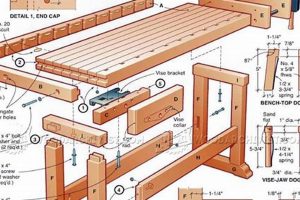
The thickness of a woodworking bench’s surface directly impacts its stability, rigidity, and overall ability to withstand the forces generated during various woodworking tasks. A surface that is too thin may flex or vibrate excessively, hindering precision and potentially compromising safety. Conversely, an adequately thick surface provides a solid, unwavering platform, facilitating accurate cuts, secure clamping, and efficient hand tool use. For instance, a substantial surface is essential when planing a board, as it resists movement and allows the plane to glide smoothly.
The sturdiness of the work surface is paramount to a functional and enduring woodworking bench. This characteristic is essential for absorbing vibrations and preventing racking, leading to greater accuracy and control. Historically, benches were crafted with considerable thickness, often employing laminated construction, to ensure longevity and resistance to warping. This tradition underscores the understanding that a robust surface is a cornerstone of effective woodworking. Benefits include improved tool control, reduced fatigue, and an extended lifespan of the workbench itself.
Factors influencing the selection of a suitable dimension include the type of wood used, the bench’s intended purpose, and the frequency of heavy-duty operations. Considerations must also be given to the undercarriage design and the method used to attach the top to the base. Therefore, the following sections will detail the typical dimensional ranges, material considerations, and construction techniques relevant to achieving a stable and effective work surface.
Bench Top Thickness Recommendations
The following recommendations provide guidance in determining appropriate dimensions for a woodworking bench top, emphasizing stability, durability, and suitability for diverse woodworking tasks.
Tip 1: Aim for a minimum thickness of 3 inches for solid wood tops. This dimension provides substantial mass and resistance to warping, particularly with hardwoods like maple or beech. Solid wood less than this thickness may be prone to cupping or twisting over time.
Tip 2: Consider a laminated construction for increased stability. Lamination, involving gluing multiple layers of wood together, distributes stress and minimizes the effects of wood movement. This allows for thinner individual layers while maintaining overall structural integrity.
Tip 3: Thickness should be increased for heavier use and specialized tasks. If the bench will be subjected to frequent heavy hammering, mortising, or other forceful operations, increasing the thickness to 4 inches or more is advisable to absorb impact and minimize vibration.
Tip 4: Evaluate the support structure beneath the top. The design and spacing of the bench’s base influence the necessary thickness. A well-supported top can potentially be slightly thinner than one spanning greater distances without adequate support.
Tip 5: Account for future surfacing and flattening. A portion of the initial thickness will be lost during the flattening and surfacing process. Therefore, it is prudent to allow for this material removal when selecting the initial stock.
Tip 6: Consider the wood species’ density. Softer woods, such as pine or fir, generally require greater thickness than hardwoods to achieve equivalent rigidity. Select wood that balances cost with performance based on the intended use.
Tip 7: For engineered materials like MDF or plywood, thickness requirements may differ. While these materials offer dimensional stability, they often lack the density of solid wood. Therefore, greater thicknesses or reinforcement may be necessary to provide sufficient mass and resistance to deflection.
Proper selection is crucial for achieving a stable and functional woodworking bench. Adhering to these recommendations contributes significantly to a durable and effective work surface, enhancing woodworking precision and overall enjoyment.
The subsequent section explores the various materials suitable for bench tops, further expanding upon the considerations for achieving an optimal woodworking platform.
1. Minimum

The specification of a three-inch minimum dimension for a woodworking bench top directly addresses the requirement for adequate mass and rigidity. It is the lower threshold for achieving a stable work surface capable of withstanding the forces inherent in woodworking tasks. Without this minimum thickness, the surface is susceptible to excessive deflection, vibration, and ultimately, compromised accuracy. A thinner top, particularly in solid wood construction, lacks the inertia necessary to resist movement during planing, sawing, or chiseling operations. The specified minimum represents a practical compromise between material cost, bench weight, and functional performance.
Consider the example of hand-planing a large, uneven board. The force applied to the plane transmits through the workpiece to the bench top. A top significantly less than three inches may flex under this pressure, causing the board to rock and rendering a flat, even surface difficult, if not impossible, to achieve. Furthermore, when mortising, the repetitive impacts of a mallet striking a chisel can generate considerable vibration. An insufficient dimension amplifies these vibrations, potentially leading to inaccuracies and increased user fatigue. The relationship is causal: inadequate dimension results in compromised performance, impacting both the quality of work and the user’s experience.
Therefore, the three-inch minimum serves as a foundational guideline for constructing a functional and reliable woodworking bench. Exceeding this minimum is often beneficial, particularly for specialized tasks or when using less dense materials. However, falling below this threshold introduces significant performance compromises. While achieving the perfect surface dimension involves multiple factors, adhering to this minimum establishes a crucial baseline for workbench construction, ensuring a platform capable of supporting a wide range of woodworking activities.
2. Maximum

While a three-inch minimum establishes a functional baseline, the rationale for a maximum dimensional limit in the six-plus-inch range primarily concerns diminishing returns and practical considerations. Increasing the thickness beyond this point yields proportionally smaller gains in stability and vibration dampening compared to the escalating costs and weight. A surface significantly exceeding this dimensional threshold becomes unwieldy, difficult to maneuver, and may necessitate specialized support structures to manage the increased load. The effect on accessibility also warrants consideration. An excessively thick surface may hinder access to vises or other work-holding devices, diminishing overall functionality.
The practical implications of an overly thick top manifest in several ways. Transporting and positioning such a bench becomes significantly more challenging, potentially requiring multiple individuals or specialized equipment. Furthermore, the increased material cost represents a substantial investment with limited additional performance benefit. For example, a bench designed for intricate carving might benefit slightly from the increased mass, but the trade-off in maneuverability and accessibility could outweigh the marginal performance gain. A top approaching or exceeding six inches presents challenges in integrating typical bench accessories and maintaining ergonomic working heights, potentially leading to user discomfort and reduced efficiency. The principle of diminishing returns dictates that the incremental improvement in stability becomes less pronounced with each additional inch of thickness beyond a certain point.
In summary, the specification of “six plus inches” as a practical upper limit acknowledges the point at which the benefits of increased mass are counterbalanced by escalating costs, diminished accessibility, and handling difficulties. While specialized applications may justify exceeding this limit, the typical woodworking bench achieves optimal performance within the dimensional range defined by the three-inch minimum and the six-plus-inch practical maximum. This range facilitates a balance between structural integrity, user accessibility, and overall bench usability, optimizing the woodworking experience.
3. Lamination
Lamination represents a critical construction technique impacting dimensional considerations for woodworking bench tops. Gluing multiple layers of wood together to form the surface offers distinct advantages over solid wood construction, directly influencing the required dimensional range for achieving desired stability.
- Reduced Warping and Cupping
Lamination effectively mitigates the natural tendency of wood to warp or cup due to changes in moisture content. By orienting the grain of adjacent layers perpendicularly, the stresses caused by expansion and contraction are distributed and neutralized. A laminated surface, therefore, remains flatter and more stable than a solid wood equivalent of the same overall dimension, potentially allowing for a slightly reduced total dimension while maintaining acceptable performance.
- Increased Strength-to-Weight Ratio
Laminated construction often results in a higher strength-to-weight ratio compared to solid wood. The individual layers, when bonded together with adhesive, act as a composite material, distributing load more effectively. This allows for a lighter surface without sacrificing structural integrity. This factor is relevant when considering bench mobility or the load-bearing capacity of the bench’s base. The increased stiffness contributes to a stable and reliable work surface that resists deflection under load.
- Use of Less Expensive Materials
Lamination enables the utilization of less expensive or lower-grade lumber for the core layers of the surface, while reserving higher-quality materials for the visible outer layers. This approach provides a cost-effective method for achieving a visually appealing and functionally sound work surface without incurring the expense of constructing the entire surface from premium-grade lumber. The overall surface dimension can be optimized by strategically combining materials with varying properties.
- Flexibility in Dimension Selection
Laminated construction provides greater flexibility in selecting the overall surface dimension. The inherent stability afforded by the lamination process allows for the construction of wider or longer surfaces with reduced risk of warping or sagging. This is particularly advantageous for benches designed to accommodate large workpieces or specialized woodworking operations. The modular nature of lamination also allows for easier repairs or replacements of individual layers if damage occurs.
In conclusion, lamination is a crucial technique influencing dimensional choices for woodworking bench tops. By mitigating warping, increasing strength, enabling cost-effective material selection, and providing flexibility in dimension, lamination allows woodworkers to optimize their bench design for stability, functionality, and longevity. The decision to employ lamination directly impacts the specific minimum and maximum dimensional parameters necessary for achieving a reliable and effective work surface. The dimension should be assessed by what is needed for stability.
4. Wood Density

The density of wood, a species-specific characteristic, directly influences the required thickness of a woodworking bench top to achieve comparable levels of stability and rigidity. Denser wood species, such as hard maple or beech, possess a higher mass per unit volume, resulting in greater resistance to deflection and vibration. This inherent stiffness allows for the construction of thinner bench tops while maintaining adequate performance under load. Conversely, less dense species, like pine or poplar, necessitate greater dimensions to compensate for their lower mass and achieve similar structural integrity. This relationship establishes a direct correlation between wood density and the appropriate thickness for a woodworking bench top, dictating material selection based on desired performance characteristics.
Practical implications of this relationship are evident in bench construction. A craftsman employing hard maple might opt for a three-inch thick surface, confident in its ability to withstand heavy use without excessive flexing. However, if using pine, the same craftsman would likely increase the thickness to four inches or more to achieve comparable stability. Failure to account for wood density can result in a bench top that either deflects excessively under load, compromising accuracy, or is unnecessarily heavy and cumbersome. The choice of wood species, therefore, represents a critical decision point in the bench design process, directly impacting the necessary dimensions. For example, heavy chopping tasks will require a much denser wood.
In summary, understanding the connection between wood density and the appropriate thickness is essential for constructing a functional and durable woodworking bench. Species-specific density dictates the dimensions necessary to achieve desired performance characteristics. Ignoring this relationship can lead to structural deficiencies or unnecessary material usage. Therefore, careful consideration of wood density represents a fundamental aspect of informed bench design, ensuring a stable, rigid, and reliable work surface tailored to the specific needs of the woodworker. This is particularly applicable when utilizing laminated tops as the density of each lamination layer dictates the final thickness.
5. Support

The undercarriage design of a woodworking bench directly influences the optimal thickness of the bench top. The support system dictates the degree to which the surface resists deflection under load, impacting the required surface dimension to maintain stability and minimize vibration. A robust undercarriage allows for a potentially thinner surface, while a less supportive structure necessitates a greater dimension to compensate for reduced stability.
- Span Between Supports
The distance between supporting members of the undercarriage dictates the bending moment experienced by the surface. A wider span necessitates a greater surface dimension to resist deflection. Benches with closely spaced stretchers and legs exhibit greater rigidity, potentially allowing for a reduced surface dimension compared to those with more widely spaced supports. For example, a surface spanning four feet between supports will require a greater dimension than one spanning only two feet to achieve comparable stability.
- Material and Joinery of Undercarriage
The materials and joinery employed in the undercarriage construction directly impact its stiffness and load-bearing capacity. A frame constructed from hardwoods with mortise-and-tenon joinery provides significantly greater support than one made from softwoods with simple screw connections. A more robust undercarriage allows for a reduction in the required surface dimension, as the frame absorbs a greater portion of the load. For instance, a metal undercarriage will generally provide superior support compared to a wooden one of similar dimensions.
- Attachment Method of Surface to Undercarriage
The method used to attach the surface to the undercarriage influences the overall stability of the bench. A secure and rigid connection, such as bolts or lag screws, effectively integrates the surface and undercarriage, distributing load and minimizing movement. A less secure connection, such as simply resting the surface on the frame, reduces the overall stiffness of the assembly and necessitates a greater surface dimension to compensate. Integrated joinery strengthens the overall build.
- Presence of a Lower Shelf
The presence of a lower shelf in the undercarriage design contributes significantly to the bench’s overall rigidity. A well-constructed shelf effectively ties the legs together, preventing racking and increasing resistance to lateral forces. This added support can allow for a reduction in the required surface dimension, as the shelf effectively stiffens the entire structure. For example, a full-width shelf provides greater support than a narrow, partial shelf.
The interrelationship between undercarriage design and the ideal surface dimension cannot be overstated. The support system dictates the necessary surface dimension to achieve a stable and functional woodworking bench. Careful consideration of the span between supports, the materials and joinery employed, the attachment method, and the presence of a lower shelf enables the construction of a bench optimized for both stability and material efficiency, reducing overall project costs.
6. Use

The intended use of a woodworking bench exerts a significant influence on the optimal dimension of its surface. Varying woodworking tasks impose different demands on the bench top, requiring adjustments to the dimension to ensure adequate stability, rigidity, and resistance to vibration. The specific operations planned for the bench dictate the necessary level of structural integrity, thereby directly impacting the selection of appropriate dimensions.
- Heavy Hammering and Chiseling
Tasks involving heavy hammering, such as mortising or shaping metal components, generate substantial impact forces. A bench intended for these operations requires a greater surface dimension to absorb the energy and minimize vibration. Insufficient dimension can result in excessive flexing, compromising accuracy and potentially damaging the bench itself. For these purposes, a thicker surface, often exceeding four inches, is recommended to provide the necessary mass and rigidity.
- Delicate Carving and Precision Assembly
In contrast to heavy hammering, delicate carving and precision assembly tasks demand a stable and vibration-free surface to ensure accuracy and control. While impact forces are minimal, even slight movement can compromise the precision of fine detail work. A moderately thick surface, typically in the range of three to four inches, provides sufficient stability without sacrificing accessibility or maneuverability. Damping qualities are also important.
- Hand Planing of Large Surfaces
Hand planing of large surfaces necessitates a rigid and unwavering platform to maintain consistent contact between the plane and the workpiece. The force applied during planing transmits through the workpiece to the bench top, potentially causing deflection if the surface dimension is inadequate. A thicker surface, combined with a robust undercarriage, ensures that the bench remains stable and flat, enabling precise and efficient planing. The length and width also play a critical role.
- General Purpose Woodworking
For general-purpose woodworking, involving a diverse range of tasks from sawing and sanding to joinery and finishing, a surface dimension in the range of three to five inches provides a versatile compromise. This dimension offers sufficient stability for most common operations while maintaining a reasonable balance between weight, cost, and accessibility. Careful consideration of the specific tasks most frequently performed on the bench will help determine the optimal dimension within this range.
In conclusion, the intended use of a woodworking bench is a primary determinant of the required dimension. Understanding the specific demands of the tasks to be performed on the bench enables woodworkers to select a surface dimension that optimizes stability, rigidity, and functionality. Careful consideration of these task-dependent factors contributes significantly to the construction of a bench that meets the unique needs of the user and enhances the overall woodworking experience.
Frequently Asked Questions Regarding Woodworking Bench Top Dimensions
The following questions and answers address common concerns and misconceptions surrounding the selection of appropriate dimensions for a woodworking bench top.
Question 1: Is there a single ideal dimension for all woodworking bench tops?
No, the optimal dimension is dependent on several factors, including the type of wood used, the bench’s intended purpose, and the design of the undercarriage. A one-size-fits-all approach is not recommended.
Question 2: Does lamination eliminate the need for a thicker surface?
Lamination enhances stability and reduces the risk of warping, but it does not necessarily eliminate the need for adequate thickness. The overall dimension should still be sufficient to provide the necessary mass and rigidity for the intended woodworking tasks.
Question 3: Can softer woods be used effectively for bench tops?
Softer woods, such as pine or fir, can be used for bench tops, but they typically require greater dimensions to achieve comparable stability to hardwoods like maple or beech. Lamination can also improve the performance of softwood surfaces.
Question 4: How important is the undercarriage design in determining the necessary surface dimension?
The undercarriage design plays a crucial role in supporting the surface and resisting deflection under load. A robust and well-designed undercarriage can allow for a slightly thinner surface, while a weaker undercarriage necessitates a greater surface dimension to compensate.
Question 5: Does the type of woodworking performed significantly impact the optimal surface dimension?
Yes, the intended use of the bench has a significant impact on the ideal dimension. Heavy hammering and chiseling require a thicker surface than delicate carving or precision assembly. Task dependent.
Question 6: Is it more cost-effective to build a thicker surface or a stronger undercarriage?
The most cost-effective approach depends on material availability and construction skills. In some cases, building a stronger undercarriage may be more economical than purchasing thicker lumber for the surface. A balance between the two is often the most practical solution.
Proper attention to these considerations contributes significantly to a durable and effective work surface, enhancing woodworking precision and overall enjoyment.
The subsequent section will address maintenance and care.
The Dimension of a Woodworking Bench Top
As demonstrated, the phrase “how thick should a woodworking bench top be” embodies a complex equation with no singular solution. The investigation reveals that numerous factorswood species density, intended use, lamination techniques, and undercarriage designinteract to determine the optimal dimension. The three-inch minimum serves as a foundational guideline, while the six-plus-inch maximum acknowledges practical limitations. Deviation from these principles risks compromising the bench’s stability and overall effectiveness.
Therefore, a thoughtful approach to surface dimension selection remains paramount. Woodworkers must carefully evaluate their specific needs and material constraints to achieve a functional and durable work platform. An informed decision, grounded in the principles outlined herein, contributes significantly to the quality of craftsmanship and the longevity of the woodworking bench itself. Continued adherence to these best practices ensures a stable and reliable workspace for generations to come.