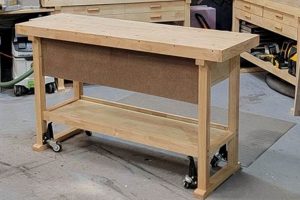
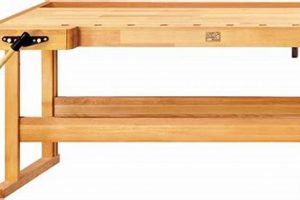
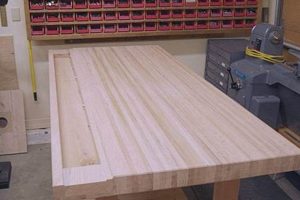
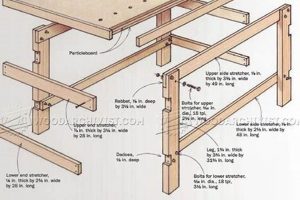
A workstation constructed primarily from medium-density fiberboard, specifically designed for woodworking tasks, provides a dedicated surface for activities like cutting, assembling, and finishing wood projects. These structures often incorporate features such as vises, clamping systems, and storage solutions to enhance functionality and efficiency.
These fiberboard-based work surfaces offer a stable and level platform crucial for precise woodworking. Their affordability makes them a practical choice for hobbyists and professionals alike, especially when considering the initial investment for a dedicated workspace. Historically, woodworkers relied on solid wood benches, but engineered materials provide alternative options balancing cost and performance.
The following sections will delve into specific design considerations, construction techniques, and the advantages and disadvantages of utilizing engineered wood in crafting such a work surface.
Tips for Selecting and Maintaining a Fiberboard Woodworking Station
The following guidelines offer advice on maximizing the lifespan and utility of a woodworking surface constructed from medium-density fiberboard.
Tip 1: Ensure Surface Sealing: Unsealed fiberboard readily absorbs moisture, leading to swelling and degradation. Apply multiple coats of a durable sealant, such as polyurethane or epoxy resin, to all surfaces and edges.
Tip 2: Implement a Robust Frame: Fiberboard’s strength lies in its flat surface; it lacks inherent structural rigidity. A solid wood or metal frame is crucial for supporting the weight of projects and tools, preventing sagging or warping.
Tip 3: Protect Against Impact: While relatively dense, fiberboard is susceptible to damage from impacts. Utilize protective pads or mats when working with heavy tools or materials to prevent dents and chips.
Tip 4: Regular Cleaning is Essential: Dust and debris accumulate rapidly on a workbench. Regularly wipe down the surface with a damp cloth and mild cleaner to maintain a clean and functional workspace.
Tip 5: Address Edge Wear Promptly: Edges are particularly vulnerable to damage. Apply edge banding or trim to protect them, and repair any chips or delamination immediately to prevent further deterioration.
Tip 6: Consider a sacrificial layer: Attach a thin, replaceable sheet of hardboard or plywood to the surface. This allows for drilling, cutting, and other destructive tasks without damaging the primary fiberboard structure.
Tip 7: Control Humidity: Excessive humidity can cause fiberboard to expand and contract, leading to warping and instability. Maintain a consistent humidity level in the workspace to minimize these effects.
Adhering to these recommendations will help extend the service life of the woodworking surface and ensure its continued functionality for a variety of woodworking projects.
The next section explores design modifications that can further enhance the utility and longevity of this essential piece of woodworking equipment.
1. Affordability

The selection of medium-density fiberboard as the primary material for a woodworking station is often dictated by its cost-effectiveness. Compared to solid hardwoods, fiberboard presents a significantly lower upfront investment, enabling individuals with limited budgets to establish a functional workspace. This difference in material cost can be substantial, potentially allowing for the allocation of funds towards essential tools and hardware that would otherwise be unattainable. The relationship between the material cost and the accessibility of the woodworking craft is direct and measurable.
This cost advantage facilitates wider participation in woodworking activities. For instance, educational institutions, community workshops, and hobbyists can equip their spaces with multiple stations at a lower overall expense. Furthermore, the affordability of fiberboard allows for experimentation with different bench designs and configurations without incurring prohibitive costs. If a design proves unsuitable, the financial impact of replacement or modification is minimized. The material’s accessibility allows for more fluid adaptation in a dynamic workshop environment. As an example, a school woodworking program can outfit an entire class with fiberboard workbenches for the price of a few solid wood alternatives.
While the initial cost savings of a fiberboard workstation are considerable, it is crucial to acknowledge the potential for increased long-term expenses associated with maintenance and replacement. Fiberboard’s susceptibility to moisture damage and its limited structural integrity necessitates diligent sealing and reinforcement, which can add to the overall cost. However, the affordability of the initial investment remains a primary driver for its adoption, making it a practical solution for numerous woodworking environments. In summary, the affordability aspect is paramount, serving as an entry point into the craft for many, while requiring due diligence regarding maintenance for lasting usability.
2. Surface Stability

Surface stability, referring to the flatness and resistance to deformation of a work surface, is a critical factor influencing the precision and quality of woodworking outcomes. A medium-density fiberboard (MDF) woodworking bench offers specific advantages and disadvantages in relation to this stability, warranting detailed examination.
- Dimensional Consistency
MDF, as an engineered wood product, exhibits minimal expansion or contraction in response to humidity changes compared to solid wood. This dimensional consistency contributes to a stable surface, particularly valuable for tasks requiring tight tolerances and precise joinery. The uniform density of MDF minimizes localized warping or cupping, providing a predictable work area.
- Flatness and Evenness
During manufacturing, MDF sheets are pressed to achieve a high degree of flatness and evenness. This characteristic minimizes the need for extensive leveling or flattening procedures commonly required with solid wood surfaces. The initial flatness of the MDF surface provides a reliable foundation for subsequent woodworking operations.
- Load-Bearing Capacity and Sag
While MDF provides a flat surface, its relatively lower density and structural integrity compared to solid wood mean it is more prone to sagging under heavy loads. Reinforcement with a sturdy frame and support structure is essential to maintain surface stability over time and prevent deflection that could compromise accuracy. The span between supports must be carefully considered to mitigate potential sag.
- Resistance to Surface Damage
Although flat, MDF is susceptible to dents and scratches from impacts. These surface imperfections, even if minor, can negatively affect the stability of the work surface, particularly when used as a reference for planing or jointing. Protective coatings and careful handling are necessary to preserve surface integrity and prevent localized instability.
The surface stability offered by an MDF woodworking bench is a product of its inherent material properties and the implementation of appropriate design and construction techniques. While its flatness and dimensional consistency are advantageous, its limited load-bearing capacity and susceptibility to surface damage necessitate careful consideration of frame design, support structures, and protective measures. The optimal utilization of an MDF workbench relies on understanding and mitigating its inherent limitations to maximize surface stability.
3. Customization Potential

The inherent properties of medium-density fiberboard (MDF) lend themselves to a high degree of customization in the construction of woodworking benches. This adaptability allows users to tailor their workstations to specific needs and preferences, optimizing the bench for a diverse range of woodworking tasks.
- Adaptable Dimensions and Form Factors
MDF is readily available in large sheets, facilitating the creation of benches of varying sizes and shapes. The material’s workability allows for easy cutting and shaping, enabling the incorporation of unique design elements such as integrated tool storage, specialized clamping systems, and ergonomic work heights. This adaptability is particularly beneficial for users with limited space or those who require a bench tailored to specific project types, such as instrument making or model building.
- Integration of Accessory Mounts and Fixtures
The uniform density and machinability of MDF enable the precise placement of threaded inserts, dog holes, and other hardware mounting points. This facilitates the seamless integration of vises, holdfasts, power tool mounts, and other accessories that enhance the functionality of the bench. The ability to add and reposition these fixtures as needed allows for dynamic adaptation of the bench to evolving project requirements.
- Surface Modification and Treatment Options
MDF surfaces can be easily modified to improve their durability, friction, or aesthetic appeal. Options include the application of epoxy coatings for chemical resistance, the addition of replaceable hardboard or laminate surfaces for wear protection, and the incorporation of non-slip materials for enhanced workpiece stability. The ability to customize the surface properties of the bench allows users to optimize it for specific materials or processes.
- Incorporation of Storage Solutions
The internal structure of an MDF bench can be readily adapted to incorporate a variety of storage solutions, ranging from simple open shelving to complex drawer systems and enclosed cabinets. The ease of constructing partitions, dividers, and drawers from MDF itself allows for efficient organization of tools, hardware, and project materials. The ability to integrate custom storage solutions into the bench design maximizes workspace efficiency and minimizes clutter.
The customization potential inherent in MDF woodworking benches allows users to create highly personalized and efficient workstations. By leveraging the material’s versatility and adaptability, woodworkers can optimize their benches to meet specific needs, project requirements, and workspace limitations, ultimately enhancing productivity and enjoyment of the craft.
4. Moisture Sensitivity

The inherent susceptibility of medium-density fiberboard (MDF) to moisture represents a significant consideration in the design, construction, and maintenance of a woodworking bench. This characteristic necessitates careful attention to material selection, surface treatment, and environmental control to mitigate potential degradation and ensure long-term functionality.
- Absorption and Swelling
MDF is hygroscopic, meaning it readily absorbs moisture from the surrounding environment. This absorption leads to swelling of the material, resulting in dimensional changes and potential warping of the bench surface. The degree of swelling is directly proportional to the level of moisture exposure. An example is the expansion of an unsealed MDF bench top in a humid workshop, leading to unevenness and difficulty in achieving precise cuts.
- Delamination and Loss of Strength
Prolonged or repeated exposure to moisture can cause delamination of the MDF layers, weakening the material’s structural integrity. This delamination manifests as separation of the fibers, reducing the bench’s load-bearing capacity and increasing the risk of failure under stress. A spill left uncleaned on an MDF bench can penetrate the surface, leading to localized delamination and weakening of the material.
- Mold and Mildew Growth
The porous nature of MDF and its organic composition provide a favorable environment for mold and mildew growth in damp conditions. This not only compromises the structural integrity of the bench but also poses potential health risks to the user. A poorly ventilated workshop with high humidity levels can promote mold growth on an untreated MDF bench, leading to discoloration and deterioration of the material.
- Protective Coatings and Sealants
To mitigate the effects of moisture, MDF woodworking benches require effective protective coatings and sealants. These barriers prevent moisture penetration, minimizing swelling, delamination, and mold growth. Examples include multiple coats of polyurethane, epoxy resin, or specialized MDF sealers applied to all surfaces, edges, and joints. Regular reapplication of these coatings is necessary to maintain their protective properties over time.
The multifaceted effects of moisture sensitivity on medium-density fiberboard necessitate a proactive approach to bench construction and maintenance. Selection of appropriate coatings, implementation of effective sealing techniques, and control of environmental conditions are all crucial for ensuring the longevity and functionality of a woodworking bench constructed from this material. The long-term viability of such a bench hinges on consistent attention to these mitigating factors.
5. Structural Reinforcement

The relatively low inherent strength of medium-density fiberboard (MDF) necessitates significant structural reinforcement in woodworking bench applications. The material’s density and composition render it susceptible to sagging, warping, and failure under load. Therefore, adequate structural support is not merely an enhancement but a fundamental requirement for creating a functional and durable workbench. Absent proper reinforcement, the MDF will deform under the weight of tools, workpieces, or applied forces, compromising accuracy and safety. For instance, a large, unsupported MDF benchtop will exhibit pronounced sag in the center over time, rendering it unsuitable for precision tasks.
Effective reinforcement strategies typically involve a combination of techniques. A robust frame constructed from solid wood or steel provides the primary load-bearing structure. This frame distributes weight evenly and prevents localized stress concentrations. Internal bracing, such as stretchers and aprons, further enhances rigidity and minimizes deflection. Additionally, laminating multiple layers of MDF or bonding it to a stronger substrate can increase its overall thickness and resistance to bending. An example of a well-reinforced MDF bench is one featuring a solid wood frame with closely spaced cross members beneath the top, effectively distributing weight and preventing sagging even under heavy use. Moreover, the type and placement of fasteners are critical; screws alone may not provide sufficient holding power, requiring the use of bolts or other mechanical fasteners in conjunction with adhesives.
In conclusion, structural reinforcement is indispensable for realizing the potential of an MDF woodworking bench. Without it, the material’s weaknesses outweigh its advantages. The implementation of a well-designed frame, internal bracing, and appropriate fastening techniques ensures a stable, durable, and safe work surface. The investment in robust reinforcement directly translates to increased longevity, improved performance, and a more enjoyable woodworking experience. The understanding of this relationship is paramount for anyone considering the construction or utilization of an MDF workbench.
Frequently Asked Questions
The following questions and answers address common concerns and misconceptions regarding the use of medium-density fiberboard (MDF) in the construction of woodworking benches. This information is intended to provide a clear understanding of the material’s properties, limitations, and appropriate applications.
Question 1: Is a woodworking bench constructed from MDF suitable for heavy-duty tasks?
MDF’s lower density and structural integrity compared to solid hardwoods make it less ideal for tasks involving significant impact or concentrated loads. Reinforcement with a robust frame is essential, but even with reinforcement, the bench may not withstand the same level of abuse as a solid wood alternative. Consider solid wood for heavy-duty tasks.
Question 2: How can one effectively seal an MDF woodworking bench to protect it from moisture?
Multiple coats of a high-quality sealant, such as polyurethane or epoxy resin, are recommended. Apply these coatings to all surfaces, edges, and joints. Consider using a specialized MDF sealer as a primer before applying the topcoat. Regular reapplication may be necessary, particularly in humid environments.
Question 3: What is the expected lifespan of a woodworking bench made from MDF?
Lifespan varies based on usage intensity, environmental conditions, and maintenance practices. With proper sealing, reinforcement, and care, an MDF bench can provide years of service. However, it is unlikely to last as long as a well-maintained solid wood bench under similar conditions.
Question 4: Can a vise be reliably mounted to an MDF woodworking bench?
Yes, but proper mounting techniques are crucial. MDF alone cannot adequately support the stress imposed by a vise. Employ a solid wood or metal backing plate behind the MDF surface to distribute the load. Use bolts rather than screws for secure attachment.
Question 5: What are the primary advantages of using MDF for a woodworking bench compared to solid wood?
The primary advantages are cost-effectiveness, surface flatness, and ease of machinability. MDF is significantly less expensive than solid hardwoods, provides a consistent and level work surface, and can be easily cut, drilled, and shaped. However, these benefits are weighed against its lower strength and moisture sensitivity.
Question 6: How does the noise level of working on an MDF bench compare to that of a solid wood bench?
MDF tends to dampen vibrations and reduce noise compared to solid wood. This can be beneficial in environments where noise levels are a concern. However, the difference may not be significant enough to be a primary factor in material selection.
In summary, medium-density fiberboard offers an accessible and workable material for constructing woodworking benches, provided its limitations are understood and addressed through proper design, reinforcement, and maintenance.
The next section will explore alternative materials for woodworking bench construction and compare their properties to those of MDF.
Conclusion
The preceding discussion has comprehensively examined the characteristics, advantages, and limitations inherent in the use of an mdf woodworking bench. While its affordability and surface stability offer considerable appeal, the material’s susceptibility to moisture and requirement for robust structural reinforcement necessitate careful consideration during design and construction. A successful implementation demands diligent attention to sealing techniques, framing strategies, and overall maintenance practices.
The choice of an mdf woodworking bench represents a trade-off between cost-effectiveness and long-term durability. Prospective users are urged to thoroughly evaluate their specific needs, anticipated usage patterns, and environmental conditions before committing to this material. Only through a complete understanding of its properties can the potential of the mdf woodworking bench be fully realized, ensuring a functional and reliable workspace for woodworking endeavors.