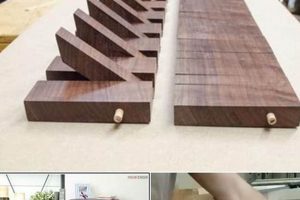
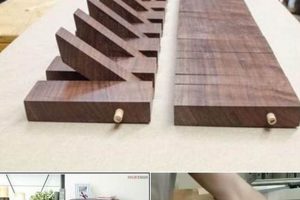
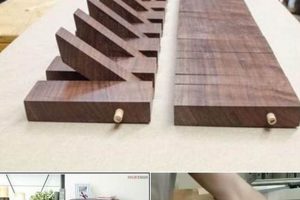
The creation of simple items using wood, designed for individuals with little to no prior experience in carpentry, forms the basis of introductory-level woodworking. These undertakings often involve minimal tools, inexpensive materials, and straightforward construction techniques. Examples encompass cutting boards, small boxes, and simple shelves.
Engaging in these initial building exercises offers numerous advantages. It allows individuals to develop fundamental skills such as measuring, cutting, and joining wood. Furthermore, successful completion of these projects provides a sense of accomplishment and encourages further exploration of woodworking techniques. Historically, such introductory projects have served as a gateway for aspiring craftspeople to learn essential construction principles and develop their aptitude.
Therefore, an examination of suitable materials, essential tools, and simplified construction methods is warranted to facilitate successful entry into this rewarding craft. Subsequent discussions will explore specific design considerations and safety protocols that are crucial for individuals embarking on their woodworking journey.
Essential Guidance for Introductory Woodworking Endeavors
The following guidelines are intended to enhance the experience and ensure successful outcomes when undertaking basic woodworking construction.
Tip 1: Prioritize Safety: Always wear appropriate personal protective equipment, including safety glasses and hearing protection. Ensure the workspace is well-ventilated, especially when working with finishes or adhesives.
Tip 2: Select Appropriate Wood: Softwoods, such as pine, are generally easier to work with than hardwoods. Consider the project’s intended use when choosing wood; select a durable wood type for items expected to withstand frequent use.
Tip 3: Master Basic Measurements: Accurate measurements are crucial. Utilize a quality measuring tape and double-check all dimensions before cutting. Precision prevents errors and material waste.
Tip 4: Learn to Cut Straight: Practice cutting straight lines using a hand saw or power saw. A miter box can aid in achieving accurate angles. Avoid rushing the cutting process to maintain control and precision.
Tip 5: Use Proper Joinery Techniques: Start with simple joints, such as butt joints or lap joints, secured with glue and screws. As skill increases, explore more complex joinery methods for added strength and aesthetic appeal.
Tip 6: Sanding is Essential: Sand all surfaces smoothly before applying a finish. Start with a coarser grit sandpaper and gradually progress to finer grits for a polished result. Smooth surfaces enhance the final appearance and tactile experience.
Tip 7: Apply Finishes Carefully: Choose a finish appropriate for the wood type and project use. Apply finishes in thin, even coats, allowing each coat to dry completely before applying the next. Proper finishing protects the wood and enhances its natural beauty.
Adhering to these recommendations will increase the likelihood of successfully completing introductory woodworking projects. Consistent application of fundamental techniques provides a solid base for advancing to more intricate woodworking endeavors.
The following section will address various project options suitable for those new to the craft, with detailed instructions and material lists to facilitate successful implementation.
1. Safety Precautions
The inextricable link between safety precautions and elementary carpentry projects is fundamental. Engaging in introductory woodworking without adhering to stringent safety protocols significantly elevates the risk of injury. The inherent nature of working with tools, sharp implements, and potentially hazardous materials necessitates a proactive approach to risk mitigation. Examples of these hazards include cuts from saws or chisels, eye injuries from flying debris, and respiratory issues from dust inhalation. Therefore, safety precautions are not merely an ancillary consideration but an indispensable component of all small beginner woodworking projects, forming the basis for a sustainable and enjoyable hobby. The cause-and-effect relationship is direct: inadequate safety measures invariably increase the probability of adverse outcomes.
Practical applications of this understanding involve several key areas. Firstly, appropriate personal protective equipment (PPE) is essential. Safety glasses protect against airborne particles, while hearing protection minimizes the risk of auditory damage from power tools. Dust masks or respirators prevent the inhalation of fine wood dust, known to cause respiratory irritation and long-term health problems. Secondly, a clean and organized workspace reduces the likelihood of trips and falls. Tools should be stored securely, and work surfaces should be free of obstructions. Thirdly, thorough knowledge of tool operation is paramount. Understanding the proper use and limitations of each tool mitigates the risk of misuse and subsequent injury. Numerous woodworking injuries stem from improper tool handling, highlighting the practical significance of adequate training and instruction.
In summary, the observance of safety precautions is not optional in the context of elementary woodworking. It is a prerequisite for ensuring a safe and rewarding experience. The challenges encountered in mastering new woodworking skills should not be compounded by avoidable injuries resulting from negligence. Prioritizing safety establishes a foundation for continued learning and skill development, linking directly to the broader theme of responsible craftsmanship. Consequently, any introductory woodworking project must begin with a comprehensive understanding and implementation of relevant safety protocols.
2. Wood Selection

The selection of appropriate wood species is critical to the success of introductory carpentry projects. The properties of the wood significantly impact workability, durability, and the final aesthetic outcome. Choosing the right material from the outset can streamline the learning process and foster positive experiences.
- Workability
Workability refers to the ease with which wood can be cut, shaped, and joined. Softer woods, such as pine and fir, are generally easier to manipulate with hand tools and power tools, making them suitable for beginners. Hardwoods, like oak and maple, require more force and can be challenging for inexperienced woodworkers to manage. Selecting a wood with good workability minimizes frustration and reduces the risk of tool slippage and errors during construction.
- Cost Considerations
The cost of different wood species varies widely. Exotic hardwoods can be prohibitively expensive for initial projects. Pine and poplar are cost-effective alternatives that provide ample material for practice and experimentation. Minimizing material costs during the learning phase allows individuals to focus on skill development without incurring substantial financial risk. Scrap wood or reclaimed lumber can further reduce expenses.
- Grain Pattern and Appearance
The grain pattern and overall appearance of the wood significantly influence the aesthetic of the finished project. While beginners may prioritize workability and cost, it’s important to consider the visual characteristics of the wood. Straight-grained woods, like pine, are generally easier to work with and provide a consistent appearance. More complex grain patterns can add visual interest but may also present challenges during finishing. Selecting a wood with an appealing grain pattern enhances the satisfaction derived from the completed project.
- Durability and Intended Use
The durability of the wood should align with the project’s intended use. Projects designed for frequent use or exposure to moisture require more durable wood species. While pine is suitable for decorative items, it may not withstand heavy use. For projects requiring greater strength and resistance to wear, consider using a moderately durable hardwood, such as poplar or birch. Understanding the relationship between wood properties and intended use ensures the longevity of the crafted item.
In summary, prudent wood selection represents a fundamental aspect of elementary carpentry. By carefully considering workability, cost, grain pattern, and durability, individuals can optimize their initial experiences and lay a foundation for continued growth in the craft. Choosing the right wood is as crucial as selecting the right tools or mastering essential techniques.
3. Precise Measurement

Precise measurement forms the bedrock upon which successful elementary carpentry projects are built. In the absence of accurate dimensions, even the simplest designs are destined for misalignment, structural weakness, or outright failure. A direct causal relationship exists: inaccurate measurements lead to flawed construction. The importance of precision cannot be overstated; it is not merely a desirable attribute but a fundamental requirement. Consider the creation of a basic box. If the sides are not cut to identical lengths and widths, the resulting box will be skewed, compromising its structural integrity and aesthetic appeal. This seemingly minor discrepancy underscores the practical significance of meticulous measurement.
Practical applications of precise measurement extend beyond simple dimensioning. They encompass angle calculations, proper marking of cut lines, and accurate alignment of components during assembly. For instance, constructing a rudimentary shelf requires precise measurements to ensure it sits level and can support the intended weight. Failure to accurately measure the wall studs and the shelf supports will result in an unstable and potentially hazardous structure. Furthermore, precise measurement minimizes material waste. By accurately determining the required dimensions before cutting, the likelihood of costly errors and the need for additional materials are substantially reduced. This not only conserves resources but also saves time and money.
In summary, precise measurement is not simply a technical skill; it is an integral component of responsible and effective craftsmanship. The challenges inherent in mastering woodworking techniques are compounded by inaccurate measurements, leading to frustration and potentially unsafe outcomes. Conversely, a commitment to precision establishes a solid foundation for successful project completion and fosters a deeper appreciation for the craft. Therefore, all introductory carpentry endeavors should prioritize the development and consistent application of accurate measuring techniques.
4. Straight Cuts

The execution of straight cuts is paramount in elementary woodworking, serving as a foundational skill upon which the structural integrity and aesthetic quality of projects depend. The ability to consistently produce straight cuts directly influences the success of simple woodworking creations, setting the stage for more complex endeavors.
- Structural Stability
Straight cuts are essential for creating stable and structurally sound projects. Consider a simple box: if the edges are not square and straight, the box will be weak and prone to collapse under minimal stress. Accurately cut pieces fit together snugly, distributing weight evenly and preventing undue stress on joints. The application of force against misaligned edges can lead to premature failure, highlighting the importance of precision in cut execution. In the construction of small shelves, straight cuts ensure the surface remains level and capable of supporting objects.
- Joint Integrity
The effectiveness of wood joints is directly proportional to the straightness of the cuts. Miter joints, butt joints, and lap joints all require accurately cut surfaces to achieve a strong and seamless bond. Gaps resulting from uneven cuts weaken the joint and compromise its overall strength. In elementary projects involving glued connections, straight cuts maximize the surface area available for adhesion, leading to a more robust and durable final product. Skewed edges prevent proper alignment, potentially requiring additional reinforcement or complete reconstruction.
- Aesthetic Quality
The visual appeal of woodworking projects is heavily dependent on the precision of the cuts. Wavy or uneven edges detract from the overall aesthetic, creating a less polished and professional appearance. Straight cuts result in clean lines and sharp angles, enhancing the visual harmony of the finished piece. Projects with noticeable inconsistencies in edge alignment often appear amateurish, undermining the intended design. Even in utilitarian objects, such as cutting boards, a straight edge is perceived as indicative of quality craftsmanship.
- Tool Control and Safety
Mastering straight cuts promotes improved tool control, indirectly increasing user safety. Attempting to compensate for uneven cuts increases the risk of tool slippage and potential injury. Developing the skill to consistently produce straight lines fosters a safer working environment and reduces the likelihood of accidents. Furthermore, straight cuts require a deliberate and controlled approach, instilling a sense of precision and focus that translates to other aspects of woodworking.
The mastery of straight cuts is not simply a technical skill but an essential element in developing sound woodworking practices. In elementary projects, this foundation provides a springboard for more intricate techniques, fostering confidence and promoting the creation of functional and aesthetically pleasing pieces. Prioritizing precision in cutting directly correlates with success in beginner carpentry, setting a pathway for continued learning and development.
5. Simple Joinery
The employment of simple joinery techniques is inextricably linked to the successful completion of elementary woodworking undertakings. The complexity of joinery directly correlates with the skill level required, making the selection of appropriate joinery methods crucial for beginners. A failure to utilize simplified techniques in initial projects often results in frustration, structural instability, or project abandonment. The selection of techniques such as butt joints, lap joints, or dowel joints, constitutes a cornerstone of achievable objectives in the craft. The structural integrity of a small box constructed with basic butt joints, secured with glue and fasteners, exemplifies the efficacy of simplified methods. The selection of appropriately sized fasteners and proper clamping during adhesive curing contribute significantly to overall stability.
The practical applications of this understanding extend beyond mere assembly. The learning curve associated with more intricate joinery methods, such as mortise and tenon or dovetail joints, can be steep, particularly for those new to woodworking. Consequently, initial projects should focus on mastering the fundamentals of simple joinery. An understanding of grain direction, wood movement, and the properties of adhesives is essential for creating durable and aesthetically pleasing connections. Furthermore, practicing simple joinery enhances tool control, improves precision in measurement and cutting, and fosters a deeper appreciation for the inherent characteristics of wood as a construction material. This foundational knowledge serves as a building block for future progression towards more advanced techniques. The repetitive practice of these methods is important, improving efficiency and accuracy over time.
In summary, simple joinery is not merely a convenient approach for introductory woodworking. It is a critical component that enables beginners to achieve tangible results while developing fundamental skills. Challenges related to intricate joinery techniques should be deferred until sufficient experience has been acquired with more basic methods. Prioritizing simplicity in joinery fosters a sense of accomplishment, promotes continued learning, and lays the foundation for a lifelong engagement with woodworking.
6. Sanding Technique

The application of appropriate sanding techniques is a pivotal element in elementary woodworking, directly influencing the tactile quality and visual appearance of finished projects. Inadequate or improper sanding detracts from the overall quality, diminishing the appeal of even the simplest creations.
- Surface Preparation
Sanding prepares wood surfaces for finishing, removing imperfections such as mill marks, scratches, and raised grain. A properly sanded surface allows finishes to adhere evenly, enhancing the wood’s natural beauty and providing a smooth, tactile experience. Failure to adequately prepare the surface results in a finish that appears uneven, highlighting imperfections and detracting from the overall aesthetic. For example, a small wooden box that has not been properly sanded will exhibit visible scratches and an uneven sheen after finishing.
- Grit Progression
Effective sanding involves a systematic progression through various grit sizes, starting with coarser grits to remove significant imperfections and gradually transitioning to finer grits to refine the surface. Skipping grits or using excessively coarse grits can damage the wood, creating deep scratches that are difficult to remove. Conversely, using only fine grits may not effectively remove existing imperfections. A typical grit progression for small woodworking projects might involve starting with 120-grit sandpaper, followed by 180-grit, and finally 220-grit for a smooth finish. This systematic approach ensures a consistent and refined surface.
- Sanding with the Grain
Sanding with the grain of the wood prevents the creation of cross-grain scratches, which are highly visible and detract from the appearance of the finished project. Sanding against the grain tears the wood fibers, resulting in a rough and uneven surface. By aligning the sanding motion with the direction of the wood grain, the fibers are smoothed rather than torn, resulting in a polished and refined appearance. For example, when sanding a small wooden cutting board, it is essential to sand in the direction of the grain to avoid creating unsightly scratches.
- Dust Removal
The removal of sanding dust is crucial for achieving a smooth and consistent finish. Sanding dust can clog the sandpaper, reducing its effectiveness and leaving scratches on the surface. Additionally, dust particles can become embedded in the finish, creating a gritty texture. Regularly removing dust with a tack cloth or vacuum ensures a clean sanding surface and prevents contamination of the finish. This practice is especially important when applying clear finishes, as dust particles are highly visible.
In conclusion, the application of appropriate sanding techniques is an integral part of elementary carpentry. Surface preparation, grit progression, sanding with the grain, and dust removal are all essential elements that contribute to a smooth, refined, and visually appealing finished product. Mastering these techniques enhances the overall quality and aesthetic of small woodworking projects, fostering a sense of accomplishment and encouraging continued exploration of the craft.
7. Protective Finishing
Protective finishing represents a critical stage in the creation of small beginner woodworking projects. It transcends mere aesthetic enhancement, serving as a barrier against environmental factors that can degrade wood over time. The selection and application of an appropriate finish are integral to ensuring the longevity and usability of these initial woodworking endeavors.
- Moisture Resistance
Wood is hygroscopic, meaning it absorbs and releases moisture from the surrounding air. Excessive moisture absorption leads to swelling, warping, and cracking, while excessive drying can cause shrinkage and splitting. Protective finishes, such as polyurethane or varnish, create a water-resistant barrier, slowing down moisture absorption and minimizing dimensional changes. In the context of small beginner woodworking projects, consider a simple wooden coaster. Without a protective finish, spills and condensation would quickly penetrate the wood, causing it to warp and potentially develop mold or mildew.
- UV Protection
Ultraviolet (UV) radiation from sunlight can cause wood to fade, discolor, and degrade over time. Clear finishes, particularly those formulated for exterior use, often contain UV inhibitors that absorb or reflect harmful UV rays, protecting the wood beneath. This is particularly relevant for small beginner woodworking projects intended for outdoor use, such as a small birdhouse or a simple garden planter. Without UV protection, these projects would quickly deteriorate, losing their color and structural integrity.
- Scratch and Abrasion Resistance
Protective finishes provide a durable surface that resists scratches and abrasions, preserving the aesthetic appearance of the wood. Harder finishes, such as epoxy resins, offer greater scratch resistance than softer finishes like wax. For small beginner woodworking projects that are likely to be handled frequently, such as a wooden toy or a decorative box, a scratch-resistant finish is essential to maintain its appearance over time. Everyday use without adequate protection quickly leads to unsightly scratches and blemishes.
- Ease of Maintenance
A well-chosen protective finish simplifies maintenance, allowing for easy cleaning and preventing the build-up of dirt and grime. Smooth, non-porous finishes can be wiped clean with a damp cloth, while unfinished wood requires more specialized cleaning methods to avoid water damage. This is particularly relevant for small beginner woodworking projects intended for kitchen use, such as a cutting board or a wooden spoon. A durable, food-safe finish allows for easy cleaning and sanitization, ensuring its continued use over time.
These facets highlight the crucial role of protective finishing in extending the life and enhancing the functionality of small beginner woodworking projects. By selecting and applying an appropriate finish, individuals can safeguard their creations from environmental factors, preserve their aesthetic appeal, and simplify ongoing maintenance, ultimately enhancing the satisfaction derived from their initial woodworking endeavors.
Frequently Asked Questions About Elementary Carpentry Projects
The following section addresses common inquiries regarding initiation into basic woodworking construction. The content aims to clarify fundamental concepts and provide practical guidance.
Question 1: What constitutes a “small beginner woodworking project?”
The term encompasses simple constructions typically involving minimal tools, readily available materials, and straightforward techniques. Examples include cutting boards, small boxes, and basic shelves. The objective is to introduce fundamental skills without overwhelming the novice.
Question 2: What tools are essential for engaging in “small beginner woodworking projects?”
A basic toolkit includes a measuring tape, hand saw or circular saw, sandpaper, wood glue, clamps, and safety glasses. Additional tools, such as a drill and a miter box, can enhance precision and efficiency but are not strictly mandatory for initial projects.
Question 3: How does one select suitable wood for “small beginner woodworking projects?”
Softwoods, such as pine, are generally easier to work with due to their lower density. However, the selection should also consider the project’s intended use. If durability is a concern, a hardwood like poplar may be more appropriate. Cost considerations should also influence the decision, prioritizing affordability for practice materials.
Question 4: What safety precautions are paramount when undertaking “small beginner woodworking projects?”
Wearing safety glasses to protect against flying debris is crucial. Ensuring adequate ventilation to minimize inhalation of wood dust and finish fumes is also essential. Furthermore, familiarity with the safe operation of all tools is imperative to prevent injury.
Question 5: How can one achieve precise measurements when working on “small beginner woodworking projects?”
Employing a quality measuring tape and carefully marking cut lines are essential. Double-checking all dimensions before cutting is a prudent practice. For angled cuts, a miter box can aid in achieving accurate results.
Question 6: What are the fundamental steps in applying a protective finish to “small beginner woodworking projects?”
First, ensure the wood surface is smooth through proper sanding. Then, select a finish appropriate for the wood type and project use. Apply thin, even coats, allowing each coat to dry completely before applying the next. Follow the manufacturer’s instructions for optimal results.
In conclusion, addressing these questions clarifies the foundational elements of elementary carpentry projects, promoting a more informed and successful initiation into the craft.
The following segment will provide a summarized checklist for those entering this hobby.
Conclusion
The preceding exploration of small beginner woodworking projects has underscored the significance of fundamental skills, appropriate material selection, and adherence to safety protocols. Mastery of accurate measurement, straight cuts, simple joinery, and proper finishing techniques form the bedrock of successful initial woodworking endeavors. The implementation of these principles directly impacts the structural integrity and aesthetic appeal of created items.
The information provided serves as a foundation for further skill development and project expansion. Continued exploration of woodworking techniques and material properties is encouraged for aspiring craftspeople. Diligence in applying these fundamentals will yield increasingly complex and rewarding woodworking outcomes.