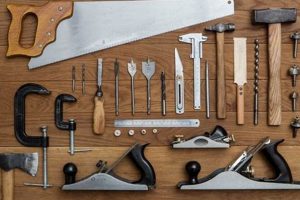
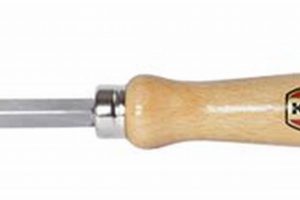
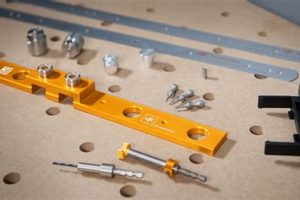
Categorizing implements employed in shaping and manipulating wood requires understanding that the nomenclature designates specific functions. These tools facilitate processes such as cutting, shaping, joining, and finishing wood. Examples include saws for sectioning material, planes for smoothing surfaces, chisels for detailed carving, and hammers for driving fasteners.
Accurate identification of these instruments is crucial for effective woodworking. Proper terminology aids in clear communication, efficient project planning, and the safe execution of tasks. Historically, the development and refinement of these tools have been central to advancements in construction, furniture making, and artistic expression. Knowledge of this historical context provides a greater appreciation for their design and utility.
The subsequent sections will delve into specific categories of these instruments, outlining their primary uses, variations, and associated maintenance procedures. This exploration will emphasize practical application and provide a framework for expanding one’s familiarity with the broad range of instruments available to the woodworker.
Guidance on Woodworking Instruments
This section provides focused guidance on selecting, maintaining, and effectively utilizing a range of instruments common in woodworking. Adherence to these principles promotes safety, precision, and longevity of equipment.
Tip 1: Selecting Appropriate Instruments: Prioritize tools specifically designed for the intended task. Using a chisel as a makeshift screwdriver, for example, can damage both the chisel and the workpiece. Refer to tool catalogs and experienced professionals for guidance.
Tip 2: Maintaining Sharp Cutting Edges: Sharpness is paramount for both efficiency and safety. Regularly hone blades with sharpening stones or a dedicated sharpening system. A dull tool requires more force, increasing the risk of slippage and injury.
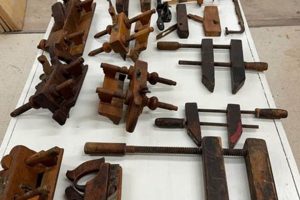
Tip 3: Proper Storage and Handling: Store implements in a dry, organized environment to prevent rust and damage. Utilize tool chests, racks, or designated storage areas. Avoid stacking tools haphazardly, as this can lead to damage and difficulty in retrieval.
Tip 4: Understanding Material Compatibility: The correct instrument choice depends on the type of wood being worked. Dense hardwoods require more robust implements than softwoods. Consult wood species guides for appropriate tool selection.
Tip 5: Utilizing Safety Equipment: Always employ appropriate personal protective equipment, including safety glasses, hearing protection, and dust masks. These measures mitigate the risks associated with woodworking operations.
Tip 6: Regular Cleaning and Lubrication: Clean tools after each use to remove debris and prevent corrosion. Lubricate moving parts with appropriate oils or lubricants to ensure smooth operation and prevent premature wear.
Tip 7: Inspecting for Damage: Regularly inspect tools for signs of damage, such as cracks, loose handles, or chipped blades. Damaged tools should be repaired or replaced immediately to prevent accidents.
Proper selection, maintenance, and utilization of woodworking instruments are foundational to achieving high-quality results and ensuring a safe working environment. Investment in knowledge and adherence to best practices will yield significant dividends in skill development and project outcomes.
The subsequent sections will explore specific tool types in greater detail, examining their individual characteristics and applications.
1. Cutting Instruments

The category of cutting instruments represents a fundamental subset within the broader context of woodwork tools. The ability to precisely divide and shape wood stock is paramount to woodworking, and cutting instruments are the means by which this is achieved. The effect of employing the correct instrument directly impacts the accuracy, efficiency, and safety of the woodworking process. Without an understanding of the specific function and designation of tools such as saws (rip, crosscut, coping, etc.), chisels, and planes, a woodworker cannot effectively execute joinery, shape contours, or prepare surfaces.
The selection of an appropriate cutting instrument is crucial for project success. For example, using a rip saw, designed for cutting with the grain, to crosscut a board will result in a rough, inefficient cut and potentially damage the tool. Conversely, employing a dovetail saw, a specialized tool for fine joinery, for rough stock preparation would be impractical and inefficient. The accurate use of a marking gauge coupled with sharp chisels is vital for precisely cutting joinery such as mortise and tenons. This ensures structural integrity and aesthetic appeal.
In summary, the proper identification and application of cutting instruments are inextricable from successful woodworking. A comprehensive understanding of the lexicon associated with these tools, alongside their respective functions, mitigates errors, promotes safety, and allows for the creation of precise and aesthetically pleasing woodwork. Proficiency in this area is a cornerstone of effective woodworking practice.
2. Shaping Implements

The correct identification and application of shaping implements are critical to the art and science of woodworking. As components of the broader spectrum of woodwork tools, shaping implements directly influence the final form and aesthetic quality of a given project. A plane, for example, allows for the precise leveling of a surface, preparing it for subsequent finishing. Incorrect use of a spokeshave when shaping a curved element can result in unevenness and a compromised final product. The relationship is one of direct cause and effect: the skill with which one employs shaping tools dictates the success of achieving a desired form. A well-defined understanding of the various shaping tool names and their specific applications is, therefore, paramount.
The practical significance of this knowledge extends beyond the aesthetic. Accurate shaping ensures structural integrity. Consider the shaping of a table leg; imprecise shaping can weaken the overall structure, leading to instability or eventual failure. The proper use of a drawknife for rough shaping followed by a rasp or file for finer adjustments enables a craftsman to create strong, visually appealing components. Recognizing the name and function of each implement, knowing when to deploy it, and understanding its limitations defines a skilled woodworker’s proficiency.
In summary, the connection between shaping implements and woodwork tools is fundamental. Skillful application of shaping tools directly impacts project quality, and a clear understanding of tool names and functions is essential. The challenges inherent in woodworking often stem from the misuse of shaping implements, reinforcing the importance of continuous learning and adherence to best practices.
3. Fastening Devices

The effective utilization of fastening devices is integral to successful woodworking. As a category within woodwork tools, these implements enable the creation of stable and durable assemblies. Specificity in nomenclature is crucial; the term “nail,” for example, encompasses a wide array of types (finish nails, common nails, brads) each designed for particular applications. Likewise, screws are designated by head type (flathead, pan head), drive type (Phillips, slotted, square), and thread pattern, each influencing holding power and aesthetic outcome. The correct selection requires a precise understanding of woodwork tools names as they relate to the fastening process.
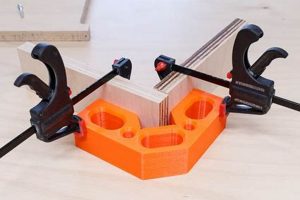
An illustrative example involves the construction of a cabinet. Securing cabinet components with improperly sized or specified screws can compromise structural integrity, leading to racking or joint failure. Conversely, using finish nails for attaching face frames provides a near-invisible fastening solution, preserving aesthetic appeal. Similarly, selecting the appropriate wood glue, although technically an adhesive rather than a mechanical fastener, necessitates considering factors such as open time, clamp pressure requirements, and wood species compatibility; the tool names associated with glue application (glue brushes, spreaders, clamps) thus form part of the broader discussion. Furthermore, the proper installation often necessitates specialized instruments; a countersink bit allows for flush screw placement, while a nail set drives nail heads below the surface for filling. An accurate understanding of these related woodwork tools names improves the outcome of the woodworking process.
In summary, the selection and application of fastening devices, as a component of woodwork tools, directly impact structural integrity and aesthetic qualities. Careful consideration of the nomenclature associated with these implements, coupled with proficiency in their use, allows for the creation of durable and visually appealing woodworking projects. Proficiency in this area mitigates potential structural failures and enhances the overall quality of finished pieces.
4. Measuring Tools

Accurate measurement is foundational to all aspects of woodworking, inextricably linking the precision of construction to the correct application and terminology of measuring tools. A thorough understanding of the nomenclature associated with these instruments is paramount for achieving intended dimensions and ensuring proper component fit.
- Linear Measurement Devices
This category includes rulers, tape measures, and yardsticks, each facilitating the determination of length, width, and height. In cabinetmaking, for instance, precise measurements obtained with a steel ruler are critical for accurately sizing cabinet doors and drawers. Deviation from specified dimensions, due to incorrect usage or misinterpretation of scale markings, results in misaligned components and a compromised finished product.
- Angle Measurement Instruments
Protractor, bevel gauge, and combination square are instrumental in establishing and transferring angles. In chair making, determining the precise angle of a chair back relative to the seat requires an accurate bevel gauge; an incorrect angle compromises comfort and structural integrity. Understanding the degree markings and proper alignment protocols for these instruments is essential.
- Thickness and Depth Gauges
Calipers (both inside and outside) and depth gauges facilitate the measurement of material thickness and the depth of recesses. When crafting a mortise and tenon joint, a depth gauge is crucial for ensuring the mortise is neither too shallow nor too deep. Incorrect depth impacts joint strength and alignment. Proficiency in reading vernier scales and digital displays is essential for precision.
- Marking and Layout Tools
Marking gauges, squares, and compasses are utilized for transferring dimensions and creating accurate layout lines. In constructing complex joinery, a marking gauge ensures consistent depth of cuts along a board’s edge. A deviation in marking, stemming from improper tool usage, leads to imprecise joinery and structural weakness.
The relationship between measuring tools and woodwork tool knowledge extends beyond mere identification. It encompasses an understanding of tool limitations, appropriate application techniques, and the ability to interpret and translate measurements accurately. Mastery of these aspects is fundamental to producing high-quality, dimensionally precise woodworking projects.
5. Finishing Equipment

The selection and application of finishing equipment directly influence the final appearance and protective qualities of woodwork. The nomenclature surrounding these implements constitutes a significant subset within the broader lexicon of woodwork tools. A spray gun, for example, requires a specific designation, differentiating between HVLP (high volume, low pressure) and airless types, each suited for distinct coating materials and desired finishes. Incorrect identification or application leads to substandard results, such as uneven coating, runs, or inadequate protection against environmental factors. The ability to specify the precise tool name dictates the outcome.
Consider the process of applying a protective varnish to a tabletop. Employing the wrong brusha low-quality brush with shedding bristlescontaminates the finish, requiring additional sanding and rework. The proper brush, a high-quality badger-hair brush designed for fine finishes, ensures smooth, even application. Similarly, using an orbital sander with incorrect grit sandpaper can damage the underlying wood, creating swirl marks or unevenness. Precise selection of the appropriate sandpaper grit sequence is critical for achieving a flawless surface prior to finishing. Application cloths and pads, also part of finishing equipment, vary greatly in material and purpose, impacting sheen and texture.
In summary, the effective use of finishing equipment is integral to successful woodworking. An understanding of the precise nomenclature associated with these tools, coupled with a knowledge of their proper application techniques, allows for the creation of durable and aesthetically pleasing finishes. Failure to correctly identify and utilize appropriate finishing equipment can negate the effort invested in earlier stages of the woodworking process, resulting in an unsatisfactory final product. This connection reinforces the significance of comprehensive knowledge of woodwork tools names.
6. Maintenance Items

The longevity and performance of woodworking instruments are directly contingent upon proper maintenance. Maintenance items, therefore, represent an essential, though often overlooked, category within the broader lexicon of woodwork tools. The absence of appropriate maintenance procedures renders even the highest-quality instruments ineffective or, in extreme cases, unusable. A dull chisel, for instance, regardless of its initial cost or construction, becomes a safety hazard and a hindrance to precise work. The specific maintenance items required vary depending on the type of tool, but the principle of preservation remains constant.
Sharpening stones, honing steels, and lapping compounds are critical maintenance items for edged tools such as chisels, planes, and knives. Without regular honing, these implements lose their keen edge, requiring increased force and resulting in rough or uneven cuts. Similarly, cleaning solvents, rust inhibitors, and lubricating oils are essential for preserving metallic surfaces on saws, planes, and measuring tools. Neglecting these maintenance procedures leads to corrosion, friction, and diminished accuracy. In the case of power tools, regular cleaning, lubrication, and replacement of worn parts (such as belts or brushes) are necessary to maintain optimal performance and extend operational lifespan. The woodwork tools names associated with these processes”sharpening stone,” “lubricating oil,” “replacement belt”become integral parts of a complete understanding of woodworking.
In summary, maintenance items are not merely ancillary accessories but fundamental components of a comprehensive woodworking toolkit. Their proper utilization ensures the reliable operation, longevity, and continued precision of all other tools. The relationship between maintenance items and woodwork tools is symbiotic; one cannot exist effectively without the other. Recognizing the importance and proper nomenclature of maintenance items is, therefore, a defining characteristic of a skilled and conscientious woodworker.
Frequently Asked Questions
The following section addresses common inquiries regarding the identification and terminology associated with implements employed in woodworking. Accuracy in nomenclature is paramount for effective communication, safe practices, and project success.
Question 1: What is the correct term for the tool used to create a rabbet joint?
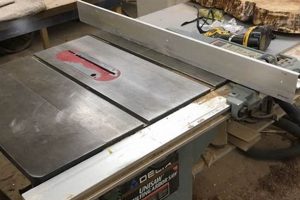
The tool commonly used to create a rabbet joint is a rabbet plane. However, a router with a rabbeting bit or a table saw can also accomplish this task, depending on the size and configuration of the rabbet.
Question 2: Is there a distinction between a coping saw and a fret saw?
Yes, while both are used for intricate curved cuts, a coping saw typically has a coarser blade and a deeper frame, making it suitable for thicker materials and following existing profiles. A fret saw, on the other hand, features a finer blade and a shallower frame, allowing for more delicate and precise cuts, often used in marquetry.
Question 3: What is the purpose of a spokeshave, and how does it differ from a drawknife?
A spokeshave is primarily used for shaping curved surfaces, such as chair spindles or rounded edges. It differs from a drawknife in that it is typically smaller, has a shorter blade, and is held with two hands, pulling towards the user. A drawknife is larger and often used for removing larger amounts of material from straight or gently curved surfaces.
Question 4: What is the difference between a mortise chisel and a bench chisel?
A mortise chisel is designed for creating mortises (rectangular holes) and is characterized by its thick, robust blade, enabling it to withstand heavy pounding. A bench chisel, while also used for general woodworking tasks, has a thinner blade and is better suited for paring and shaping rather than heavy mortising.
Question 5: What is the correct name for the tool used to create a decorative edge profile on a piece of wood?
The tool used to create a decorative edge profile is generally referred to as a molding plane. Alternatively, a router equipped with a molding bit can be used to achieve similar results.
Question 6: What is the proper way to refer to a tool used to create perfectly aligned pilot holes for screws?
This tool is called a self-centering drill bit or a Vix bit. The bit’s design ensures the pilot hole is precisely centered, preventing the screw from drifting off-center during installation.
A thorough understanding of the proper terminology for woodworking implements ensures clarity, safety, and precision in all phases of woodworking projects.
The subsequent section will provide a glossary of commonly used woodworking terms, further enhancing comprehension and effective communication.
Conclusion
This exploration has underscored the importance of accurate and specific terminology related to implements used in woodworking. Proper identification of these instruments is crucial for effective communication, safe operational practices, and achieving desired project outcomes. A thorough understanding of the names associated with cutting instruments, shaping implements, fastening devices, measuring tools, finishing equipment, and maintenance items forms the foundation of skilled craftsmanship.
As woodworking techniques evolve and new tools emerge, ongoing education and a commitment to precision in language remain essential. The value of clarity in nomenclature extends beyond individual projects, fostering collaboration and facilitating the transmission of knowledge within the woodworking community. Continuous refinement of this understanding is critical for maintaining standards of excellence in the craft.