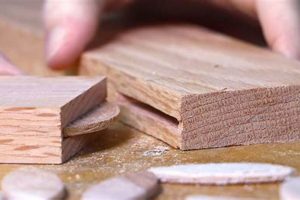
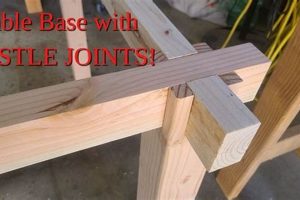
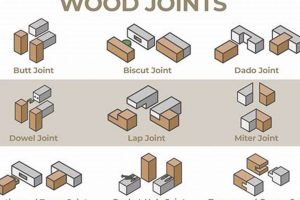
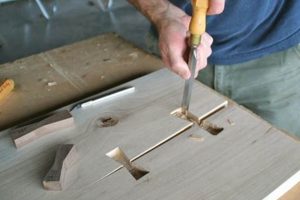
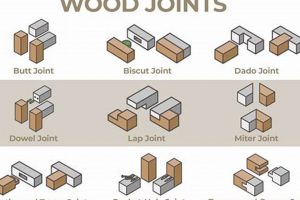
A connection where two pieces of wood overlap, with material removed from each piece to create a flush surface. This technique joins wood pieces together face to face. Examples include joining boards to create a wider panel or constructing frame corners.
This joint offers enhanced strength compared to a simple butt joint, due to the increased surface area for adhesive. Its stability makes it suitable for projects requiring structural integrity. Historically, this method has been employed in furniture making, shipbuilding, and construction, showcasing its long-standing reliability.
The following sections will delve into specific variations of this joint, optimal applications based on project requirements, the tools and techniques involved in its creation, and considerations for selecting the appropriate adhesive for maximum strength and longevity.
Essential Guidance
The following points address key considerations for achieving optimal results when employing overlapping connections in woodworking.
Tip 1: Material Selection: Choose lumber with consistent grain patterns and density. Matching wood species enhances the adhesive bond and minimizes differential expansion or contraction.
Tip 2: Precise Layout: Accurate marking is crucial for a tight-fitting joint. Utilize sharp marking tools and ensure squareness during the layout process.
Tip 3: Accurate Material Removal: Employ a saw and chisel or router to remove material with precision. Aim for a smooth, flat surface for maximum adhesive contact.
Tip 4: Dry Fit: Always dry-fit the components before applying adhesive. This allows for adjustments and ensures proper alignment.
Tip 5: Adhesive Selection: Choose an adhesive appropriate for the wood species and intended use. Consider factors such as open time, clamping pressure, and water resistance.
Tip 6: Clamping Pressure: Apply sufficient clamping pressure to ensure intimate contact between the surfaces. Use cauls to distribute pressure evenly and prevent damage.
Tip 7: Clean Up: Remove excess adhesive immediately after clamping. This prevents hardened glue lines and simplifies finishing.
Adherence to these guidelines will contribute to a strong, aesthetically pleasing, and durable woodworking project.
The subsequent section will summarize the core principles and provide recommendations for advanced techniques.
1. Strength and Stability

The inherent strength and stability of a woodworking lap joint stem from its design, which maximizes the surface area available for adhesive bonding. This increased surface contact, relative to a butt joint for instance, directly contributes to a greater resistance against tensile and shear forces. The overlapping configuration distributes stress more evenly across the joined components, minimizing the likelihood of localized failure. A well-executed lap joint, therefore, provides a more robust connection capable of withstanding significant loads and stresses.
Consider a bookshelf construction. The shelves, secured to the vertical supports using lap joints, exhibit enhanced resistance to sagging under the weight of books. The increased glue surface area ensures that the load is distributed along the entire length of the joint, preventing concentrated stress points. In contrast, a shelf attached with only end-grain glued butt joints would be prone to failure due to the weakness of the adhesive bond on end-grain surfaces and the stress concentration at the joint.
Understanding the relationship between strength, stability, and lap joint construction is vital for designing durable and reliable woodworking projects. While the lap joint offers superior structural integrity compared to simpler joinery methods, its effectiveness is contingent upon precise execution and proper material selection. Challenges may arise from inaccurate cuts or improper adhesive selection. Overcoming these challenges, however, results in a joint that significantly enhances the longevity and structural soundness of the overall piece.
2. Adhesive Surface Area

Within the context of woodworking, the available surface area for adhesive application is a critical determinant of joint strength and longevity. The design of a woodworking lap joint inherently provides a substantial surface area for adhesive bonding, directly influencing its overall performance.
- Bond Strength Enhancement
An increase in the area available for adhesive application directly correlates with enhanced bond strength. A larger surface area allows for a more extensive and robust bond between the wood components. A wider, longer lap joint, as opposed to a shorter one, demonstrates significantly higher resistance to pulling forces due to the increased glue surface. This principle is applied in structural applications like timber framing, where expansive lap joints are used to join large beams, ensuring that the structure can withstand considerable weight and stress.
- Stress Distribution
The adhesive surface area contributes to stress distribution along the joint. A larger surface area allows forces to be spread more evenly across the joint, preventing stress concentrations that can lead to premature failure. Consider a table leg attached with a lap joint; the broader the glued surface, the better the distribution of the weight from the tabletop, reducing the risk of the joint cracking or separating under load.
- Adhesive Type Considerations
The choice of adhesive must complement the available surface area. Different adhesives have varying bond strengths per unit area. For lap joints with extensive surface area, adhesives with high shear strength and gap-filling capabilities may be preferred to maximize the benefit of the joint’s design. An epoxy, for instance, might be chosen over a standard wood glue if the surface area is substantial and the joint requires exceptional water resistance or gap-filling properties.
- Joint Longevity and Durability
Expanded adhesive surface area contributes to joint longevity and durability. With a more extensive bond, the joint is less susceptible to degradation over time due to factors like moisture changes, temperature fluctuations, and physical stress. Lap joints in outdoor furniture, such as benches or picnic tables, benefit from this increased durability, as they are better able to withstand the elements and repeated use compared to joints with limited glue surface.
These factors collectively demonstrate the fundamental relationship between adhesive surface area and the efficacy of the lap joint in woodworking. Understanding and optimizing this relationship is crucial for creating strong, durable, and reliable wooden structures.
3. Joinery Precision

Joinery precision serves as a foundational element in the successful execution of woodworking lap joints. Accurate material removal and dimensioning are critical; deviations from the intended specifications can compromise the integrity of the joint. A lap joint’s strength is predicated on a flush, gap-free fit between the overlapping surfaces, maximizing the contact area for adhesive bonding. Imprecise cuts or inaccurate mortise and tenon dimensions within the lap joint introduce weak points, reducing the joint’s capacity to withstand load. For example, in crafting a frame and panel door using lap joints, inaccuracies in the shoulder cuts of the tenons will result in gaps, diminishing the door’s structural stability and potentially leading to warping over time.
The practical implications of joinery precision extend beyond mere structural integrity. A poorly executed lap joint detracts from the aesthetic appeal of the finished piece. Visible gaps, misalignments, or inconsistencies in the surface plane are immediately apparent, undermining the craftsmanship. Furthermore, inaccuracies necessitate corrective measures, such as filling gaps with wood filler or planing surfaces, which add time and complexity to the project. Consider constructing a table apron using lap joints; precise execution ensures the apron is square, level, and visually appealing, complementing the tabletop seamlessly. Conversely, inaccurate joints will result in an uneven or unstable structure, requiring extensive rework to rectify the issues.
In summary, joinery precision is indispensable for realizing the full potential of a woodworking lap joint. Accuracy in layout, cutting, and assembly directly translates to increased strength, enhanced aesthetic quality, and reduced project time. While challenges may arise from tool limitations or skill deficiencies, a commitment to precision throughout the process is paramount for achieving successful and enduring woodworking outcomes. This understanding underscores the importance of meticulous craftsmanship in all aspects of woodworking, ensuring both structural integrity and visual appeal.
4. Material Compatibility

Material compatibility is a critical factor influencing the long-term performance of a woodworking lap joint. The physical and mechanical properties of the wood species employed directly affect the joint’s strength, stability, and resistance to environmental factors. Selecting incompatible materials can lead to premature failure, regardless of the precision and execution of the joint itself. For instance, joining a highly stable wood, such as mahogany, with a dimensionally unstable wood, such as poplar, in a lap joint will likely result in stress as the poplar expands and contracts with changes in humidity, potentially weakening or fracturing the adhesive bond and distorting the joint’s geometry. Therefore, understanding the inherent characteristics of different wood species is essential.
Consider the practical application of constructing a frame using lap joints. If the frame requires exposure to varying environmental conditions, selecting woods with similar expansion and contraction rates is crucial. Pairing quartersawn oak with quartersawn maple, both relatively stable hardwoods, would provide a more durable and reliable lap joint than pairing oak with a softwood like pine. The similar densities and moisture content of oak and maple ensure consistent behavior over time, minimizing stress on the joint and the adhesive bond. Furthermore, the adhesive itself must be compatible with the specific wood species used, as some adhesives bond more effectively with certain wood types than others. Resin selection often depends upon the wood species.
In conclusion, material compatibility constitutes an indispensable component of successful lap joint construction. The strategic selection of compatible wood species, coupled with an understanding of appropriate adhesives, ensures the joint’s longevity and structural integrity. While challenges may arise in sourcing compatible materials or accurately predicting their behavior, prioritizing material compatibility mitigates the risk of joint failure and contributes to the overall quality and durability of woodworking projects. Attention to material compatibility is just as important as the design of the lap joint.
5. Load Distribution

Load distribution is intrinsically linked to the effectiveness of a woodworking lap joint. The joint’s design inherently increases the surface area available for load transfer between connected members. A properly executed lap joint ensures that forces are not concentrated at a single point, but are instead distributed across the entire overlapping surface. This distribution minimizes stress on the adhesive bond and the surrounding wood fibers, reducing the likelihood of joint failure. Consider a table leg attached to an apron using a lap joint; the weight of the tabletop and any items placed upon it is transferred from the apron to the leg via the overlapping surfaces. The larger the surface area of the lap joint, the more evenly this load is distributed, enhancing the table’s overall stability and load-bearing capacity.
The effectiveness of load distribution in a lap joint is directly influenced by the precision of its construction. Gaps or uneven surfaces within the joint create points of concentrated stress, compromising its ability to evenly transfer loads. Accurate cutting and assembly are therefore essential for maximizing the benefits of the lap joint’s design. In applications where significant loads are anticipated, the dimensions of the lap joint should be carefully considered to ensure adequate surface area for load distribution. For example, in building a heavy-duty workbench, deeper and wider lap joints would be employed to connect the legs to the frame, distributing the substantial weight of tools and materials across a greater surface, thereby preventing the legs from shearing off under load.
In summary, load distribution is a critical performance criterion for any woodworking lap joint. By maximizing the surface area for load transfer and ensuring precise construction, the joint’s ability to withstand stress and maintain structural integrity is significantly enhanced. While factors such as wood species and adhesive type also contribute to joint strength, the principles of load distribution remain paramount. Understanding and applying these principles results in woodworking projects that are both durable and structurally sound. The challenges are to ensure accuracy.
Frequently Asked Questions
The following questions address common concerns and misconceptions regarding the design, construction, and application of woodworking lap joints.
Question 1: What distinguishes a woodworking lap joint from a butt joint, and what advantages does the former offer?
A woodworking lap joint is characterized by the overlapping of two wood members, with material removed to create a flush surface. A butt joint simply joins two pieces end-to-end. The lap joint offers superior strength due to the increased surface area for adhesive bonding and improved load distribution compared to the weaker butt joint.
Question 2: In what applications is the use of a woodworking lap joint most appropriate?
The lap joint is suitable for applications requiring moderate structural strength and aesthetic integration. It is commonly used in frame construction, drawer assembly, and situations where the overlapping profile is acceptable or desirable. Specifically, It is suitable for joining components and table legs,.
Question 3: What considerations should be given to material selection when constructing a woodworking lap joint?
Material selection is critical. Wood species with similar expansion and contraction rates should be selected to minimize stress on the joint. Grain orientation should also be considered to maximize the joint’s resistance to splitting or warping. Wood materials should be chosen appropriately to have similar properties.
Question 4: What are the primary challenges encountered during the construction of a woodworking lap joint, and how can they be mitigated?
Challenges include achieving precise material removal, maintaining accurate dimensions, and ensuring a tight fit. These can be mitigated through the use of sharp tools, accurate measuring techniques, and careful attention to detail during layout and execution. Precision tools are usually needed.
Question 5: What types of adhesives are best suited for use in woodworking lap joints, and why?
Adhesives with high shear strength and good gap-filling properties are generally preferred. Polyvinyl acetate (PVA) glues are commonly used, but epoxy resins may be appropriate for applications requiring increased water resistance or gap-filling capabilities. Make sure the adhesive has good shear.
Question 6: How does the size and proportion of a woodworking lap joint influence its overall strength and stability?
The size and proportion of the lap joint directly affect its load-bearing capacity. Larger surface areas for adhesive bonding provide greater strength and stability. The dimensions should be appropriate for the anticipated loads and stresses on the joint. Calculate the dimension beforehand.
These questions and answers highlight the essential considerations for successfully designing, constructing, and utilizing woodworking lap joints in a variety of applications. Remember that a larger surface is better!
The subsequent section will provide a comprehensive guide to advanced techniques and best practices for creating strong and aesthetically pleasing lap joints.
Conclusion
This exploration has demonstrated that the woodworking lap joint, while seemingly simple, embodies fundamental principles of joinery crucial to structural integrity and aesthetic appeal. Aspects of surface area, precision, material compatibility, and load distribution directly influence joint performance. Proper application necessitates a thorough understanding of these interconnected elements.
Mastery of the woodworking lap joint provides a solid foundation for advanced techniques and complex projects. Further study and practical experience will enhance the ability to create durable and visually appealing woodworking pieces. Its continued relevance in both traditional and contemporary woodworking underscores its enduring significance.