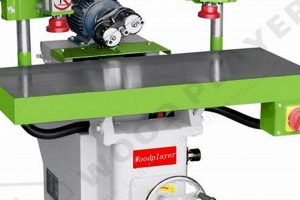
This specialized equipment facilitates the creation of precisely aligned, evenly spaced holes in wood components. It is typically employed in applications requiring consistent hole patterns, such as cabinet making for shelf supports or hardware installation. The machine utilizes multiple drill bits operating simultaneously along a linear axis, ensuring accuracy and repeatability in drilling operations.
The significance of this technology lies in its ability to significantly increase production efficiency and reduce manufacturing errors compared to manual drilling methods. The uniform hole patterns created enhance the structural integrity and aesthetic appeal of finished products. Historically, these machines represented a significant advancement in woodworking technology, allowing for greater precision and scalability in furniture and cabinet production.
The following sections will delve deeper into the specific components, operational principles, and practical applications of this essential piece of woodworking machinery, providing a comprehensive overview of its capabilities and limitations.
Operating Insights for Optimal Performance
The following insights are crucial for maximizing the efficiency and precision of the equipment, ensuring consistent results and minimizing potential operational issues.
Tip 1: Regular Calibration is Essential: Consistent use can lead to minor misalignments. Schedule regular calibration checks, ideally weekly or bi-weekly depending on usage frequency. Utilize precision measuring tools to verify drill bit alignment and spacing to maintain accuracy.
Tip 2: Material Compatibility is Key: Different wood densities and types require varying drill speeds and feed rates. Consult the machine’s documentation and experiment with scrap pieces to determine optimal settings for each material. This minimizes splintering and ensures clean hole creation.
Tip 3: Invest in High-Quality Drill Bits: The quality of the drill bits directly impacts the precision and longevity of the equipment. Opt for carbide-tipped bits designed for industrial use. Regularly inspect bits for wear and sharpness, replacing them as needed.
Tip 4: Proper Dust Extraction is Mandatory: Fine wood dust accumulation can negatively affect the machine’s mechanics and create a fire hazard. Implement a robust dust extraction system connected directly to the equipment to remove dust and debris during operation.
Tip 5: Scheduled Maintenance Prevents Downtime: Adhere to the manufacturer’s recommended maintenance schedule. This includes lubricating moving parts, inspecting belts and pulleys for wear, and cleaning the machine thoroughly after each use. Proactive maintenance minimizes costly repairs and extends the machine’s lifespan.
Tip 6: Secure Material Clamping is Paramount: Inadequate clamping can lead to material shifting during drilling, resulting in inaccurate hole placement and potential damage to the workpiece. Use appropriate clamping mechanisms and ensure they are properly tightened before initiating the drilling process.
Tip 7: Monitor Air Pressure Consistently: If the equipment utilizes pneumatic components, maintain consistent air pressure within the recommended range. Fluctuations in air pressure can affect drilling speed and precision. Regularly check the air compressor and adjust as needed.
By adhering to these operational best practices, users can optimize the performance of the woodworking equipment, ensuring consistent accuracy, reducing downtime, and maximizing its overall lifespan.
The subsequent sections will explore specific applications and emerging technologies related to this type of woodworking equipment.
1. Precision Hole Alignment

The correlation between precision hole alignment and the equipment is fundamental to its function and value. The machine’s design directly addresses the need for accurately spaced and consistently sized holes, a critical requirement in numerous woodworking applications. The consistent spacing ensures that components, such as shelves or drawer slides, fit seamlessly into the finished product. Any deviation from precise alignment can lead to structural weakness, aesthetic flaws, or functional impairment.
The practical effect of this precision is exemplified in the mass production of cabinetry. Consider a large furniture manufacturer tasked with producing hundreds of identical cabinets daily. Without this equipment, achieving consistent hole patterns for shelf supports would be time-consuming and prone to error. The resulting inconsistencies would lead to variations in shelf placement, reducing storage capacity and potentially compromising the structural integrity of the shelves under load. However, by utilizing a line boring machine, each cabinet receives precisely aligned holes, ensuring uniformity and reliability across the entire production run.
In summary, the equipment directly enables precision hole alignment, transforming a potentially complex and error-prone task into a repeatable and efficient process. This precision translates to improved product quality, increased manufacturing efficiency, and ultimately, greater customer satisfaction. The understanding of this connection is vital for anyone involved in woodworking, from machine operators to furniture designers, as it underscores the machine’s indispensable role in achieving high-quality woodworking outcomes.
2. Enhanced Production Speed

The relationship between enhanced production speed and the woodworking equipment is a cornerstone of its operational value. This machinery is specifically engineered to accelerate the hole-drilling process, significantly reducing the time required compared to manual or single-spindle drilling methods. The impact on production timelines and overall efficiency is substantial.
- Multiple Drill Bit Operation
The simultaneous operation of multiple drill bits is a primary driver of enhanced production speed. The equipment is designed to drill multiple holes in a single pass, eliminating the need for repetitive repositioning of the workpiece. For example, in cabinet manufacturing, a line boring machine can drill all the shelf support holes along a cabinet side in one operation, a task that would take significantly longer with a conventional drill press. The implications are a drastically reduced cycle time and a higher throughput of finished components.
- Automated Positioning Systems
Many models incorporate automated positioning systems, further accelerating the drilling process. These systems use computer numerical control (CNC) to precisely position the workpiece under the drill bits, eliminating the need for manual adjustments. An instance of this is seen in high-volume furniture production, where CNC-controlled machines can drill complex hole patterns with minimal operator intervention. This results in not only faster drilling but also reduced error rates, contributing to overall production efficiency.
- Reduced Material Handling Time
The equipment minimizes material handling time, which is often a bottleneck in woodworking operations. Its design allows for easy loading and unloading of workpieces, and its automated features reduce the need for manual manipulation. For example, a machine with an integrated conveyor system can automatically feed workpieces into the drilling station and then transport them to the next stage of production. This streamlined material flow significantly reduces the overall production cycle time.
- Minimized Setup Time
While initial setup may require some time, the repeatability of the machine significantly minimizes setup time for subsequent production runs. Once a program is created for a particular hole pattern, it can be easily recalled and executed, eliminating the need for manual measurements and adjustments. This is particularly beneficial in situations where frequent product changeovers are required, allowing manufacturers to quickly adapt to changing customer demands. The machine allows consistently creating drilling template.
In conclusion, the equipment’s design and functionality are intrinsically linked to enhanced production speed. The integration of multiple drill bit operation, automated positioning systems, reduced material handling time, and minimized setup time synergistically contribute to a substantial increase in throughput and efficiency in woodworking operations. This enhanced speed directly translates to increased profitability and competitiveness for woodworking businesses.
3. Material Versatility

Material versatility, as it relates to the woodworking equipment, refers to its capability to efficiently and accurately process a wide array of wood types and composite materials. The design and functionality of the machine are directly correlated with its ability to handle diverse material characteristics, ranging from softwoods like pine to hardwoods such as oak and maple, and engineered wood products including plywood, MDF (Medium-Density Fiberboard), and particleboard. The equipment’s adaptability to varying material densities and textures is critical for its utility in diverse woodworking applications.
The versatility stems from adjustable parameters within the machine’s operation. Drill bit speed, feed rate, and clamping pressure can be modified to suit the specific properties of the material being processed. For instance, a lower drill speed and slower feed rate are typically employed when working with hardwoods to prevent splintering and ensure clean hole creation. Conversely, higher speeds and feed rates may be suitable for softer woods. Additionally, the ability to accommodate different drill bit types and sizes further enhances its adaptability to various material requirements. An example of this is the use of specialized drill bits for working with MDF, which minimizes chipping and produces smoother hole edges. Another is the capability to adjust the clamping pressure according to density to avoid imprints or damage to surface during operation.
In conclusion, the material versatility of the woodworking equipment is a key determinant of its overall value and applicability. This feature enhances its utility across a spectrum of woodworking projects, from furniture manufacturing to cabinet making, and beyond. While challenges remain in optimizing settings for novel composite materials, the equipment’s inherent adaptability remains a significant advantage. The proper understanding of how to leverage material versatility directly translates into optimized production efficiency, minimized material waste, and enhanced product quality.
4. Consistent Drilling Depth

The woodworking equipment’s capacity to maintain consistent drilling depth is integral to its operational effectiveness and the quality of finished products. This consistency is not merely a desirable attribute but a necessary function, directly impacting the structural integrity, aesthetic appeal, and functional performance of assembled wood components. Inconsistent drilling depths can lead to a range of problems, including weak joints, misaligned hardware, and uneven surfaces.
The equipment achieves consistent drilling depth through a combination of mechanical precision and adjustable control mechanisms. These mechanisms ensure that each drill bit penetrates the workpiece to a predetermined depth, regardless of minor variations in material density or surface irregularities. For example, in the production of kitchen cabinets, consistent drilling depth is essential for the proper installation of hinges and drawer slides. If the drilling depth varies, the hinges may not sit flush against the cabinet surface, leading to uneven door alignment and potential hardware failure. Similarly, inconsistent drilling depth for drawer slides can result in drawers that do not open or close smoothly, compromising functionality. These examples highlight the importance of consistent drilling depth in ensuring the quality and longevity of the final product.
In summary, the equipment’s ability to consistently drill to a specific depth is a critical factor in achieving high-quality woodworking results. This feature minimizes errors, reduces rework, and ensures that finished products meet stringent quality standards. While challenges remain in maintaining consistent drilling depth across exceptionally dense or knotty wood, the equipment’s precision engineering and adjustable control mechanisms provide a robust solution for most woodworking applications. Understanding this connection is paramount for woodworking professionals seeking to maximize efficiency, minimize waste, and produce superior finished products.
5. Reduced Labor Costs

The implementation of specialized woodworking equipment directly influences labor costs within manufacturing environments. This impact stems from increased automation, improved efficiency, and decreased reliance on manual processes. The reduction in labor expenditure becomes a critical factor in assessing the return on investment for such machinery.
- Decreased Man-Hours per Unit
The primary contribution to reduced labor costs arises from the significant decrease in man-hours required to produce a unit of finished product. The automated drilling processes inherent in the equipment allow for the completion of tasks in a fraction of the time compared to manual methods. The effect is particularly evident in high-volume production settings, where the cumulative time savings translate into substantial labor cost reductions. Example: In a cabinet manufacturing plant, manual drilling might require one hour per cabinet for shelf supports, whereas the machine can complete the same task in five minutes, freeing up manpower for other tasks.
- Lower Skill Requirements for Operation
While specialized woodworking equipment necessitates trained operators, the skill level required for operation is often lower compared to that required for manual drilling tasks. The automated nature of the machine minimizes the need for highly skilled craftsmen, reducing the wage expenses associated with specialized labor. Moreover, the standardization of processes facilitated by the equipment decreases the likelihood of human error, further reducing the need for rework and associated labor costs. Example: An entry-level operator can be trained to operate the woodworking equipment effectively in a few days, while mastering manual drilling techniques for comparable output speed and accuracy requires years of experience.
- Minimized Material Waste and Rework
The precision and repeatability of the automated drilling process contribute to minimized material waste and a reduction in the need for rework. Inaccuracies and errors inherent in manual drilling can lead to material spoilage and necessitate time-consuming repairs. By contrast, the equipment’s consistent performance minimizes these issues, reducing both material costs and the labor expenses associated with correcting errors. Example: In furniture manufacturing, manually drilled holes may be misaligned, requiring replacement of the entire component. The machine’s accuracy significantly reduces the frequency of such errors, saving on both material and labor costs.
- Increased Production Throughput
The automated processes significantly increase overall production throughput. The machine’s ability to consistently and efficiently drill multiple holes simultaneously accelerates the entire manufacturing process. This increased output allows companies to produce more units with the same labor force or, alternatively, to reduce the labor force while maintaining existing production levels, resulting in direct labor cost savings. Example: A small woodworking business can significantly increase its cabinet output by investing in the equipment, enabling it to fulfill larger orders and compete more effectively in the market without proportionally increasing its labor expenses.
The facets discussed converge to demonstrate that integration of the equipment in woodworking operations translates to significant reduced labor costs. The automation, precision, and increased production throughput collectively contribute to more efficient use of labor resources, providing a competitive advantage for businesses that adopt this technology. The initial capital expenditure is offset by the long-term savings in labor costs and the enhanced productivity that accompanies the specialized woodworking processes.
Frequently Asked Questions About Woodworking Line Boring Machines
This section addresses common inquiries and clarifies misunderstandings regarding the operation, maintenance, and application of woodworking equipment designed for creating precisely aligned holes in wood components.
Question 1: What is the primary function of a woodworking line boring machine?
The primary function is to create a series of precisely aligned and evenly spaced holes in a workpiece, typically for hardware installation, shelf supports, or other applications requiring consistent hole patterns.
Question 2: What types of materials can be processed using this equipment?
This equipment is capable of processing a wide range of wood types, including both softwoods (pine, fir) and hardwoods (oak, maple). Additionally, it can be used with engineered wood products such as plywood, MDF (Medium-Density Fiberboard), and particleboard. Material settings should always be configured as appropriate.
Question 3: How does a woodworking line boring machine enhance production efficiency?
Efficiency is enhanced through simultaneous drilling of multiple holes. Also enhanced by automated positioning systems, and reduced material handling. This minimizes production time and maximizes throughput compared to manual drilling processes.
Question 4: What maintenance procedures are essential for ensuring optimal performance?
Essential maintenance procedures include regular calibration checks to ensure drill bit alignment, routine cleaning to remove wood dust and debris, lubrication of moving parts, and inspection of belts and pulleys for wear. Timely replacement of worn or damaged components is also crucial.
Question 5: What safety precautions should be observed when operating a woodworking line boring machine?
Safety precautions include wearing appropriate personal protective equipment (PPE) such as safety glasses and hearing protection, ensuring that the workpiece is securely clamped before initiating drilling, maintaining a safe distance from moving parts, and adhering to all manufacturer-recommended safety guidelines. A properly functioning dust collection system is also vital for respiratory health and fire safety.
Question 6: What are the typical applications of this type of woodworking equipment?
Typical applications include cabinet making (shelf supports, hinge placement), furniture manufacturing (dowel joints, hardware installation), and other woodworking projects requiring precise and repeatable hole patterns.
These FAQs provide a fundamental understanding of the woodworking equipment. Correct operation, maintenance, and safety practices are paramount for maximizing efficiency and ensuring a safe working environment.
The next article will delve into the integration of this technology with other woodworking processes.
Conclusion
This exploration has illuminated the multifaceted nature of the woodworking line boring machine, underscoring its vital role in modern woodworking. The discussion encompassed its operational principles, benefits regarding precision and efficiency, material versatility, maintenance requirements, and safety considerations. The capacity to consistently deliver accurately spaced holes, coupled with the enhanced production speeds, establishes this machinery as a key asset for businesses seeking to optimize their woodworking operations.
The woodworking industry faces ever-increasing demands for precision and efficiency. Understanding and effectively utilizing equipment like the woodworking line boring machine is no longer a mere advantage, but a necessity for sustained competitiveness. Continuous improvements and adoption of advanced techniques will be critical for meeting future challenges and harnessing the full potential of this technology.