



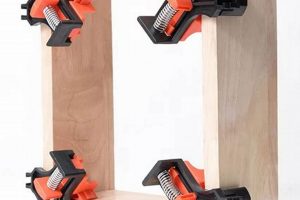
This specialized holding device is engineered to maintain a precise right angle between two workpieces during assembly. A common application involves securing frame components or box corners while adhesives dry or fasteners are applied. These devices typically feature jaws or clamping surfaces designed to exert even pressure, ensuring a strong and accurate bond.
The use of these tools enhances the accuracy and efficiency of woodworking projects requiring perpendicular joints. They contribute to the creation of professional-quality assemblies by minimizing the risk of misalignment or distortion. Historically, achieving accurate 90-degree angles relied on cumbersome jigs and fixtures; the advent of these dedicated clamps has streamlined the process, reducing both time and labor.
The following sections will explore the diverse range of styles available, factors to consider when selecting an appropriate model, and best practices for employing these tools to achieve optimal results in woodworking applications. We will also delve into maintenance tips and troubleshooting common issues.
Effective Use Tips
Optimizing the employment of these clamps requires attention to detail and adherence to established techniques. The following tips enhance accuracy and maximize the utility of these tools.
Tip 1: Verify Squareness: Prior to clamping, ensure both workpieces are precisely square. Use a reliable square or combination square to confirm a true 90-degree angle. Inaccurate starting points negate the benefits of the holding device.
Tip 2: Apply Even Pressure: Over-tightening can distort the joint or damage the material. Distribute clamping force evenly across the faces of the pieces. Multiple clamps are advisable for larger assemblies.
Tip 3: Protect Surfaces: Employ protective pads or shims between the clamp jaws and the workpiece surfaces. This prevents indentation and marring, especially on softer woods or finished surfaces.
Tip 4: Consider Clamp Style: Different styles cater to various project needs. Corner clamps are suitable for simple frame construction. Face frame clamps offer greater versatility for attaching face frames to cabinets. Choose based on the specific application.
Tip 5: Allow Adequate Drying Time: When used in conjunction with adhesives, allow sufficient drying time before removing the clamp. Consult the adhesive manufacturer’s recommendations for optimal curing duration.
Tip 6: Inspect for Debris: Regularly inspect the clamping surfaces for sawdust or adhesive residue. Clean surfaces ensure consistent clamping pressure and prevent inaccuracies.
Tip 7: Utilize a Clamping Jig: For repetitive tasks, consider incorporating a clamping jig. A jig provides consistent positioning and repeatable accuracy for mass production or complex assemblies.
Adhering to these recommendations maximizes the potential of right-angle clamping devices, resulting in stronger, more accurate, and aesthetically pleasing woodworking projects.
The subsequent segment of this article will address common troubleshooting scenarios encountered during usage, along with preventative maintenance strategies.
1. Joint Accuracy

Joint accuracy is a paramount concern in woodworking, directly influencing the structural integrity, aesthetic appeal, and overall quality of finished projects. Maintaining precise 90-degree angles during assembly is often essential, and the right-angle clamping device serves as a crucial tool for achieving this accuracy.
- Squareness Verification
Ensuring that the components to be joined are square prior to clamping is essential. A slight deviation from squareness will be amplified when the joint is clamped, resulting in a compromised structure. A precision square should be employed to verify the accuracy of each component before proceeding.
- Consistent Clamping Pressure
The application of even and consistent clamping pressure is vital for maintaining joint accuracy. Uneven pressure can distort the joint, leading to misalignment and a weakened bond. Right-angle clamps designed with adjustable pressure mechanisms are often preferred for ensuring uniform force distribution.
- Minimizing Slippage
During the clamping process, slippage between the joined components can compromise accuracy. Clamps that incorporate non-slip surfaces or features, such as textured jaws or integrated positioning pins, help to prevent movement and maintain the desired 90-degree angle.
- Adhesive Application
The method of adhesive application can also influence joint accuracy. Applying excessive adhesive can create a slippery interface, increasing the likelihood of misalignment. A thin, even coat of adhesive is generally recommended to promote a strong bond without compromising dimensional stability.
In conclusion, achieving joint accuracy with the aid of this tool requires a multi-faceted approach that encompasses component verification, controlled clamping pressure, slippage prevention, and careful adhesive application. These considerations are vital for producing woodworking projects that exhibit both structural soundness and aesthetic precision.
2. Clamping Force

Clamping force, in the context of right-angle woodworking clamps, refers to the pressure exerted by the clamp to hold two workpieces together at a precise 90-degree angle. The magnitude and distribution of this force are critical factors that directly influence the strength, accuracy, and longevity of the resulting joint. Insufficient force results in a weak or misaligned joint, while excessive force can damage the materials being joined.
- Force Distribution and Joint Integrity
The distribution of clamping force across the joint surfaces dictates the effectiveness of the adhesive bond and the structural integrity of the assembled piece. Uneven force can concentrate stress in certain areas, leading to joint failure over time. Right-angle clamps designed with wider jaws or pressure-spreading mechanisms mitigate this risk by ensuring a more uniform distribution of force. Consider the use of softwood as a frame assembly versus hardwood, each material requires different clamping force.
- Material Deformation and Clamp Selection
The material properties of the workpieces directly impact the optimal clamping force. Softer woods are more susceptible to compression damage under high clamping pressure. Selecting clamps with adjustable force settings or incorporating protective pads between the clamp jaws and the workpiece surfaces minimizes the risk of deformation. The choice of clamp material and design should, therefore, be aligned with the material being clamped. A steel face frame clamp is more likely to withstand warping and stress than a plastic clamp.
- Clamp Mechanism and Force Modulation
The mechanical design of the clamp determines the ease and precision with which clamping force can be applied and modulated. Clamps with ratcheting mechanisms or fine-threaded screws offer greater control over the applied force compared to simpler spring-loaded designs. This level of control is particularly important when working with delicate materials or complex joint geometries where precise force application is critical.
- Joint Type and Force Requirements
Different joint types require varying levels of clamping force to achieve optimal strength. Miter joints, for example, typically require higher clamping force than butt joints due to the increased surface area and inherent weakness of the mitered corner. The specific requirements of the joint type should be considered when selecting a right-angle clamp and determining the appropriate clamping force.
The effective use of right-angle woodworking clamps necessitates a thorough understanding of clamping force and its interplay with material properties, clamp design, and joint type. By carefully considering these factors, woodworkers can ensure the creation of strong, accurate, and durable 90-degree joints that meet the demands of the intended application.
3. Material Compatibility
Material compatibility is a critical consideration when employing right-angle woodworking clamps. The interaction between the clamp’s material and the workpiece’s material can significantly impact the quality and integrity of the finished joint. Selecting a clamp that is incompatible with the workpiece can lead to surface damage, staining, or compromised structural integrity.
- Clamp Material and Wood Hardness
The hardness of the wood being clamped must be considered in relation to the clamp’s jaw material. Using clamps with hard metal jaws on softwoods can cause indentation or crushing of the wood fibers, especially when applying significant clamping pressure. Clamps with softer jaw surfaces or the use of protective padding are recommended for delicate woods. Conversely, softer clamp materials may be insufficient for hardwoods.
- Chemical Reactivity and Finish Compatibility
Certain clamp materials can react chemically with wood finishes or adhesives, resulting in staining or discoloration. For example, some metal clamps may leave dark marks on woods containing tannins, such as oak. Selecting clamps made of inert materials or using barriers between the clamp and the workpiece is essential to prevent undesirable chemical reactions. Similarly, be wary of finishes such as shellac that can bond to the clamp itself.
- Clamp Design and Pressure Distribution
The design of the clamp influences the distribution of pressure across the workpiece surface. Clamps with narrow jaws can concentrate pressure in small areas, increasing the risk of damage. Clamps with wider jaws or those that incorporate a pressure-spreading mechanism are preferable for distributing force more evenly and minimizing the potential for localized damage. Soft pad inserts can also help by adapting to unevenness.
- Contamination and Material Transfer
Residue from previous projects or the clamp’s own construction (e.g., oil, grease, metal shavings) can transfer to the workpiece, causing staining or interfering with the adhesion of finishes. Regularly cleaning clamps and ensuring they are free from contaminants is crucial for maintaining material compatibility. Be mindful of the composition of the clamp’s components, such as the screw threads and handles.
In conclusion, achieving optimal results with right-angle woodworking clamps requires careful consideration of material compatibility. Selecting clamps that are chemically inert, appropriately sized, and designed to distribute pressure evenly helps to prevent damage, staining, and compromised structural integrity. Attention to these details ensures the creation of high-quality, aesthetically pleasing woodworking projects.
4. Frame Assembly

Frame assembly, the process of constructing skeletal structures from interconnected members, relies heavily on precise angular alignment, particularly the establishment and maintenance of 90-degree corners. Deviation from these right angles compromises structural integrity and aesthetic appeal. Dedicated clamping tools, specifically those designed for 90-degree angles, directly address this requirement by providing a means to securely hold frame components in the correct orientation during adhesive curing or mechanical fastening. Consider the construction of picture frames, cabinet doors, or furniture frames, where accurate right angles are crucial for both visual harmony and load-bearing capacity. These clamps minimize distortion and ensure consistent corner geometry.
The utilization of specialized clamping devices for frame assembly mitigates several common challenges. Traditional methods, such as relying solely on jigs or hand-held positioning, are prone to inaccuracies and inconsistencies, particularly when working with larger or more complex frames. 90-degree clamps distribute clamping force evenly across the joint, preventing warping or slippage that can occur when using conventional clamps positioned at an angle. This is exemplified in the construction of large cabinet frames, where multiple clamps are strategically positioned to maintain squareness while the adhesive cures, ensuring a stable and durable structure. The clamping pressure and design of each must be considered so as not to damage the material being used in frame assembly.
Therefore, the relationship between frame assembly and 90-degree clamps is one of critical dependency. The clamps facilitate accurate and efficient frame construction, minimizing errors and improving the overall quality of the finished product. While alternative methods exist, these clamps offer a reliable and repeatable solution for achieving precise right angles, a fundamental requirement for robust and visually appealing frame structures. The ongoing challenge lies in selecting the appropriate clamp type and employing proper clamping techniques to optimize performance for specific frame assembly applications.
5. Corner Stabilization

Corner stabilization, in the context of woodworking, refers to the techniques and processes employed to ensure that corners of assembled structures maintain their intended geometric form and structural integrity over time. The maintenance of 90-degree angles is frequently paramount, and dedicated clamping devices play a critical role in achieving and preserving this angular precision.
- Initial Angle Accuracy
The primary function of a 90-degree woodworking clamp is to establish an accurate right angle during the initial stages of assembly. If the corner is not square from the outset, subsequent efforts to stabilize it will be compromised. The clamp serves as a temporary fixture, holding the components in precise alignment while adhesive cures or fasteners are applied. Consider the assembly of a cabinet carcass; accurate corners are fundamental to the overall squareness and functionality of the finished piece.
- Clamping Pressure Distribution
Effective corner stabilization requires even distribution of clamping pressure across the joint surfaces. Uneven pressure can distort the corner, leading to misalignment and a weakened bond. Clamps designed with wider jaws or adjustable pressure mechanisms are better suited for distributing force uniformly, minimizing the risk of localized stress concentrations. This is particularly important when working with softer woods or delicate joinery.
- Long-Term Joint Integrity
While a 90-degree clamp ensures accurate alignment during assembly, its contribution to long-term joint integrity depends on the quality of the joinery and the adhesive or fasteners used. The clamp facilitates a tight, gap-free joint, which promotes a stronger bond and reduces the likelihood of the corner shifting or becoming unstable over time. However, proper joint design and material selection are equally important factors in achieving lasting corner stability. Frame and panel construction, as used for doors, relies on this stability.
- Mitigating External Forces
Stabilized corners must withstand external forces that can compromise their integrity. These forces may include racking, impact, or changes in humidity that cause wood to expand or contract. The 90-degree clamp contributes to corner stability by creating a strong, rigid joint that resists these forces. However, additional measures, such as reinforcing the corner with corner blocks or metal fasteners, may be necessary in applications where the structure is subjected to significant stress.
The use of 90-degree woodworking clamps is an integral aspect of corner stabilization in woodworking, providing the necessary support for achieving accurate angular alignment and promoting strong, durable joints. When coupled with appropriate joinery techniques, adhesive selection, and reinforcement strategies, these clamps contribute significantly to the longevity and structural soundness of assembled structures. The choice of clamp and its effective utilization depend on the specific requirements of the project and the materials being used.
Frequently Asked Questions
This section addresses common inquiries regarding the selection, application, and maintenance of right-angle clamping devices utilized in woodworking. Clarification of these points promotes efficient and effective use of these tools.
Question 1: What clamping force is appropriate for joining softwood components?
Excessive clamping force can damage softwood fibers, leading to indentation or crushing. Applying sufficient pressure to achieve a tight joint without distorting the material is recommended. The use of protective pads between the clamp and the workpiece is advisable.
Question 2: Are specialized adhesives required when using these clamps?
While not strictly required, the use of woodworking adhesives formulated for specific joint types and materials enhances the strength and durability of the bond. Follow the adhesive manufacturer’s instructions for optimal application and curing times.
Question 3: How can misalignment during clamping be prevented?
Prior to clamping, ensure that both workpieces are precisely square. Utilize a reliable square or combination square to verify a true 90-degree angle. Securely position the clamp to prevent slippage during the clamping process.
Question 4: What is the recommended maintenance procedure for these clamps?
Regularly inspect the clamping surfaces for sawdust or adhesive residue. Clean surfaces ensure consistent clamping pressure and prevent inaccuracies. Lubricate moving parts as needed to maintain smooth operation.
Question 5: Is one style universally suitable for all woodworking applications?
Different styles cater to various project needs. Corner clamps are suitable for simple frame construction, while face frame clamps offer greater versatility. Select the clamp style based on the specific application.
Question 6: Can these clamps be used on materials other than wood?
While primarily designed for woodworking, these clamps can be used on other materials provided the clamping force is adjusted appropriately and protective measures are taken to prevent damage or contamination.
Proper selection and application of 90-degree woodworking clamps are crucial for achieving accurate and durable joints. Adhering to best practices and addressing potential issues enhances the quality and longevity of woodworking projects.
The subsequent section of this document will provide a comprehensive overview of the different types of these tools available on the market.
Conclusion
This exploration of 90 degree woodworking clamp applications has underscored the tool’s importance in achieving accurate and robust right-angle joints. Proper selection, informed usage, and diligent maintenance are key determinants of its effectiveness, as is an understanding of material compatibility and clamping force dynamics. Ignoring these factors can compromise structural integrity and aesthetic quality.
Therefore, informed implementation of 90 degree woodworking clamp principles contributes directly to professional-grade outcomes. Continued refinement of technique and awareness of evolving clamp designs will further enhance its contribution to the craft.
![Top-Rated: Best Quick Clamps for Woodworking Projects [2024] | Step-by-Step Guides, Tools & Inspiration to Build Beautiful Wooden Decor on a Budget](https://woodfromhome.com/wp-content/uploads/2026/04/th-264-300x200.jpg "Top-Rated: Best Quick Clamps for Woodworking Projects [2024] Step-by-Step Guides, Tools & Inspiration to Build Beautiful Wooden Decor on a Budget")