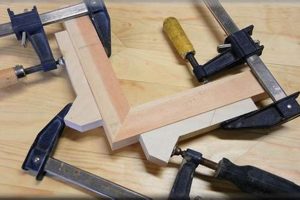
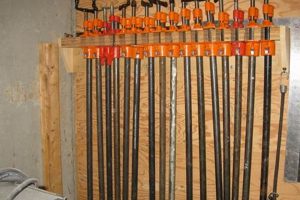
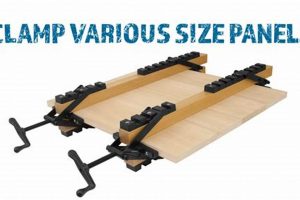
These devices are tools employed in woodworking to securely hold workpieces together. Typically constructed from durable synthetic polymers, these implements apply pressure to maintain a firm bond during gluing, fastening, or assembly processes. An example includes securing two pieces of wood while adhesive cures, ensuring a precise and lasting connection.
The utility of these holding mechanisms lies in their non-marring properties, preventing damage to the material surface. Their composition often provides resistance to common woodworking adhesives and finishes, extending their lifespan. Historically, metal alternatives were prevalent, but the advantages of lighter weight and reduced potential for surface blemishes have increased the adoption of polymer-based options.
The subsequent discussion will delve into the various types available, selection criteria based on project requirements, and best practices for achieving optimal results. Considerations will include clamping force, throat depth, and the specific advantages offered by different designs.
Optimizing Use
Effective utilization is paramount for achieving desired woodworking outcomes. The following guidelines offer insights into maximizing performance and ensuring project integrity.
Tip 1: Distribute Clamping Force Evenly: Employ multiple devices to disperse pressure across the workpiece. Uneven pressure can lead to warping or joint failure. For instance, when gluing a large panel, space implements approximately every six inches.
Tip 2: Protect Soft Materials: When working with delicate woods, use protective pads between the tool and the material surface. This prevents indentation or marking. Cork or thin wood shims serve as suitable barriers.
Tip 3: Avoid Over-Tightening: Excessive force can damage both the tool and the workpiece. Tighten only until the joint is secure and the adhesive begins to squeeze out. Over-compression weakens the bond.
Tip 4: Choose the Correct Size: Select a size appropriate for the project’s dimensions. Using an undersized tool may result in inadequate holding power, while an oversized one can be cumbersome. Measure the workpiece thickness prior to selection.
Tip 5: Clean After Use: Remove adhesive residue promptly after each use to prevent hardening and ensure proper function. Isopropyl alcohol is effective for dissolving most woodworking glues.
Tip 6: Inspect for Damage: Regularly examine the mechanisms for cracks, deformation, or thread damage. Faulty equipment compromises safety and effectiveness. Discard or repair damaged units immediately.
Tip 7: Consider Thread Pitch: Finer thread pitches provide greater mechanical advantage, allowing for increased clamping force with less effort. Select models with appropriate thread pitch based on the typical workload.
Adhering to these guidelines will enhance the reliability and precision of woodworking projects. Proper technique and maintenance are essential for realizing the full potential of this equipment.
The subsequent sections will address advanced techniques and explore specialized applications within the broader field of woodworking.
1. Material Durability
Material durability is a critical factor determining the lifespan and effectiveness of polymer-based holding devices in woodworking. The inherent strength and resistance to degradation of the polymer dictate its ability to withstand repeated stress and environmental factors encountered during woodworking projects. A polymer lacking sufficient strength will fracture or deform under clamping pressure, rendering the tool unusable and potentially compromising the workpiece. Conversely, a robust polymer maintains its structural integrity over extended periods, providing consistent and reliable clamping force. For example, a polymer blend exhibiting high tensile strength and resistance to UV degradation is better suited for prolonged outdoor use, as demonstrated when constructing wooden patio furniture exposed to direct sunlight.
The choice of polymer also directly influences resistance to common woodworking solvents and adhesives. Exposure to certain chemicals can cause degradation, swelling, or softening of the material, ultimately weakening the tool. Polymers like glass-filled nylon or polypropylene offer enhanced chemical resistance compared to lower-grade plastics, making them more suitable for applications involving frequent contact with solvents, such as cleaning adhesive residue. The consequence of neglecting material durability is premature tool failure and the potential for project defects caused by inadequate holding pressure or slippage.
In summary, material durability is not merely a feature, but an essential characteristic of polymer-based holding devices. A robust polymer composition ensures tool longevity, consistent performance, and resistance to environmental factors. Selection should prioritize materials engineered for high strength, chemical resistance, and UV stability to maximize the tool’s service life and minimize the risk of project failures due to tool degradation. Understanding the material properties and limitations is crucial for proper tool selection and maintenance.
2. Clamping Force
Clamping force represents the pressure exerted by a woodworking clamp to securely hold workpieces together. In the context of polymer-based devices, this force directly influences joint integrity and the quality of the finished product. Insufficient force results in gaps within the joint, compromising structural stability and aesthetic appeal. Conversely, excessive force, while less common with polymer variants, can potentially damage delicate materials or the clamp itself. An example is joining two pieces of softwood. Applying adequate clamping force ensures proper adhesive distribution, crucial for creating a strong, lasting bond. The magnitude of this force is dictated by the clamp design, material properties, and the user’s application of pressure.
The limitations of polymer construction compared to metal counterparts directly affect achievable clamping force. Polymer-based devices typically offer lower maximum force ratings. However, this characteristic can be advantageous in situations where delicate materials are involved. The controlled force minimizes the risk of indentation or surface damage. For instance, when assembling pre-finished furniture components, utilizing a polymer clamp with a moderate clamping force can prevent unsightly marks and maintain the integrity of the finish. Understanding these limitations and benefits is essential for choosing an appropriate clamp for the task.
Effective utilization hinges on matching the required clamping force to the material and joint type. For instance, assembling a small picture frame requires significantly less force than joining large cabinet panels. Selection should prioritize clamp models that offer adjustable force settings or mechanisms to prevent over-tightening. Awareness of clamping force is also vital for detecting potential clamp failure. A sudden loss of pressure indicates damage or wear, necessitating replacement to ensure continued reliable performance. Ultimately, a sound understanding of clamping force principles is indispensable for achieving successful woodworking outcomes.
3. Jaw Design
Jaw design is a crucial determinant of functionality in polymer-based woodworking clamps. It dictates the clamp’s ability to accommodate various workpiece shapes, sizes, and angles. The configuration of the jaws influences the distribution of clamping force, impacting the integrity of the joint. An improperly designed jaw can lead to uneven pressure, resulting in joint failure or workpiece damage. For example, when edge-gluing boards to create a wider panel, parallel jaw faces are essential to ensure consistent contact and even pressure distribution across the entire joint line.
Specific design elements, such as the presence of swiveling pads or V-grooves, cater to specialized applications. Swiveling pads adapt to non-parallel surfaces, maintaining full contact even when clamping irregularly shaped pieces. V-grooves are commonly employed when securing round or cylindrical workpieces. The depth of the jaw throat also affects the clamp’s ability to reach into recessed areas or to accommodate thicker materials. Ignoring these design considerations may result in instability, slippage, or an inability to effectively clamp the workpiece. An illustrative example can be found when using bar clamps with a long throat to clamp the face frame to a cabinet carcass, ensuring the frame is fully supported and flush during the glue-up.
In summary, the jaw design significantly contributes to the performance and versatility of these clamping implements. A well-considered jaw configuration optimizes force distribution, accommodates diverse workpiece geometries, and minimizes the risk of damage. Selection criteria should prioritize designs that align with the specific requirements of the woodworking project, thereby ensuring a secure and reliable clamping action. Failure to understand the impact of jaw design can lead to inefficient clamping, compromised joint strength, and potential damage to the workpiece.
4. Size Variety

The availability of diverse sizes directly impacts the utility of polymer-based woodworking clamps. The dimensions of the workpiece necessitate corresponding variations in clamp size to effectively apply and maintain pressure. An undersized clamp lacks the necessary reach to span the joint, rendering it ineffective. Conversely, an oversized clamp, while potentially functional, may prove unwieldy and impede maneuverability, particularly in confined spaces. The effect of inappropriate sizing extends to the quality of the joint, where uneven pressure distribution stemming from mismatched dimensions may compromise structural integrity. The importance of size variety, therefore, lies in its capacity to address the diverse demands of woodworking projects, from delicate model making to large-scale furniture construction. The selection of an appropriately sized clamp is crucial for achieving the desired outcome.
Consider the example of assembling a small picture frame versus constructing a large cabinet door. The former requires miniature clamps with jaws spanning a few inches, while the latter necessitates larger clamps with extended reach. Furthermore, throat depth, the distance between the jaw face and the clamp’s bar, must also correspond to the workpiece thickness. If the throat is too shallow, the clamp cannot engage the material effectively. Practical applications demonstrate the necessity of maintaining an inventory of different sizes to accommodate a wide range of woodworking tasks. Without sufficient size variety, the woodworker is limited in scope and efficiency.
In conclusion, size variety is an indispensable characteristic of polymer-based woodworking clamps. It allows for effective adaptation to diverse workpiece dimensions and project requirements. Challenges associated with size selection include accurately assessing workpiece dimensions and understanding the limitations of each clamp size. The absence of appropriate sizing undermines the intended function of securing workpieces, ultimately impacting project success. A comprehensive understanding of size implications ensures the tool functions as intended.
5. Release Mechanism

The release mechanism is a critical component of polymer-based woodworking clamps, directly influencing efficiency and user-friendliness. This mechanism facilitates the rapid and controlled disengagement of the clamp from the workpiece following adhesive curing or assembly completion. A well-designed release minimizes the risk of damage to both the clamped material and the clamp itself. Conversely, a poorly designed or malfunctioning release can result in prolonged working times, marred surfaces, or complete tool failure. The connection between the release mechanism and the clamp’s overall performance cannot be understated.
Several variations exist, ranging from quick-release levers to threaded spindles. Quick-release levers offer rapid disengagement, suitable for repetitive tasks where speed is paramount. Threaded spindles, while slower, provide finer control over pressure reduction, potentially minimizing stress on delicate joints. The choice of mechanism directly impacts the user’s workflow and the type of woodworking projects best suited for the tool. For example, cabinetmakers frequently utilize quick-release bar clamps for efficient glue-ups, reducing cycle times and maximizing productivity. When the release mechanism malfunctions, disassembly of the clamped items requires additional time, which can be detrimental if the glue starts to set.
In summary, the release mechanism is integral to the effective operation of polymer-based woodworking clamps. Its design directly influences ease of use, efficiency, and the potential for workpiece damage. Understanding the advantages and limitations of different release mechanism types is essential for selecting the appropriate clamp for specific woodworking applications. A reliable and well-designed release contributes to both the quality of the finished product and the overall woodworking experience. Maintenance of this mechanism must also be considered to minimize malfunctions.
6. Non-Marring
The non-marring property of polymer-based woodworking clamps is a defining characteristic, distinguishing them from traditional metal alternatives. This attribute is particularly relevant in woodworking projects where preserving the surface finish of the material is paramount. The selection of these specific holding mechanisms is often dictated by the need to avoid indentation, scratches, or other blemishes on the workpiece.
- Material Composition and Surface Protection
The inherent softness of many polymers, relative to metals, minimizes the risk of surface damage. The composition of the polymer itself contributes directly to this effect. For instance, clamps manufactured from nylon or polypropylene are less likely to cause indentation compared to steel clamps exerting the same clamping force. This consideration is significant when working with softwoods like pine or easily scratched materials such as pre-finished plywood.
- Jaw Pad Integration
Many polymer-based clamps incorporate soft, non-marring pads at the jaw faces to further protect the workpiece. These pads, often made from thermoplastic elastomers or similar materials, provide a cushioning effect, distributing pressure evenly and preventing direct contact between the clamp body and the wood surface. This design feature is particularly advantageous when clamping delicate veneers or intricate carvings.
- Controlled Clamping Force
The inherent flexibility of certain polymers allows for a more controlled application of clamping force. This inherent characteristic minimizes the risk of over-tightening, a common cause of indentation or distortion, especially when working with thinner materials. The material yield strength is also a consideration for polymer clamps, as some have a point where the plastic weakens.
- Resistance to Chemical Reactions
Some polymers exhibit resistance to chemical reactions with common woodworking adhesives and finishes, further safeguarding the surface integrity of the workpiece. This characteristic is particularly important when clamping glued assemblies, as certain adhesives can react with metal clamps, causing staining or discoloration. The use of appropriate release agents for different adhesives is an integral approach for minimizing these reactions.
The integration of non-marring properties into the design and material selection of these devices directly enhances their value in woodworking applications where surface preservation is critical. These features minimize the need for additional surface preparation or repair, reducing labor costs and ensuring a higher quality finished product. The absence of non-marring characteristics can often result in significant material waste and increased project timelines.
Frequently Asked Questions
This section addresses common inquiries regarding the selection, application, and maintenance of plastic woodworking clamps.
Question 1: What are the primary advantages of plastic woodworking clamps compared to metal clamps?
Plastic variants offer reduced weight, eliminating the risk of marring delicate surfaces. They often exhibit greater resistance to corrosion from common woodworking adhesives and finishes, prolonging lifespan.
Question 2: Are plastic woodworking clamps suitable for heavy-duty applications requiring high clamping force?
While capable, plastic clamps generally provide lower maximum clamping force compared to metal counterparts. Evaluate project force requirements prior to selection. For heavy-duty applications, consider reinforced or composite models.
Question 3: What factors should be considered when selecting the appropriate size of plastic woodworking clamps?
Workpiece thickness and overall dimensions dictate optimal size. The throat depth must accommodate material thickness, while jaw length should exceed the joint width to ensure adequate pressure distribution.
Question 4: How can surface damage be prevented when using plastic woodworking clamps on sensitive materials?
Employ clamps equipped with soft, non-marring pads or utilize protective shims between the clamp jaws and the workpiece. Avoid over-tightening, which can still cause indentation, even with polymer-based tools.
Question 5: What is the recommended method for cleaning plastic woodworking clamps after use?
Remove adhesive residue promptly with a solvent appropriate for the adhesive used (e.g., isopropyl alcohol for woodworking glues). Avoid abrasive cleaners that may scratch or damage the plastic surface.
Question 6: How should plastic woodworking clamps be stored to maximize their lifespan?
Store in a dry, climate-controlled environment away from direct sunlight. Prolonged exposure to extreme temperatures or UV radiation can degrade the polymer material. Periodic inspection for cracks or deformation is also recommended.
In summary, careful consideration of material properties, size, and application techniques is crucial for maximizing the effectiveness and longevity of plastic woodworking clamps.
The following section will explore specialized applications and advanced clamping techniques within the field of woodworking.
Plastic Woodworking Clamps
This exploration has examined the multifaceted characteristics of polymer-based holding devices. Material durability, clamping force limitations, jaw design considerations, size variety demands, the significance of release mechanisms, and the critical non-marring property have been discussed. These aspects collectively define the suitability and effectiveness of these implements in diverse woodworking contexts. A comprehensive understanding of these elements is essential for informed tool selection and optimal project outcomes.
Continued adherence to established best practices, along with a critical evaluation of emerging polymer technologies, will enable woodworkers to leverage the benefits of plastic woodworking clamps effectively. Proper application ensures both the integrity of the workpiece and the longevity of the tool itself. This focused approach contributes to a higher standard of craftsmanship and project sustainability within the woodworking domain.
![Top-Rated: Best Quick Clamps for Woodworking Projects [2024] | Step-by-Step Guides, Tools & Inspiration to Build Beautiful Wooden Decor on a Budget](https://woodfromhome.com/wp-content/uploads/2026/04/th-264-300x200.jpg "Top-Rated: Best Quick Clamps for Woodworking Projects [2024] Step-by-Step Guides, Tools & Inspiration to Build Beautiful Wooden Decor on a Budget")