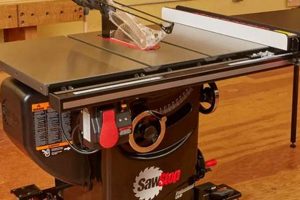
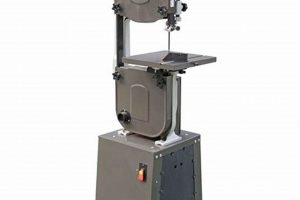
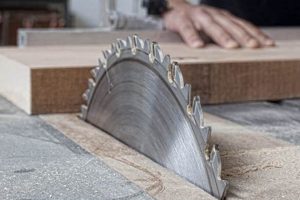
A band saw’s primary function in woodworking involves cutting various shapes and sizes of wood. This stationary power tool employs a continuous, toothed metal band stretched between two or more wheels to create precise and intricate cuts. For instance, it can re-saw thick boards into thinner pieces, cut curves for furniture components, or create decorative shapes in wooden projects.
The utility of this tool lies in its ability to efficiently execute both straight and curved cuts, offering a level of control and versatility that surpasses many other woodworking saws. Historically, band saws represented a significant advancement over traditional hand saws, enabling faster and more accurate wood processing, contributing to improved efficiency in furniture making and other woodworking applications.
Understanding the diverse applications, appropriate blade selection, and safe operational practices associated with this tool is fundamental for any woodworker seeking to maximize its potential. Subsequent sections will delve into specific uses, blade types, safety considerations, and maintenance procedures related to maximizing the tool’s effectiveness.
Essential Band Saw Usage Tips
Optimizing the use of a band saw requires careful consideration of technique, maintenance, and safety procedures. The following tips will assist in maximizing its effectiveness and longevity.
Tip 1: Blade Selection: Employ the correct blade width and tooth configuration for the material thickness and cut type. A wider blade is suitable for straight cuts, while a narrower blade facilitates tighter curves.
Tip 2: Blade Tension: Ensure proper blade tension according to the manufacturer’s specifications. Insufficient tension results in wandering cuts, whereas excessive tension can lead to premature blade failure.
Tip 3: Guide Adjustment: Adjust the upper and lower blade guides so they are close to the workpiece without hindering its movement. This minimizes blade flutter and improves cut accuracy.
Tip 4: Feed Rate: Maintain a consistent and appropriate feed rate. Forcing the material can cause the blade to bind or break, while feeding too slowly can result in burning or uneven cuts.
Tip 5: Sharp Blades: Regularly inspect and replace blades that are dull or damaged. Dull blades require more force, increasing the risk of kickback and reducing cut quality.
Tip 6: Coolant Application: For metal cutting or dense hardwoods, consider using a coolant to reduce friction and heat buildup, prolonging blade life and improving cut quality.
Tip 7: Regular Cleaning: Remove sawdust and debris from the machine after each use. This prevents buildup that can affect performance and shorten the lifespan of moving parts.
Implementing these guidelines ensures optimal performance, prolongs tool life, and enhances safety during band saw operation. Consistent application of these practices will contribute to improved woodworking outcomes.
The subsequent section will address common issues, troubleshooting techniques, and preventative measures related to band saw operation.
1. Curved cuts

The ability to execute curved cuts is a core function inextricably linked to a band saw’s utility in woodworking. This functionality arises from the saw’s continuous blade design, allowing for movement along non-linear paths within a workpiece. The cause is the narrow blade and continuous cutting action; the effect is the capacity to create shapes beyond the scope of circular saws or hand saws. A band saw provides superior control and precision when forming curved components for furniture, cabinetry, and decorative objects. Without the capacity for curved cuts, a significant portion of a band saw’s potential in woodworking would be unrealized. For example, creating the curved back slats of a Windsor chair or the sweeping curves of a Queen Anne table leg heavily relies on the band saw.
Furthermore, the effectiveness of curved cuts is directly related to blade selection. A narrower blade allows for tighter radii, while a wider blade provides more stability for gentle curves. Proper technique, including consistent feed rate and accurate guide adjustment, are crucial for achieving clean, accurate curved cuts. Consider the creation of a violin, where intricate curves define the instrument’s acoustic properties. These curves, often too complex for other power tools, are efficiently formed using a band saw. The practical significance of this connection is evident in the broad range of projects that benefit from curved elements, and the efficiency with which a band saw enables their creation.
In summary, the connection between curved cuts and the capabilities of this woodworking tool is fundamental. The machine offers efficient creation of elements impossible with other saws. Mastering this aspect of its use unlocks creative possibilities in woodworking projects. Challenges, such as blade wandering or tear-out, can be mitigated through proper blade selection, machine setup, and operator skill, reinforcing the importance of understanding and refining this key aspect of band saw operation.
2. Resawing Lumber

Resawing lumber constitutes a significant application, underscoring the versatility of this woodworking tool. Resawing, the process of cutting a board along its thickness to produce thinner boards, expands the usability of available lumber. The cause is often the need for thinner stock than is commercially available or the desire to match grain patterns across multiple components. The effect is the creation of custom-thickness lumber suitable for veneer work, drawer sides, or other specialized applications. Without the ability to resaw, woodworkers would be constrained by the available stock sizes, limiting design options and potentially leading to material waste. Consider a craftsman requiring thin walnut veneers for a decorative box. Resawing allows the craftsman to obtain these veneers from a thicker walnut board, maintaining consistent grain and color matching, which would be difficult or impossible with commercially available veneers.
The efficiency and accuracy of resawing are directly tied to the band saw’s design and blade selection. A taller fence or riser block extension allows for handling wider stock. The use of a wide, low-tooth-count blade minimizes drift and produces a straighter cut. Further, the tool’s consistent cutting action, as opposed to the intermittent action of hand saws, contributes to more consistent thickness in the resawn pieces. The practical application extends to creating book-matched panels, where two resawn pieces are joined to create a mirror image effect. The ability to resaw not only saves material costs but also enhances design possibilities, offering a level of customization unattainable through purchasing pre-dimensioned lumber.
In summation, resawing lumber is intrinsically linked to the core capabilities of this equipment in woodworking. It empowers woodworkers to customize lumber dimensions, create veneers, and achieve specific design aesthetics. The ability to overcome challenges such as blade drift, uneven cuts, and material waste through proper setup, blade selection, and technique highlights the practical value of understanding this key application. This expands the creative possibilities for woodworkers.
3. Shape Creation
Shape creation, enabled by the capacity of the band saw, plays a pivotal role in woodworking. This capability facilitates the production of complex and non-standard forms, expanding design possibilities beyond simple geometric shapes.
- Freeform Design Realization
The band saw allows for the execution of freeform designs that would be difficult or impossible to achieve with other woodworking tools. This encompasses organic shapes, flowing curves, and asymmetrical forms. Examples include custom furniture elements, sculptural components, and artistic wood carvings. The ability to realize freeform designs directly impacts the aesthetic value and uniqueness of woodworking projects.
- Template-Based Replication
Shapes can be accurately replicated using templates in conjunction with a band saw. This process involves tracing a template onto a workpiece and then using the band saw to follow the traced outline. Applications include producing multiple identical parts for furniture, architectural trim, or decorative items. The template-based approach ensures consistency and precision in shape replication.
- Internal Cutouts and Contours
The band saw’s ability to make internal cutouts and contours is critical for certain woodworking applications. This involves drilling a pilot hole in the workpiece and then threading the blade through the hole to begin cutting out an interior shape. Examples include creating openings in cabinet doors, crafting decorative fretwork, and producing hollow forms. The internal cutout capability significantly expands the range of possible designs and structural elements.
- Curvilinear Joinery
Shape creation extends to the fabrication of curvilinear joinery, where joints are designed with curved or non-linear mating surfaces. This technique, often used in fine woodworking, requires precise shaping of the joint components to ensure a strong and aesthetically pleasing fit. Examples include curved dovetail joints, sculpted mortise-and-tenon joints, and other complex joint configurations. Curvilinear joinery enhances the structural integrity and visual appeal of assembled wood products.
These facets of shape creation collectively demonstrate the tool’s integral function in facilitating complex and customized woodworking projects. Its capabilities extend beyond simple cutting tasks to enable the realization of artistic and structurally sophisticated designs. These examples highlight its role in shaping wood in ways that enhance both function and aesthetics.
4. Intricate Details

The execution of intricate details represents a significant aspect of woodworking, where a band saw’s capabilities are effectively leveraged to achieve complex designs and refined elements. The precision offered by the band saw enables woodworkers to incorporate detailed features that enhance the aesthetic and functional aspects of a project.
- Scrollwork and Fretwork
The band saw is instrumental in creating scrollwork and fretwork, which involve cutting intricate patterns and designs into wood. Examples include decorative panels, headboards, and furniture accents. The narrow blade and controlled movement of the band saw allow for precise cuts along complex curves and tight corners, resulting in detailed and visually appealing designs. This is relevant because it enables crafting elements that add a distinct level of artistry to woodworking projects.
- Shaped Inlays and Veneers
Intricate shapes for inlays and veneers can be accurately cut using a band saw. This process involves cutting thin pieces of wood into precise shapes to be inlaid into a contrasting background or used as decorative veneers on furniture surfaces. The band saw’s ability to follow intricate patterns and create clean edges is essential for achieving seamless and visually striking inlays and veneers. This application increases the aesthetic possibilities in woodworking, by incorporating decorative elements.
- Miniature Modeling and Carving
For smaller-scale projects like miniature models or detailed carvings, a band saw facilitates the removal of excess material and the shaping of intricate forms. It allows for the rough shaping of delicate components before further refinement with hand tools. Examples include architectural models, scale replicas, and detailed wooden figurines. This provides precision and efficiency in the creation of detailed pieces in fine woodworking.
- Custom Jig Creation for Detailed Joinery
The band saw is also used to create custom jigs that facilitate the precise cutting of intricate joinery details. Custom jigs, such as those designed for specific dovetail or mortise configurations, allow for repeatable and accurate cuts on multiple components. This allows for the achievement of complex joinery that strengthens the structure while enhancing the visual appeal of the project.
These facets collectively illustrate the band saw’s integral role in incorporating intricate details into woodworking projects. From creating decorative scrollwork to shaping custom joinery, the tool enhances design possibilities, precision, and craftsmanship. The ability to execute these details elevates the aesthetic and functional qualities of the finished product, highlighting the tool’s value in woodworking applications.
5. Precise Sizing
The capacity for precise sizing is intrinsically linked to band saw applications in woodworking. This capability arises from the saw’s consistent cutting action, enabling the creation of components with accurate dimensions. The cause is the continuous blade movement and stable platform, resulting in the effect of dimensionally accurate parts that are essential for joinery, assembly, and overall project integrity. Without this level of precision, components would require extensive post-cutting adjustments, increasing labor and material waste. Consider the construction of a cabinet where accurately sized stiles and rails are critical for a flush and square frame. Inaccurate sizing would result in gaps, misalignment, and a structurally unsound assembly.
The effectiveness of precise sizing is directly influenced by blade selection, machine setup, and operator technique. A sharp blade, properly tensioned, minimizes wandering and produces a cleaner cut. The use of a fence or miter gauge ensures consistent angles and dimensions. Furthermore, the operator’s ability to maintain a steady feed rate and control the workpiece contributes significantly to dimensional accuracy. For instance, in the creation of segmented bowls, each segment must be precisely sized to ensure a tight and seamless fit when assembled. The band saw, with its potential for accurate cuts, facilitates this intricate process, yielding aesthetically pleasing and structurally sound results. Its practical application allows achieving the desired and calculated project size and shapes, allowing for accurate construction.
In summary, precise sizing forms a cornerstone of this woodworking tool’s utility. It empowers woodworkers to create components that meet exacting specifications, facilitating efficient assembly and structurally sound, aesthetically pleasing finished products. While challenges such as blade drift, material inconsistencies, and operator error can affect precision, these can be mitigated through careful technique and tool maintenance. This reinforces the importance of understanding and mastering the fundamentals of band saw operation to fully realize its potential for precise sizing in diverse woodworking applications.
Frequently Asked Questions
The following addresses common inquiries regarding the capabilities and applications of a band saw within woodworking contexts.
Question 1: Can a band saw replace a table saw?
While both tools cut wood, they serve distinct purposes. A table saw excels at precise, straight cuts, while a band saw is superior for curves and resawing. It is not a direct replacement but a complementary tool.
Question 2: What is the maximum thickness of wood a band saw can cut?
The maximum cutting thickness is determined by the saw’s “resaw capacity,” which is the distance between the blade and the upper guide. This varies by model, but larger band saws can handle thicker stock.
Question 3: What type of blade is best for cutting curves?
Narrower blades are better suited for cutting tight curves. A 1/4-inch or 3/16-inch blade can navigate intricate shapes more easily than a wider blade.
Question 4: Is a band saw suitable for cutting metal?
Some band saws are designed for metal cutting, but a standard woodworking band saw is not. Metal-cutting band saws typically have slower speeds and use blades with a higher tooth count.
Question 5: How often should the blade be changed?
Blade replacement frequency depends on usage and material. Dull blades result in slower cutting, increased effort, and potential for burning. A blade should be changed when it no longer cuts cleanly or efficiently.
Question 6: What safety precautions should be observed when using a band saw?
Always wear eye protection, keep fingers away from the blade, use push sticks when necessary, and ensure the workpiece is firmly supported. Proper blade tension and guide adjustment are also crucial for safe operation.
Understanding these points can lead to safer and more effective employment of a band saw. Its capabilities are key to woodworking projects.
The next section will discuss maintenance procedures to ensure lasting performance.
Conclusion
The preceding discussion illustrates the band saw’s versatility and significance within woodworking. Its aptitude for curved cuts, resawing, shape creation, intricate detailing, and precise sizing establishes its place as a core tool. An understanding of its capabilities facilitates informed decision-making in project planning and execution.
Mastery of its applications directly influences the quality and efficiency of woodworking endeavors. Continued learning and practical application of the techniques outlined will enhance a woodworker’s skill set and unlock further creative possibilities within the craft.