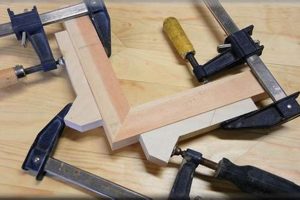
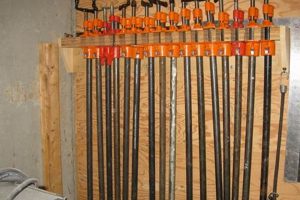
Constructing holding devices at home for carpentry projects involves resourcefulness and adaptability. These user-created tools serve the purpose of securing workpieces together, enabling gluing, fastening, and shaping operations. Examples range from simple screw-tightened mechanisms to more complex lever-activated systems constructed from readily available materials.
The practice offers economic advantages, allowing woodworkers to avoid purchasing commercially produced equipment. Furthermore, it promotes problem-solving skills and fosters innovation in adapting designs to suit specific project requirements. Historically, artisans have often relied on ingenuity to create custom jigs and fixtures, reflecting a tradition of self-reliance within the craft.
The subsequent sections will explore various methods for creating these bespoke solutions, highlighting design considerations, material selection, and techniques for achieving reliable and effective holding power.
Essential Guidance for Homemade Woodworking Holding Devices
The following constitutes vital considerations when fabricating customized workpiece retention apparatus. These directives enhance the functionality, safety, and longevity of user-created clamping mechanisms.
Tip 1: Prioritize Material Selection: The constituent materials should exhibit sufficient strength and rigidity to withstand applied forces without deformation or failure. Hardwoods such as maple or oak are preferable for wooden components, while steel or aluminum are suitable for metallic elements. Avoid using brittle or easily fractured materials.
Tip 2: Implement Effective Thread Engagement: When incorporating threaded fasteners, ensure adequate thread engagement length. Insufficient engagement diminishes holding power and increases the risk of stripping threads. Utilize thread-locking compounds to prevent loosening due to vibration.
Tip 3: Distribute Clamping Force Evenly: Uneven pressure can damage workpieces or compromise joint integrity. Employ pads or cauls between the clamping surface and the workpiece to distribute force uniformly. Contoured pads are advisable for conforming to irregular shapes.
Tip 4: Incorporate Mechanical Advantage: Leverage or cam mechanisms can significantly amplify clamping force with minimal effort. Careful design of these systems ensures secure workpiece retention with reduced strain on the operator.
Tip 5: Verify Alignment and Squareness: Misaligned or skewed clamping can induce stress and inaccuracies in the finished product. Implement features to maintain precise alignment and ensure workpieces are held square during assembly.
Tip 6: Regularly Inspect and Maintain Components: Periodically examine all parts for signs of wear, damage, or loosening. Replace worn components promptly to prevent failures and maintain optimal performance. Lubricate moving parts to ensure smooth operation.
Tip 7: Design for Specific Applications: Tailor the device’s design to the particular requirements of the task at hand. Consider factors such as workpiece size, shape, material, and the type of operation being performed. A specialized approach yields superior results.
Adherence to these guidelines promotes the creation of robust, reliable, and safe woodworking clamping solutions, enhancing the overall quality and efficiency of projects.
The subsequent section transitions to a discussion of practical applications and project examples, illustrating the versatility of these user-constructed holding mechanisms.
1. Force Distribution

Within the realm of user-fabricated workpiece retention, force distribution emerges as a pivotal design consideration directly impacting project quality and material integrity. When constructing holding devices at home for carpentry projects, unevenly applied pressure can induce stress concentrations on workpieces, leading to deformation, fracture, or compromised glue joints. The absence of uniform pressure distribution negates the primary function of these tools: to securely hold components for assembly or machining operations. A practical example is observed when using a standard screw-type configuration without adequate padding; the area directly beneath the screw experiences significantly higher force than surrounding regions, potentially marring the wood surface or weakening the bond. The efficacy of any shop-made clamping apparatus hinges on its ability to apply consistent pressure across the contact area.
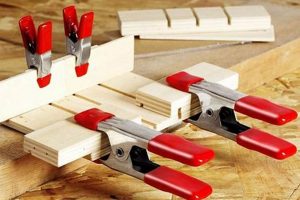
One method to mitigate uneven stress is the strategic incorporation of pads or cauls. These intermediary layers, typically crafted from softer materials like cork, leather, or even compliant wood, serve to diffuse pressure peaks and distribute force more broadly. For instance, creating custom-fitted cauls to match the contours of curved workpieces allows for even pressure during lamination. Furthermore, the design of the device itself can influence force distribution. Distributing multiple pressure points across a wider area, as opposed to a single concentrated point, enhances stability and minimizes localized stress. In edge-gluing applications, using multiple, smaller, user-created clamps spaced closely together achieves a more uniform bond line compared to relying on a single, high-force device.
Therefore, understanding and implementing strategies for controlled force application are essential for successful completion of carpentry projects utilizing user-fabricated workpiece retention tools. While the allure of economic savings and customization drives the creation of these devices, neglecting the principles of force distribution ultimately undermines their utility and increases the risk of project failure. The challenges lie in accurately predicting stress patterns and adapting designs to achieve the desired evenness. Ultimately, a well-designed homemade clamp considers force distribution as a primary factor, directly contributing to the creation of durable and aesthetically pleasing woodworking pieces.
2. Material Rigidity

Material rigidity constitutes a critical factor in the design and effectiveness of user-constructed holding devices for woodworking. The ability of these devices to maintain their form under applied stress directly impacts their capacity to securely hold workpieces, ensuring precision and stability during assembly and machining operations.
- Structural Integrity Under Load
Rigidity ensures the homemade apparatus resists deformation when clamping force is applied. Insufficient rigidity leads to flexing or bending of the clamp itself, reducing the applied pressure on the workpiece and compromising joint integrity. For example, clamps constructed from thin or low-density wood may bow under pressure, rendering them ineffective for securely holding pieces during gluing.
- Dimensional Stability
Rigidity contributes to dimensional stability, preventing expansion or contraction due to temperature or humidity fluctuations. This stability is crucial for maintaining consistent clamping pressure over extended periods, particularly during glue drying or complex assembly processes. A clamp fabricated from dimensionally unstable material could loosen its grip over time, requiring readjustment or risking workpiece slippage.
- Thread Holding Capacity
In clamps utilizing threaded fasteners, material rigidity directly influences the holding capacity of those threads. A rigid material provides a more secure anchor for threads, preventing stripping or pull-out under stress. Conversely, softer materials are more prone to thread damage, leading to premature failure of the clamping mechanism. The choice of hardwood versus softwood for screw-operated clamps directly affects thread lifespan and overall performance.
- Resistance to Wear and Tear
Rigid materials exhibit greater resistance to wear and tear from repeated use. Constant application and release of clamping pressure can degrade less robust materials over time, resulting in reduced effectiveness and potential failure. Durable materials maintain their shape and functionality longer, extending the lifespan of the homemade device and ensuring consistent performance across numerous projects.
The interplay between material rigidity and design considerations dictates the performance and longevity of user-created clamping apparatus. Selection of appropriate materials, such as hardwoods or steel, coupled with thoughtful design, ensures the creation of holding devices capable of withstanding the demands of woodworking applications. A lack of consideration for material rigidity undermines the effectiveness and lifespan of even the most ingeniously designed homemade tool.
3. Thread Integrity

In the context of user-constructed holding devices for woodworking, thread integrity is paramount to the reliable transmission of force. The threaded components, typically screws or bolts, are often the primary mechanism for applying and maintaining clamping pressure. Degraded or compromised threads diminish the tool’s ability to securely grip workpieces, leading to slippage, joint failure, and potential safety hazards. The relationship is causal: insufficient thread strength directly results in reduced clamping force. The inclusion of robust threads is not merely an addendum, but a fundamental component of a functional and safe homemade apparatus.
Several factors contribute to thread degradation in user-constructed clamps. Over-tightening subjects the threads to excessive stress, exceeding their yield strength and causing deformation or stripping. Using incompatible or low-quality fasteners with weak threads exacerbates this problem. Wood, a common material in these builds, can be easily damaged when tapped for threads, particularly softwoods. To counter these issues, strategies such as using hardened steel fasteners, implementing thread-locking compounds, and utilizing threaded inserts or T-nuts to distribute stress over a larger area are essential. Real-world examples demonstrate the significance: a clamp employing a stripped screw fails to hold a miter joint securely, resulting in a skewed frame. Conversely, a clamp using a robust bolt with a locking nut maintains consistent pressure throughout the glue-up, yielding a strong, accurate assembly. The practical significance lies in the correlation between thread quality and the success or failure of woodworking projects utilizing shop-made holding devices.
Maintaining thread integrity presents challenges, especially when working with limited resources or improvising designs. However, understanding the principles of thread mechanics and implementing appropriate preventative measures significantly enhances the performance and lifespan of user-built apparatus. The discussion underscores the importance of considering thread quality as a crucial component within the broader theme of constructing reliable and effective woodworking holding devices. Investing in quality fasteners and employing appropriate installation techniques are vital for achieving secure and durable clamping solutions.
4. Alignment Precision
Alignment precision directly influences the accuracy and quality of woodworking projects employing user-constructed holding devices. Misalignment during clamping introduces stress, distorts joints, and compromises structural integrity. The effectiveness of these shop-made solutions hinges not merely on their ability to apply pressure, but on their capacity to maintain workpieces in the desired spatial relationship throughout the fastening process. For instance, in edge-gluing boards for a tabletop, inaccurate alignment during clamping results in an uneven surface requiring extensive sanding or planing, negating the benefits of a properly glued joint. In mitered frame construction, any deviation from square induces gaps and weakens the corners, compromising the aesthetic and structural soundness. Therefore, careful attention to alignment represents a critical component in the successful utilization of user-fabricated woodworking holding devices.
Achieving accurate alignment necessitates incorporating design features that promote precise positioning and resist movement during clamping. Examples include integrated fences, jigs, and stops within the device itself. A simple corner holding device might feature 90-degree angles to ensure squareness, while an edge-gluing device might incorporate parallel bars to maintain coplanarity. Further refinement can be achieved by incorporating adjustable elements that allow for fine-tuning alignment before the application of clamping force. Moreover, careful execution of the clamping process is paramount. Even a perfectly designed apparatus can produce inaccurate results if not used properly. This involves verifying alignment before tightening, applying pressure gradually and evenly, and monitoring for any movement throughout the process. The construction of homemade clamps for picture frames, for instance, demands meticulous alignment to guarantee perfectly square corners.
In conclusion, the pursuit of accuracy and stability in woodworking necessitates a thorough understanding of the connection between alignment precision and user-constructed holding devices. While the appeal of these homemade apparatus stems from their cost-effectiveness and adaptability, the failure to prioritize alignment undermines their potential benefits. Ensuring proper alignment requires thoughtful design, careful construction, and diligent execution, ultimately leading to higher quality woodworking results. Addressing this challenge contributes directly to the overall efficacy of the solutions.
5. Mechanical Advantage

The incorporation of mechanical advantage represents a critical design principle in user-constructed woodworking holding devices. The term refers to the amplification of force achieved through leverage or other mechanical means, allowing users to exert significantly greater clamping pressure with minimal physical effort. The strategic application of this principle directly impacts the usability, effectiveness, and overall practicality of homemade clamping solutions.
- Leverage Systems
Leverage systems, such as pivoting arms or toggle joints, exemplify the application of mechanical advantage. These systems translate a small input force applied over a long distance into a larger output force exerted over a shorter distance at the clamping point. A cam clamp, for instance, utilizes an eccentric cam to convert rotational motion into linear clamping pressure. The mechanical advantage is determined by the ratio of the cam’s radius to the distance from the pivot point to the clamping surface. This allows for rapid application and release of significant clamping force with a simple lever action.
- Screw Thread Pitch
The pitch of a screw thread directly influences the mechanical advantage of screw-type clamping devices. A finer thread pitch requires more rotations to achieve a given clamping distance, but it also provides a greater mechanical advantage, resulting in higher clamping force for the same applied torque. Conversely, a coarser thread allows for faster clamping but delivers less force. The selection of an appropriate thread pitch represents a trade-off between clamping speed and clamping power, depending on the specific application and the materials being used.
- Toggle Clamps
Toggle clamps provide significant mechanical advantage through an over-center locking mechanism. As the clamp arm approaches its fully closed position, the mechanical advantage increases dramatically, resulting in a very high clamping force. This feature makes toggle clamps particularly suitable for applications requiring secure and repeatable clamping with minimal user effort. The design of the toggle mechanism dictates the magnitude of the mechanical advantage and the force required to actuate the clamp.
- Compound Mechanisms
More complex devices may incorporate compound mechanisms, combining multiple elements to achieve even greater mechanical advantage. For example, a clamp might utilize a lever system to drive a screw mechanism, effectively multiplying the force output. These designs require careful consideration of the force transmission pathways and the strength of the constituent components to ensure reliable performance and prevent premature failure. The benefits of increased clamping force must be balanced against the complexity and cost of the compound mechanism.
These facets of mechanical advantage are essential considerations in the design and construction of user-constructed woodworking clamps. By strategically incorporating these principles, woodworkers can create cost-effective and highly functional clamping solutions tailored to their specific needs. Balancing mechanical advantage with material strength and ease of use is crucial for achieving optimal performance in shop-made holding devices.
6. Application Specificity

The effectiveness of user-constructed woodworking holding devices is intrinsically linked to their design tailored for specific tasks. A general-purpose clamping solution often lacks the precision and optimized force application required for specialized operations. Therefore, application specificity emerges as a paramount consideration in the fabrication of these apparatus, directly influencing project outcomes.
- Edge Gluing Clamps
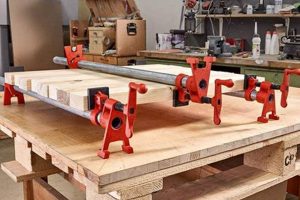
Edge gluing requires clamps that apply uniform pressure along the length of the boards to create seamless joints. User-designed edge gluing solutions often incorporate parallel bars to maintain alignment and prevent bowing. Examples include using pipe clamps with wooden cauls shaped to distribute pressure evenly across the board surfaces. The objective is to ensure a flat, gap-free glue line, which a standard, non-specialized clamp might fail to achieve due to uneven force distribution.
- Miter Clamps
Miter joints demand clamps that maintain precise 45-degree angles during assembly. Homemade miter clamps frequently feature corner jigs or straps to secure the pieces accurately. Examples include right-angle clamp designs or band clamps with corner reinforcements. Failure to maintain precise angles results in visible gaps and weakened joints in frames and boxes, highlighting the need for specialized tools.
- Frame Clamps
Frame construction necessitates clamps capable of applying pressure evenly on all four corners simultaneously to ensure squareness. User-built frame-clamping solutions may employ strap clamps with corner protectors or specialized corner clamps. These devices help prevent racking and distortion, yielding a sturdy and aesthetically pleasing frame. A generic clamp setup often lacks the necessary control over all four corners, leading to skewed or unstable frames.
- Curved Work Clamps
Securing curved or irregularly shaped workpieces requires clamps that conform to the object’s contours without causing damage. User-designed solutions may involve custom-shaped cauls or flexible clamping arms. Examples include clamps with padded jaws or vacuum-based systems for holding delicate curves. Standard clamps, with their flat gripping surfaces, can easily mar or deform curved surfaces, necessitating specialized adaptation.
The examples underscore the importance of aligning the design of homemade holding devices with the specific requirements of the woodworking task. While versatility is a desirable trait, specialized designs often provide superior results in particular applications. The effectiveness of the user-constructed solutions significantly depends on the degree to which they are tailored to the job.
7. Maintenance Protocol

The operational lifespan and consistent performance of user-constructed woodworking holding devices are fundamentally linked to adherence to a structured maintenance protocol. These self-made tools, often crafted from diverse materials and employing various mechanical principles, are susceptible to wear, corrosion, and mechanical failure if neglected. A proactive maintenance approach is therefore not merely a supplementary practice, but an integral component ensuring the longevity and reliability of these invaluable shop aids. Neglecting regular maintenance presents a direct causal relationship to diminished clamping force, compromised alignment, and potential safety hazards.
Implementation of a comprehensive maintenance protocol involves several key elements. Periodic inspection of all components is essential to identify signs of wear, cracks, or corrosion. Threaded fasteners should be checked for proper engagement and lubricated to prevent seizing. Wooden components should be inspected for splitting or warping, and treated with appropriate protective coatings. Clamping surfaces should be cleaned to remove debris and prevent marring of workpieces. Real-world examples highlight the necessity of these practices: A homemade screw clamp left exposed to moisture may develop rust, hindering its smooth operation and reducing its clamping force. A wooden clamp subjected to repeated stress without reinforcement may eventually crack, rendering it unusable. Regular maintenance mitigates these risks, ensuring that the tools perform as intended and contribute to project success.
In summary, a well-defined maintenance protocol is indispensable for maximizing the utility and safety of user-constructed woodworking clamps. This involves systematic inspection, cleaning, lubrication, and repair of all components. The challenges lie in recognizing the specific maintenance needs of each unique device and consistently adhering to the prescribed procedures. Prioritizing maintenance transforms these homemade tools from temporary solutions into reliable assets, contributing to the overall efficiency and safety of the woodworking shop. This focus on maintenance ensures that shop-made solutions remain viable.
Frequently Asked Questions
This section addresses common inquiries regarding the design, construction, and utilization of holding devices fabricated for carpentry applications.
Question 1: What constitutes the most critical factor in determining the clamping force of a user-created woodworking clamping solution?
The inherent mechanical advantage of the clamping mechanism, the material strength of the clamp components, and the friction present between the clamping surfaces are primary determinants. The interplay of these variables dictates the device’s ability to exert sufficient pressure on the workpieces.
Question 2: What materials exhibit superior performance in the construction of shop-fabricated clamps intended for long-term durability?
Hardwoods, such as maple or oak, provide adequate rigidity and resistance to deformation under sustained pressure. For components subjected to high stress or requiring precise threading, steel or aluminum alloys offer enhanced strength and longevity.
Question 3: What constitutes an effective methodology for preventing workpiece damage during the clamping process using user-constructed devices?
The utilization of compliant padding material, such as cork, leather, or soft wood cauls, between the clamp jaws and the workpiece surface distributes clamping force evenly, preventing localized stress concentrations and potential marring.
Question 4: What design modifications mitigate the risk of misalignment when employing user-fabricated holding devices?
Incorporating integrated guides, stops, and precisely machined surfaces ensures accurate workpiece positioning and prevents slippage during clamping. Adjustable features allow for fine-tuning alignment prior to force application.
Question 5: What safety precautions are paramount when employing homemade apparatus?
Thorough inspection of the device prior to each use is essential to identify signs of wear, damage, or impending failure. Over-tightening should be avoided to prevent component breakage. Users should employ appropriate personal protective equipment, including eye protection, during operation.
Question 6: What constitutes the optimal approach to maintaining user-built devices?
Regular cleaning to remove debris, lubrication of moving parts, and periodic inspection for wear or damage are essential. Damaged or worn components should be promptly replaced to ensure continued functionality and safety.
These answers provide a foundation for understanding the principles governing the design, construction, and maintenance of dependable woodworking holding solutions.
The subsequent section will delve into specific project plans and build guides for the construction of these valuable tools.
Concluding Remarks on User-Fabricated Woodworking Holding Devices
The preceding analysis has explored the multifaceted nature of diy clamps woodworking, emphasizing design principles, material selection, and maintenance protocols essential for creating reliable and effective solutions. The investigation has underscored the importance of mechanical advantage, alignment precision, material rigidity, and application-specific design in ensuring project success and user safety.
Mastery of these techniques empowers woodworkers to develop customized clamping apparatus tailored to unique project demands, fostering both ingenuity and self-sufficiency within the craft. Continued exploration and refinement of these techniques will undoubtedly contribute to advancements in woodworking practices and promote the creation of increasingly sophisticated and dependable shop-made tools. Skillful application of these practices enhances project reliability and worker safety.
![Top-Rated: Best Quick Clamps for Woodworking Projects [2024] | Step-by-Step Guides, Tools & Inspiration to Build Beautiful Wooden Decor on a Budget](https://woodfromhome.com/wp-content/uploads/2026/04/th-264-300x200.jpg "Top-Rated: Best Quick Clamps for Woodworking Projects [2024] Step-by-Step Guides, Tools & Inspiration to Build Beautiful Wooden Decor on a Budget")