



Clamping devices that provide even pressure across a broad surface are indispensable for achieving strong and accurate joints in woodworking projects. These tools secure workpieces together while adhesives cure, ensuring proper alignment and preventing movement. For example, when assembling a tabletop from individual boards, these devices apply uniform force, minimizing gaps and creating a flush surface.
The utilization of these force application tools offers several key advantages. They contribute to enhanced structural integrity of finished products, improve the precision of joinery, and reduce the likelihood of warping or distortion during the assembly process. Historically, woodworking relied on simpler clamping methods; the development of these specialized devices represents a significant advancement in the craft, allowing for the creation of more complex and robust structures.
The following sections will delve into the specific types, applications, selection criteria, and maintenance practices associated with these essential workshop implements, providing a comprehensive understanding of their role in achieving optimal woodworking outcomes.
Essential Usage Considerations
Effective utilization of these devices requires careful consideration of several factors to ensure optimal results and prevent damage to workpieces.
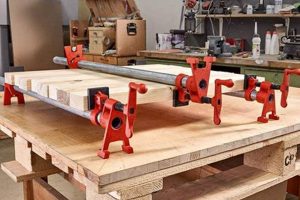
Tip 1: Select Appropriate Type: Different designs are suited for varying applications. Bar styles are effective for large panels, while parallel models maintain consistent pressure across wider surfaces. Choose based on project requirements.
Tip 2: Use Protective Pads: Implement padding between the clamping surface and the workpiece. This prevents indentation, marring, and potential staining, particularly on softwoods or finished surfaces.
Tip 3: Distribute Pressure Evenly: Employ multiple units, spaced strategically, to distribute force across the entire joint line. Uneven pressure can lead to misaligned joints or structural weakness.
Tip 4: Avoid Over-Tightening: Excessive force can damage wood fibers and compromise the joint. Tighten only until the joint is securely closed and adhesive squeeze-out is observed. Observe adhesive manufacturer recommendations for ideal clamping pressure.
Tip 5: Ensure Proper Alignment: Before applying final pressure, verify that all components are precisely aligned. Minor adjustments are easier to make before the adhesive begins to set.
Tip 6: Consider Material Compatibility: When working with certain hardwoods, pre-drilling pilot holes may be necessary to prevent splitting or cracking under pressure.
Tip 7: Maintain Clamps Properly: Regular cleaning and lubrication will ensure smooth operation and prevent corrosion. Inspect pads for wear and replace as needed.
Adhering to these guidelines enhances the quality and longevity of woodworking projects by ensuring accurate and secure joinery.
The subsequent sections will explore specific applications and advanced techniques, further refining the understanding of these crucial woodworking tools.
1. Pressure Distribution

The concept of pressure distribution is fundamental to the successful application of devices designed for woodworking. Its influence on joint strength, aesthetic quality, and overall structural integrity cannot be overstated. Inadequate or uneven pressure application can compromise the entire assembly, regardless of the quality of materials or craftsmanship.
- Even Force Application
Even force application across the joint line is crucial. These tools are designed to distribute force uniformly, minimizing the risk of gaps or misalignments. This is particularly important when joining large panels or applying veneers, where inconsistent pressure can result in visible defects and weakened bonds. An example is seen when joining multiple boards to form a tabletop; using multiple, properly spaced devices ensures a flush and level surface.
- Mitigating Warping and Distortion
Uneven pressure can induce warping or distortion in the wood, particularly when adhesives are drying. By providing consistent pressure, these clamping devices counteract these forces, preserving the intended shape and dimensions of the workpiece. For instance, clamping a frame assembly with inadequate pressure can lead to racking or twisting as the glue sets.
- Optimizing Adhesive Bonding
Proper pressure distribution directly affects the effectiveness of adhesive bonding. Consistent pressure ensures full contact between the joined surfaces, maximizing the bond strength. Insufficient pressure can result in starved joints, where the adhesive is not fully compressed, leading to a weak connection. Examples include edge-joining boards for a panel, where consistent pressure is key to a strong and durable bond.
- Preventing Joint Failure
Uneven force concentration can lead to premature joint failure. Over-tightening in one area can stress the wood fibers, while under-tightening in another can create weak points. Properly selected and applied devices distribute force to prevent stress concentrations and ensure a uniform, robust joint. This is critical in structural applications, such as building furniture frames, where joint integrity is paramount.
In summation, pressure distribution is not merely a procedural detail but a critical factor dictating the success or failure of woodworking projects. Skillful application of these tools, with careful attention to force distribution, ensures both the structural soundness and aesthetic appeal of the finished piece.
2. Surface Protection
Surface protection is a crucial consideration when employing clamping devices in woodworking. The direct contact between the tool and the workpiece presents a potential risk of damage. Mitigation strategies are therefore essential to preserve the aesthetic quality and structural integrity of the wood.
- Preventing Indentation and Marring
The clamping force exerted by these devices can leave indentations or marring on the surface of the wood, particularly on softer species. Implementing protective barriers reduces this risk. For example, applying a thin layer of cork or felt between the tool and the workpiece disperses the pressure, minimizing the likelihood of lasting impressions. This is especially important on projects with a pre-existing finish or when using delicate veneers.
- Minimizing Staining and Discoloration
Certain clamping materials, such as metal, can react with wood tannins, leading to staining or discoloration, especially in humid environments or with woods rich in extractives. Using non-reactive materials like wood or plastic as buffers prevents direct contact and mitigates the risk of unwanted color changes. For instance, when clamping oak or cherry, employing wooden pads avoids potential blackening or discoloration of the wood around the clamped area.
- Protection Against Adhesive Contamination
Adhesive squeeze-out is an inevitable part of the gluing process. Direct contact with the clamping surface can result in the adhesive adhering to the tool and potentially transferring to the wood during subsequent uses. Using wax paper or Teflon sheets as a barrier prevents this transfer, ensuring a clean and professional finish. Consider applying wax paper when clamping joints with epoxy resin to prevent bonding to the metal surface.
- Preserving Existing Finishes
When working with pieces that already have a finish, protecting the surface during clamping is paramount. The pressure and friction can damage or remove the finish, requiring costly repairs. Employing soft, non-abrasive materials like leather or thick cloth between the tool and the finished surface minimizes this risk. This is especially critical when assembling pre-finished cabinet components or antique furniture pieces.
In summary, integrating surface protection measures into the clamping process is not merely a matter of cosmetic concern. It safeguards the inherent properties and the visual appeal of the wood, contributing to the longevity and overall value of the finished product.
3. Joint Alignment

Accurate joint alignment is paramount in woodworking, directly influencing the structural integrity and aesthetic appeal of finished products. The effective use of clamping devices is inextricably linked to achieving and maintaining precise alignment during the assembly process.
- Initial Positioning and Securing
The initial positioning of components prior to applying full clamping pressure is crucial. Clamping devices serve to hold the pieces in the desired configuration, preventing slippage and ensuring that the joint is correctly oriented before the adhesive sets. For instance, when assembling a mortise and tenon joint, these clamps secure the tenon within the mortise, maintaining perfect alignment while the glue dries and the joint strengthens.
- Maintaining Coplanarity
Achieving coplanarity, or ensuring that surfaces lie in the same plane, is often critical. Clamping devices provide the necessary pressure to force components into alignment, compensating for minor imperfections or warping in the material. When constructing a tabletop, for example, these tools press individual boards into a flat, uniform surface, eliminating gaps and preventing unevenness.
- Preventing Joint Movement During Curing
Adhesives require time to cure and develop their full strength. During this period, even slight movement can compromise the integrity of the joint. Clamping devices provide the static pressure necessary to prevent such movement, allowing the adhesive to bond correctly and ensuring a strong, durable connection. In frame construction, these tools hold the joints firmly in place, preventing shifting or separation that could weaken the overall structure.
- Facilitating Complex Assemblies
Complex woodworking projects often involve multiple joints and intricate angles. Clamping devices enable the precise assembly of these structures, holding components securely in place while more permanent fasteners, such as screws or nails, are installed. For instance, when building a complex cabinet with multiple drawers and shelves, these implements support the framework, allowing for accurate positioning and secure attachment of individual elements.
The aforementioned facets illustrate the indispensable role these devices play in achieving and maintaining accurate joint alignment. Their application extends beyond mere holding force; they serve as essential tools for ensuring the precision, strength, and longevity of woodworking projects.
4. Material Compatibility
The interaction between the materials of clamping devices and the workpieces they secure is a critical factor in woodworking. Incompatibility can lead to undesirable outcomes, impacting both the aesthetic quality and structural integrity of the project. Choosing appropriate clamping implements, considering their material composition in relation to the wood being worked, is essential.
- Metal Clamps and Tannin Reactions
Certain metals, particularly iron and steel, can react with the tannins present in various wood species, notably oak, walnut, and cherry. This reaction often results in dark staining or discoloration of the wood at the points of contact. The use of barrier materials, such as wood pads or plastic shims, is necessary to prevent this chemical interaction when metal clamps are employed with tannin-rich woods.
- Clamp Hardness and Wood Compression
The relative hardness of the clamping surface in relation to the workpiece is also significant. Applying excessive force with an overly hard clamp, particularly on softwood species like pine or cedar, can cause compression of the wood fibers, leading to indentation or marring. It is advisable to use clamps with softer clamping surfaces, or to implement protective padding, to distribute the clamping force more evenly and prevent damage.
- Adhesive Compatibility and Clamp Materials
The material composition of the clamping device can also influence the performance of certain adhesives. Some adhesives, such as epoxy resins, can bond tenaciously to metal surfaces, making it difficult to remove the clamps after the adhesive has cured. Applying a release agent, such as wax paper or Teflon tape, to the clamping surface is recommended to prevent adhesion and facilitate clean removal. Wooden clamps, being porous, might absorb the adhesive, resulting in bond weakness.
- Moisture Content and Clamp-Induced Staining
Variations in moisture content between the clamping device and the workpiece can also lead to staining or discoloration. If a damp clamp is applied to dry wood, moisture can be transferred, creating localized swelling and potentially leading to staining as the wood dries. Ensuring that the clamp and workpiece are at similar moisture levels helps to prevent this issue.
In summary, a comprehensive understanding of material compatibility is crucial for achieving optimal results when utilizing clamping devices in woodworking. Careful consideration of the materials involved, and the implementation of appropriate preventative measures, will help to ensure the longevity, aesthetic quality, and structural integrity of the finished product.
5. Clamp Selection

The effectiveness of achieving desired outcomes with woodworking depends significantly on the appropriate choice of clamping devices. This is particularly evident when working with designs requiring broad, even pressure across flat surfaces. The selection process becomes crucial, as an unsuitable choice can directly lead to joint failure, surface damage, or misalignment, negating the benefits of precise cuts and quality adhesives. For example, attempting to join wide boards for a tabletop using inadequate clamping methods will invariably result in an uneven surface or weak joints, demonstrating the direct cause-and-effect relationship between selection and results.
The importance of clamp selection is further amplified when considering the specific requirements of the project. Factors such as the size and shape of the workpiece, the type of wood being used, and the nature of the joint all influence the decision-making process. A cabinet face frame, for instance, requires clamps that can apply uniform pressure across its entire surface without causing distortion, thereby underscoring the practical significance of choosing the correct type. Ignoring these considerations can lead to structurally unsound or visually unappealing results. The clamp selection is very important when dealing with flat clamps woodworking.
In conclusion, the selection process for the clamps should not be viewed as an arbitrary step, but rather as an integral element in the creation of high-quality woodworking pieces. Recognizing this interdependency, and addressing the specific requirements of each project, ensures strong, accurate, and aesthetically pleasing outcomes. The challenge lies in understanding the nuances of different clamping mechanisms and their suitability for various applications, emphasizing the necessity for informed decision-making throughout the woodworking process. An understanding that the type and material of wood plays a great role in clamping is vital.
6. Tension Control

Tension control is a critical element in the effective utilization of clamping devices in woodworking. Its precise management dictates the success or failure of achieving robust, well-aligned joints. Excessive tension can deform wood fibers, leading to weakened joints and potential structural failure. Conversely, insufficient tension fails to ensure complete contact between joined surfaces, resulting in compromised adhesive bonds. Therefore, a balanced approach is essential.
In practical terms, achieving optimal tension control necessitates careful adjustment and monitoring. Example: when gluing large panels, employing multiple clamps with consistent tension is crucial to prevent warping. Another application example is when attaching edge banding to plywood, excessive tension applied to clamping devices can cause the thin banding to crack or separate from the substrate. A light and steady application of the proper tool and clamping method can secure these edges without damaging the surfaces.
Mastery of tension control is not simply a matter of applying force; it requires an understanding of material properties, adhesive characteristics, and the mechanics of the tools being employed. Challenges arise from the variability of wood density and the potential for uneven pressure distribution. The overarching goal remains consistent: to ensure the application of precisely the right amount of pressure to achieve secure, durable, and aesthetically pleasing joints.
7. Maintenance

The longevity and efficacy of devices used in securing flat surfaces in woodworking is directly dependent on consistent and appropriate maintenance practices. Neglecting maintenance results in compromised performance, reduced lifespan, and potential damage to workpieces. Corrosion, buildup of adhesive residue, and misalignment are common consequences of inadequate upkeep, all of which degrade the tool’s ability to apply even pressure. The result being imperfect joinery. For example, a clamp with a corroded screw mechanism will apply uneven pressure, leading to a warped joint or a compromised adhesive bond.
Regular cleaning is essential. Removing adhesive residue with appropriate solvents prevents binding and ensures smooth operation. Lubrication of threaded components reduces friction and prevents corrosion. Periodic inspection for signs of damage, such as bent bars or cracked pads, allows for timely repairs or replacements. Proper storage in a dry environment further mitigates the risk of corrosion and extends the tool’s useful life. The tools and methods described above are all necessary to maintain the integrity of flat clamps woodworking.
Therefore, a proactive maintenance regimen is not merely an optional task but an integral component of responsible tool management. Adherence to these maintenance protocols preserves the precision, reliability, and overall effectiveness of clamping devices, ultimately contributing to the production of high-quality woodworking projects. The consequences of neglecting these measures are significant, underscoring the practical significance of prioritizing maintenance in any woodworking endeavor.
Frequently Asked Questions
The following questions address common concerns and provide clarity regarding the use and application of these essential woodworking tools.
Question 1: What constitutes an adequate clamping force for edge-joining boards?
Adequate clamping force is determined by observing a consistent, thin bead of adhesive squeeze-out along the entire joint line. Overtightening, indicated by excessive squeeze-out or indentation of the wood, should be avoided.
Question 2: How often should these devices be inspected for signs of wear?
Clamping tools should be inspected prior to each use for signs of damage, corrosion, or misalignment. Damaged or compromised clamps should be removed from service immediately.
Question 3: Is there a specific type best suited for assembling cabinet face frames?
Parallel jaw models, known for their ability to apply consistent pressure across a broad surface, are generally preferred for assembling cabinet face frames. This ensures square and even joints.
Question 4: Can these clamping devices be used on pre-finished surfaces without causing damage?
Protective padding, such as cork or felt, should always be used between the clamping surface and pre-finished wood to prevent indentation, scratching, or staining. Careful application of clamping pressure is also crucial.
Question 5: What is the recommended method for removing adhesive residue from these clamping devices?
Adhesive residue should be removed promptly using a solvent appropriate for the adhesive type. Mineral spirits or acetone are often effective. Care should be taken to avoid damaging the finish of the clamp itself.
Question 6: How does humidity affect the performance of devices employed in joining flat surfaces?
Significant fluctuations in humidity can affect wood’s moisture content, potentially leading to joint movement or failure. Maintaining a stable humidity level during clamping and curing is recommended to minimize these risks. The material construction of the clamps is also relevant, to avoid corrosion.
Effective utilization of these tools requires attention to detail and adherence to best practices. Consistent application of these principles contributes to high-quality woodworking outcomes.
The subsequent sections will delve into advanced techniques and specialized applications, providing a more nuanced understanding of these essential woodworking tools.
Conclusion
The preceding discussion has illuminated the critical role of flat clamps woodworking in achieving precise and durable results. From the principles of pressure distribution and surface protection to the nuances of material compatibility and meticulous maintenance, a comprehensive understanding of these tools is paramount for woodworkers seeking to elevate the quality and longevity of their projects.
The mastery of flat clamps woodworking represents not merely a technical skill, but a commitment to craftsmanship. Continued refinement of these techniques, coupled with a discerning awareness of evolving materials and methods, will undoubtedly contribute to future innovations and enduring legacies within the woodworking community.
![Top-Rated: Best Quick Clamps for Woodworking Projects [2024] | Step-by-Step Guides, Tools & Inspiration to Build Beautiful Wooden Decor on a Budget](https://woodfromhome.com/wp-content/uploads/2026/04/th-264-300x200.jpg "Top-Rated: Best Quick Clamps for Woodworking Projects [2024] Step-by-Step Guides, Tools & Inspiration to Build Beautiful Wooden Decor on a Budget")