



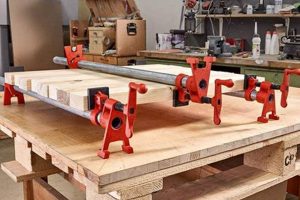
The construction of pipe clamps, tailored for securing wooden components during assembly, involves utilizing threaded pipes and specialized hardware. These clamps exert consistent pressure across a broad surface area, facilitating strong and accurate bonds in woodworking projects. A functional example includes using a length of 3/4″ threaded pipe, coupled with a commercially available clamp head and tailpiece, to firmly hold glued boards together until the adhesive cures.
Employing self-constructed clamping mechanisms offers several advantages to woodworkers. It provides a cost-effective solution compared to purchasing numerous pre-made clamps, especially when dealing with large-scale projects. Furthermore, the ability to customize the length of the pipe allows for unparalleled flexibility in accommodating diverse project dimensions. Historically, similar clamping principles have been employed for centuries, evolving from simple wedges to sophisticated threaded devices.
The following sections will delineate the specific materials required, offer a step-by-step guide to assembling a functional woodworking clamp, and provide valuable tips for ensuring optimal performance and longevity. This includes detailing proper thread engagement, surface protection strategies, and routine maintenance procedures.
Essential Considerations for Constructing Pipe Clamps
Effective creation of pipe clamps necessitates careful attention to detail and adherence to specific guidelines to ensure reliable and durable performance.
Tip 1: Pipe Selection. Opt for Schedule 40 steel pipe, as its increased wall thickness provides superior strength and resistance to bending under pressure, crucial for maintaining even clamping force across the workpiece.
Tip 2: Thread Engagement. Ensure full thread engagement between the pipe and the clamp head and tailpiece. Insufficient engagement compromises the clamp’s holding power and increases the risk of slippage or failure under load.
Tip 3: Protective Padding. Implement protective padding, such as cork or thin wood strips, between the clamp jaws and the wood surface. This mitigates the potential for indentation or marring of the workpiece during clamping.
Tip 4: Lubrication. Apply a light lubricant, such as machine oil or silicone spray, to the pipe threads. This reduces friction, facilitating smooth and consistent tightening of the clamp.
Tip 5: Even Pressure Distribution. Distribute clamps evenly along the length of the workpiece. Uneven distribution can induce warping or bowing, compromising the integrity of the assembled joint.
Tip 6: Regular Inspection. Conduct routine inspections of the clamps for signs of wear or damage, such as stripped threads or cracked components. Replace damaged parts promptly to maintain clamp functionality and safety.
Tip 7: Storage Considerations. Store clamps in a dry environment to prevent corrosion and rust formation. Proper storage extends the lifespan of the clamps and ensures consistent performance.
By adhering to these recommendations, woodworkers can fabricate robust and dependable clamping solutions, ensuring the successful execution of various woodworking endeavors.
The subsequent discussion will address potential troubleshooting scenarios and offer solutions for maintaining optimal clamp performance over extended periods.
1. Pipe thread compatibility

Pipe thread compatibility is a foundational element in the creation of effective woodworking clamps. The failure to ensure proper thread matching between the pipe and clamp head renders the entire clamping assembly unusable, effectively halting construction. Incompatible threads, whether due to size or thread type discrepancies, will either prevent any connection or result in a weakened, unreliable joint prone to slippage and failure under load. This incompatibility directly impacts the clamp’s ability to exert consistent and secure pressure on the workpiece.
A common scenario involves the accidental mixing of National Pipe Taper (NPT) and British Standard Pipe (BSP) threads. While visually similar, these standards possess slightly different thread angles and pitches. Attempting to force these together will damage the threads on both components, precluding their use in a functioning clamp. Similarly, using a 1/2″ clamp head on a 3/4″ pipe, or vice versa, is physically impossible, underscoring the absolute necessity for precise thread matching. The selection of appropriately sized and compatible components is therefore a critical first step in the construction process.
In summary, verified thread compatibility represents a non-negotiable precondition for the successful fabrication of pipe clamps. Careful attention to thread size and thread type during component selection is essential to avoid wasted materials, compromised clamp integrity, and potential project failures. The ramifications of neglecting this critical aspect extend beyond mere inconvenience, potentially leading to unsafe working conditions if clamps fail under pressure.
2. Clamp head selection

Clamp head selection directly influences the functionality and utility when constructing pipe clamps for woodworking applications. The clamp head provides the crucial mechanism for applying and maintaining pressure on the workpiece. Variations in clamp head design, such as the presence or absence of a swivel foot, the material composition, and the clamping capacity, directly affect the clamp’s ability to conform to uneven surfaces, distribute force effectively, and accommodate projects of varying sizes. A poorly chosen clamp head can result in insufficient clamping pressure, slippage, or damage to the wood, thereby compromising the quality of the woodworking joint. For example, using a light-duty clamp head on a large glue-up risks deformation of the head or failure under load.
Further considerations in clamp head selection involve the type of threading and the overall construction quality. Mismatched threads, as previously noted, render the assembly unusable. The durability of the clamp head itself, particularly its resistance to deformation and wear over time, is also paramount. A robust cast-iron clamp head, for instance, will withstand significantly more use and stress compared to a stamped steel alternative. The ease of adjustment and the smoothness of the clamping action are additional factors affecting the efficiency and precision of the woodworking process. Consider a scenario in which a craftsman relies on pipe clamps to glue long pieces of wood together. Smoothly adjusting the clamp ensures the wood fits together and is aligned properly while glue sets.
In conclusion, the proper selection of the clamp head is not merely a detail, but rather an integral determinant of the success of self-constructed pipe clamps. A well-chosen clamp head enhances the reliability, accuracy, and overall effectiveness, while a poorly chosen component undermines the structural integrity and the precision required for quality woodworking projects. This understanding is vital for anyone undertaking the construction of their own clamping solutions, highlighting the critical link to the broader theme of how to make pipe clamps for woodworking.
3. Pipe length determination
Proper pipe length determination is a critical factor in fabricating functional pipe clamps, directly influencing the clamp’s versatility and suitability for various woodworking projects. Selecting an appropriate length is not arbitrary; it is dictated by the dimensions of the workpieces to be joined and the specific clamping requirements of the task. Insufficient length renders the clamp unusable, while excessive length introduces unnecessary bulk and potential instability.
- Project Size Accommodation
The pipe length must exceed the maximum width or length of the pieces being clamped. Woodworkers typically maintain an array of pipes in varying lengths to accommodate diverse project scales, from small boxes to large table tops. A pipe that is too short simply cannot apply clamping pressure, rendering it useless. Consider the construction of a large cabinet door. A pipe shorter than the door’s width prohibits effective clamping of the stiles and rails.
- Clamp Positioning and Clearance
Pipe length affects the clamp’s ability to be positioned effectively around the workpiece. Adequate length allows for proper spacing of multiple clamps along the joint, ensuring even pressure distribution. Insufficient length might force clamps to be placed too close together or too near the edge, leading to uneven clamping force and potential warping. For example, clamping edge-glued boards requires sufficient pipe length to space the clamps evenly along the entire seam.
- Threaded Length and Engagement
The overall pipe length must account for the portion of the pipe threaded into the clamp head and tailpiece. This reduces the effective clamping length. Therefore, woodworkers must factor in the depth of thread engagement when calculating the required pipe length for a given project. Failure to consider thread engagement will result in a shorter usable clamping distance than initially anticipated.
- Storage and Workspace Constraints
While longer pipes provide greater versatility, they also present storage and workspace management challenges. Excessively long pipes become cumbersome and difficult to store. A balance must be struck between maximizing versatility and minimizing space constraints within the workshop. Woodworkers often opt for a selection of pipes of varying lengths to address this issue, optimizing both clamping capability and storage efficiency.
The selection of an appropriate pipe length is integral to the overall construction and effectiveness of pipe clamps. The considerations outlined above highlight the direct relationship between pipe length and clamping performance, emphasizing its significance in achieving successful woodworking outcomes. Without proper determination of length, the benefits derived from the components used within “how to make pipe clamps for woodworking” cannot be realized.
4. Padding implementation

Padding implementation is intrinsically linked to the successful application of self-constructed pipe clamps. The direct contact between the metal clamp jaws and the wooden workpiece introduces a significant risk of indentation, marring, and staining, thereby compromising the aesthetic and structural integrity of the project. The interposition of a cushioning material, such as cork, felt, or wood veneer, acts as a buffer, distributing clamping pressure more evenly across the surface and minimizing the potential for localized damage. Without proper padding, even moderate clamping force can leave permanent marks, particularly on softer woods or delicate veneers. This critical step, therefore, directly affects the quality and final appearance of the woodworking endeavor. Consider a scenario where delicate molding is being glued to a cabinet. Without padding, the clamps will likely dent the molding.
Effective padding implementation necessitates careful selection of the appropriate material and thickness. Materials should be non-reactive with common wood adhesives to prevent unintended staining or discoloration. The thickness of the padding must be sufficient to provide adequate cushioning without unduly reducing the clamping force or compromising the stability of the setup. Woodworkers often maintain a variety of padding options to accommodate different wood species, project sizes, and clamping pressures. The adherence of the padding to the clamp jaws also requires consideration, with options ranging from adhesive-backed materials to temporary clamping or taping methods. Proper selection of pad increases the likelihood of achieving project success.
In summary, padding implementation is not a mere ancillary step but an essential component in the workflow. The practice is a preventative measure designed to mitigate the adverse effects of direct metal-to-wood contact during clamping. When “how to make pipe clamps for woodworking” is undertaken, the necessity to pad the clamping jaws should be a part of the process. Acknowledging the importance of this step ensures a higher quality outcome, free from avoidable imperfections and damage. Omission can diminish aesthetic value, compromising a woodworking project, thus highlighting the practical significance of understanding and implementing proper padding techniques.
5. Thread lubrication needs

Proper thread lubrication is a critical, often overlooked, aspect in the successful assembly and operation of pipe clamps utilized in woodworking. The application of a suitable lubricant to the threads of the pipe and the clamp head significantly reduces friction, enabling smoother tightening and loosening of the clamp, and contributes to the longevity of the clamp assembly. Neglecting this requirement can lead to increased wear and tear on the threads, potentially resulting in binding, seizing, or even complete failure of the clamp mechanism over time.
- Reduced Friction and Binding
Lubrication minimizes friction between the contacting surfaces of the pipe threads and the clamp head. This reduction in friction translates to a smoother and more consistent tightening action, preventing the threads from binding or seizing. A common example is the difficulty encountered when attempting to tighten a dry, unlubricated bolt and nut; a similar principle applies to pipe clamps. In the context of pipe clamp construction, this means easier adjustment and more reliable clamping pressure.
- Corrosion Prevention
Many lubricants possess inherent corrosion-inhibiting properties, protecting the metal threads from oxidation and rust formation. This protection is particularly relevant in woodworking environments, where humidity levels can fluctuate. Rust can significantly increase friction and lead to thread damage, compromising the clamp’s integrity. By applying a suitable lubricant, the woodworker mitigates the risk of corrosion and extends the lifespan of the clamping assembly. A thin layer of oil acts as a barrier against moisture, ensuring smooth operation even after prolonged storage.
- Extended Thread Life
The consistent application of lubrication reduces wear and tear on the threads, prolonging their functional life. The constant friction during tightening and loosening gradually erodes the thread surfaces, leading to eventual stripping or deformation. Lubrication minimizes this wear, maintaining the integrity of the threads and ensuring consistent clamping force over numerous uses. This aspect is crucial for woodworkers who rely on their clamps for repetitive or high-stress applications.
- Consistent Clamping Force
Thread lubrication contributes to achieving a more consistent and predictable clamping force. Reduced friction allows for a more accurate translation of torque applied to the clamp handle into clamping pressure on the workpiece. This is particularly important when working with delicate materials or when precise clamping pressure is required to avoid damage or distortion. A lubricated clamp will provide a more uniform and controllable clamping force compared to an unlubricated one, leading to more reliable and accurate woodworking outcomes.
The careful consideration of thread lubrication needs directly impacts the longevity, functionality, and overall effectiveness of pipe clamps in woodworking. Failing to address this requirement can result in increased wear, reduced clamping force, and potential clamp failure. Thus, the application of a suitable lubricant should be considered an integral part of the process when one considers “how to make pipe clamps for woodworking”. A well-lubricated clamp ensures smoother operation, prevents corrosion, and extends the lifespan of the tool, contributing to more reliable and accurate woodworking results.
6. Storage environment optimization
Storage environment optimization directly influences the longevity and operational effectiveness of pipe clamps constructed for woodworking. Exposure to adverse conditions, particularly humidity and temperature fluctuations, accelerates corrosion and degradation of metal components, thereby diminishing the clamp’s structural integrity and functionality. Proper storage mitigates these risks, ensuring the clamps remain in optimal working condition for extended periods. This consideration is an integral component of a holistic approach to “how to make pipe clamps for woodworking,” extending beyond the initial construction phase to encompass long-term maintenance. For instance, storing pipe clamps in a damp basement inevitably leads to rust formation, impacting thread engagement and reducing clamping force. In contrast, storing them in a dry, climate-controlled environment preserves their integrity, ensuring reliable performance when needed.
Implementing effective storage strategies involves several practical measures. These include selecting a dry, well-ventilated location away from direct exposure to moisture and extreme temperature variations. Applying a protective coating of rust inhibitor to the threads and metal surfaces further enhances their resistance to corrosion. Regular inspection and cleaning of the clamps are also essential, removing any accumulated dust, debris, or moisture that could contribute to degradation. Woodworkers often employ dedicated storage racks or cabinets to organize and protect their clamps, preventing physical damage and facilitating easy access. Specifically, coating the threads and exposed metal with a silicone-based lubricant spray can impede humidity’s degradation to its performance. For those who frequently travel to worksites, a hard protective case will maintain performance.
In summary, optimizing the storage environment is not merely a matter of convenience but a crucial step in preserving the investment in self-constructed pipe clamps. A proactive approach to storage management directly contributes to the durability, reliability, and overall cost-effectiveness of these essential woodworking tools. The challenges of uncontrolled environments can be overcome through diligent application of preventative measures, safeguarding the performance and extending the useful life of pipe clamps, thus completing the cycle of construction, maintenance, and storage associated with “how to make pipe clamps for woodworking.”
Frequently Asked Questions
The following addresses common inquiries and misconceptions regarding the fabrication and utilization of pipe clamps within a woodworking context. The information provided aims to offer clarity and enhance understanding of best practices.
Question 1: What type of pipe is best suited for making woodworking clamps?
Schedule 40 black steel pipe is generally recommended. It offers a balance of strength, affordability, and availability. Galvanized pipe is discouraged due to potential interference with wood finishes and adhesives.
Question 2: How critical is thread compatibility between the pipe and clamp head?
Thread compatibility is non-negotiable. The use of mismatched threads will result in a compromised connection, rendering the clamp ineffective and potentially dangerous under load. National Pipe Taper (NPT) threads are the most prevalent standard in North America.
Question 3: What is the optimal length of pipe to use for a versatile woodworking clamp setup?
A range of pipe lengths is recommended to accommodate diverse project sizes. Commonly, lengths of 12 inches, 24 inches, 36 inches, and 48 inches offer sufficient versatility for most woodworking applications. Longer lengths may be required for larger projects.
Question 4: Is padding truly necessary when using pipe clamps on wood?
Padding is strongly advised to prevent indentation and marring of the workpiece. Soft materials, such as cork, felt, or thin wood shims, provide a buffer between the metal clamp jaws and the wood surface, distributing pressure and minimizing damage.
Question 5: What type of lubricant is appropriate for maintaining pipe clamp threads?
A light machine oil or silicone-based lubricant is suitable for maintaining pipe clamp threads. The lubricant reduces friction, facilitates smoother tightening and loosening, and protects against corrosion. Avoid lubricants containing solvents that could damage wood finishes.
Question 6: How should pipe clamps be stored to maximize their lifespan?
Pipe clamps should be stored in a dry, well-ventilated environment to prevent rust and corrosion. Applying a rust inhibitor and storing clamps horizontally on a rack or in a cabinet will further protect them from damage and degradation.
In summation, adherence to these guidelines will enhance the performance and longevity of woodworking pipe clamps, contributing to improved project outcomes.
The subsequent section delves into advanced techniques and modifications for further optimizing pipe clamp construction and utilization.
Conclusion
This exploration of crafting pipe clamps for woodworking has detailed the essential elements for successful construction. From pipe selection and thread compatibility to padding implementation and proper storage, each aspect contributes to the durability and effectiveness of these indispensable tools. Addressing thread lubrication and length determination further refines the process, ensuring reliable performance across diverse woodworking projects.
Mastering the intricacies of pipe clamp creation empowers woodworkers to tailor their tools to specific needs, promoting efficiency and precision. Consistent application of the principles outlined herein fosters both craftsmanship and long-term resourcefulness within the workshop. Continued refinement of technique will ensure that self-constructed clamping solutions contribute substantively to quality woodworking outcomes.
![Top-Rated: Best Quick Clamps for Woodworking Projects [2024] | Step-by-Step Guides, Tools & Inspiration to Build Beautiful Wooden Decor on a Budget](https://woodfromhome.com/wp-content/uploads/2026/04/th-264-300x200.jpg "Top-Rated: Best Quick Clamps for Woodworking Projects [2024] Step-by-Step Guides, Tools & Inspiration to Build Beautiful Wooden Decor on a Budget")