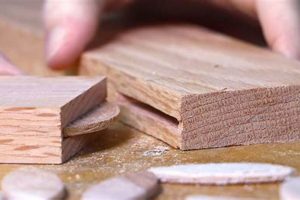
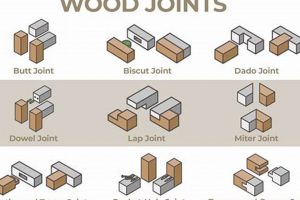
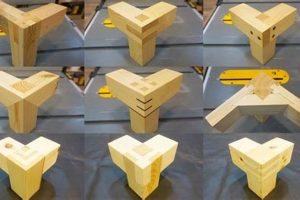
This method, involving a thin strip of material inserted into grooves cut into two workpieces, creates a strong and accurate bond. A common application is joining two boards edge-to-edge, providing increased surface area for glue adhesion and mechanical interlock. The inserted element, typically wood but sometimes other materials, reinforces the junction, resisting racking and shear forces.
The result is a structurally sound and visually appealing connection. It has been employed for centuries in furniture making and construction, offering superior strength compared to simple butt joints. This technique ensures longevity and stability in projects, and is particularly useful in applications where aesthetics are paramount, as it can be designed to be either concealed or exposed as a decorative element.
The following sections will delve into the specific types, techniques for creating accurate slots, the selection of appropriate materials, and practical considerations for executing effective and durable connections. Detailed instructions and examples will be provided to facilitate a thorough understanding of its practical applications.
Essential Considerations for Strong and Accurate Connections
Achieving optimal results requires careful planning and execution. The following considerations will contribute to creating robust and aesthetically pleasing bonds.
Tip 1: Material Selection is Paramount: Choose the right material based on the specific application. For maximum strength, select stock with grain oriented perpendicular to the joint line. Consider the species’ density and glue-holding properties. In decorative applications, match the color and grain of the adjoining pieces.
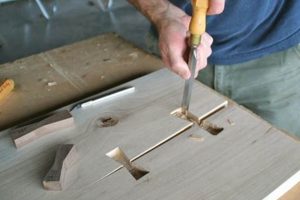
Tip 2: Precision in Slot Creation: Accurate slot dimensions are crucial. Employ a router with a precisely sized bit, a table saw with a jig, or specialized slotting cutters. Ensure the slot is consistently deep and wide along its entire length to provide a snug and even fit.
Tip 3: Grain Direction Matters: When constructing, pay close attention to grain direction. Orient the grain perpendicular to the grain of the surrounding wood to maximize strength and prevent potential splitting or warping.
Tip 4: Glue Application and Clamping: Apply adhesive evenly to all mating surfaces, including the slot and the insert itself. Utilize clamps to apply consistent and adequate pressure during the curing process, ensuring a tight and secure bond. Avoid over-clamping, which can starve the joint of adhesive.
Tip 5: Consider Length and Placement: The length of the insert should be proportional to the size and stress the joint will endure. Strategically place multiple shorter inserts along longer joints for enhanced stability and load distribution.
Tip 6: Dry Fit Before Gluing: Always conduct a dry fit to ensure proper alignment and fit before applying glue. This allows for any necessary adjustments and prevents irreversible errors once the adhesive is applied.
Tip 7: Allow Adequate Curing Time: Respect the adhesive manufacturer’s recommendations for curing time. Premature removal of clamps can compromise the bond’s strength and integrity.
By adhering to these guidelines, a craftsperson can enhance the structural integrity and aesthetic appeal of projects.
The subsequent sections will explore the diverse applications in various woodworking contexts and highlight techniques for addressing common challenges.
1. Strength

The inherent strength of a joint is paramount in woodworking. The utilization of splines significantly enhances the durability and load-bearing capacity of joined components, making it a critical factor in construction where structural integrity is essential.
- Increased Glue Surface Area
The presence of a spline notably expands the surface area available for adhesive bonding. This augmented surface, compared to simple edge-to-edge butt joints, facilitates a stronger, more resilient connection. Examples include table tops and cabinet doors, where a larger glued area reduces the risk of joint failure under stress.
- Mechanical Interlock
A spline creates a mechanical key between the joined pieces. This interlocking element resists shear forces and prevents racking, contributing significantly to the overall robustness of the assembly. Instances such as chair rails and frame-and-panel construction demonstrate how this resistance to movement under load preserves structural integrity.
- Reinforcement Against Wood Movement
Solid wood expands and contracts with changes in humidity. A properly executed spline joint, particularly with consideration given to wood grain orientation, can mitigate the stresses caused by seasonal wood movement. This is especially crucial in large panels or tabletops, where unrestricted movement can lead to warping or joint separation.
- Distribution of Stress
The spline aids in distributing stress evenly across the joint, rather than concentrating it at the edges. This uniform distribution minimizes the potential for localized failure. Applications such as joining wide boards for a workbench top benefit greatly from the enhanced load distribution provided.
These facets of strength, achieved through the integration of splines, establish a connection far superior to simple butt joints. The enhanced glue surface, mechanical interlock, resistance to wood movement, and stress distribution work in concert to yield strong, reliable, and long-lasting assemblies.
2. Alignment

Precise alignment is a critical factor in the successful execution of spline joints woodworking. Any deviation from accurate alignment compromises both the structural integrity and aesthetic appeal of the finished piece. The spline, acting as a key between two workpieces, amplifies the significance of proper alignment during the assembly process. When misaligned, the resulting joint may exhibit uneven surfaces, reduced strength, and visual imperfections that detract from the overall quality of the woodworking project. For instance, a tabletop constructed with misaligned splines will present an uneven surface, impacting functionality and appearance. Similarly, in cabinet door construction, misalignment can cause the door to bind or fail to close properly.
Achieving accurate alignment necessitates careful measurement, precise cutting, and meticulous assembly techniques. Jigs and fixtures are frequently employed to maintain consistency and ensure that the spline slots are cut parallel and at the correct depth. During glue-up, clamps must be strategically positioned to apply even pressure and prevent shifting. The use of registration marks or temporary fasteners can further assist in maintaining the desired alignment until the adhesive sets. The selection of appropriate materials is also relevant; stable, well-seasoned wood is less prone to warping or movement that could introduce misalignment during or after assembly. An example of the meticulous effort needed can be seen in the construction of musical instruments, where even slight deviations in alignment can drastically affect the instrument’s sound and playability.
In summary, alignment stands as a non-negotiable aspect of spline joint woodworking. Its impact extends beyond mere aesthetics, influencing the joint’s strength and longevity. While challenges may arise from material inconsistencies or procedural errors, employing precise techniques and careful attention to detail mitigates the risk of misalignment. A thorough understanding of this connection ultimately leads to the creation of higher quality, more durable woodworking projects.
3. Adhesive Surface

The adhesive surface in spline joints woodworking is a critical determinant of the joint’s overall strength and durability. A larger, well-prepared surface area allows for a more robust bond between the spline, and the joined workpieces, increasing resistance to stress and shear forces.
- Expanded Glue Area
A primary advantage of employing splines is the significant increase in available surface for adhesive application, compared to a butt joint. The spline extends into grooves cut into both workpieces, effectively doubling the gluing area. This expanded area provides a more secure connection, especially beneficial in projects subject to heavy use or stress, such as table construction or cabinetry.
- Consistent Adhesive Distribution
Properly prepared and fitted splines promote even distribution of adhesive along the entire joint length. Consistent adhesive coverage eliminates weak points and ensures a uniform bond, enhancing the joint’s load-bearing capacity. A well-fitted spline, with minimal gaps, allows the adhesive to create a continuous film between the wood fibers, maximizing the joint’s integrity.
- Adhesive Compatibility with Materials
The selection of an appropriate adhesive, compatible with both the spline and workpiece materials, is crucial. Different wood species possess varying densities and absorption rates, which affect adhesive penetration and bonding. Furthermore, if materials other than wood are utilized for the spline (e.g., fiberboard, plastic), the adhesive must be specifically formulated for these materials to ensure adequate adhesion and long-term performance.
- Surface Preparation Techniques
Proper surface preparation is essential to optimize the adhesive bond. Smooth, clean surfaces free from dust, oil, or contaminants promote maximum adhesion. Techniques such as sanding or light scoring of the joint surfaces can increase the adhesive’s mechanical keying to the wood fibers, further strengthening the bond. Failure to prepare the surfaces adequately can result in a weak, unreliable joint that is prone to failure under stress.
In summation, the adhesive surface within a spline joint is a multifaceted element encompassing area maximization, uniform distribution, material compatibility, and meticulous preparation. Attending to these aspects ensures a resilient, durable connection capable of withstanding the stresses inherent in woodworking applications. Projects ranging from furniture construction to intricate joinery all benefit from the enhanced adhesive surface provided by the thoughtful use of spline joints.
4. Material Compatibility

Material compatibility in spline joints woodworking is not merely a matter of aesthetic preference; it is a crucial determinant of the joint’s structural integrity and long-term performance. Disparities in physical properties between the spline and the surrounding wood can lead to joint failure, dimensional instability, and aesthetic flaws. Careful selection of materials is therefore essential to ensure the longevity and success of the woodworking project.
- Expansion and Contraction Rates
Different wood species expand and contract at varying rates in response to changes in humidity. When dissimilar species are joined, the differential movement can induce stress within the joint, potentially leading to cracking, warping, or glue bond failure. For instance, using a spline of highly reactive wood like beech in a frame of dimensionally stable wood like mahogany could result in the beech expanding and putting undue pressure on the mahogany, causing the joint to fail. Therefore, selecting species with similar expansion coefficients is advisable.
- Wood Density and Hardness
Significant differences in wood density and hardness can also compromise joint integrity. A very hard spline inserted into softer wood may not provide adequate adhesive bonding surface, resulting in a weak connection. Conversely, a soft spline in a hard wood frame may be crushed or deform under stress. Ideally, the spline should be of similar or slightly greater hardness than the surrounding wood to ensure adequate support and adhesive bond strength. For example, using a soft pine spline in a hard maple frame is unlikely to yield a durable joint.
- Adhesive Compatibility
The chosen adhesive must be compatible with both the spline and the workpiece materials. Some wood species contain oils or extractives that can interfere with adhesive bonding. Furthermore, if the spline material is not wood (e.g., composite material), a specialized adhesive designed for that material is necessary. Selecting an inappropriate adhesive will invariably result in a weak or unreliable bond. A polyurethane adhesive may be suitable for oily woods, while a standard PVA may not be adequate.
- Grain Orientation and Strength
The grain orientation of both the spline and the surrounding wood must be considered to maximize joint strength. A spline with long grain running perpendicular to the joint line provides the greatest resistance to shear forces. However, if the surrounding wood has a weak grain structure or is prone to splitting, even a well-oriented spline may not prevent joint failure under stress. Careful assessment of grain direction and selection of appropriate wood with strong, stable grain patterns are essential.
The interconnectedness of these factors underscores the importance of comprehensive material assessment prior to commencing any spline joint woodworking project. A thorough understanding of wood properties, adhesive characteristics, and joint mechanics enables informed decisions that contribute significantly to the creation of durable, aesthetically pleasing, and structurally sound woodworking pieces. Failing to consider these material compatibilities can cause structural weakness or aesthetic failures in spline joints woodworking.
5. Slot Precision

Slot precision is a foundational element within spline joints woodworking, directly impacting the structural integrity and aesthetic quality of the completed piece. The accuracy with which the slots are cut determines the fit of the spline, and consequently, the effectiveness of the joint. Undersized slots impede proper insertion, potentially causing splitting or requiring excessive force, while oversized slots compromise the glue surface and mechanical interlock, resulting in a weaker connection. An example illustrating this significance is the construction of a high-end cabinet; imprecisely cut slots lead to gaps and misalignments, diminishing the piece’s overall value and longevity.
The method employed for slot creation is critical. Table saws with appropriate jigs, routers with guided templates, and dedicated slotting machines offer varying degrees of precision. Irrespective of the chosen method, meticulous calibration of tools and adherence to precise measurements are paramount. Furthermore, consistency throughout the slotting process is essential; variations in depth or width along the slot’s length introduce points of weakness or misalignment. In the context of crafting musical instruments, the narrow tolerances demanded necessitate specialized tools and techniques to ensure slot precision, as even minute discrepancies can affect sound quality.
In summary, slot precision represents a critical control point in spline joints woodworking. The quality of this connection directly influences the strength, appearance, and longevity of the resulting piece. By investing in accurate tools, employing careful techniques, and maintaining a commitment to consistent measurements, woodworkers can maximize the benefits of spline joints and create durable, aesthetically pleasing, and structurally sound creations. The challenges associated with achieving consistent accuracy emphasize the necessity of careful control of all the steps.
6. Grain orientation

Grain orientation holds significant importance in spline joints woodworking, directly impacting the joint’s strength and resistance to stress. The alignment of wood fibers relative to the forces acting upon the joint dictates its ability to withstand load and resist failure. Misalignment or disregard for grain direction can lead to weakened joints that are prone to cracking, splitting, or complete failure.
- Longitudinal Grain Orientation
Orienting the long grain of the spline perpendicular to the joint line maximizes resistance to shear forces. This configuration provides optimal strength by leveraging the wood’s inherent resistance to splitting along its grain. For example, in edge-to-edge joints for tabletops, a spline with longitudinal grain orientation significantly increases the joint’s ability to withstand bending and shear stresses.
- Transverse Grain Orientation (End Grain)
Using end grain in splines should be avoided wherever possible, as it provides minimal strength. End grain is highly absorbent and allows for deep glue penetration, however it lacks the cohesive strength of long grain. A spline made of end grain will be brittle and prone to failure under stress. This is especially critical in applications requiring high load-bearing capacity.
- Grain Direction and Wood Movement
Wood expands and contracts perpendicular to the grain with changes in humidity. When incorporating splines, consideration must be given to the grain direction of both the spline and the joined pieces. Mismatched grain orientations can result in uneven expansion and contraction, leading to stress within the joint and potentially causing it to fail. In situations where wood movement is a significant concern, quarter-sawn lumber may be preferred for both the spline and the surrounding pieces due to its dimensional stability.
- Aesthetic Considerations
Grain orientation also plays a role in the aesthetic appearance of spline joints. Matching the grain patterns of the spline and the joined pieces creates a visually seamless transition and enhances the overall aesthetic appeal. Conversely, contrasting grain patterns can be used to create a decorative effect, highlighting the joint as a design element. However, aesthetic considerations should not compromise the structural integrity of the joint.
The principles governing grain orientation in spline joints underscore the importance of a comprehensive understanding of wood properties and joint mechanics. Attention to grain direction, in conjunction with appropriate material selection and construction techniques, is essential for creating robust, durable, and aesthetically pleasing woodworking projects. Ignoring these factors can cause long term issues or even immediate failure.
7. Clamping pressure

Clamping pressure exerts a direct influence on the integrity and longevity of spline joints in woodworking. Proper application of force during adhesive curing ensures intimate contact between the mating surfaces, facilitating a robust and enduring bond. Conversely, insufficient or excessive pressure can compromise the joint’s strength, leading to premature failure.
- Adhesive Distribution
Adequate clamping pressure promotes even distribution of adhesive throughout the joint. This ensures that all surfaces are wetted and that no voids or air pockets exist that could weaken the bond. In cases where clamping pressure is uneven, areas may be starved of adhesive, resulting in localized points of failure. Examples include uneven tabletop joints or cabinet frames with weak corners, both consequences of inadequate pressure distribution during assembly.
- Material Compression and Fit
Clamping pressure serves to compress the wood fibers, ensuring a tight and gap-free fit between the spline and the slot. This compression maximizes the contact area for adhesive bonding and enhances the mechanical interlock between the components. Insufficient pressure may result in gaps that compromise the strength of the joint and provide avenues for moisture intrusion. Excess pressure can crush the wood fibers, weakening the joint and potentially leading to misalignment.
- Joint Alignment Maintenance
The application of clamping pressure is instrumental in maintaining proper alignment of the joint during the adhesive curing process. Clamps strategically positioned and tightened prevent shifting or movement of the components, ensuring that the finished joint is square, flush, and visually appealing. Misalignment during glue-up can result in uneven surfaces, racking, or structural instability.
- Adhesive Cure Optimization
Sustained clamping pressure during the adhesive’s open and cure time is essential for optimal bond strength. Clamping maintains constant contact, preventing movement that could disrupt the adhesive film and weaken the bond. Premature release of clamping pressure can lead to incomplete curing, resulting in a joint that is susceptible to failure under stress.
In conclusion, clamping pressure is a critical parameter in the successful execution of spline joints woodworking. Its role in adhesive distribution, material compression, joint alignment, and adhesive cure optimization underscores the importance of meticulous attention to this aspect of the assembly process. Proper clamping techniques contribute significantly to the creation of robust, durable, and aesthetically pleasing woodworking projects.
Frequently Asked Questions about Spline Joints Woodworking
This section addresses common inquiries regarding the nature, application, and best practices associated with the creation of joints using splines.
Question 1: What defines a spline joint, and how does it differ from other woodworking joints?
A spline joint utilizes a separate piece of material, often wood, inserted into grooves cut into two or more workpieces. This contrasts with joints like dovetails or mortise-and-tenon, where the joint is formed by the shaping of the pieces themselves. The separate spline provides increased glue surface and mechanical interlocking.
Question 2: What are the primary advantages of employing spline joints in woodworking projects?
Spline joints offer enhanced strength compared to butt joints, improve alignment during assembly, and increase the gluing surface area. They also allow for joining materials of varying thicknesses and can be concealed for a clean aesthetic.
Question 3: What types of materials are suitable for use as splines?
Hardwoods, such as maple or oak, are commonly used for splines due to their strength and durability. However, other materials like plywood or even metal can be employed depending on the specific application and desired properties.
Question 4: How critical is precision in cutting the slots for spline joints?
Precision is paramount. Inaccurately sized or positioned slots can compromise the joint’s strength and alignment, leading to structural weakness or aesthetic imperfections. Precise cutting tools and techniques are essential for achieving optimal results.
Question 5: What factors should be considered when selecting an adhesive for spline joints?
Adhesive selection should be based on the materials being joined, the intended application, and the required strength. Consider the adhesive’s open time, curing time, water resistance, and gap-filling capabilities to ensure a durable and reliable bond.
Question 6: Is clamping necessary when creating spline joints, and if so, what is the recommended pressure?
Clamping is essential to ensure close contact between the spline and the slot walls during adhesive curing. The appropriate clamping pressure depends on the materials and adhesive used. Excessive pressure can starve the joint of adhesive, while insufficient pressure can result in gaps and a weak bond.
Mastering the intricacies of spline joints involves attention to detail, precision, and a thorough understanding of material properties and woodworking techniques. The rewards, however, are strong, durable, and aesthetically pleasing woodworking creations.
The next section will detail advanced techniques and specialized applications of spline joints in furniture construction.
Spline Joints Woodworking
This exploration has detailed the fundamental principles, practical considerations, and diverse applications of spline joints. From material selection and slot precision to adhesive application and clamping techniques, the success of this method hinges on a comprehensive understanding of each element. The enduring strength, improved alignment, and expanded adhesive surface it provides are demonstrably superior to simpler connection methods.
The persistent demand for durable and aesthetically refined woodworking necessitates continued refinement of this technique. Whether employed in furniture making, cabinet construction, or intricate joinery, mastery of spline joints represents a tangible investment in the quality and longevity of any woodworking endeavor. Practitioners are encouraged to apply this knowledge to elevate their craft and contribute to the enduring legacy of fine woodworking.