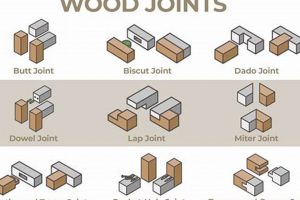
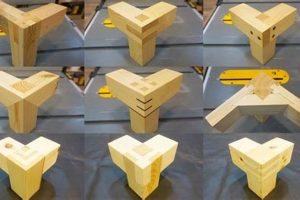
A connection in woodworking subjected to forces that threaten its integrity is one experiencing significant strain. This strain can manifest in various forms, including tension (pulling forces), compression (crushing forces), shear (sliding forces), or a combination thereof. For example, a table leg attached to the tabletop with screws, if subjected to excessive weight, can experience considerable shear stress on the screw shanks and tensile stress on the wood fibers surrounding the screw holes. This condition can lead to joint failure, such as the screws loosening or the wood cracking.
Understanding the nature and magnitude of forces acting upon woodworking joints is paramount for ensuring structural stability and longevity. Historically, joiners have relied on empirical knowledge and observation to develop robust joint designs. Modern woodworking often incorporates engineering principles to calculate anticipated loads and select appropriate joint configurations and materials. Addressing these stresses proactively prevents premature failure, costly repairs, and potential safety hazards.
The primary factors that contribute to the forces experienced by such a connection include the type of load applied (static vs. dynamic), the geometry of the joint itself, the properties of the wood species used, and the quality of the adhesive or mechanical fasteners employed. Subsequent sections will delve into specific joint types and methods for mitigating the effects of excessive forces to create durable and reliable woodworking projects.
Mitigating Forces on Woodworking Joints
The following guidelines offer strategies for designing and constructing woodworking joints that can withstand significant forces and ensure structural integrity. Implementing these techniques contributes to the longevity and reliability of woodworking projects.
Tip 1: Choose Appropriate Wood Species: Select wood species with high strength-to-weight ratios and inherent resistance to splitting. Hardwoods, such as oak or maple, generally offer superior performance compared to softwoods when subjected to substantial forces.
Tip 2: Employ Interlocking Joint Designs: Utilize joinery methods that create mechanical interlocks, such as mortise-and-tenon joints or dovetail joints. These designs distribute forces over a larger surface area, reducing stress concentrations and preventing joint separation.
Tip 3: Reinforce with Mechanical Fasteners: Augment adhesive bonds with screws, bolts, or dowels. These fasteners provide additional clamping force and prevent joint slippage, particularly in applications where shear stresses are prevalent.
Tip 4: Ensure Proper Joint Fit: Precise joint fit is essential for optimal load transfer. Gaps or irregularities in the joint surfaces create stress concentrations and reduce the effectiveness of adhesives and fasteners.
Tip 5: Apply Adhesive Sparingly and Evenly: Excessive adhesive can weaken the joint by preventing direct wood-to-wood contact. Apply a thin, consistent layer of high-quality wood glue to ensure maximum bond strength.
Tip 6: Consider Grain Orientation: Aligning the wood grain strategically can significantly improve joint strength. Avoid situations where forces are applied perpendicular to the grain, as this can lead to splitting and joint failure.
Tip 7: Account for Environmental Factors: Wood expands and contracts with changes in humidity. Design joints to accommodate these movements to prevent stress buildup and potential joint failure.
Tip 8: Prototype and Test Designs: Before committing to a final design, build prototypes and subject them to simulated loads. This allows for identifying potential weaknesses and refining the design for optimal performance.
By adhering to these guidelines, woodworking professionals and enthusiasts can significantly reduce the likelihood of joint failure and create structures capable of withstanding considerable forces. A proactive approach to joint design and construction ensures lasting quality and safety.
The subsequent section will address specific joint types and their suitability for various applications, further reinforcing the principles outlined above.
1. Excessive Load

Excessive load, in the context of woodworking, refers to a force applied to a structure or component that exceeds its designed capacity. This directly relates to the creation of a stressed joint because exceeding the joint’s capacity induces stresses beyond its material limits, leading to deformation, fracture, or complete failure. The relationship is one of cause and effect: Excessive load is the cause, and a state of stress ultimately, potential failure is the effect on the joint.
As a component of a stressed joint, excessive load is often the most direct and readily identifiable factor. A bookshelf designed to hold paperback books, for instance, will experience increased stress if loaded with heavy hardcovers. Similarly, a table leg jointed with inadequate tenons will fail quickly if someone sits on the tabletop. Calculating and accounting for expected loads is a critical step in woodworking design. It necessitates understanding the density of the materials that will be supported, as well as the potential for dynamic loads resulting from impacts or movement.
Understanding this relationship is crucial for ensuring the longevity and safety of woodworking projects. While other factors, such as material selection and joint design, contribute to overall structural integrity, the ability to withstand anticipated loads is paramount. Ignoring this factor risks compromising the entire structure and potentially causing harm. The application of engineering principles, such as calculating bending moments and shear forces, can help predict and mitigate the impact of excessive loads.
2. Improper Alignment

Improper alignment in woodworking joinery introduces uneven stress distribution, directly contributing to a compromised connection. When components of a joint are not precisely aligned, the forces intended to be distributed evenly across the joint surface are instead concentrated in specific areas. This concentration creates stress points, which can lead to premature failure.
- Uneven Load Distribution
When joinery components are misaligned, the load bearing is not distributed evenly. A mortise and tenon joint where the tenon is skewed within the mortise will bear the load primarily on one side. This localized pressure exceeds the material’s capacity, leading to crushing, cracking, or eventual separation. The integrity of the joint is diminished as the intended load distribution is compromised.
- Increased Shear Stress
Misalignment often introduces increased shear stress, where forces act parallel to the joint surface. Consider a table leg attached with screws that are not perfectly perpendicular to the tabletop. The resulting angle forces the screws to resist lateral movement, creating shear. This shearing action can strip the screw threads, weaken the wood fibers, and ultimately lead to instability as the connection loosens over time.
- Compromised Adhesive Bonds
Adhesive bonds rely on close contact between joint surfaces to achieve optimal strength. Improper alignment creates gaps or voids within the joint, preventing the adhesive from forming a continuous, uniform bond. The resulting weak spots become points of vulnerability under load, allowing the joint to flex and degrade more quickly. Furthermore, attempting to force misaligned joints together can create internal stresses that undermine the adhesive’s integrity.
- Structural Instability
The cumulative effect of uneven load distribution, increased shear stress, and compromised adhesive bonds is overall structural instability. Furniture or structures with misaligned joints are prone to wobble, racking, and eventual collapse. The lack of precise alignment undermines the intended design and compromises the safety and longevity of the piece. Addressing misalignment during construction is crucial for achieving a stable and durable outcome.
These facets underscore the critical role of precise alignment in woodworking. Addressing potential alignment issues during the design and construction phases is paramount to creating robust joints that can withstand applied forces without experiencing undue stress. Ignoring the consequences of improper alignment invariably leads to weakened connections and structural compromise.
3. Weak Material

The use of deficient materials in woodworking creates a predisposition to joint failure under load. This condition, where the inherent properties of the wood or other components are inadequate for the intended application, directly contributes to the formation of a compromised connection subjected to excessive force.
- Reduced Load-Bearing Capacity
Inferior materials, such as low-density softwoods or woods with extensive knotting, exhibit diminished resistance to compression and tension. When incorporated into a joint, these materials compromise its ability to withstand applied forces, increasing the likelihood of deformation or fracture. For example, using pine in a structural beam designed for oak loading would lead to bending or collapse under expected weight.
- Increased Susceptibility to Shear Stress
Materials lacking adequate shear strength are prone to failure when subjected to forces acting parallel to the grain. Softwoods or woods with irregular grain patterns are particularly vulnerable. Consider a mortise and tenon joint constructed with a weak tenon: even under moderate shear stress, the tenon may split or shear off, compromising the entire connection. This effect contrasts with hardwoods with high shear strength, such as maple or walnut, which can withstand significant lateral forces without damage.
- Accelerated Degradation Under Stress
Weak materials are more susceptible to creep and fatigue, phenomena where prolonged or repeated stresses cause gradual deformation or weakening of the material. A joint constructed with such materials may initially appear sound but progressively degrade over time, leading to eventual failure. This is particularly relevant in applications subject to dynamic loads or environmental fluctuations, such as outdoor furniture or heavily used work surfaces.
- Compromised Fastener Retention
The ability of a material to securely hold fasteners, such as screws or nails, is critical for joint integrity. Weak or porous materials offer diminished resistance to fastener pullout, resulting in a weakened connection. For instance, using screws in particleboard for a load-bearing joint is likely to result in the screws stripping or the material crumbling, rendering the joint ineffective. The quality of the material directly impacts the effectiveness of mechanical fasteners.
These considerations underscore the importance of material selection in woodworking. The use of inappropriate or substandard materials undermines the structural integrity of joints, predisposing them to excessive stress and premature failure. By carefully selecting materials with adequate strength and durability, woodworking professionals and enthusiasts can create robust connections capable of withstanding anticipated loads and environmental conditions, thereby enhancing the longevity and safety of their projects.
4. Poor Adhesion

In woodworking, deficient adhesive bonding, termed poor adhesion, significantly compromises the structural integrity of joints, predisposing them to premature failure under stress. This deficiency negates the intended load-bearing capacity, resulting in a connection highly susceptible to damage.
- Inadequate Bond Strength
The primary consequence of poor adhesion is a reduction in the joint’s capacity to resist tensile and shear forces. An adhesive joint lacking sufficient bond strength will separate under minimal load, shifting the stress burden onto mechanical fasteners, if present. For instance, in a poorly glued dovetail joint, the tails may pull apart from the pins under tension, rendering the joint ineffective and increasing the risk of complete structural failure.
- Incomplete Surface Contact
Adhesive performance hinges on intimate contact between mating surfaces. Poor preparation, such as the presence of dust, oil, or improperly machined surfaces, inhibits proper wetting and bonding. This incomplete surface contact creates voids or weak spots within the joint, concentrating stresses and increasing the likelihood of crack propagation under load. Consequently, the joint’s overall strength diminishes, predisposing it to separation under even moderate strain.
- Environmental Sensitivity
Many adhesives are susceptible to degradation under varying environmental conditions, such as humidity and temperature fluctuations. Poor adhesion exacerbates this sensitivity, accelerating the breakdown of the bond. A joint glued with an inappropriate adhesive for the intended environment may weaken over time, leading to creep, distortion, or eventual failure. The cyclical expansion and contraction of wood can further compromise a poorly adhered joint, inducing stress and accelerating bond degradation.
- Compromised Load Distribution
A well-bonded joint distributes applied forces evenly across the entire bonded surface. Poor adhesion disrupts this distribution, creating stress concentrations at points of weakness. This uneven stress concentration can lead to localized failure, such as delamination or cracking, even under loads that the joint would otherwise withstand. The absence of a uniform adhesive bond compromises the joint’s ability to function as a cohesive unit, increasing its vulnerability to external forces.
These factors highlight the crucial role of proper adhesion in woodworking. Achieving a strong, durable adhesive bond requires careful surface preparation, the selection of appropriate adhesives, and adherence to recommended application techniques. Neglecting these considerations inevitably leads to stressed joints prone to premature failure, undermining the overall structural integrity and longevity of woodworking projects.
5. Inadequate Design

Inadequate design constitutes a primary cause of highly stressed connections in woodworking. Designs that fail to account for anticipated loads, material properties, and environmental factors inevitably produce joints susceptible to premature failure. The absence of sound structural engineering principles in the design phase directly translates into a compromised connection vulnerable to excessive stresses.
As a fundamental component of a stressed joint, inadequate design manifests through various deficiencies. This can include the selection of inappropriate joint types for the applied load, insufficient joint surface area, or the absence of reinforcement in critical areas. For example, a simple butt joint used to support the weight of a heavy tabletop lacks the mechanical strength to withstand the resulting shear stress. Similarly, mortise-and-tenon joints with excessively short tenons are prone to failure under bending loads. A poorly conceived design overlooks potential failure points, creating inherent weaknesses within the structure. Consider a bookcase constructed with shelves supported only by small dowels: the dowels, designed without calculating the load of books, would likely shear or pull out over time, causing the shelves to sag or collapse. This example underscores the importance of understanding load paths and stress distribution during design.
A thorough understanding of structural mechanics and material science is essential for preventing design-induced joint stress. Adhering to established engineering principles, such as calculating bending moments, shear forces, and stress concentrations, enables the creation of robust and durable woodworking projects. Overcoming these challenges requires a commitment to both theoretical knowledge and practical experience, ensuring that design choices reflect a deep understanding of how forces act upon woodworking structures. Ignoring these principles risks producing pieces that are not only structurally unsound but also potentially hazardous. Prioritizing sound design minimizes the risk of failure and guarantees the longevity and safety of the finished product.
6. Environmental Changes
Environmental changes induce stresses within woodworking joints through fluctuations in temperature and humidity, directly impacting material properties and dimensional stability. These changes contribute significantly to the potential for joint failure, underscoring the need for careful consideration during design and construction.
- Moisture Content Fluctuations
Wood is hygroscopic, meaning it absorbs and releases moisture from the surrounding environment. Changes in humidity cause wood to swell when moisture is absorbed and shrink when moisture is released. These dimensional changes induce internal stresses within joints, particularly when dissimilar materials are combined or when grain orientations restrict movement. For example, a solid wood panel glued into a frame constructed with a different wood species will experience significant stress as the panel expands and contracts relative to the frame. This stress can lead to glue line failure, cracking of the wood, or distortion of the assembly.
- Temperature-Induced Expansion and Contraction
While wood exhibits a relatively low coefficient of thermal expansion compared to metals, temperature changes can still induce stresses within woodworking joints, especially in applications exposed to direct sunlight or extreme temperature variations. Differential expansion and contraction between components of a joint can generate significant forces, leading to fastener loosening, glue line failure, or warping of the assembly. Consider an outdoor wooden gate exposed to direct sunlight: the surface of the gate heats up more quickly than the interior, creating a temperature gradient that induces stress and potential distortion.
- Cyclical Stress and Fatigue
Repeated cycles of swelling and shrinking due to humidity fluctuations can cause fatigue in woodworking joints. Each cycle induces stress that weakens the glue bond or mechanical fasteners over time, leading to a progressive loss of joint strength. This cyclical stress is particularly detrimental to joints subjected to constant load, such as those in furniture. For example, a chair joint exposed to seasonal humidity changes may exhibit increasing looseness and instability over several years due to fatigue caused by repeated expansion and contraction of the wood fibers.
- Biological Degradation
Environmental factors such as moisture, temperature, and exposure to sunlight can promote biological degradation of wood, including decay and insect infestation. Decay weakens the wood fibers, reducing the joint’s load-bearing capacity and increasing its susceptibility to failure. Insect infestations, such as termites or woodworms, can further compromise joint integrity by consuming structural wood, creating voids, and weakening the surrounding material. Outdoor structures are particularly vulnerable to biological degradation, highlighting the need for protective finishes and preservative treatments.
These environmental influences collectively underscore the importance of accounting for potential dimensional changes and biological degradation when designing and constructing woodworking joints. Selecting appropriate wood species, employing moisture-resistant adhesives, incorporating expansion joints, and applying protective finishes can mitigate the impact of environmental factors, ensuring the long-term stability and durability of woodworking projects exposed to varying environmental conditions.
7. Shear Force
Shear force, defined as a force acting parallel to a surface, represents a critical stressor in woodworking joints. Its presence is a primary indicator of a connection at risk of failure, making it a central consideration in any analysis of what is considered a stressed joint. When shear force exceeds the joint’s capacity to resist it, the result is often slippage, deformation, or complete separation of the joined components.
The effect of shear force on woodworking joints can be understood through various examples. Consider a shelf supported by pins inserted into the sides of a cabinet. The weight on the shelf exerts a downward force, which translates into a shear force acting on the pins where they meet the shelf and the cabinet wall. If the pins are too small or the wood is too soft, the pins will either shear off or the wood will deform, causing the shelf to collapse. Similarly, in a mortise-and-tenon joint, shear force acts along the mortise walls, tending to slide the tenon out of the mortise. A well-designed joint will have sufficient surface area and adhesive strength to resist this shear force, while a poorly designed or constructed joint will succumb to it. In furniture construction, understanding how shear stress affects joinery is crucial for stability and longevity. The use of interlocking joinery, such as dovetails, significantly increases the resistance to shear force by creating mechanical resistance independent of adhesive strength.
Understanding the role of shear force is paramount for woodworking professionals and enthusiasts alike. The ability to identify potential shear stress points in a design allows for the selection of appropriate joint types, materials, and construction techniques. Overcoming shear force requires a combination of careful planning, precise execution, and a thorough understanding of material properties. By proactively addressing shear stress considerations, it is possible to create woodworking projects that are not only aesthetically pleasing but also structurally sound and durable. The practical significance lies in the creation of lasting and reliable structures, mitigating the risk of joint failure and ensuring the safety and longevity of woodworking creations.
Frequently Asked Questions
This section addresses common inquiries regarding what constitutes a stressed connection in woodworking. It aims to clarify misconceptions and provide a deeper understanding of the factors influencing joint integrity.
Question 1: What are the primary indicators of a woodworking joint experiencing excessive stress?
The primary indicators include visible cracking or splitting in the wood surrounding the joint, loosening of mechanical fasteners, separation of the glue line, or noticeable deformation of the joint components under load. Audible creaking or groaning sounds may also indicate excessive stress.
Question 2: How does the type of wood used affect a joint’s susceptibility to stress?
The inherent strength and stiffness of the wood species significantly influence a joint’s ability to withstand stress. Hardwoods, such as oak or maple, generally offer greater resistance to compression, tension, and shear forces compared to softwoods, such as pine or fir. Grain orientation also plays a crucial role, with long, straight grain patterns providing greater strength than irregular or knotty grain.
Question 3: Can environmental factors contribute to joint stress even in well-designed and constructed joints?
Yes, environmental factors, such as fluctuations in temperature and humidity, can induce stress in woodworking joints due to the hygroscopic nature of wood. Changes in moisture content cause wood to swell and shrink, generating internal stresses that can weaken glue lines and mechanical fasteners over time. Extreme temperature variations can also lead to differential expansion and contraction, further stressing the joint.
Question 4: To what extent does the quality of adhesive impact the stress resistance of a woodworking joint?
The adhesive’s quality is paramount for joint integrity. A high-quality adhesive forms a strong, durable bond that distributes stress evenly across the joint surface. Conversely, a weak or poorly applied adhesive creates stress concentrations and reduces the joint’s overall load-bearing capacity. The adhesive must also be compatible with the wood species used and resistant to environmental degradation.
Question 5: What role do mechanical fasteners play in mitigating stress on woodworking joints?
Mechanical fasteners, such as screws, bolts, and dowels, provide additional clamping force and prevent joint slippage, particularly in applications where shear stresses are prevalent. These fasteners supplement the adhesive bond, ensuring that the joint remains secure even under load. The size, type, and placement of mechanical fasteners must be carefully considered to optimize their effectiveness in stress mitigation.
Question 6: How can design choices minimize stress on woodworking joints?
Strategic design choices, such as selecting appropriate joint types for the applied load, maximizing joint surface area, and incorporating interlocking joinery, significantly reduce stress concentrations. Designs should also account for potential environmental factors and material properties. Employing engineering principles, such as calculating bending moments and shear forces, enables the creation of robust and durable woodworking projects.
In summary, several factors contribute to what constitutes a joint experiencing stress. Recognizing these indicators, understanding the role of material selection, and implementing sound design principles are essential for creating enduring woodworking projects.
The next section will delve into strategies for assessing existing woodworking joints and identifying potential weaknesses before they lead to failure.
Concluding Considerations Regarding Stressed Woodworking Joints
This exploration of the factors defining “what is considered a stressed joint in woodworking” underscores the multifaceted nature of structural integrity in woodworking. It is established that elevated levels of force on a joint stem from a complex interplay of material properties, design choices, construction quality, and environmental influences. Each element must be carefully considered to ensure the longevity and safety of woodworking projects. Understanding the causes and indicators of stress is paramount to prevent premature failure and costly repairs.
As such, continued diligence in applying engineering principles, selecting appropriate materials, and adhering to meticulous construction practices is essential for mitigating joint stress. A proactive approach, combining theoretical knowledge with practical expertise, is critical for creating durable and reliable woodworking structures that withstand the test of time. Failure to address these considerations responsibly will inevitably compromise structural integrity, potentially resulting in damage or hazard.