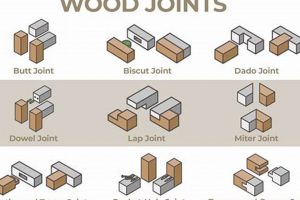
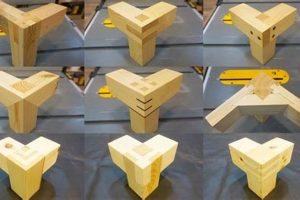
A joinery technique characterized by interlocking “fingers” that extend from the edges of two boards being joined. These fingers mesh together, creating a strong and visually appealing corner, often employed in constructing boxes, drawers, and other right-angled structures. The resulting pattern exhibits a uniform, toothed appearance.
This method offers superior strength compared to simpler joints due to the increased gluing surface area and mechanical interlock. This durability makes it suitable for applications requiring robustness and resistance to racking forces. Historically, its prevalence stems from its efficiency in utilizing material and creating aesthetically pleasing and functionally reliable constructions.
The subsequent discussion will delve into the specific techniques for creating this strong corner, the appropriate tool selections, variations in design, and considerations for wood selection to achieve optimal results. Different machine and hand-tool methods will be compared to identify the best method for different woodworking skill levels and shop environments.
Tips for Achieving Optimal Results
Employing this joinery technique successfully requires precision and attention to detail. The following tips provide guidance for creating strong and visually appealing corners.
Tip 1: Wood Selection is Crucial: Hardwoods such as maple, oak, or cherry are preferred for their strength and stability. Softwoods can be used, but require careful consideration to avoid crushing the “fingers” during assembly.
Tip 2: Precision in Cutting is Paramount: Accurate measurements and consistent cuts are essential. Any variation in finger width or spacing will result in a weak or misaligned joint. A precisely fitted jig is often necessary.
Tip 3: Glue Application: Apply glue evenly to all mating surfaces. Insufficient glue can compromise the joint’s strength, while excessive glue can create a messy cleanup.
Tip 4: Clamping Strategy: Use an appropriate clamping strategy to ensure the fingers are tightly pressed together during glue-up. Even pressure distribution is necessary to prevent warping or misalignment.
Tip 5: Dry Fit Before Glue-Up: Always dry-fit the joint before applying glue. This allows for adjustments and corrections, preventing irreversible errors during the final assembly.
Tip 6: Grain Direction Awareness: Pay attention to grain direction. Aligning grain patterns can enhance the joint’s strength and visual appeal. Contrasting grain can also create a deliberate design element.
Tip 7: Jig Construction: Whether using a router or table saw, a well-constructed jig is essential for repetitive accuracy. The jig should be stable, square, and designed to hold the workpiece securely.
By adhering to these guidelines, one can ensure a strong, accurate, and aesthetically pleasing result, suitable for a wide range of woodworking projects.
These tips provide a solid foundation for successfully using this robust corner creation. The article will now discuss common challenges and troubleshooting techniques associated with this joinery method.
1. Strength

The inherent strength of a woodworking box joint is a primary driver for its selection in various applications. This strength arises from specific design characteristics that distribute stress and maximize adhesive surface area, enhancing the overall durability and longevity of the assembled piece.
- Increased Glue Surface Area
The interlocking fingers significantly increase the surface area available for adhesive bonding compared to butt joints or simple rabbet joints. This expansion allows for a stronger, more resilient connection, reducing the risk of joint failure under stress.
- Mechanical Interlock
The physical interlocking of the fingers provides a mechanical connection that resists shear forces. This mechanical interlock adds stability and prevents the joint from easily separating, even under significant pressure or movement.
- Even Stress Distribution
The design promotes a more even distribution of stress along the joint. By distributing forces across multiple points of contact, it minimizes stress concentrations that can lead to cracking or separation in weaker joint designs.
- Resistance to Racking Forces
The box joint exhibits exceptional resistance to racking forces, which are forces that tend to distort or twist a structure. This characteristic is particularly valuable in applications such as drawers and boxes that are subjected to repetitive opening and closing motions and lateral stresses.
These factors collectively contribute to the box joint’s reputation for robustness. Its implementation is preferred where structural integrity and resistance to stress are paramount, resulting in long-lasting and reliable wooden assemblies.
2. Accuracy

In the context of creating a woodworking box joint, accuracy is not merely a desirable attribute but a fundamental necessity. The interlocking finger design demands precise correspondence between mating surfaces; deviations from exact measurements or angles directly undermine the joint’s integrity and aesthetic appeal. For instance, inaccurate finger widths will result in either a joint too tight to assemble without damaging the wood or a loose joint with gaps that compromise its structural strength. Similarly, incorrect finger spacing disrupts the uniformity of the pattern, detracting from the visual harmony typically associated with well-executed examples. The construction of drawers for fine furniture exemplifies this need: a slight inaccuracy in any of the four corners formed with this joinery method can cause the drawer to bind, stick, or fail to fit properly within its frame.
The consequences of neglecting precision extend beyond mere functionality and aesthetics. A lack of accuracy can necessitate rework or even abandonment of the project, resulting in wasted materials, increased labor costs, and project delays. Furthermore, attempting to compensate for inaccuracies with excessive adhesive or forceful assembly can lead to structural weaknesses and long-term instability. In mass production settings, where consistency is paramount, even minor inaccuracies accumulate, creating a significant impact on overall product quality and efficiency. The construction of identical boxes, where a consistent production line requires tight tolerances and precise cuts, would suffer greatly if accuracy were not prioritized in the execution of the box joints.
Therefore, accuracy is the cornerstone upon which the success of a woodworking box joint rests. Its influence extends to the joint’s strength, aesthetic quality, and overall project efficiency. Overcoming the challenges associated with achieving such precision often involves investing in accurate measuring tools, well-maintained machinery, and the development of meticulous woodworking techniques. Ultimately, the pursuit of accuracy is an investment in the long-term quality and value of the finished piece, and is key to a long-lasting woodworking box joint.
3. Aesthetics

The integration of aesthetics within the execution of this joint elevates its status beyond mere structural necessity. The visible, interlocking fingers present a deliberate design element, adding visual interest and a suggestion of craftsmanship to the finished piece. The resulting pattern serves as a testament to the joiner’s skill and attention to detail.
- Visual Rhythm and Pattern
The repeating sequence of fingers and spaces creates a visual rhythm that is inherently appealing. This pattern can be further enhanced through careful wood selection, contrasting light and dark species to accentuate the interlocking elements. The consistency of this rhythm is critical; variations in finger width or spacing disrupt the overall harmony.
- Exposed Joinery as Decoration
Unlike many joinery methods concealed within the structure, this design celebrates the act of joining. The exposed nature of the joint transforms a functional element into an ornamental feature, showcasing the craftsmanship involved. This is particularly evident in high-end furniture, where the joint becomes a design signature.
- Contrasting Wood Species
The use of contrasting wood species within the construction of a box joint can significantly enhance its aesthetic impact. A dark wood juxtaposed against a light wood highlights the interlocking pattern, creating a visual contrast that draws attention to the joint. For example, walnut fingers interlocked with maple create a striking and sophisticated appearance.
- Finger Shape and Proportions
While the standard design features rectangular fingers, variations in finger shape and proportions can drastically alter the aesthetic. Rounded fingers, tapered fingers, or fingers of varying widths can create a more dynamic and visually interesting joint. However, any deviation from the standard design must be carefully considered, as it can affect the joint’s structural integrity.
By consciously considering the visual impact of the method, woodworkers can transform a purely functional element into a distinct design feature, enhancing the overall appeal and perceived value of the finished product. The careful selection of materials, precise execution, and thoughtful consideration of proportions all contribute to elevating it from a mere structural component to an integral element of the overall design.
4. Tooling

The successful execution of woodworking box joints is intrinsically linked to the selection and proper utilization of appropriate tooling. The precision required for this joint demands tools capable of delivering consistent and accurate results. The choice of tools can significantly impact the joint’s strength, aesthetics, and the overall efficiency of the woodworking process.
- Table Saw and Box Joint Jig
The table saw, in conjunction with a specialized box joint jig, represents a common and efficient method for cutting these joints. The jig guides the workpiece across the blade, ensuring uniform finger widths and spacing. The precision of the table saw’s fence and the accuracy of the jig are critical for achieving tight-fitting joints. In production environments, this combination allows for rapid creation of consistent joints. Misalignment or wear in either the saw or jig leads to inaccuracies, resulting in weakened or unsightly joints.
- Router and Box Joint Template
A router, when paired with a box joint template, offers an alternative approach. The template guides the router bit, creating the interlocking fingers. This method is particularly suitable for smaller workshops or when working with irregularly shaped workpieces. The accuracy of the template and the stability of the router are paramount. Template wear or router bit deflection can compromise the joint’s precision. The construction of custom drawer boxes, where the sides may not be perfectly square, is a use case where the router excels over the table saw method.
- Hand Tools: Saws and Chisels
While more labor-intensive, hand tools such as saws and chisels provide a traditional method for crafting woodworking box joints. This approach demands a high level of skill and precision. The accuracy of the cuts depends entirely on the woodworker’s ability to follow layout lines precisely. This method is typically reserved for smaller projects or when a hand-crafted aesthetic is desired. An example would be restoration work, where matching the construction methods of an antique is desired. Inaccuracy with hand tools often results in a joint that is both weak and visually unappealing.
- Dedicated Box Joint Machines
In high-volume manufacturing settings, specialized machines are often employed. These machines are designed specifically for creating this joinery method and offer unparalleled speed and precision. Examples include CNC routers programmed with optimized cutting paths or dedicated dovetail machines adapted for finger joints. While these machines require a significant initial investment, they offer substantial improvements in efficiency and consistency for large-scale production. A large scale furniture manufacturer might use a CNC machine to product perfect, repeatable parts for thousands of items.
The selection of appropriate tooling is a critical decision in the woodworking process. Each method offers unique advantages and disadvantages in terms of speed, accuracy, and cost. The woodworker must carefully consider the specific requirements of the project and the available resources when selecting the optimal tooling for creating this strong and visually appealing joint. Improper tooling or poor technique will always be a detriment to a perfectly woodworking box joint.
5. Material

The selection of material is fundamentally intertwined with the integrity and aesthetic outcome of the woodworking box joint. Wood species exhibit varying degrees of hardness, density, and grain structure, each of which directly influences the strength, durability, and visual appeal of the completed joint. For example, hardwoods such as maple, oak, or walnut, due to their inherent strength and tight grain patterns, are frequently chosen for applications requiring robustness and longevity, such as drawer boxes subjected to repeated stress. Conversely, softwoods, while easier to work with, possess a lower resistance to shear forces and are more prone to compression, making them less suitable for high-stress applications unless specific design adaptations or reinforcements are implemented. Pine boxes would likely be used for simple home projects, whereas a walnut box is more suited for a high-end item. Selecting the wrong material impacts the functional integrity of this joint.
Furthermore, material stability plays a crucial role in the long-term performance of the joint. Wood is hygroscopic, meaning it absorbs and releases moisture from the environment, causing dimensional changes. Species with high tangential shrinkage, such as certain tropical hardwoods, are more susceptible to warping or joint failure if not properly acclimatized to the environment or if joined with dissimilar materials possessing different expansion coefficients. Conversely, stable species like quarter-sawn white oak exhibit minimal movement, making them ideal for applications where dimensional stability is paramount. Failure to account for these material properties can result in the joint becoming loose or developing cracks over time. The ideal material for each project depends on whether the finished woodworking box joint will be stored outdoors or indoors.
In conclusion, the choice of material is a critical determinant of the success or failure of a woodworking box joint. Understanding the mechanical properties, stability characteristics, and aesthetic qualities of different wood species is essential for selecting the appropriate material for a given application. This knowledge, combined with skillful execution of the joint, ensures both structural integrity and visual appeal, resulting in a long-lasting and aesthetically pleasing woodworking creation. The understanding of the selected material is a core element of creating a woodworking box joint. Challenges such as material availability or cost often necessitate compromises; however, a thorough understanding of material properties allows for informed decisions that minimize potential drawbacks.
6. Technique

The mastery of technique is paramount to the successful creation of a structurally sound and aesthetically pleasing woodworking box joint. This facet encompasses not only the precise execution of cuts but also the thoughtful application of various woodworking principles to ensure optimal results.
- Layout and Marking
Accurate layout and marking form the foundation of the entire process. Precise measurements and the use of sharp marking tools, such as a marking gauge and knife, are essential for transferring dimensions to the workpiece. Inaccurate layout inevitably leads to misaligned fingers and a weakened joint. An example would be using a dull pencil, which can result in measurements being off by a significant amount, ruining the joint. Precise and sharp marking is crucial for success.
- Cutting Methods and Precision
The choice of cutting method, whether using a table saw, router, or hand tools, directly impacts the precision achievable. Each method demands specific techniques to ensure accurate cuts. For example, when using a table saw, a stable jig and consistent feed rate are critical for maintaining uniform finger widths. Choosing the right cutting method and executing it skillfully is crucial for the final product. Proper practice is always necessary.
- Assembly and Glue-Up
The assembly and glue-up stage require careful attention to detail. Even application of glue to all mating surfaces is essential for maximizing joint strength. Proper clamping techniques are necessary to ensure the fingers are tightly compressed during the curing process. A dry fit is always necessary. The glue-up stage is a final chance to verify accuracy, with some tolerance available before full clamping is initiated.
- Finishing and Refinement
The final stage involves refining the joint through sanding, planing, or other finishing techniques. This step is crucial for achieving a smooth, seamless surface and enhancing the aesthetic appeal of the joint. Attention to detail in this stage can elevate a functional joint to a work of art. Some woodworkers enjoy the beauty of the finished woodworking box joint.
These facets of technique are not isolated but rather interconnected elements of a holistic process. A deficiency in any one area can compromise the overall quality of the woodworking box joint. The application of sound technique, combined with appropriate tooling and material selection, is the key to producing durable and visually appealing joinery that will stand the test of time. Proper technique is always paramount in the execution of a perfectly sound woodworking box joint.
Frequently Asked Questions About Woodworking Box Joints
This section addresses common inquiries regarding woodworking box joints, providing clarity on their application, construction, and limitations.
Question 1: What is the primary advantage of a woodworking box joint over a butt joint?
The interlocking fingers of a woodworking box joint significantly increase the glue surface area and provide a mechanical interlock, resulting in a substantially stronger joint compared to a simple butt joint, which relies solely on adhesive bonding.
Question 2: What types of wood are best suited for constructing woodworking box joints?
Hardwoods such as maple, oak, walnut, and cherry are generally preferred due to their strength and ability to hold the intricate finger patterns. Softwoods can be used, but require greater care to prevent crushing during assembly.
Question 3: Is specialized equipment required to create woodworking box joints?
While hand tools can be used, specialized equipment such as a table saw with a box joint jig or a router with a box joint template greatly simplifies the process and improves accuracy, particularly for repetitive cuts.
Question 4: What are the common causes of a weak woodworking box joint?
Common causes include inaccurate cutting, resulting in gaps or misalignments; insufficient glue application; inadequate clamping pressure during assembly; and the use of unsuitable wood species.
Question 5: How does moisture content affect the integrity of a woodworking box joint?
Fluctuations in moisture content can cause wood to expand and contract, potentially weakening the joint over time. It is crucial to use properly seasoned wood and to consider the environmental conditions in which the finished piece will be used.
Question 6: Can a woodworking box joint be used in curved or non-rectangular applications?
While primarily designed for right-angled joints, variations exist that allow for its adaptation to curved surfaces. However, these variations typically require advanced woodworking skills and specialized tooling.
In essence, successful implementation of woodworking box joints relies on precision, appropriate material selection, and a thorough understanding of woodworking principles.
The subsequent section will explore advanced techniques and design variations of the woodworking box joint.
Conclusion
This exploration of the woodworking box joint has underscored its significance as a robust and aesthetically pleasing joinery technique. The discussion has detailed its fundamental principles, emphasizing the critical role of accuracy, material selection, and appropriate tooling. Furthermore, various challenges and troubleshooting methods have been addressed, providing a comprehensive understanding of the joint’s construction and potential pitfalls. The inherent strength derived from its increased glue surface and mechanical interlock makes it a preferable choice over simpler joints in applications demanding durability.
As woodworking practices evolve, the principles governing the successful execution of the woodworking box joint remain steadfast. The pursuit of excellence in this technique necessitates a commitment to precision and a thorough understanding of woodworking principles. Continued exploration and refinement of these methods will undoubtedly contribute to the advancement of woodworking practices and the creation of lasting, high-quality crafted objects.