



These tools are essential in carpentry for firmly holding wood components together during adhesive drying. A typical application involves securing freshly joined segments of a cabinet frame, ensuring a robust bond as the adhesive cures. The devices apply pressure, maintaining alignment and maximizing contact between the surfaces being joined.
Their use significantly enhances the structural integrity of finished pieces and minimizes the risk of joint failure. Historically, simple wedges and ropes were employed for similar purposes; modern iterations offer greater precision, control, and ease of use, contributing to increased efficiency and quality in woodworking projects.
The following sections will delve into various types, selection considerations, and optimal application techniques. Understanding these aspects allows for successful utilization and improved project outcomes.
Essential Usage Guidance
Proper application techniques are crucial for achieving optimal results. Adhering to these guidelines will enhance the strength and appearance of finished woodworking projects.
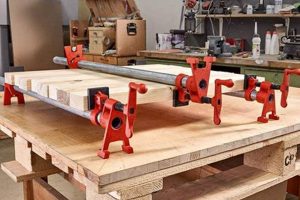
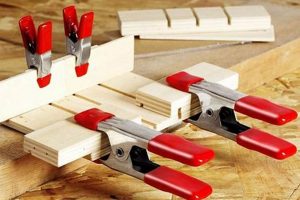
Tip 1: Selection Based on Project Needs. Determine the appropriate type according to the scale and configuration of the project. Bar styles are well-suited for large surfaces, while spring styles are often preferable for smaller, more delicate pieces. Consider reach and pressure capacity when selecting.
Tip 2: Even Pressure Distribution. Distribute applied force evenly across the joint surface to prevent warping or distortion. Employ cauls or spreader blocks to facilitate uniform pressure distribution, especially when bonding irregular shapes.
Tip 3: Surface Preparation is Paramount. Ensure surfaces are clean, dry, and free of contaminants before applying adhesive and engaging these tools. Proper surface preparation promotes maximum adhesion strength and prevents premature joint failure.
Tip 4: Adhesive Application Technique. Apply adhesive according to the manufacturer’s instructions, ensuring adequate coverage and wetness. Avoid excessive application, which can lead to weakened joints and messy cleanup.
Tip 5: Monitoring Adhesive Curing. Adhere to the adhesive’s recommended curing time and temperature specifications. Premature removal can compromise joint integrity, while extended clamping may be unnecessary and potentially damaging.
Tip 6: Preventing Adhesive Squeeze-Out. While some squeeze-out is expected, excessive amounts indicate over-application of adhesive or excessive pressure. Manage squeeze-out by using appropriate adhesive quantity and pressure, and address any excess promptly to avoid staining the wood.
Tip 7: Protection of Workpiece Surfaces. Use protective pads or blocks between the clamp jaws and the wood surface to prevent marring or indentation. This is particularly important when working with softwoods or finished surfaces.
By following these recommendations, woodworkers can maximize the effectiveness of these tools, ensuring strong, durable, and visually appealing results. Proper technique minimizes waste and increases the longevity of finished woodworking projects.
The subsequent section will discuss maintenance and storage considerations for these vital pieces of equipment.
1. Pressure Distribution Control

Pressure distribution control is a critical aspect of employing these tools in woodworking. Uneven pressure can compromise joint integrity, leading to weakened bonds or visible defects. Therefore, understanding and implementing strategies for uniform force application is paramount.
- Use of Cauls and Spreader Blocks
Cauls and spreader blocks are intermediary materials placed between the jaws and the workpiece. Their purpose is to distribute force evenly across the joint. For example, when joining two curved surfaces, a custom-shaped caul can prevent localized pressure points that might otherwise damage the wood. These ensure the bonding process remains consistent regardless of variations in surface geometry.
- Clamp Placement Strategies
Strategic placement of clamps is crucial. Overcrowding clamps in one area while leaving others unsupported leads to imbalanced forces. A best practice is to space them evenly along the joint, considering the wood’s density and the adhesive’s properties. For instance, a long, thin piece of hardwood requires more closely spaced clamps than a shorter, thicker piece of softwood to prevent warping.
- Adjusting Clamp Pressure
Applying excessive pressure does not necessarily improve joint strength and can, in fact, be detrimental. Over-tightening can crush wood fibers, weakening the bond and potentially leaving visible indentations. Controlled, moderate pressure is generally more effective. Spring clamps, for example, offer a pre-set pressure level, minimizing the risk of over-tightening.
- Addressing Complex Geometries
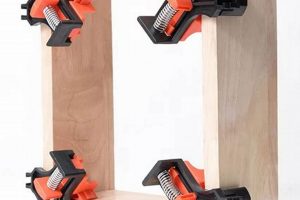
Joining complex shapes, such as miters or curves, requires careful consideration of pressure distribution. Specialized clamps, such as band clamps or corner clamps, are designed to apply force evenly across these challenging joints. For example, band clamps can be adjusted to conform to circular or irregularly shaped pieces, ensuring uniform pressure around the entire circumference.
Effective pressure distribution control, facilitated by appropriate techniques and equipment, directly influences the strength, appearance, and longevity of woodworking projects. By carefully managing the force applied during adhesive curing, woodworkers can consistently achieve high-quality, durable joints.
2. Adhesive compatibility

The effectiveness of glue clamp usage in woodworking is intrinsically linked to adhesive compatibility. Incompatibility can nullify the pressure applied by the clamps, resulting in joint failure despite proper technique. The type of wood, its preparation, and the environmental conditions must align with the chosen adhesive’s properties. For instance, using polyvinyl acetate (PVA) glue, commonly employed in general woodworking, on oily woods such as teak or rosewood can lead to a weak bond because the oil prevents proper adhesion. Clamps alone cannot compensate for this fundamental incompatibility.
Epoxy adhesives represent a different scenario. They are often selected for their gap-filling properties and superior strength on non-porous surfaces. In this context, clamps serve to maintain precise alignment and contact during the epoxy’s curing process, maximizing its structural benefits. Similarly, polyurethane adhesives, which expand slightly as they cure, require careful clamping to control this expansion and prevent joint distortion. Clamping also mitigates the effects of moisture, which is critical for the curing of polyurethane adhesives. Furthermore, consider cyanoacrylate adhesives. They are used on small woodworking projects. The clamp is required as this glue takes time to cure for wooden products.
Therefore, adhesive compatibility is not merely a preliminary consideration but an integral component of successful woodworking. Clamps facilitate optimal contact and alignment, but their effectiveness hinges on the correct adhesive selection and application. Recognizing this interdependence mitigates the risk of structural deficiencies, ensuring the longevity and integrity of the finished product. The specific adhesive type selected must be appropriate for the species of wood and working condition to produce robust results.
3. Joint alignment

Joint alignment represents a cornerstone of successful woodworking projects utilizing adhesive and clamping techniques. Misalignment, even slight, compromises structural integrity and aesthetic quality. Clamps, when properly employed, exert consistent pressure to maintain the desired position of joined components during the adhesive curing phase. The initial setup significantly impacts the final outcome; accurate alignment before clamp engagement is crucial. Consider assembling a cabinet frame: if the corners are not square and precisely aligned, tightening the clamps will only exacerbate the existing error, resulting in a distorted and structurally unsound frame.
The role extends beyond merely holding pieces together; they actively contribute to correcting minor deviations and ensuring accurate mating surfaces. For example, when edge-joining boards to create a tabletop, carefully positioned clamps can eliminate slight warps or bends, producing a flat and seamless surface. Furthermore, specialized clamping tools, such as corner clamps and miter clamps, are specifically designed to maintain accurate angles and prevent slippage during the bonding of intricate joints. Failure to achieve correct alignment negates the adhesives bonding strength, potentially leading to joint separation or failure under stress. In situations involving complex joinery, mock-ups and dry-fitting with the clamping system are best practices to identify and resolve alignment issues before applying adhesive.
In summary, effective joint alignment in conjunction with appropriate clamping techniques is fundamental. It minimizes imperfections, maximizes bond strength, and contributes significantly to the overall quality and longevity of the woodworking project. Addressing potential alignment problems early in the process, before adhesive application, is crucial for achieving professional-level results. Precision alignment ensures the project meets the intended design and structural requirements.
4. Material protection
Material protection during glue clamp usage is essential for preserving the aesthetic and structural integrity of woodworking projects. Clamping force, while necessary for secure adhesion, can inflict damage if not managed carefully. Therefore, employing protective measures becomes a critical aspect of the woodworking process.
- Use of Protective Pads
Protective pads, typically made of cork, leather, or soft wood, are interposed between the clamp jaws and the workpiece. These pads distribute pressure evenly, preventing localized indentations or crushing of wood fibers, particularly on softer species like pine or cedar. For instance, when clamping a delicate veneer, even slight over-tightening without a pad can result in irreversible surface damage.
- Selection of Appropriate Clamp Jaws
Different clamps feature varying jaw designs. Clamps with broad, flat jaws are less likely to cause concentrated pressure points compared to those with narrow or uneven jaws. Some clamps offer replaceable jaw pads of varying hardness, allowing for customization based on the material being worked. Using a clamp with non-marring jaws is crucial when working with finished or easily dented surfaces.
- Controlling Clamp Pressure
Excessive clamping pressure does not necessarily improve joint strength and can be detrimental. Over-tightening can crush wood fibers, leading to weakened bonds and visible indentations. Utilizing clamps with adjustable pressure mechanisms or employing a “feel” for appropriate tightness is essential. For example, spring clamps provide a pre-set level of force, minimizing the risk of over-tightening on fragile pieces.
- Preventing Adhesive Staining
Adhesive squeeze-out can stain the wood surface if left unchecked. Applying a release agent, such as wax paper or masking tape, to areas adjacent to the joint prevents direct contact with the adhesive. Promptly removing any squeeze-out with a damp cloth minimizes the risk of permanent discoloration. Additionally, certain adhesives are more prone to staining than others, requiring careful consideration when selecting materials.
These facets underscore the importance of material protection in conjunction with glue clamp application. Prudent practices not only safeguard the workpiece from physical damage but also maintain its aesthetic appeal, contributing to the overall quality and longevity of the finished product. Considering these precautions ensures that the clamping process enhances, rather than detracts from, the final result.
5. Curing environment
The curing environment plays a critical role in the success of adhesive-based woodworking projects utilizing clamps. Optimal adhesive performance is directly influenced by temperature, humidity, and air circulation during the curing process. Inadequate control over these factors can compromise joint strength and long-term durability, irrespective of proper clamping techniques.
- Temperature Influence
Adhesive curing rates are highly temperature-dependent. Most adhesives have a specified temperature range for optimal curing. Lower temperatures slow the curing process, potentially leading to incomplete bonds and reduced strength. Conversely, excessively high temperatures can cause premature curing or degradation of the adhesive, resulting in weakened joints. For example, polyvinyl acetate (PVA) adhesives, commonly used in woodworking, exhibit significantly reduced bond strength if cured at temperatures below 50F. Temperature control mechanisms, such as heated workshops or curing ovens, may be necessary in colder climates to ensure proper curing.
- Humidity Considerations
Humidity levels also affect adhesive curing, particularly for moisture-curing adhesives like polyurethane. These adhesives require moisture to initiate the curing process. Insufficient humidity can lead to incomplete curing and weak bonds. Conversely, excessive humidity can cause the adhesive to cure too quickly, resulting in a brittle and compromised joint. A humidity range of 40-60% is generally considered ideal for most woodworking adhesives. In arid environments, humidifiers may be necessary to maintain adequate moisture levels during curing.
- Air Circulation Effects
Air circulation influences the evaporation of solvents or water from the adhesive, affecting the curing rate and bond strength. Stagnant air can trap moisture or solvents, hindering proper curing. Conversely, excessive air circulation can cause the surface of the adhesive to dry too quickly, forming a skin that prevents complete curing of the underlying layers. Gentle air circulation is generally recommended to promote even drying and prevent moisture buildup.
- Impact on Wood Movement
Fluctuations in temperature and humidity can cause wood to expand and contract, potentially stressing adhesive bonds during curing. Maintaining a stable environment minimizes wood movement, reducing the risk of joint failure. For instance, if a glued-up panel is allowed to cure in a high-humidity environment and then subsequently exposed to a dry environment, the resulting shrinkage can place undue stress on the adhesive bonds, leading to cracks or separation. Stabilizing the wood’s moisture content before assembly and maintaining a consistent environment during curing mitigates these risks.
In summation, the curing environment constitutes a crucial factor in determining the ultimate success of woodworking projects involving adhesives and clamps. Precisely managing temperature, humidity, and air circulation optimizes adhesive performance, mitigates the risk of joint failure, and ensures the longevity of the finished product. Ignoring these environmental considerations can negate the benefits of proper clamp usage and compromise the structural integrity of the workpiece.
Frequently Asked Questions
This section addresses common inquiries regarding the effective use of these tools in woodworking, offering concise explanations to facilitate informed decision-making and optimal application.
Question 1: What types of adhesives are most suitable for use?
The selection depends on the specific wood species and project requirements. Polyvinyl acetate (PVA) adhesives are commonly used for general woodworking purposes. Epoxy adhesives excel in gap-filling and bonding non-porous materials. Polyurethane adhesives are suitable for moisture-rich environments. Always consult adhesive specifications for compatibility.
Question 2: How much clamping pressure is necessary?
Excessive pressure does not necessarily improve joint strength. Moderate, even pressure is generally more effective. Over-tightening can crush wood fibers, weakening the bond. Spring clamps provide pre-set pressure, minimizing the risk of damage.
Question 3: How long should remain in place?
The duration depends on the adhesive type and environmental conditions. Always adhere to the adhesive manufacturer’s recommended curing time. Premature removal can compromise joint integrity. Extended clamping may be unnecessary and potentially damaging.
Question 4: How to prevent adhesive squeeze-out?
Apply adhesive sparingly and evenly. Using cauls or spreader blocks distributes pressure, minimizing squeeze-out. Remove excess adhesive promptly with a damp cloth to prevent staining.
Question 5: How to maintain proper alignment during clamping?
Ensure accurate initial alignment before engaging the clamps. Employ specialized clamps, such as corner clamps, for intricate joints. Dry-fitting components before adhesive application helps identify and resolve alignment issues.
Question 6: What are the best practices for material protection?
Use protective pads between the jaws and the wood surface to prevent marring or indentation. Choose clamps with broad, flat jaws to distribute pressure evenly. Consider the use of non-marring jaw pads when working with delicate surfaces.
Proper application of these principles maximizes the effectiveness of these tools, ensuring robust and aesthetically pleasing woodworking results.
The following section explores advanced techniques and specialized applications.
Conclusion
The preceding exploration of these tools highlights their vital role in achieving robust and aesthetically pleasing wood joinery. The selection of appropriate types, adherence to proper techniques, and consideration of environmental factors are all critical components of successful utilization. Material compatibility, alignment precision, and controlled pressure distribution directly influence joint strength and longevity. The integration of these factors ensures optimal performance.
Mastery of these principles empowers woodworkers to consistently achieve high-quality results. Continued refinement of technique and a commitment to best practices will further enhance the value and durability of woodworking projects. The significance of understanding and properly employing these tools cannot be overstated in the pursuit of excellence in woodworking.
![Top-Rated: Best Quick Clamps for Woodworking Projects [2024] | Step-by-Step Guides, Tools & Inspiration to Build Beautiful Wooden Decor on a Budget](https://woodfromhome.com/wp-content/uploads/2026/04/th-264-300x200.jpg "Top-Rated: Best Quick Clamps for Woodworking Projects [2024] Step-by-Step Guides, Tools & Inspiration to Build Beautiful Wooden Decor on a Budget")